pic.twitter.com/5TcdNuNWv2— Rapid Response 47 (@RapidResponse47) October 10, 2025
Posted on 10/12/2025 8:55:24 PM PDT by SeekAndFind
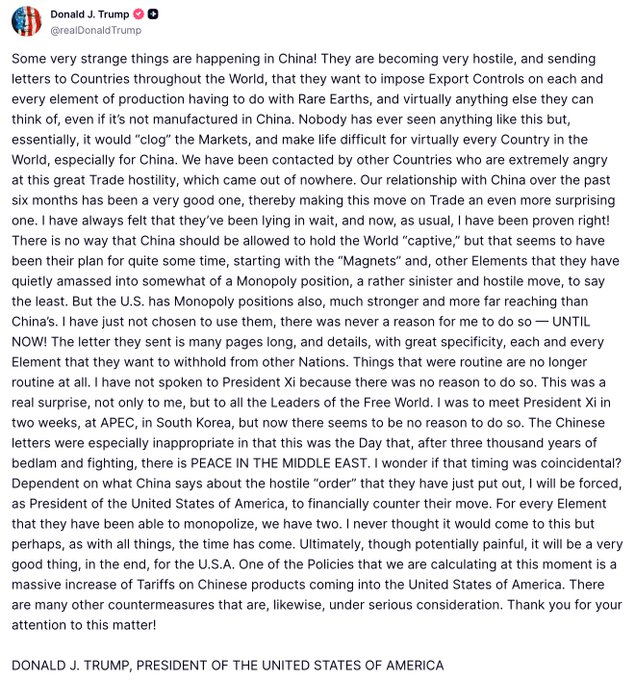
On Friday, President Trump made two posts on Truth Social in response to China’s announcement of stringent export controls on rare earth elements (REE) and related processing equipment. In the first post, he appeared to threaten to cancel his meeting with Xi at the upcoming APEC summit in South Korea. More importantly, in his second post, he announced an additional 100% tariff on Chinese imports in response to Beijing’s economic coercion, effective November 1 or earlier. If implemented, this would bring the total tariff rate for China to 130%.
pic.twitter.com/5TcdNuNWv2— Rapid Response 47 (@RapidResponse47) October 10, 2025
pic.twitter.com/TtnPx2l2er— Rapid Response 47 (@RapidResponse47) October 10, 2025
China accounts for 70% of global REE mining and 90% of the world’s REE processing/refining. These minerals are essential for weapons systems and electronics. Beijing’s export restrictions on 12 REEs could very well disrupt the global economy and pose a risk to the U.S.’s defense supply chains. This is unsustainable and dangerous—and it has gone on for far too long. Washington must decouple.
Beijing’s practice of weaponizing its REE dominance is straight from the CCP’s unrestricted warfare playbook, a concept first outlined in 1999—combining elements of resource warfare, economic warfare, and lawfare (the CCP’s uses laws and regulations to further its national interests, when and where it sees fit).
China’s announcement to impose export restrictions on resources that it has monopolized aligns with its ongoing demands over recent months, including the demand that the U.S. change its official language regarding Taiwan independence.
This move is also part of a broader pattern: decades of the Chinese government violating its commitments after joining the World Trade Organization, facilitated by our own elected officials and lobbyists.
President Trump’s response represents a rejection of the Chinese government’s series of demands and non-adherence to the rules-based trading system. What China thought was leverage backfired.
President Trump has been well aware of China’s actions all along. Earlier this year, when it became clear that China was holding back rare earths, a violation of the trade terms set in Geneva in May, President Trump expressed concern.
President Trump also mentioned in his earlier post on Friday that China’s actions confirmed his long-held suspicions that they have been “lying in wait.” This was carefully—but aggressively—planned by the CCP over the years. Even Deng Xiaoping made the observation in 1992 that “the Middle East has oil, China has rare earths,” a hint at what was to come.
President Trump has been warning about China’s predatory economic practices for decades now, before it became fashionable.
I've been warning about China since as early as the 80’s. No one wanted to listen. Now our country is in real trouble. #TimetoGetTough— Donald J. Trump (@realDonaldTrump) June 12, 2013
It is hard to believe that President Trump did not see this coming, as some have suggested. He did. Rather, all of this seems to be calculated—the Trump administration’s attempt to force concessions from Beijing. Trump was not expecting much from Xi. After all, he dealt with Xi in his first term and seems to be aware that the CCP has never held up its end of the bargain.
Instead, Xi overplayed his hand, and President Trump exposed China’s ill intentions to the world, for all to see. China is fast-tracking its own global economic isolation.
Washington has the upper hand in this trade war. The U.S. remains the largest single-country market for China’s export-oriented economy. Tariffs have done their part to make matters worse for Beijing, impacting the Chinese export sector by markedly reducing the flow of Chinese goods into the U.S. China remains stuck in a deflationary spiral, with no indications of it easing.
The Trump administration has also been successful at convincing some countries to adopt anti-dumping measures and probes, eliciting condemnation and threats from Beijing, while others, such as the European Union, are quietly moving to impose their own tariffs on China without admitting that they are following President Trump’s lead.
President Trump has also proposed export controls on critical software and Boeing airplane parts. China has approximately 1,855 Boeing airplanes currently in use.
Another weak spot the administration could exploit in the future is China’s reliance on American ethane. Ethane is used to produce plastics.
The stock market predictably reacted to this sudden tariff announcement. The Dow Jones and the S&P 500 fell roughly 1.9% and 2.7%, respectively, the worst since April. But do not panic. Remember when free trade ideologues and the MSM attempted to convince the public that a recession was imminent following the market’s reaction to Liberation Day tariffs? Weeks later, the market rebounded.
Year-to-date gains have not been negatively affected either. And as AI remains a strong force, it remains to be seen whether this trade war will impact the trajectory of the market in any substantial way.
The market may react positively to the Chinese Ministry of Commerce’s recent response in which it failed to impose countermeasures, though the statement doubled down on its initial measures and provided ambiguous wording about continuing to process “eligible applications” (this is based on whatever the CCP arbitrarily deems to be eligible).
There is likely to be a favorable market reaction to today’s post by President Trump. This is a strategic power move. It’s a polite way of humiliating Xi while reasserting Washington’s strength over the Chinese economy. It is yet to be seen what actions the Trump administration will take; do not rule anything out.
pic.twitter.com/Xg4il82zF8— Rapid Response 47 (@RapidResponse47) October 12, 2025
Regardless, all the hyper-fixation on the stock market’s reaction must not drown out the fact that the main intention behind these tariffs is to protect America’s long-term economic and national security, with the two being interlinked. Without a state that is capable of protecting its citizens from foreign and domestic threats, its foremost responsibility, as well as ensuring economic independence, economic prosperity is not possible. National and economic security are essential building blocks.
China’s tightening of export controls should serve as a reminder of the need to decouple. Washington cannot rely on China for anything, but this statement is especially true when it comes to the U.S.’s REE supply chain and pharmaceutical industry—about 90% of the U.S.’s generic antibiotics are imported from China. China could very easily initiate a public health crisis.
But tariffs alone will not break China’s stranglehold on minerals. Achieving this goal will require sustained government intervention—although unfavorable to us small government proponents, it is the best path forward during such a national emergency—and a rollback of environmental and licensing regulations that CCP-backed environmental groups have been fighting for (green warfare). It was the Chinese state’s aggressive subsidization and regulation of its REE industry—coupled with destructive globalist policies—that made this dominance possible.
The administration has done a lot already in this respect, from setting a price floor for rare earth oxides and the Department of War’s investments to the opening of mines and a potential resources deal with Australia, but more is needed, especially relating to developing America’s processing/refining capacity. Some individuals have called for an Operation Warp Speed for rare earths. This is the right mentality.
Regardless of how China responds and how that response is interpreted, now is not the time for Washington to let up. It is the right time to act before matters get worse. Decoupling will demand significant effort, but it must get done. We have to start somewhere.
We almost got started under Bush II. Senator Malcolm Wallop (R-WY) hand carried copies into the White House, but the book came out just before 9-11 and once the towers came down things were different.
A mine is an awfully aggressive place to start with a free market environmental management system (I was thinking fire hazard reduction would be a better and that was 25 years ago). Maybe it's time to try again. I wish I had a way to contact Mr. Zinke but the network I developed with that first book is now long gone.
Greed got us here.
We should never let ourselves become economically intertwined with nations that have opposing interests to ours, different cultural values and economic / political organization from ours.
For 40 years were been getting globalization rammed down our throat. It’s going to usher in peace, prosperity, bla bla bla. In fact you’re even a xenophobic racist of you’re not on board.
So, today we have “dependencies” on nations that see us as their #1 military threat, communist single party political systems in societies that are entirely estranged to Western values that are actively working against us, i.e. Ukraine (regardless where you stand on that war).
Not smart.
Lenin may not have been an nice guy, but he did say something very profound about us:
“The capitalist will sell us the rope with which we will hang them.”
https://quoteinvestigator.com/2018/02/22/rope/
The arguments for free trade are TRUE!!! But with nations that have common interests and values.
Conduct trade with nations that are enemies, not smart. Would you want to sell Nazi Germany advanced radio, computing or materials to develop and build an atomic bomb with?
The political elite in the US is for sale to the highest bidder. American business wanted this for years. We were the pioneers and the biggest investor in China. We early on gave them a huge boost when it came to modernization and industrialization. Cheep labor, avoiding environmental, labor, and safety standards, in some cases even taxes drove this.
China would be finished if the world united against it.
“single party political systems in societies that are entirely estranged to Western values that are actively working against us, i.e. Ukraine”
You don’t think that describes Russia a little better than Ukraine?
Ukraine cancelled their elections, jails journalists that say anything derogatory, uses the idea of a state secret to hide all derogatory information, banned opposition parties, jailed or had some of their opposition party heads killed, closed radio and TV stations that didn’t play along...
Nope, he’s still alive: https://youtu.be/MC—IPkjRWE?si=lvTePHHKda_301CY
In fact,
There are Putin critical papers.
Putin critical music and TV celebrities.
There are news commentators critical of Putin...
You might want to ask yourself, why would you ask such a question? Could there be a bias?
A massive discovery of US rare earths (REE) was announced yesterday.
It’ll be a bigger mine than China’s.
Sure.
Big if.
They are a monster, that’s for sure.
We are far from perfect. But if in 20 years China emerges in pole position on the world stage, defining the world order (hate that term but it’s real), God help us and all our allies.
Being called a globalist should as shameful as being called a child abuser or arsonist. To me the are at the same level.
The arguments for free trade are not true.
China’s internal politics may get a shake up at their upcoming 4th plenum, October 20th.
Xi’s power may be reduced further.
Disclaimer: Opinions posted on Free Republic are those of the individual posters and do not necessarily represent the opinion of Free Republic or its management. All materials posted herein are protected by copyright law and the exemption for fair use of copyrighted works.

