Skip to comments.
Spanish Banks Will Be Forced to Report Every Penny
EuroWeekly News ^
| 08 Dec 2024
| Marc Menendez-Roche
Posted on 12/09/2024 12:22:36 PM PST by nickcarraway
In a move that’s left self-employed workers scratching their heads, the Spanish tax office, Hacienda, has dropped a bombshell: banks will have to report every single payment made to self-employed clients, even those under the previous €3,000 threshold.
The unexpected measure slipped quietly into a royal decree that also tweaks corporate tax rates for multinationals, which means the taxman will have eyes on transactions of any amount, whether through traditional methods or modern mobile systems like the popular Bizum.
The €3,000 rule is no more For years, banks only raised the alarm for transactions over €3,000. As José María Peláez, a spokesperson for the State Inspectors Association, previously explained, withdrawing amounts under this limit typically didn’t require identification. “When you take out €2,000 or €2,500, no one asks questions. But take out €3,000, and they start filling out forms,” Peláez said.
Now, that €3,000 cushion has been binned – but only for the self-employed.
“This is a surprise measure,” said La Linterna host Ángel Expósito, who, alongside economic journalist Pilar García de la Granja, broke the news. “Banks will need to report all payments to the self-employed on a monthly basis, regardless of the amount.”
‘It’s always the little guy’, say workers
The announcement has left self-employed workers fuming, with many branding it another blow to an already strained group. Eduardo Abad, head of the Professional Association of Self-Employed Workers (UPTA), didn’t hold back.
“We have no clue why this measure has been introduced,” Abad told Spanish media outlet Cope. “In meetings with the government, this was never even on the table – it’s come completely out of the blue.”
Abad accused the Spanish government of unfairly targeting self-employed workers. “It’s always the smallest fish in the economic pond that get caught. We’re the easiest to go after,” he said bitterly. “Why not apply the same rules to multinationals stashing their profits in tax havens? Maybe one day they’ll get the same scrutiny.”
A flood of data – and more chaos?
Abad also warned of the chaos this measure will unleash. With over 3.3 million self-employed workers in Spain conducting countless daily transactions, the sheer volume of data could overwhelm Hacienda’s systems.
“We’re talking millions of daily operations. How do they plan to process all of this? It’s unmanageable,” he argued.
The union leader also blasted what he called yet another heavy-handed approach by the Spanish tax office. “They act like we’re the country’s default fraudsters,” Abad fumed. “It’s time to stop treating self-employed workers in Spain as if we’re all trying to cheat the system.”
What’s next for freelancers? As the self-employed brace again for impact, the jury’s still out on how banks and workers will cope with this new layer of scrutiny. Whether it’s a necessary evil or just another spectacular bureaucratic blunder by the Spanish government, one thing’s for sure – Spain’s freelancers aren’t taking it lying down.
Is it short-sighted to continually go after the group of people who are starting businesses and hoping one day to boost the economy by growing their businesses and providing jobs? While other Western European countries try to take care of their self-employed and help them along their way as they grow, Spain seems to continually hammer them down. Are we missing a trick here, or is the government just that clueless?
TOPICS: Business/Economy; Crime/Corruption; Government; News/Current Events
KEYWORDS: banking; banks; communism; currency; europe; finance; marxism; privacy; socialism; spain; spying
To: nickcarraway
Uh, no deposits to the banks?
2
posted on
12/09/2024 12:31:28 PM PST
by
rktman
(Destroy America from within ? Check! WTH? Enlisted USN 1967 to end up with this💩? 🚫💉! 🇮🇱👍!)
To: nickcarraway
"Slipped in" by royal decree. See how that works? The government and its monarchy will be looking for every last cent, because.....
Spanish Debt as % of GDP -- 139.02%
Source: Spain Debt Clock: Double Digit Debt To GDP Ratio Could Spell Disaster
Seems many nations, including this one, are maxing out their national credit cards to pay for social welfare to migrants and supporting war, as well as their other "duties." Oddly, they're running out of other people's money.
To: 444Flyer; metmom; dpetty121263
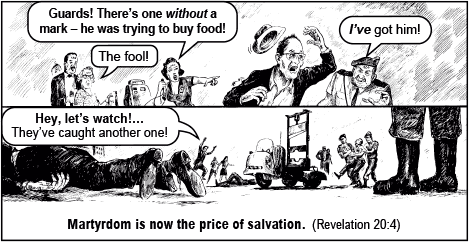
This noose is going to keep on tightening at the national level in every country - it will definitely have its act together for the New World Order of Daniel 7:23
They ARE going to control the masses by:
1) Controlling access to your MONEY
2) Controlling access to your FOOD There will be NO WAY to escape this. They will force you to use a National Digital Currency too - no cash eventually
Now the Mark of the Antichrist Beast DOES NOT happen until the middle of the 7 years of 'Peace and Security'
(Global digital ID system....The Mark of the Beast.)
Once they have most everyone on Digital Currency and Social Credit scores, it's pretty much game over. There are many who think it won't happen. COVID-19(84) showed just how quickly things can change WORLDWIDE.
NOTE:
I don't post these just for fun. Only to warn the as-yet unbelieving world 🌎🌍 as regarding what is coming. And to attempt to bring in as many souls as possible into His Kingdom. 🛐🛐🛐✝️✝️✝️. The most life-changing events, EVER, are coming to planet Earth 🌍🌎🌏.
I can only pray 🙏🙏🙏 that it gets shared all over the world 🌎🌏🌍 before Satan's goats 🐐🐐🐐🐐 make it nigh-impossible to share the Word of God.

 (lurkers please click on my screen name to see my FR homepage for more information)
4
posted on
12/09/2024 12:50:25 PM PST
by
SaveFerris
(Luke 17:28 ... as it was in the Days of Lot; They id Eat, They Drank, They Bought, They Sold ......)
Sorry, the Godless Globalists can't let you grow your own food. 🍅🍅🍅🌽🌽🌽🥔🥔🥔
You must use your Global One-World Digital Currency to shop at only "officially-approved" stores using your hand or cellphone 📱📱📱 to authorize payment.
That is all, Comrade Global Citizen.

5
posted on
12/09/2024 12:52:32 PM PST
by
SaveFerris
(Luke 17:28 ... as it was in the Days of Lot; They id Eat, They Drank, They Bought, They Sold ......)
Disclaimer:
Opinions posted on Free Republic are those of the individual
posters and do not necessarily represent the opinion of Free Republic or its
management. All materials posted herein are protected by copyright law and the
exemption for fair use of copyrighted works.
FreeRepublic.com is powered by software copyright 2000-2008 John Robinson