Posted on 03/04/2020 6:23:10 AM PST by Kaslin
The senator was adamant.
"People should not have to force the federal government to live up to our responsibilities to enforce our borders and our laws. Period," she said.
"We do not have the luxury of debating this issue for another two years or four years," she added. "Rather we have the responsibility to take action now."
She wanted the government to enforce the border and the laws against employing illegal immigrants.
"Illegal immigration, however, is a matter of law enforcement," she said. "Whether it is enforcing our borders, enforcing our laws against working illegally or hiring someone to work illegally."
"It is the federal government's responsibility to enforce these laws," she insisted.
Yet, just three years into office, this senator seemed to have lost faith in Washington's commitment to that responsibility.
"Unfortunately," she said, "this job has not been done well over the years, and the prohibitions against illegal immigration, while on the books, have meant very little in reality.
"The cost of the failure to act on this responsibility has been very high," she said.
Was this the Senate's version of President Donald Trump? Who was this firebrand?
It was Sen. Dianne Feinstein -- the former Democratic mayor of San Francisco, who was first elected to the Senate in 1992.
On Sept. 30, 1996, Feinstein stood on the Senate floor and -- in the words cited above -- advocated enactment of the Illegal Immigration Reform and Immigrant Responsibility Act.
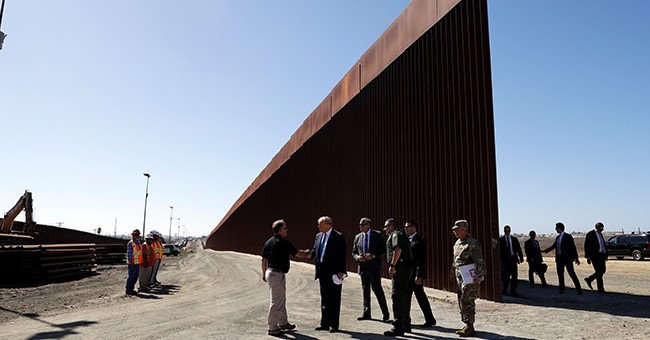
It called for a triple fence along the U.S.-Mexico border south of San Diego.
On May 1, 1996, Feinstein had given a floor speech advocating an amendment she and fellow Democratic Sen. Barbara Boxer of California had offered for this bill.
"Earlier I sent an amendment to the desk on behalf of Senator Boxer and myself which relates to the triple fencing of the Southwest border, particularly in the vicinity of San Diego and Mexico," Feinstein said.
"Essentially, the language would authorize the appropriation of $12 million for the construction, expansion, improvement, and deployment of triple fencing," she explained.
The final version of Illegal Immigration Reform and Immigrant Responsibility Act included language specifically authorizing this triple fence to protect the border in Feinstein's home state.
It required the attorney general (who was then responsible for border security), to "provide for the construction along 14 miles of the international border of the United States, starting at the Pacific Ocean and extending eastward, of second and third fences, in addition to the existing reinforced fence, and for roads between the fences."
President Bill Clinton signed this into law.
But just because the law commanded it, did not mean the government would do it.
"Environmental concerns and litigation resulted in significant delays in fulfilling this requirement," the Congressional Research Service explained in a 2017 report. "Over eight years after IIRIRA was enacted, the DHS had not completed the fencing project."
So, in 2006, Congress enacted the Secure Fence Act. This reduced the number of layers in the required border fence from three to two but vastly expanded the number of miles it was required to cover.
"CBP estimated that covered roughly 850 miles," said the Congressional Research Service.
Two years later, in an appropriations act, Congress amended the fence law again. This time, it reduced the number of layers from two to one, reduced the length of mandated fence from 850 miles to "not less than 700 miles" and gave the secretary of Homeland Security discretion over where it should be built.
The law also did not specify the architecture of the fence. So, the Department of Homeland Security built some "fencing" that was not designed to stop people from crossing the border.
"Some disagreement has arisen over DHS's use of 'vehicle fencing' to satisfy IIRIRA's fencing requirements," said the Congressional Research Service report. "Vehicle fencing is a type of barrier designed to inhibit the illegal crossing of vehicles into the United States, but not pedestrians."
Five days after he took office, Trump reinvigorated the effort to build a border barrier. He issued an executive order that said: "It is the policy of the executive branch to: secure the southern border of the United States through the immediate construction of a physical wall on the southern border, monitored and supported by adequate personnel so as to prevent illegal immigration."
This Republican president in 2017 sounded a bit like Dianne Feinstein in 1996.
"The nearly $4.5 billion in appropriations provided by Congress for border barrier planning and construction since the signing of the E.O. exceeds the amount provided for those purposes from FY 2007 to FY 2016 combined by almost $2 billion," the Congressional Research Service said in a report published this January.
Even so, this was merely a modest down payment on enforcing the laws Feinstein had called out the government for not enforcing -- almost a quarter-century ago.
In fiscal 2006, the year Congress enacted the Secure Fence Act, the Border Patrol apprehended 1,071,972 deportable aliens illegally crossing the U.S.-Mexico border.
By fiscal 2017, the year Trump took office, total apprehensions had dropped to 303,916.
In fiscal 2019, they climbed back to 851,508.
At the end of fiscal 2019, according to the Border Patrol, there were 654 total miles of "primary" barriers along the U.S.-Mexico border. Of these, 374 miles would stop pedestrians, and 280 miles would stop vehicles; 37 had a "secondary" pedestrian fence; and 14 had a "tertiary" pedestrian fence.
The full border is 1,954 miles long.
Trump needs to keep fighting the Washington establishment to build his border wall and establish for history that he meant what he said when he beat that establishment in the 2016 election.
I hope and pray that we will have 1,954 miles of the Great Wall of Trump within the next two years and that we will then deport all illegals. No exceptions. If you rob a bank and avoid getting caught for two years, that does not mean you get to keep the money. If you enter our country illegally and sneak around without getting caught for two years that should not mean that you get to stay. Rewarding criminal behavior is always a bad idea.
ping
“So, in 2006, Congress enacted the Secure Fence Act. This reduced the number of layers in the required border fence from three to two but vastly expanded the number of miles it was required to cover.”
Lest we forget the sad state of the border is a result of the actions, or inaction, of both political parties.
George W. Bush was president in 2006. He spent his first 4 years trying to persuade Congress to pass another amnesty. As to the 2006 legislation, instead of building a secure fence, his administration implemented a virtual fence which turned out to be ineffective and a billion dollar boondoggle for Boeing who designed the virtual fence.
We do not need all 1954 miles walled - there are natural barriers in many places. There will be 885 miles completed or funded and on contract
Just imagine how many fewer problems we would have had if that wall had been built close to 1996. We wouldn’t have had all those caravans of illegals coming here, court fights, crowded schools, strains on the budget, calls for the abolishment of ICE, fewer crimes against citizens, etc., etc.
Once we have 885 miles, will will discover a need for more wall. Perhaps we don’t need a Wall for all 1954 miles, but we need all 1954 miles to be difficult even for healthy adversaries to penetrate. We need illegals and other uninvited invaders to give up on trying rather than finding ways to work around our barriers.
Imagine how much better it would have been if we didn’t have the 1986 amnesty and had constructed a wall instead...
need all 1954 miles to be difficult even for healthy adversaries to penetrate. We need illegals and other uninvited invaders to give up on trying rather than finding ways to work around our barriers.
Those unfenced/unwalled miles are already nearly impassable and are already monitored - any one crossing those natural obstacles will be caught, and likely taken to a hospital with broken bones or extreme dehydration - it will be by the individual, not by the masses or even smugglers.
Take a look at the real border not the one seen on TV. Look at the mountains and so on. ping or freep mail Beaubo for more info
This should be part of a Comprehensive Immigration Enforcement bill, missing since 1986 ONE TIME amnesty. The List of Comprehensive Immigration Enforcement, missing since 1986 goes like this -
1) southern barrier;
2) require eVerify to hire;
3) end all chain migration;
4) birthright per Minor v. Happersett (plural parents);
5) end work visas;
6) 10-year moratorium on all new applications for citizenship (40 years to allow workplace automation effects on downsizing population);
7) Set up an illegal aliens’ victim restitution fund.
Enactment of these provisions will motivate illegal aliens to SELF-deport, and remove colonizadors from our welfare rolls.
We should have finished the damn wall already. Just let muzzie terrorists stream across so we can look like good Joel Olsteen Christians or some crap? If we don’t have secure borders, just forget about everything.
Agreed in principle, but many of their children are U.S. citizens, by virtue of our own (albeit misguided) laws. That's why they call them anchor babies. First, have that law changed.
Do you believe that the USSC (and you know it will end up there) will approve of deporting citizens because of the behavior of their parents?
I suggest a system of voluntary sponsorship; a U.S. citizen sponsors the illegal and assumes responsibility for their behavior. No sponsor, no stay. Selling sponsorship means prison time for the "sponsor" (because you know some will try it).
Imagine how much better it would have been if we didn’t have the 1986 amnesty and had constructed a wall instead...
__________
Almost heaven! Reagan sure got fooled on that one.
I am with pollster1, but for a different reason.
We’ve waited 40, that is FOURTY DAMN YEARS for a wall.
We deserve to get EVERY FRICKIN MILE.
Screw everything else, and Ffff the establishment by building all of it.
And then back it up with an earthen wall 200 yards back from this temporary metal barrier so our grandchildren don’t have to fight this same fight all over again.
Why build a wall on the other side of a sheer cliff?
There are some things that are pointless to do and a great waste of money - just take a trip done there to see what it is you are asking and get back after.
Personally, I prefer turret mounted remote controlled quad GAU 9As with overlapping fields of fire, A-10s and Apaches on daytime patrol, and AC-130Js on night patrol
I explained why we should build in those places.
Saying it twice won’t help.
Seems like u just have a grudge and no real perspective on the problem - you want yours, no matter the cost, or, in this case, desire a total waste of money and effort for something that has no purpose other then satisfying your personal needs.
You think I’m the only one?
I’m not.
“Perhaps we don’t need a Wall for all 1954 miles, but we need all 1954 miles to be difficult even for healthy adversaries to penetrate.”
That is the truth of it.
Five days after taking office, President Trump issued Executive Order 13767 (Border Security and Immigration Enforcement Improvements), directing the wall to be built, and a Comprehensive Plan be developed for attaining Full Operational Control of the Southern Border - every mile. That kicked off a fairly massive analytic effort, that brought in top flight experts, and was subject to extensive review by often hostile professional auditors in the OMB and CBO. It was carefully developed and thoroughly vetted, and finally accepted by Congress as complete in December of 2018.
It calls for 1,100 miles of (effective) barrier, $25 billion over five years, thousands of additional full time positions, and several technology programs. Although not every mile is planned for barrier, every mile is planned for persistent surveillance, effective detection and interception capability.
No barrier is 100% effective, on its own. With ladders and ropes, people climb Mount Everest (in growing numbers each year). That is why the infrastructure being built under the Trump Administration is often officially referred to as “Wall System” instead of just wall. It includes all weather, high speed access road, lighting cameras, alarms and sensors as needed.
The design of the Wall System in each local segment, is calculated to achieve certain measurable effects, in terms of what percentages of the population it can deter or defeat, against penetration attacks (tunneling under, climbing over or breaching through). Finally, after reducing the raw numbers of crossers, the barrier must provide enough delay, that the paired detection and response capability has enough time to interdict. When they build Trump-style Wall System in an area, they are designing for full operational control of that segment, not just some unquantified marginal improvement.
That “Border Calculus” of the time required to interdict, is the basic design requirement of each segment of the border. In a border city, fence jumpers could sometimes sprint into a shopping mall, residential backyards, or waiting vehicles in under a minute. That extremely low “Disappearing Time”, requires exceptionally long delays from barriers, earlier detection, and faster response/ more staffing.
In rural areas, where terrain is impassable to 4WD vehicles, and it is more than a day’s walk to a road, the delay afforded by having to stand up a ladder and drop a rope, becomes insignificant to the equation calculating successful interdiction time. Reliable detection, tracking and response capability are all that really matter out there.
If you include the $3.7 billion which the Administration has declared that it intends to divert to wall building, out of FY 2020 Military Construction accounts, under the Presidential Emergency Declaration (but not yet officially transferred), then just over $18 billion will have been dedicated to wall building during President Trump’s first term (designated to build 885 miles of specific, prioritized segments). 221 miles of the existing barrier has been assessed as effective enough for re-use, totaling very closely to the 1,100 miles identified in unclassified summaries of the Comprehensive Plan.
So this Administration seems to have succeeded in providing funding for all the barrier really needed, with enough time to get it on contract, before the first term is over.
Less visible, and far less expensive per mile (often only 1/1,000th the cost) are the technology programs to monitor the whole of the border - every mile, barrier or not. There are several programs, which are often layered on top of each other in any given segment.
Technology programs have been following a similar general timeline to the barrier Program (slow rollout during the first two years, while trade offs were being analyzed, with accelerating full scale deployment since the Emergency Declaration). But on a mileage basis, technology is deploying more quickly.
Pretty much every mile of barrier being built, also indicates the extension of multiple technology programs into that mile as well. But technology (what used to generically be called “Virtual Fence”) is also currently contracted for long stretches, where barrier is not yet contracted. For example, the whole length of the Arizona/Mexico border is currently either covered, or contracted for the installation of, the Integrated Fixed Towers Program.
This integrated string of towers provides line of sight persistent surveillance (day/night cameras with powerful zoom) of the border from back in the command post (indeed the feeds can be shared to operations centers at multiple levels, and shared Inter-Agency, such as with the Military). Those towers, their power supplies and communications networks; can quickly and cheaply support many additional sensor packages, such as radar and lidar, to detect motion on the ground or in the air.
The IFT Program for Arizona was scheduled for completion this year (2020) when it was contracted. Even if it runs over a few months, it is a pretty dramatic upgrade - they are routinely lighting up new towers, and bringing more of the border under dramatically increased detection and improved tracking.
Some technology is fixed in place along the border, like a tripwire. Other systems are mobile, to establish “ambushes” on changing smuggler routes, or to augment the abilities of Border Patrol Officers themselves, like vehicles with powerful mast mounted optics and IR (bodyheat) detection capabilities, that allow officers to see a kid hiding under a bush from literally miles away, or small aerial drones that make tracking through brushland as easy as shooting fish in a barrel.
Other technology programs provide very wide coverage, like Aerostat blimps, Predator drones, or satellite surveillance. Some of these very broad area capabilities have already begun expanding, at the same time that dense networks of local sensors and alarm systems have been being installed/activated at local hot spots.
What is going on in 2020 is going to dwarf what we have been seeing in past years - indeed, ever before in history. All the analysis is done, and the money is now on hand for massive full scale deployment. To date, about $6 billion has been awarded on contract for barrier, and most of that is underway, rather than already complete. About twice that total (around $12 billion) is expected to go on contract this year alone.
Around the end of April, we should be averaging about one additional mile of completed barrier per day (per Jared Kushner, at CPAC last week). The rate of production will increase from there, as more contracts are awarded, and more crews are simultaneously working. Multiple technology Programs will be rolling out at some more rapid rate, with elements of those programs classified and unreported.
The whole effort has been carefully prioritized to target the most operationally important miles first. Because of that prioritization, and the large scale of the current rollout, this year is going to start showing some significant overall operational effects. Next year, significantly more.
Completing construction on the mountain of contracts to be awarded this year, will extend through 2021, and into 2022 - but those will increasingly be the more marginal and lower priority miles toward the end of the list.
The ten year baseline budget was modified under then Speaker of the House Paul Ryan, to include an annual wedge of $1.4 billion (expected to inflate closer to $1.6 by its end in 2027) for building border barrier. That equates to roughly 70 miles ($20 million per mile) of top of the line Wall System (or more miles in less challenging areas), each year, well beyond the 1,100 mile Program. This will allow DHS/CBP/Border Patrol to maintain a deliberate annual process of monitoring shifting illegal activities on the border, deliberately prioritize the current requirements, and to fund a robust (by historical norms) annual Wall System extension Program.
If that program is allowed to run on bureaucratic auto-pilot through the 2027 budget, it would be in the ballpark of 500 (or more) additional miles, on top of the 1,100 miles in the Comprehensive Plan.
Disclaimer: Opinions posted on Free Republic are those of the individual posters and do not necessarily represent the opinion of Free Republic or its management. All materials posted herein are protected by copyright law and the exemption for fair use of copyrighted works.