Skip to comments.
Grim Jobs Picture Gets Grimmer
Townhall.com ^
| October 18, 2011
| Mike Shedlock
Posted on 10/18/2011 6:39:56 AM PDT by Kaslin
Financial job carnage has already been announced. Layoffs in the financial sector may affect 80,000 or more. Cash strapped cities and states are shedding workers. Housing is abysmal. To top it off, Retail jobs carnage is just around the corner.
- Gap will close 189 stores in the US and instead expand in China.
- Walmart plans smaller stores.
- Lowes announced today it will close 20 stores affecting 1,950 employees.
- Best Buy plans to reduce square footage by 10%.
- Regional and strip mall vacancies are at record highs already.
How many trucking jobs will that cost? How many manufacturing jobs? Note the implications on commercial real estate rents and prices.
Today Citigroup set aside lower reserves for losses. What a farce.
Let's take a look at some of the retail stories.
Lowe's to Close 20 Stores, Reduce Planned Openings
The Wall Street Journal reports Lowe's to Close 20 Stores, Reduce Planned Openings
Lowe's Cos. is shutting 20 of its home-improvement stores and greatly slowing future openings in an effort to improve its profitability.
The closings affect about 1,950 employees, and the retailer will book a related second-quarter charge of $345 million to $415 million, or 17 cents to 20 cents a share.
The company now expects to open 10 to 15 stores a year in North America from 2012 forward, down from its prior assumption of about 30 stores a year. Lowe's will open about 25 stores this year, as planned, having already committed to the sites.
Lowe's closed 10 stores on Sunday and said it would shut 10 more within a month.
"Today we have a clearer view of the long-term economic recovery and decided to close these 20 stores," Lowe's spokeswoman Chris Ahearn said. "The stores have under-performed and we haven't seen progress necessary for them to reach profitability."
Gap Closing 189 U.S. Stores, Expanding in China
Yahoo!News reports Gap closing stores in US
Oct 14, 2011
The struggling retailer, which runs the Gap, Old Navy and Banana Republic chains, detailed plans on Thursday to close 189 locations, or 21 percent of its namesake Gap stores in the U.S., by the end of 2013. At the same time, the largest U.S. clothing chain said it plans to triple the number of Gap stores in China from about 15 by the end of the year to roughly 45 by the end of next year.
On Thursday, Gap officials offered more details to analysts gathered in New York for its annual meeting. The company said that it plans to have closed 34 percent of its namesake Gap stores between 2007 and the end of 2013, not including Gap Outlet locations. After the reduction, it will have 700 Gap stores left by the end of 2013, down from 1056 in 2007.
80,000 Financial Sector Layoffs
NakedEmpire says 'Financial Sector Layoffs could top 80,000'
August 2, 2011
In July, as financial sector layoffs mounted, a top executive search firm estimated as many as 80,000 jobs might go in this coming round of financial layoffs.
“This is kind of like the beginning of a tsunami,” said Richard Stein of Caldwell Partners. “You don’t get it in one go — it comes in sort of short shock waves.”
Wall Street Turns the Jobs Gun on Itself
The Wall Street Journal reports Wall Street Turns the Jobs Gun on Itself
Job cuts on Wall Street are nothing new. The industry is well known for its sponge-like quality, absorbing bankers when times are flush, squeezing them from the ranks when the business cycle slows. Hire, fire, repeat.
But the most recent rounds of cuts—5% or more at Goldman Sachs Group Inc., 400 to 600 employees at Credit Suisse Group Inc. and a combined 700 jobs at Barclays PLC since the start of the year—could snap the trend.
Those jobs might not come back for a long time. Goldman is even shipping some jobs to Asia.
The securities industry still employs about 800,000 people nationwide, according to the Securities Industry and Financial Markets Association. That is only 7.8% fewer than the all-time high, and roughly the same as in 2006, when Bear Stearns Cos. and Lehman Brothers Holdings Inc. still roamed the earth.
It isn't a stretch to think that employment could fall to 2003 levels, meaning another 50,000 job cuts. And, in a worst-case scenario, the decline could feel like a throwback to pre-tech bubble days, when the industry employed 100,000 fewer people than at the end of March.
This latest cycle has a something in common with layoff waves such as the purges of the late 1990s, the post 9/11 downsizing and belt-tightening during of the financial crisis: It is all business.
The big difference, of course, is that unlike those employment trends in the past, there isn't much evidence that these jobs will come back this time.
Mall Vacancies Hit All Time Record
Zero Hedge has a post out today with good commentary and excellent charts. Please consider "Internet Killed The Radio Store" - Mall Vacancies Hit All Time Record
While the incremental bankruptcies in commercial REITs have been slow in coming primarily due to record low interest rates, the mall vacancy number just hit a new all time high.
During the third quarter, vacancies at regional and super-regional malls rose to 9.4 percent from 8.8 percent a year earlier and 9.3 percent in the second quarter, according to the New York-based property research company Reis. This was the highest since data was compiled in 2000."

Citing a Bloomberg report but providing no link, Zerohedge states ...
Employment data reveal the trend away from hiring at establishments that sell goods easily purchased on the Internet like books and hobby supplies. The need to employ sales people at apparel and accessory stores has actually increased since sales assistance is a necessity. An extra large shirt is not the same across all brands, and footwear sizes vary greatly. Colors can mislead on the web.
Wal-Mart and Best Buy are experimenting with smaller store formats. In its last quarterly earnings conference call Best Buy said, “… we are planning to reduce our big box square footage by 10 percent over the next three to five years. Our test results so far in this space continue to indicate that a store prototype which combines the enhanced operating model with reduced space and lower operating costs has not materially lowered our sales volumes.”
Where the Hell are the Jobs Going to Come From?
I keep asking where are the jobs going to come from?
Housing - no
Financials - no
Government - no (hopefully)
Commercial Real Estate - no
Retail Sales - no
"What If" Scenarios
Here is a chart I posted in 2009 showing job growth by month since 1999, and reposted this October in Hypothetical Employment and Unemployment Charts from the Atlanta Fed; Mish "What If" Scenarios
Monthly Job Growth 1999-2009
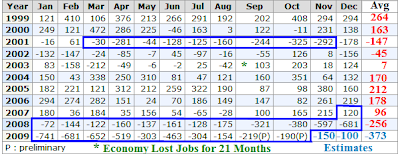
click on chart for sharper image
I posted the above table in November of 2009. The key years are 1999, 2005, and 2006.
Chart courtesy of BLS. Annotations by me, numbers are in thousands.
The areas in deep blue mark recessions.
- At the height of the internet bubble with a nonsensical Y2K scare on top of that, the economy managed to gain 264,000 jobs a month.
- At the height of the housing bubble in 2005, the economy added 212,000 jobs a month.
- At the height of the commercial real estate bubble with massive store expansion, the economy added somewhere between 96,000 and 178,000 jobs per month depending on where you mark the peak.
Neither the housing boom, nor the commercial real estate boom is coming back. Nor is there going to be another internet revolution.
Structural Problems
Government is not the answer nor are Keynesian makeshift work programs that will hire a few union workers at monstrous costs, fixing little. We need to fix structural problems.
That means scrapping Davis-Bacon and prevailing wage laws, getting rid of poisonous public union collective bargaining agreements, lowering benefits of public unions that act as a drain on cities, states, and municipalities, and expending education opportunities via accredited low-cost online schools.
In addition we should cut back military spending by 33% or more, and fix corporate tax laws that reward the flight of jobs and capital overseas. Finally I suggest a return to the gold standard as noted in Hugo Salinas Price and Michael Pettis on the Trade Imbalance Dilemma; Gold's Honest Discipline Revisited
TOPICS: Business/Economy; Culture/Society; Editorial
KEYWORDS:
1
posted on
10/18/2011 6:39:58 AM PDT
by
Kaslin
To: Kaslin
Gap will close 189 stores in the US and instead expand in China. Well at least the trip from sweatshop to retailer won't involve an overseas leg.
2
posted on
10/18/2011 6:55:17 AM PDT
by
relictele
(Pax Quaeritur Bello)
To: Kaslin
We should all have bumper stickers that say “Give the free market a chance”.
But then again talk like that is considered blasphemy in Obama’s America.
3
posted on
10/18/2011 6:56:58 AM PDT
by
MichaelCorleone
(Doesn't anyone love liberty anymore?)
To: Kaslin
I'm so going to be the nominee

4
posted on
10/18/2011 6:59:51 AM PDT
by
TSgt
(Legal Disclaimer: Look at my profile at your own risk)
To: Kaslin
In addition we should cut back military spending by 33% or more,Easier said than done. Should our defense budget be based on our perceived national security threats and risk or should it be cut regardless to meet a bottomline? What are our priorities?
5
posted on
10/18/2011 7:11:23 AM PDT
by
kabar
To: Kaslin
We have two Lowe’s stores here within a fifteen minute drive of each other but amazingly they seem to have no intention of closing either one. The town doesn’t really seem big enough for that but I suppose they know their market.
6
posted on
10/18/2011 7:15:54 AM PDT
by
RipSawyer
("IDIOCRACY" is a documentary of current conditions in America.)
To: Kaslin
We need more government spending! Only the gubbermint can save us now! lol
Targeted tax cuts in key areas, limited and targeted spending by government in area's where the money actually flows back into the US economy, creating an environment of stability and certainty regards regulations and taxes, deregulation to ease the flow of money, start up new businesses, bring new technologies to market faster or allow business to reorganize and restructure to be more efficient or profitable can NEVER work to stimulate an economy, right? /sarc
Our monetary policy has been sound.
Our fiscal policies coming from Washington suck.
The recession is protracted and exacerbated by poor fiscal policy and an administration that “seized the opportunity” (they see the recession as a means to push their socio economic paradigm) to drive an ideologically based agenda with health care, green power, massive expanse of welfare and social services, more regulations, vast uncertainty created by lots of change with little real planning or simply hand waved idealistic trash that was pushed through and is quickly looking like the garbage it was, massive changes to the tax code etc.
The US will recover eventually, but when she does, it should be noted that this is despite this administration and like the Euro’s, the heavy yolk of an overbearing government and massive social programs will drag on us in the future as well.
7
posted on
10/18/2011 7:16:12 AM PDT
by
Red6
To: Kaslin
"Nor is there going to be another internet revolution" I believe there is still room for another internet boom as more and more people shift to fully utilizing higher bandwidths. This will require building out fiber optic networks, WiFi networks, cell towers (and microcells), etc. It will also mean a variety of new applications that take advantage of the increased bandwidth. I believe there is some hope there.
To: Kaslin
That means scrapping Davis-Bacon and prevailing wage laws, getting rid of poisonous public union collective bargaining agreements, lowering benefits of public unions that act as a drain on cities, states, and municipalities, and expending education opportunities via accredited low-cost online schools. In addition we should cut back military spending by 33% or more, and fix corporate tax laws that reward the flight of jobs and capital overseas.
That's not the issue at all, nor the answer...All that will do is put what's left of the middle class into poverty...
The problem is not that the people still working are making too much money...Why was it not suggested that car dealers drop their prices so more people can afford new vehicles which would put more people to work???
The jobs are gone...It is not just a temporary down-turn that is putting millions of Americans out of work...Those people will not be called back...The jobs are gone...
Funny thing is that what those former employees produced is not gone...The inventory is still here...It's source of production has changed...
Until the gov't will deal with bringing the jobs back from China, Mexico and every other place in the world, we have no choice but continue on to the next depression...
9
posted on
10/18/2011 7:48:43 AM PDT
by
Iscool
(You mess with me, you mess with the WHOLE trailerpark...)
To: Kaslin
All according to “their” plan. What can we call Obama’s million dollar Canadian bus tour? Tour of Lies?
10
posted on
10/18/2011 8:04:49 AM PDT
by
thirst4truth
(The left elected a mouth that is unattached to an eye, brain or muscle.)
To: Kaslin
Oct 14, 2011 CSM:
Rick Perry jobs plan: Make rest of America more like Texas -- Working ........."Not all economists would put domestic energy production among their top five priorities for job growth. But many do see significant potential in this field, as the Perry campaign does.
For example, economist Peter Morici at the University of Maryland, in a recent analysis of the nation's employment crisis, wrote that "shutting down US oil and gas development is costing the US economy millions of jobs."
His view: An emphasis on domestic production could create jobs by dramatically reducing America's trade deficit, thus recycling more consumer dollars in the domestic economy. Promotion of energy production would also spill over into job creation in other industries, Mr. Morici says, as a need for refineries and pipelines boosts demand for construction workers, steel, and heavy machinery.".......
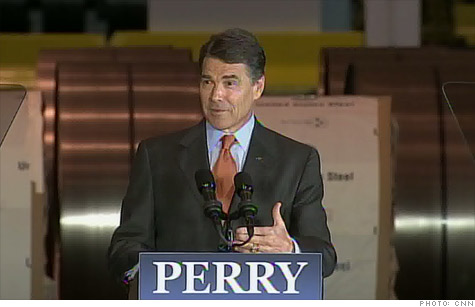
Gov. Rick Perry delivers Energizing American Jobs and Security
Source speech at the United States Steel Irvin Works in West Mifflin, Pa
October 14, 2011..........Gov. Rick Perry: "The plan I present this morning, Energizing American Jobs and Security, will kick-start economic growth and create 1.2 million jobs.
It can be implemented quicker and free of Washington gridlock because it doesn’t require congressional action. Through a series of executive orders, and other executive actions, we will begin the process of creating jobs soon after the inauguration of a new president.
There is, of course, an important role for Congress to play. And in a matter of days I will offer to the American people a broader package of economic reforms that I will take to Congress when I am elected President. My complete economic growth package will tackle tax reform, entitlement reform and real spending reductions in order to address our growing debt crisis."............
Sections: [ Policy Recommendations with each section]
Energizing American Jobs and Security
Our Conservative Philosophy
ENERGIZING AMERICA
The Failed Current Approach
BARACK OBAMA’S INCOHERENT ENERGY POLICY
Our Approach
AN ALL-AMERICAN ENERGY POLICY
American Energy, American Jobs
DEVELOPING AMERICA’S DOMESTIC RESOURCES IN THE GULF
American Energy, American Jobs
PENNSYLVANIA’S MARCELLUS SHALE
Maintaining Reliable and Affordable Energy
POWERING AMERICA’S ENGINES OF COMMERCE
Renewable Energy
THE VIRGINIA CASE STUDY
Maintaining Reliable and Affordable Energy
EPA REFORM
Energizing America: Jobs and Security
A NEW PRESIDENT, A RENEWED AMERICA
To: Kaslin
12
posted on
10/18/2011 8:11:13 AM PDT
by
Bean Counter
(Obama got mostly Ds and Fs all through college and law school. Keep repeating it.....)
To: Kaslin
all you need to know about jobs and opportunity in USA...basically the better off government is...the worse off we all are..
The story of American jobs and labor is deeply intertwined with predatory Federal, state and local taxation and regulation....
South Koreans sleep soundly on their border with NORKS because of American Taxpayer dollars and the American GI.
Why can’t Texans, New Mexicans, Arizonans and Californians?....BECAUSE
Illegal immigration is THE KEY to the perpetuation of the status quo in DC......
Predatory tax and regulatory policies-actions that basically serve to perpetuate and grow governments-leave what business is left in the country seeking disposable labor.
Illegal Labor is the Feds out for preserving the status quo regarding Taxes and Regulation. Interestingly, that is WHY the Feds encourage in-state tuition etc for illegals under-the-table -their presence providing disposable labor allows Federal, State and local regulatory and tax excess in the status quo to continue
Immigration is the ultimate litmus test as to the candidates in question commitment to meaningful regulatory and tax reform. If they are wishy-washy on the subject...they have no real intent to disturb the DC status quo...no matter how big their cowboy hat and six-gun.
Real”leadership” is that which will place Flyover Country’s interest ahead of the Feds....haven’t yet seen anything meaningful anywhere from anybody to indicate that might happen. We have just one more election cycle to make that happen via rule of law. Otherwise its the end of the run for America.
13
posted on
10/18/2011 8:23:56 AM PDT
by
mo
To: Kaslin
The financial sector has clearly been impacted by periodic shifts in the economy. However, the industry has never been hit the Dodd-Frank tsunami. Even without difficult times, Dodd-Frank would lead to large movement of jobs. Dodd-Frank will strangle the sector with government oversight of new products severely limiting innovation and associated investment. A little known part of Dodd-Frank is the quota system imposed on the industry. Dodd-Frank has imposed a quota bureacracy on the industry effectively imposing hiring quotas. Dodd-Frank socializes the financial services industry, a soft form of government control that will lead to widespread job losses.
To: Kaslin
Neither the housing boom, nor the commercial real estate boom is coming back. Nor is there going to be another internet revolution.True, but we are an the eve of an energy boom. We can be an exporter, like Canada and be prosperous once again.
People still want to travel and will spend money on travel. Plus people want to be comfortable.
15
posted on
10/18/2011 8:51:20 AM PDT
by
cicero2k
To: Iscool; All
Until the gov’t will deal with bringing the jobs back from China, Mexico and every other place in the world, we have no choice but continue on to the next depression..
Bingo.
Only Pat Buchanan and Trump have said this.
Wish Buchanan would run. He’s right on this and immigration.
“A historical episode that opponents of consumer sovereignty—that is, opponents of free trade—frequently cite to support their case for high tariffs is late nineteenth-century America. Pat Buchanan, for example, in his book The Great Betrayal asserts about the 1800s that “Behind a tariff wall . . . the United States had gone from an agrarian coastal republic to become the greatest industrial power the world has ever seen—in a single century. Such was the success of the policy called protectionism that is so disparaged today.”
http://www.thefreemanonline.org/columns/thoughts-on-freedom/tariffs-and-freedom/
16
posted on
10/18/2011 10:32:16 AM PDT
by
Democrat_media
(Why is no government creating a product we can hold in our hands like a cell phone..?)
To: Democrat_media
Only Pat Buchanan and Trump have said this.Buchanan was on Coast to Coast AM last night, he was spot on with every question. I was surprised to hear him on that show.
17
posted on
10/18/2011 10:40:59 AM PDT
by
thirst4truth
(The left elected a mouth that is unattached to an eye, brain or muscle.)
Disclaimer:
Opinions posted on Free Republic are those of the individual
posters and do not necessarily represent the opinion of Free Republic or its
management. All materials posted herein are protected by copyright law and the
exemption for fair use of copyrighted works.
FreeRepublic.com is powered by software copyright 2000-2008 John Robinson


