Skip to comments.
NASA Set to Launch Spacecraft to Pluto
AP on Yahoo ^
| 1/16/06
| Mike Schneider - ap
Posted on 01/16/2006 1:38:06 PM PST by NormsRevenge
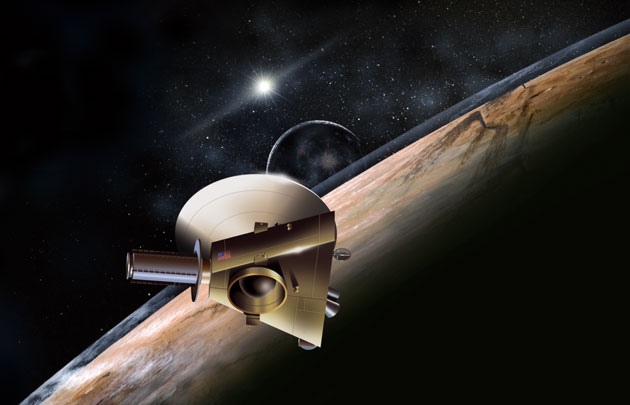
CAPE CANAVERAL, Fla. - An unmanned NASA spacecraft the size of a piano is set to lift off Tuesday on a nine-year journey to Pluto, the last unexplored planet in the solar system.
Scientists hope to learn more about the icy planet and its large moon, Charon, as well as two other, recently discovered moons in orbit around Pluto.
The $700 million New Horizons mission also will study the surrounding Kuiper Belt, the mysterious zone of the solar system that is believed to hold thousands of comets and other icy objects. It could hold clues to how the planets were formed.
"They finally are going! I can't believe it!" said Patricia Tombaugh, 93, widow of Clyde Tombaugh, the Illinois-born astronomer who discovered Pluto in 1930.
Patricia Tombaugh, her two children, and the astronomer's younger sister planned to witness the launch of the New Horizons spacecraft at the Cape Canaveral Air Force Station on Tuesday afternoon.
Pluto is the only planet discovered by a U.S. citizen, though some astronomers dispute Pluto's right to be called a planet. It is an oddball icy dwarf unlike the rocky planets of Mercury, Venus, Earth and Mars and the gaseous planets of Jupiter, Saturn, Uranus and Neptune.
NASA has sent unmanned space probes to every planet but Pluto.
"What we know about Pluto today could fit on the back of a postage stamp," said Colleen Hartman, a deputy associate administrator at NASA. "The textbooks will be rewritten after this mission is completed."
New Horizons will lift off on an Atlas V rocket and speed away from Earth at 36,000 mph, the fastest spacecraft ever launched. It will reach Earth's moon in about nine hours and arrive in 13 months at Jupiter, where it will use the giant planet's gravity as a slingshot, shaving five year off the 3-billion-mile trip.
The launch had drawn protests from anti-nuclear activists because the spacecraft will be powered by 24 pounds of plutonium, which will produce energy from natural radioactive decay.
NASA and the U.S. Department of Energy have put the probability of an early-launch accident that could release plutonium at 1 in 350. The agencies have brought in 16 mobile field teams that can detect radiation and 33 air samplers and monitors.
"Just as we have ambulances at football games, you don't expect to use them, but we have them there if we need them," NASA official Randy Scott said.
___
On the Net:
Global Network Against Weapons & Nuclear Power in Space:
http://www.space4peace.org
New Horizons Mission: http://pluto.jhuapl.edu
TOPICS: Culture/Society; Foreign Affairs; Government; US: Florida
KEYWORDS: kuiperbelt; launch; nasa; newhorizons; pluto; spacecraft
Navigation: use the links below to view more comments.
first 1-20, 21-40, 41-46 next last

The Atlas V rocket that will carry the New Horizons spacecraft to Pluto moves from the Vertical Integration Facility, left, to the launch pad at the Kennedy Space Center in Cape Canaveral, Fla. on Monday Jan. 16, 2006. The spacecraft which will take 9 to 14 years to reach Pluto is powered by 24 pounds of plutonium. (AP Photo/John Raoux)
To: NormsRevenge
I hipe that security is tight.
THe communist anti-nuclear crowd would LOVE to sabotage this rocket.
2
posted on
01/16/2006 1:40:33 PM PST
by
MonroeDNA
(Look for the union label--on the bat crashing through your windshield!)
To: NormsRevenge
Darn. I was hoping for a "NASA sends probe to Uranus" headline.
To: All
Click image for Countdown to Launch page and webcam shots.

4
posted on
01/16/2006 1:41:51 PM PST
by
NormsRevenge
(Semper Fi ... Monthly Donor spoken Here. Go to ... https://secure.freerepublic.com/donate/)
To: NormsRevenge
To: iPod Shuffle
We will send a probe to Uranus at a much later date....lol.
6
posted on
01/16/2006 1:45:05 PM PST
by
TheLion
To: iPod Shuffle
"Darn. I was hoping for a "NASA sends probe to Uranus" headline."
Now THAT was funny! ;-)
7
posted on
01/16/2006 1:45:28 PM PST
by
jamese777
To: NormsRevenge
protests from anti-nuclear activists because the spacecraft will be powered by 24 pounds of plutonium Anybody have a number of pounds of "ordinary" rocket fuel that would be required for an equivalent trip?
8
posted on
01/16/2006 1:45:47 PM PST
by
Izzy Dunne
(Hello, I'm a TAGLINE virus. Please help me spread by copying me into YOUR tag line.)
9
posted on
01/16/2006 1:46:17 PM PST
by
NormsRevenge
(Semper Fi ... Monthly Donor spoken Here. Go to ... https://secure.freerepublic.com/donate/)
To: Izzy Dunne
> Anybody have a number of pounds of "ordinary" rocket fuel that would be required for an equivalent trip?
You're imagining the wrong kind of "power." The RTG used hgere provides electrical power to run the computers, comm systems, sensors, etc. No nuclear propulsive capability.
10
posted on
01/16/2006 1:47:46 PM PST
by
orionblamblam
(A furore Normannorum libra nos, Domine)
To: Izzy Dunne
9 years to get there.... 1 in 350 odds..
Light her up!
11
posted on
01/16/2006 1:48:24 PM PST
by
NormsRevenge
(Semper Fi ... Monthly Donor spoken Here. Go to ... https://secure.freerepublic.com/donate/)
To: NormsRevenge
The space craft will take "9" to "14" years...wow...talk about a confidence interval. Space Travel..there's a faster way. I hope those guys get the Heim Engine to work.
Anyway, to bad we're not sending Sen. Kennedy and the Hildabeast along for the trip.
12
posted on
01/16/2006 1:49:35 PM PST
by
in hoc signo vinces
("Houston, TX...a waiting quagmire for jihadis.")
13
posted on
01/16/2006 1:50:26 PM PST
by
NormsRevenge
(Semper Fi ... Monthly Donor spoken Here. Go to ... https://secure.freerepublic.com/donate/)
To: NormsRevenge
To: NormsRevenge
So Pluto is an "oddball" icy dwarf? How is it different from "normal" icy dwarfs?
I had the good fortune to hear Clyde Tombaugh speak once, about 15 years ago. He was quite a guy, and I'm glad his relatives are being included in the event.
To: NormsRevenge
Power
http://pluto.jhuapl.edu/spacecraft/power.php
As designed, electrical power for the New Horizons spacecraft and science instruments would be provided by a single radioisotope thermoelectric generator, or RTG. Provided by the Department of Energy, an RTG is used on missions that can not use solar power -- yet require a proven, reliable power supply that can produce up to several kilowatts of power and operate under severe environmental conditions for many years.
New Horizons' journey is planned to take it more than 4 billion miles from Earth, where the Sun is just a bright star in the dark sky. Besides taking longer than 4 hours to reach Pluto and nearby Kuiper Belt objects, light from the Sun is 1,000 times fainter there than at Earth.
Carrying out the New Horizons mission safely is NASA's top priority. As part of this, NASA is informing the public about New Horizons' use of an RTG by publishing a detailed Environmental Impact Statement - or EIS - and several fact sheets. The Final EIS, which includes public comments on the Draft EIS and NASA's responses to those comments, was released in July 2005.
Here are documents related to power on the New Horizons mission:
TITLE DATE FORMAT/SIZE
New Horizons Power 10/2004 PDF/57 K
http://pluto.jhuapl.edu/common/content/pdfs/NHRTG_FS_100804.pdf Final Environmental Impact Statement (Vol. I) 7/2005 PDF/2.3 MB
http://www.spacescience.nasa.gov/admin/pubs/plutoeis/NH-FEIS_Vol1.pdf Final Environmental Impact Statement (Vol. II) 7/2005 PDF/3.5 MB
http://www.spacescience.nasa.gov/admin/pubs/plutoeis/NH-FEIS_Vol2.pdf
16
posted on
01/16/2006 1:57:18 PM PST
by
NormsRevenge
(Semper Fi ... Monthly Donor spoken Here. Go to ... https://secure.freerepublic.com/donate/)
To: NormsRevenge
...some astronomers dispute Pluto's right to be called a planet. It is an oddball icy dwarf... Geez, not even there yet and already we're being condescending. I believe the proper name is "oddball icy little-person". No wait, that's my ex-wife.
17
posted on
01/16/2006 1:57:29 PM PST
by
fat city
("The nation that controls magnetism controls the world.")
To: NormsRevenge
To: in hoc signo vinces
> The space craft will take "9" to "14" years...wow...talk about a confidence interval.
Actaully, they are quite clear on the precision of the travel time. The problem is that if the mission launches within the current launch window, it'll zing past Jupiter and get there in 9 years. If they miss this launch window, they'll also miss the gravity assist from Jupiter, and it'll take 14 years.
19
posted on
01/16/2006 2:03:02 PM PST
by
orionblamblam
(A furore Normannorum libra nos, Domine)
To: NormsRevenge
Navigation: use the links below to view more comments.
first 1-20, 21-40, 41-46 next last
Disclaimer:
Opinions posted on Free Republic are those of the individual
posters and do not necessarily represent the opinion of Free Republic or its
management. All materials posted herein are protected by copyright law and the
exemption for fair use of copyrighted works.
FreeRepublic.com is powered by software copyright 2000-2008 John Robinson