
Posted on 07/30/2005 10:18:41 PM PDT by anymouse
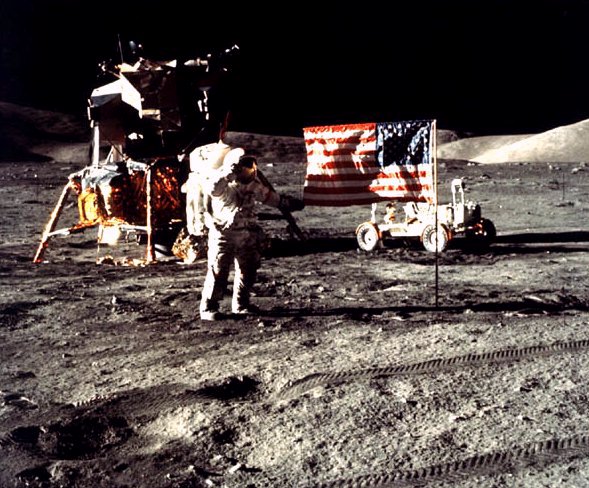
NASA's new road map for the human exploration of space would land four astronauts on the moon by 2018 as the first step toward an eventual six-person voyage to Mars.
Pioneers would build a lunar outpost, most likely at the south pole, with living quarters, power plants and communication systems. Expeditions would scavenge the desolate landscape for precious supplies such as fuel and water.
(Excerpt) Read more at orlandosentinel.com ...
Space ping
Reality: nasa's got a pretty good track record of launching things (O-rings aside), but the system is rather fragile and can fall apart when you want to come back DOWN again - AND try to GLIDE on it (thus prolonging its period-of-use) into the bargain.
Probably the safest return vehicle they had was the Saturn-5's command capsule. One big, solid, ablative heatshield under their [backsides] rather than these styrofoamy puzzle-piece shuttle bottoms.
Don't tell anybody at the new NASA that the old NASA did this by 1970.
The "Big Dumb Boosters" are also cheaper in the long run per pound of cargo lifted.
My prediction: by 2018 there will be no NASA!
And the Mexican border is still WIDE open, eh..
Must give the sheeple something to 'think" about I guess..
Lots of distractions (from the obvious) these days..
I don't understand why they won't break up the lunar portion of the mission into cargo and crew like they're doing for the Earth part. I'm no rocket scientist but it seems like this would be a good, incremental plan:
1) Land a habitat module on the Moon autonomously.
2) Place a "Moonstation" in orbit around the Moon. It could be just a frame with connection points. Attached to it are the simple "Buck Rogers" landers that were proposed for Apollo. The astronaut sits exposed in a spacesuit, which drastically reduces the weight and complexity of the lander.
3) The CEV travels to the Moonstation and docks. The crew puts on suits, spacewalks to the landers, then descend to the habitat on the surface.
It just seems wasteful to carry a disposable lander with you on every mission, especially one that needs to support four men for a week. Wouldn't it be better for the crew to just carry supplies for a mission, not the hardware itself???
The gubmint was only as inept as the populace which lost interest in the moon as soon as this amazing feat was accomplished.
Make no mistake, our gubmint is a reflection of it's people.
Hell, I would of opened up a fur shop on Pluto by now.
My prediction: by 2018 there will be no moon :)
Who have they got anyway?...Tim the toolman Taylor from Home Improvement????
You'd be tempting fate!
"All These Worlds Are Yours Except Europa. Attempt No Landing There. Use Them Together. Use Them in Peace."
=)
N.A.S.A. has become an over engineered uptight dinosaur incapeable of accomplishing much for the sizeable sum of tazpayer dollars they receive.
Time to go private in the space exploration business.
Can you imagime what Burt Rutan could have accompolished with a fraction of n.a.s.a. budget?
Get these folks sitting around waiting to get a pension out of the space business and get them where they belong say working at the dept of motor vehicles getting fat dong little.
That makes no obvious sense. The longest continuous stay in space has been 366 days, by Russians manning the Mir station, and the longest total days spent in space has been 747 days by another Russian over the course of three missions to the International Space Station. None of them died. What am I missing?
.........Current plans call for a minimum of two lunar missions per year beginning in 2018.
Astronauts would conduct long-term research in several scientific disciplines, including astrobiology, geology, astronomy and physics. Some of the studies will gauge how the human body responds over time to weaker gravity, increased solar radiation and other conditions found away from Earth.
Crews also would try to take advantage of any available resources on the moon and live off the land. The goal is to eventually develop a lunar base.
A likely location for an outpost is near Shackleton Crater at the moon's south pole, where scientists suspect there are relatively high levels of hydrogen, a potential fuel source, and the possibility of water ice. Missions would gradually build power, communication and navigation systems, and a place to live. Rovers more advanced than those during Apollo would be used to explore the surface. ........

Disclaimer: Opinions posted on Free Republic are those of the individual posters and do not necessarily represent the opinion of Free Republic or its management. All materials posted herein are protected by copyright law and the exemption for fair use of copyrighted works.