|
Posted on 08/26/2003 12:10:04 AM PDT by SAMWolf
|
|
 are acknowledged, affirmed and commemorated.
|

| Our Mission: The FReeper Foxhole is dedicated to Veterans of our Nation's military forces and to others who are affected in their relationships with Veterans. In the FReeper Foxhole, Veterans or their family members should feel free to address their specific circumstances or whatever issues concern them in an atmosphere of peace, understanding, brotherhood and support. The FReeper Foxhole hopes to share with it's readers an open forum where we can learn about and discuss military history, military news and other topics of concern or interest to our readers be they Veteran's, Current Duty or anyone interested in what we have to offer. If the Foxhole makes someone appreciate, even a little, what others have sacrificed for us, then it has accomplished one of it's missions. We hope the Foxhole in some small way helps us to remember and honor those who came before us.
|
|
By the spring of 1782, independence from Britain was won in Illinois country and the duties of the Illinois militia turned toward protection of settlements from Indian attacks. Illinois became part of the Northwest Territory in 1787 and in 1809, Illinois Territory was formed, with two counties: Saint Clair and Randolph. A military department was established under the acting governor, Nathaniel Pope, and militia regiments and companies were organized throughout the territory. Four Illinois Militia regiments were organized prior to the War of 1812. The First and Third Regiments were formed in Randolph County. These regiments included two battalions of militia troops. The Second Regiment consisted of three battalions, organized in Saint Clair County. The Fourth Regiment was formed by militiamen along the Wabash River and maintained two battalions. Illinois Territory became the 21st state to join the Union on December 3, 1818, authorized by President James Monroe, and the Illinois Militia was organized to correspond to the new state boundaries.  Though Illinois had come a long way from its early days under French rule, there was still mounting concern over conflict between whites and Indians. After 1783, ...pressures from land companies and prominent speculators, as well as the Indian-hating sentiments along the frontiers, fueled the government’s drive to secure Indian acceptance of the American land demands. Between 1784 and 1789, government negotiation coerced Indian leaders in the East and in the Northwest Territory into signing a number of cession treaties, reducing the Indians’ land base and resources. ...[T]hese treaties were usually negotiated by the government, the insufficient authority or misrepresentation of many of the Indian individuals who signed the treaties, and the enormous loss of lands and resources resulting from the cessions caused the majority of Indian people to denounce the agreements.  MA-CA-TAI-ME-SHE-KIA-KIAK Chief Black Hawk The Black Hawk War, named for the leader of a band of Sauk and Fox Indians, was the result of government cession of lands in Illinois. Black Hawk was born in 1761 on the banks of the Rock River to the Sauk Indian tribe. As a young man, Black Hawk fought under Tecumseh in the War of 1812, and had formed an early dislike of United States policy regarding Indians. His feelings intensified when, on July 10, 1830, Sauk Chief Keokuk sold 26,500,000 acres of Sauk land east of the Mississippi to the United States government for three cents an acre. Part of the agreement included the selling of the village at the junction of the Rock River and the Mississippi River, a village that had been the home of Black Hawk’s band of Sauk and Fox Indians for over 150 years. Black Hawk and his followers did not sanction the sale of their lands, and when Black Hawk’s band returned from their hunt in the fall of 1830 to find whites occupying their village, they were determined to regain their homes. Fearful whites called upon Governor John Reynolds, who issued a proclamation calling out a mounted volunteer militia force to repel Black Hawk and his band. Illinois settlers volunteered to undertake this task, which ended in Black Hawk’s retreat across the river.  On April 6, 1832 Black Hawk, along with 1000 men, women and children, came back across the Mississippi into Illinois. The band proceeded up the Rock River in an attempt to reclaim their homeland, causing many settlers to flee. The governor of Illinois deemed this movement an invasion, mobilizing a militia of 1600 men and calling for support from U.S. troops. Federal authorities, along with Sauk and Fox tribal councils had ordered Black Hawk and his band west of the Mississippi, but Black Hawk would not give in. The governor issued a proclamation on April 16 that the militias assemble at Beardstown on the 22nd, and volunteers organized into four regiments under Colonel John Thomas, Jacob Fry, Abraham DeWitt and Samuel M. Thompson. A spy battalion under Major James D. Henry was formed, along with two "odd battalions" under Major Thomas James and Major Thomas Long. From Beardstown, 1600 men proceeded to Fort Armstrong and arrived there on May 7. On May 9, the militia began to pursue Black Hawk’s band. Black Hawk, knowing of Major Stillman’s encampment three miles down the Rock River near Dixon, sent men bearing white flags, but Stillman’s troops fired on them and forty of Black Hawk’s warriors retaliated, killing eleven soldiers. The militia numbered 300, but fled after the first volley from Black Hawk’s warriors. The militia returned home with news that 2000 "bloodthirsty warriors were sweeping all Northern Illinois with the bosom of destruction." After this initial skirmish, Black Hawk removed the women and children of his band to Lake Koshkonong in Michigan Territory then descended into Northern Illinois.  On the 19th, General Atkinson and the entire militia moved up the Rock River, leaving Stillman’s Corps at Dixon to care for the wounded and guard supplies, but they fled and went home. Atkinson returned to Dixon and General Whiteside followed Black Hawk’s trail up the Kishwaukee River, but many of the militia men did not want to leave Illinois territory. Having been enlisted for one month, the militia was mustered out of service by the Governor on May 27 and 28. The Federal Government ordered 1000 regulars to the seat of war from the seaboard, under General Winfield Scott to resume the chase, and three hundred volunteer mounted rangers from Illinois agreed to remain in the field under Colonel Henry Frye and Lt. Colonel James D. Henry. On May 22 Sauks and allied Potawotomis began raiding settlements in Illinois near Ottawa and Galena, Illinois, and LaFayette County, Virginia. The militia caught up with the raiding Indians and several small skirmishes ensued near Kellogg’s Grove, Plum River Fort, Burr Oak Grove, Sinsiniwa Mound, and Blue Mounds. Three weeks after Stillman’s defeat, the governor recruited additional militia forces, raising the number to 4000 troops including mounted militia, spy battalions, rangers, regular infantry, and 75 Potawatomis.  Fort Armstrong From the end of June to the beginning of August, the militia chased Black Hawk and his band from the Illinois-Wisconsin border to the mouth of the Kishwaukee River, to Lake Koshkonong, and to Rock River, trailing behind them and missing them by two to three days at each location. On August 1 Black Hawk reached the Mississippi, at an eastern tributary, near the mouth of the Bad Axe River. His band was depleted and hungry and Black Hawk, defeated, appeared with a white flag to surrender to the Warrior, a supply transport steamer from Prairie du Chien, Captained by John Throckmorton. Black Hawk was ordered to board by his own canoe, but women and children of his band had already begun crossing the river with the band’s canoes. Throckmorton fired the cannon of the Warrior upon them at the shore, and both sides exchanged musket fire. Of the 1000 Indians who followed Black Hawk, only 150 survived the three-hour battle, and 17 white soldiers were killed. Three hundred of Black Hawk’s band managed to cross the river unscathed, but they where killed by Sioux warriors hired by General Atkinson. Black Hawk escaped with ten warriors and 35 women and children to the Dalles of Wisconsin but on August 27 they were delivered to Prairie du Chien. On September 21 a peace treaty was signed and on August 1, Black Hawk was placed under the guardianship of Keokuk. He never again attempted to regain his homeland. Black Hawk died in October 1838 at the age of 71, on a reservation on the Des Moines River in Davis County, Iowa.  Sauk Chief Keokuk The Black Hawk War of 1832 lasted fifteen weeks and resulted in the deaths of seventy settlers and soldiers and hundreds of Black Hawk’s band. The Black Hawk War affected not only the lives of the Indians, settlers, and militiamen involved, but also the settlement of Illinois and Wisconsin. The consequence of that inglorious skirmish was a campaign which ended in the almost complete annihilation of Black Hawk’s band, the demoralization of the Sauk and Fox nation, and untold hardship and inconvenience to thousands of white persons - to say nothing of the impetus camp life gave to the spread of the cholera epidemic.  The movement of soldiers throughout the state alone caused the deaths of two hundred and fifty soldiers and settlers due to disease. The war was also responsible for the end of conflict between whites and Indians in Illinois or Wisconsin. All remaining Indian land was purchased from tribes, opening the settlement of Northern Illinois and the southern portion of Wisconsin. It called attention to the ...attractions and resources of an important section of the Northwest. The troops acted as explorers of a large tract concerning which nothing hitherto definitely been known among white men… From the press were issued books and pamphlets by the score, giving sketches of the war and accounts of the newly discovered paradise…they advertised the country as set flowing thither a tide of immigration.
|
|
Air Power |
The Tu-16 was designed as an high-speed jet bomber for operations in theaters close to the Soviet Union. Intended to replace the propeller-driven TU-4, the greatest challenge during development was to doubling the speed to improve survivability in the face of enemy fighters.
OKB A.N. Tupolev started working on the design of a new jet bomber soon after development of the TU-4 was completed. The resulting design "82" consisted of a swept-wing aircraft with RD-45F or VK-1 turbojet engines. The bomber was supposed to have a speed of Mach 0.9-0.95 with a range and payload were comparable to the TU-4.
After the bomber's operational characteristics were coordinated with the military, the government officially approved the development of the "82" aircraft in 1948. The prototype, which was the first Soviet aircraft with swept-wings, made its' first flight on 24 March1949. It reached a speed of 934 km/h, 20 percent faster than the TU-14 which also had BK-1 engines. The "82" design was initially supposed to serve as the basis for the "83" bomber, but with the start of serial production of the Il-28, the project was dropped.
Based on the results of the "82" aircraft, in 1950 OKB Tupolev started developing the "492" heavy long-range bomber that had a better performance than the TU-4 and the Il-28. The design provided for a bomb load of 6000 kg, a range of 7,500 km, a speed of 1000 km/h and a ceiling of 12000-13000 m. The maximum bomb load could be increased up to 12000kg. The aircraft could be outfitted with three different types of engines: two AM-3 engines with a thrust of 8750 kg, 4 engines ?R-3A engines (5000 kg) or 4 TR-5 two circuit engines (5000 kg). As the TR-5 engines were the most reliable at that time, Tupolev was charged with the development of an experimental long-range bomber (project "88") equipped with two TR-5 engines. However, work on the AM-3 engines continued and was completed in August 1951.
The wings of the Badger are mid-mounted, swept-back, and tapered with blunt tips. There are fences on top of the wings and its landing gear pods extend beyond the wings’ trailing edges. The Badger's engine(s) are two turbojets mounted in wing roots which extend beyond the leading and trailing edges of the wing root. The engines also have round air intakes. Its fuselage is long, slender, and bulging where the engines are mounted and tapered to the tail. It has a round, glassed-in nose and a stepped cockpit. The tail is swept-back, tapered fin and flats with blunt tips. The Badger also has a tail gunner compartment. All models of Badger are equipped for aerial refueling.
The first prototype of the "88" aircraft received the designation Tu-16 and carried out the first flight on 27 April 1952. During flight tests, the aircraft exceeded the expected speed but lagged in range due to insufficient engine performance. As a result, the second prototype had a reduced weight though less speed at small and medium altitudes. In April 1953 it actually exceeded the expected range.
In December 1952, series production was initiated. In 1953 series production of the TU-16 began at the plant Nr. 22 in Kazan and in 1954, also at the plant Nr.1 in Kuibyshev and at the plant Nr. 64 in Voronezh. During production, the aircraft were outfitted with a modified AM-3 engine - the PD-3MT. While the bombers were already operational, the AM-3 and PD-3M engines were replaced by PD-3M-500 engines with improved characteristics. When production of the TU-16 finally stopped in 1963, a total of 1509 aircraft had been built.
Deployment of the first TU-16 bombers started in 1954. They replaced the TU-4, operating in theaters close to Soviet territory
The TU-16 remained in Soviet and later Russian service until 1993. They were used during the war in Afghanistan. The Badger is used by Egypt, Iraq, the People’s Republic of China (H-6), and Ukraine. In 1958, delivery of TU-16 bombers to China began, where series production received the designation H-6. In the summer of 1961, twenty TU-16KS were sold to Indonesia. In the 1960s, TU-16 bombers were delivered to Egypt which also received TU-16KS aircraft in 1967 and Tu-16K-11-16 in 1973. Iraq also received TU-16K-11-16 bombers in the 1960s.
Specifications:
Primary Function: Multi-role bomber / recce. platform
Contractor: Tupolev
Crew: 7
Unit Cost: N/A
Powerplants: Two Mikulin AM-3M turbojets, 20,920 lb thrust each
Dimensions:
Length: 114 ft 2 in (34.8 m)
Wingspan: 108 ft 3 in (32.99 m)
Height: 34 ft (10.36 m)
Weights: Empty: 82,000 lb / Maximum Takeoff: 165,350 lb
Performance :
Speed: 652 mph (1,050 km/h)
Ceiling: 49,200 ft
Range: 4,505 miles (7,250 km)
Armaments:
Seven AM-23 23mm cannons in pairs with single in nose,
plus 19,800 lb including free-fall weapons and ASMs

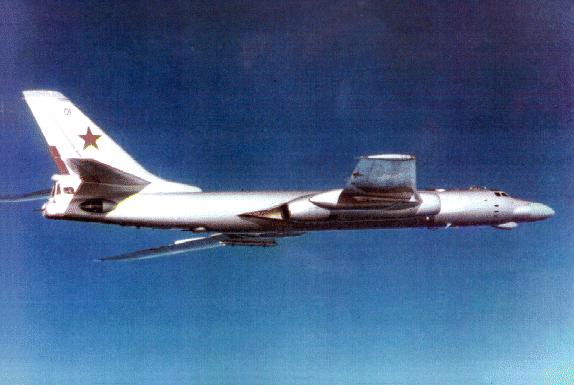


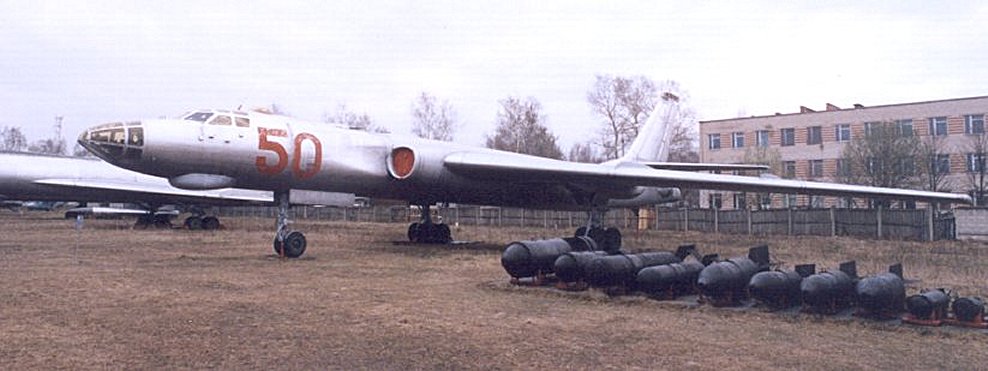
All photos Copyright of FAS.ORG
he issued orders to kill numerous Indian captives, including women & children!
NOT an American hero.
free the south,sw
it's POURING out there AGAIN!
free dixie,sw
What? How can that be? I always hear about how the Germans were too busy with the "french resistance collaborators" to do things like this in france.
Disclaimer: Opinions posted on Free Republic are those of the individual posters and do not necessarily represent the opinion of Free Republic or its management. All materials posted herein are protected by copyright law and the exemption for fair use of copyrighted works.