|
Posted on 07/22/2003 12:01:23 AM PDT by SAMWolf
|
|
 are acknowledged, affirmed and commemorated.
|

| Our Mission: The FReeper Foxhole is dedicated to Veterans of our Nation's military forces and to others who are affected in their relationships with Veterans. In the FReeper Foxhole, Veterans or their family members should feel free to address their specific circumstances or whatever issues concern them in an atmosphere of peace, understanding, brotherhood and support. The FReeper Foxhole hopes to share with it's readers an open forum where we can learn about and discuss military history, military news and other topics of concern or interest to our readers be they Veteran's, Current Duty or anyone interested in what we have to offer. If the Foxhole makes someone appreciate, even a little, what others have sacrificed for us, then it has accomplished one of it's missions. We hope the Foxhole in some small way helps us to remember and honor those who came before us.
|
|
AT ONE MINUTE PAST MIDNIGHT on 9 September, loudspeakers on the transports called the first boat teams to their stations. Soldiers clambered down the nets into landing craft. Motors sputtered and then roared as the first boats pulled away. Soon the calm sea was alive with snub-nosed craft, circling to reach their proper positions. In the darkness some of the coxswains failed to locate their leaders. Lanes had been previously swept through the mine fields, but occasionally mines broke free and drifted into the paths which the boats were trying to follow. Spray drenched the men and their equipment. Many of the soldiers became seasick. But at length the LCM's (Landing Craft, Mechanized) and LCVP's (Landing Craft, Vehicle, Personnel), carrying the first assault waves, turned east behind the guide boats toward the rendezvous deployment line, 6,000 yards from the Salerno beaches. Under orders from General Clark, the VI Corps and, in turn, the 36th Division had prepared landing plans. The 141st and 142d Regimental Combat Teams (36th Division) were to land as assault forces, in six waves on the Paestum beaches, advance to the railroad about 2,500 yards inland, reorganize in assembly areas, then move on to their objectives—the hills 10 miles distant. Once established on the hills, they would control the entire southern half of the Salerno plain. The 143d Regimental Combat Team (36th Division) was to land after the first two and be prepared to replace the assault forces on either flank. While the infantry worked inland, engineer beach groups of the Army and Navy were to organize the beaches for following landings, communication, and supply. If the plan operated successfully, American soldiers of VI Corps would hold a beachhead of 100 square miles, within the 25-mile mountain arc from Ponte Sele south to Roccad'aspide and thence southwest to Agropoli on the coast.  Three and a half hours after the first call to stations, all the assault troops and necessary vehicles had left the transports. Behind them came other craft with tanks, antiaircraft artillery, ammunition vehicles, and heavy weapons. Dukws (2½-ton amphibian trucks) were carrying crews with light artillery and antitank guns. From the north, where the British were firing a bombardment on 10 Corps beaches, came the dull boom of heavy naval guns. In the vicinity of Salerno the sky was lighted by flares and fires burning on the mainland. South of Salerno, the VI Corps made its assault on the beaches at Paestum without previous naval or air bombardment. According to plan, the four landing areas, designated by colored lights and panels, were to extend southward from the Fiumarello for a distance of 2 miles. Red Beach was to be 800 yards in length; Green, 500 yards; Yellow, 1,000 yards; and Blue, 1,500 yards. In actual operation, the frontage was narrowed because of initial heavy opposition, particularly on Yellow and Blue, so that each of the beaches was about 600 yards long. Ahead of VI Corps, the beaches of Paestum were dark and silent. Then a strident voice over a loudspeaker, apparently from the landing area, called out in English, "Come on in and give up. We have you covered." Our troops came in. The first wave grated on all four beaches exactly at H Hour, 0330.1 Flares went up immediately, and enemy guns opened fire as our soldiers leaped into the shallow water, waded to the narrow strip of sand, and started inland for the assembly areas. On the left at Red and Green beaches, the 142d Regimental Combat Team, commanded by Col. John D. Forsythe, began the push that was designed to take it eventually to the high ground extending from Ponte Sele through Altavilla, Albanella, and Roccad'aspide to Mount Vesole and Magliano. On the right at Yellow and Blue beaches, the 141st Regimental Combat Team, under Col. Richard J. Werner, was already meeting fire as it moved to maintain contact with the 142d at Mount Vesole and Magliano and to occupy key points in the mountain arc as far as Agropoli at the southern end of the Gulf of Salerno.  After H Hour the second and third assault waves hit the beaches at 8-minute intervals. On Red and Green beaches, the men of the 142d, creeping, crawling, and running, worked their way through barbed wire and around enemy machine guns and tanks dimly silhouetted in the light of flares. Behind them shells formed geysers in the water, and equipment from stricken craft floated offshore. On the left flank of the regiment, the 3d Battalion Combat Team, commanded by Lt. Col. Thomas H. McDonald, was to reorganize at the railroad east of Paestum, advance north about 3 miles, then turn east to Tempone di San Paolo (Hill 140). On the right flank of the regiment, the 2d Battalion Combat Team, under Lt. Col. Samuel S. Graham, was also to reorganize at the railroad, then to advance inland along the Capodifiume River to occupy the nose of Mount Soprano, northwest of Hill 386. Under Lt. Col. Gaines J. Barron, the 1st Battalion, in reserve at the beginning of the assault, was to land later than the 2d and 3d Battalions, assemble, and take up a position at the southeast end of Hill 140. The first heavy weapons of the 142d Regimental Combat Team were brought in at 0345. The 1st and 2d Squads of the Mine Platoon, Antitank Company, also landed with the first assault waves. Despite the destruction of some of their equipment by enemy fire they began to clear the beaches of mines and wire obstacles. As soon as their work was completed, they moved inland, advancing as riflemen. Both assault battalions of the 142d on Red and Green beaches were pinned down from time to time. Machine gunners and snipers in the 50-foot Tower of Paestum and in two-story buildings north of the tower fired on them. To the northwest they met similar opposition from Germans concealed in a grove of saplings and sheltered by the dunes overlooking the beach. Officers and men were separated. Nevertheless, elements of the 2d and 3d Battalions worked their way toward the railroad.  THE TOWER OF PAESTUM, a medieval watch-tower, is a 50-foot stone structure with excellent view of the VI Corps beaches. From the balcony at its top German machine gunners and snipers fired on the troops of the 36th Division. During the first hour of the landings, Pvt. J. C. Jones of Company E found about 50 leaderless men from various companies and guided them off the beaches through falling shells and small-arms fire. As they went, they destroyed several machine-gun positions, although when the reserve forces of the 143d landed, between 0640 and 0800, enemy machine gunners and snipers were still active in the Paestum area. T/Sgt. Manuel S. Gonzales of Company F discovered an 88-mm gun firing from the dunes toward our landing craft. Machine-gun tracers set fire to his pack, but he wriggled out of it and crawled on past exploding grenades toward the gun. Then he threw his own grenades, killed the crew, and blew up their ammunition. On the right flank of the division, the assault battalions of the 141st Infantry landed on schedule and began working through wire obstacles and mines. Intense fire from machine guns, field pieces, mortars, and tanks made their progress difficult. On Yellow Beach, the area assigned to the 3d Battalion, under Lt. Col. Edward D. McCall, the first three assault waves were pinned down after advancing about 400 yards inland and could move only by crawling under fire. Part of Company L, however, led by Capt. Edgar Ford, headed toward its objective. Companies I and K were unable to reform, but the men fought forward singly and in groups of two or three. At one point the movement to reassemble was held up by an enemy machine gun, firing from behind a rock wall 200 yards forward. Pvt. James M. Logan, of Company I, advanced alone from an irrigation canal 800 yards from shore. With bullets hitting around him, he killed three Germans who rushed from a gap in the wall. Then, running through a stream of fire to the machine-gun position, he shot the gunners and turned the weapon on the rest of the crew as they fled.  LT. GEN. MARK W. CLARK Commanding General, Fifth Army, United States Army The 1st Battalion, under Lt. Col. Carlos C. Smith, landed about 500 yards south of Blue Beach, and the first two waves proceeded inland; but after the third wave resistance was so heavy that the subsequent landings had to be made farther north. In the third boat wave of the 1st Battalion three 75-mm self-propelled howitzers of the Regimental Cannon Company had attempted to land. The landing craft carrying one cannon was turned back; a mine destroyed another of the guns before it could clear the beach, killing four men who were bringing it in. The third pulled up in a defile on the dunes and went into action, with 1st Lt. Clair F. Carpenter directing the fire and Cpl. Edgar L. Blackburn manning the gun. The defile was swept by enemy machine-gun fire from both flanks, but the gun destroyed one machine-gun nest and knocked out a tank before a hit damaged its gunsight. Lt. Carpenter ran across the beach and took the sight from the cannon which had struck a mine. With the help of Cpl. Blackburn he tried to adjust the new sight, but both men were exposed to machine-gun fire, which killed Cpl. Blackburn and seriously wounded Lt. Carpenter. At 0415 enemy fire became especially strong. Some of the boats suffered direct hits and drifted helplessly while the men shed their equipment and swam to shore. A few vessels turned back or changed direction and landed at other beaches, but most of them came on with their cargoes of men, guns, and supplies. For a while the scene was one of great confusion. Flares dropped by enemy planes shed an unnatural light over the beaches and the ships at sea; the sky was laced by patterns of tracers. Meanwhile from Blue Beach, elements of the 1st Battalion worked their way to the vicinity of the railroad bridge over the Solofrone River, but the remainder were pinned down. Scrub growth scattered over the area and shallow irrigation ditches provided the only available protection. As our men sought cover, the Germans poured machine-gun fire directly down the ditches and swept the patches of scrub. We had many casualties. To evacuate the wounded, a boat was sent out from Yellow Beach but was sunk by mortar fire before it could get in to load. Two other craft which made a similar attempt were forced to turn back.  The Gulf of Salerno Assault troops continued to come in. The 2d Battalion of the 141st, commanded by Maj. Norman A. Webster, landed at 0530 on Yellow Beach, 5o minutes late, under the same type of fire that earlier waves had encountered. Passing through and to the left of elements of the 3d Battalion dug in near the dune line, the companies slowly reorganized. The 1st Battalion was cut off. Col. Werner, coming ashore with the regimental combat team command group at 0550, began to coordinate the attack of the other two battalions. It was clear that heavier fire would be needed to throw the enemy back. In order to get support from offshore, Capt. Frederick A. Booth, commanding the Cannon Company, returned to the beach to look for Ens. Alistair Semple, naval gun observer. While searching on the beach he was hit by shell fire and seriously wounded. Col. Werner then went down to the beach himself and found the observer. Semple tried many times to reach the naval gunboats by radio, but the ships were too far out at sea for contact. On all beaches, provisional batteries of antiaircraft artillery had come in with the first waves, supplying .50-caliber defense until the heavier guns could be emplaced. Light artillery and antitank guns, all on dukws, and antiaircraft guns on LCM's arrived shortly after dawn. As enemy opposition stiffened, boat schedules were upset, making it difficult for radio teams and gun crews to operate effectively. Men were separated from the crew-served weapons to which they were assigned; boats carrying needed parts of equipment were forced off their course. But the landing craft continued to pour men on the beaches and into the fight. In the two crowded hours between 0530 and 0730, 123 dukws came ashore. The 133d Field Artillery Battalion brought in twelve 105-mm howitzers. Each of these guns was loaded on a dukw, together with 21 rounds of ammunition and a gun section of seven men. Other dukws carried additional ammunition and were equipped with small cranes for unloading the howitzers. At 0800, immediately upon landing, the dukws were driven over the dune line and unloaded. Ammunition was transferred to the gun dukws, and the ammunition dukws were sent back to the beach to assist in unloading the transports.  MOUNT SOPRANO, towering over 3000 feet above sea level, dominated the Paestum beaches where Me Americans landed. Together with the knoll on its western slope, known as Hill 386, it was a guide point for the troops. The ancient Greek Temple of Neptune, at the lower right, and the ruins surrounding it were used by the 111th Medical Battalion for its headquarters and clearing station. Guns of the 151st Field Artillery Battalion had reached the mainland with the fifth and sixth waves at 0555 and 0615, just in time to beat off an early German tank attack. The sixth wave also brought in our first tanks. By 0615 all six assault waves had reached the shore. At 0640 the 143d Regimental Combat Team, commanded by Col. William H. Martin, arrived at Red and Green beaches on schedule. Operating between the 142d and the 141st, this combat team was to cross the beaches, reorganize at the railroad east of Paestum, and then move to the road junction south of Hill 140, ready to assist the infantry on either flank. The ultimate objectives of the 143d were Hill 386 and the little town of Capaccio, less than 3 miles to the southeast, from which the routes to the east could be controlled. By 0800 the 2d Battalion of the 143d Infantry, commanded by Lt. Col. Charles H. Jones, Jr., and the 3d Battalion, commanded by Lt. Col. Joseph S. Barnett, Jr., had arrived in four waves, landing under considerable artillery and mortar fire. The men were scattered on various beaches and organization was difficult. Singly, by pairs, and in small groups they worked toward the railroad. Enemy machine gunners were still firing on the beaches and snipers in the houses north of Paestum kept up their harassing of the 143d, but eventually the men reached the reorganization line and were ready to move toward the nose of Mount Soprano. Meanwhile the 1st Battalion, under Lt. Col. Fred L. Walker, Jr., had landed after the 2d and 3d and had gone north to guard the Division Command Post which had been set up at Casa Vannulo.
|
Hurrah!
|
Air Power |
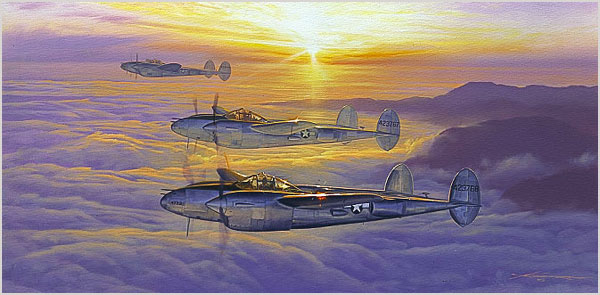
The Lightning designed by Lockheed engineer Clarence "Kelly" Johnson and his team of designers, represented one of the most radical departures from tradition in American fighter development. The Lightning was a complete break-away from conventional airframe design, power, and at long last, armament. Not only did it have twice the power and almost twice the size of its predecessors, but with no less than four .50 cal. machine guns plus a 20 mm cannon, the P-38 had enough firepower to sink a ship--and sometimes did. Concentrated in the central fuselage pod, the guns fired parallel which eliminated a need for a propeller synchronizer.
The Lightning tricycle landing gear and twin-boom configuration completed the list of major deviations from what might he considered conventional Army fighters. In this respect, it was very unusual that the Lightning design progressed beyond the testing stage; such radical concepts seldom achieved production status. But the simple fact was that the P-38 design worked and the Army seemed to have found its dream plane in this 400 mph fighter.
The XP-38, 37-457, was built under tight secrecy and made its maiden flight on January 27, 1939, with Air Corps test pilot and P-38 project officer, Lt. Benjamin S. Kelsey, at the controls. The P-38's performance justified Lockheed's investment of nearly $6,000,000 of its own funds to complete the prototype. The Army was so delighted with the big new fighter, it lifted the wraps of secrecy from the plane for a transcontinental speed dash on February 11, 1939. This event was marred by a crash when Kelsey undershot the runway at Mitchell Field, NY. Kelsey survived the crash and remained an important part of the Lightning program. The airplane was written off, but Lockheed received a contract for thirteen YP-38s along with the usual list of improvements.
The XP-38 had been powered by two liquid cooled, Allison V-1710 engines turning 11 1/2 foot Curtiss Electric, inward turning, counter-rotating propellers. With the YP-38s and all subsequent Lightings, the propellers rotated outward negating torque when both engines were operating (A batch ordered by Britain did not have counter-rotating propellers.) One XP-38A was built with a pressurized cabin. Armament on the YPs was altered by replacement of two of the .50s with .30s, and the 20 mm cannon gave way to a 37 mm. But even before the YP-38s were completed, the original machine gun arrangement was standardized for production types. The first production order was 35 P-38Ds, followed by 210 P-3XEs which reverted back to the 20 mm cannon. These planes began to arrive in October 1941, just before America entered World War II. With the P-38D came self sealing fuel tanks and armor protection for the pilot. The Lightning was ready for war!
A major problem surfaced with the loss of control in a dive caused by aerodynamic compressibility. During late spring 1941, Air Corps Major Signa A. Gilke encountered serious trouble while diving his Lightning at high-speed from an altitude of 30,000 ft (9,120 m). When he reached an indicated airspeed of about 320 mph (515 kph), the airplane's tail began to shake violently and the nose dropped until the dive was almost vertical. Signa recovered and landed safely and the tail buffet problem was soon resolved after Lockheed installed new fillets to improve airflow where the cockpit gondola joined the wing center section. Seventeen months passed before engineers began to determine what caused the Lightning's nose to drop. They tested a scale model P-38 in the Ames Laboratory wind tunnel operated by the NACA (National Advisory Committee for Aeronautics) and found that shock waves formed when airflow over the wing reached transonic speeds and became turbulent. Lockheed never remedied this problem but the firm did install dive recovery flaps under each wing in 1944 to restore lift and smooth the airflow enough to maintain control when diving at high-speed
The fastest of the Lightnings was the P-38J with a top speed of 420 mph, and the version produced in the greatest quantity was the "L", of which 3,735 were built by Lockheed and 113 by Vultee. The P-38L was powered by two 1,475 hp Allison V1710-111 engines. As with any long-term production aircraft, the P-38 underwent many modifications. The P-38J intakes under the engines were enlarged to house core-type intercoolers. The curved windscreen was replaced by a flat panel, and the boom mounted radiators were enlarged. Some were fitted with bombardier type noses, and were used to lead formations of bomb-laden P-38s to their targets. The P-38M was a two-seat radar-equipped night fighter, a few of which had become operational before the war ended. One interesting variation had an elevated tail assembly on upswept booms; another one had an elongated center pod and was used for airfoil evaluation.
The dimensions of the P-38 remained the same throughout production, its wing spanning 52 feet with an area of 328 square feet. overall length was 37 feet 10 inches; height was 12 feet 10 inches. The P-38L weighed 12,800 pounds empty and 17,500 pounds gross. Thus, the P-38 was the largest, heaviest, and fastest "P" type to date. An internal fuel capacity of 410 gallons could be increased to 1,010 gallons with two external drop tanks and gave the Lightning a range of 450 miles, making it the first fighter suitable as a long-range bomber escort. In addition to its devastating nose armament, the P-38 could carry up to 4,000 pounds of external weapons including bombs and rockets.
Specifications:
Primary Function: Pursuit (fighter)
Contractor: Lockheed
Crew: One
Unit Cost: $115,000
Powerplants: Two Allison V-1710-111/113 of 1,475 hp. ea.
Dimensions:
Length: 37 ft 10 in
Wingspan: 52 ft
Height: 12 ft 10 in
Weights: Gross: 15,340 lb / Loaded: 17,500 lb
Performance :
Speed: 414 mph
Ceiling: 40,000 ft
Range: 1,100 miles
Armaments:
Four .50-cal. machine guns and one 20mm cannon.
External bomb load of 4,000 lbs. or ten 5 in. rockets.
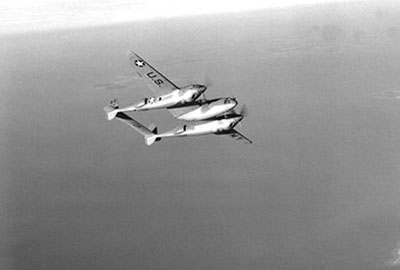


All photos Copyright of Global Aircraft.Org
| .......................Lockheed P-38 Lightning | |
|---|---|
| USA | |
 |
|
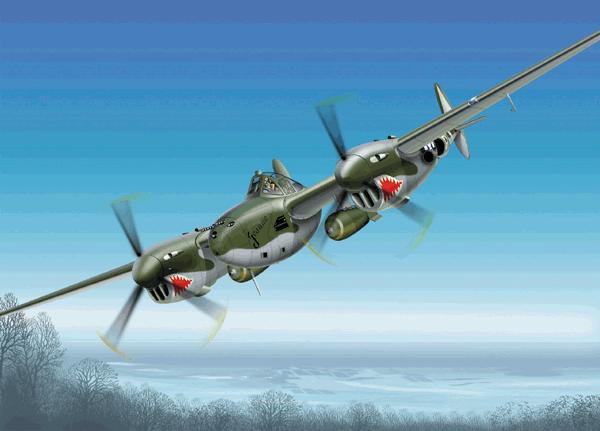
| The P-38 Lightning introduced a new dimension to American fighters - a second engine. The multi-engine configuration reduced the Lightning loss-rate to anti-aircraft gunfire during ground attack missions. Single-engine airplanes equipped with power plants cooled by pressurized liquid, such as the North American P-51 Mustang, were particularly vulnerable. Even a small nick in one coolant line could cause the engine to seize in a matter of minutes. | |
| P-38 Lighting USAAF, 20th FG. | |
 |
|---|
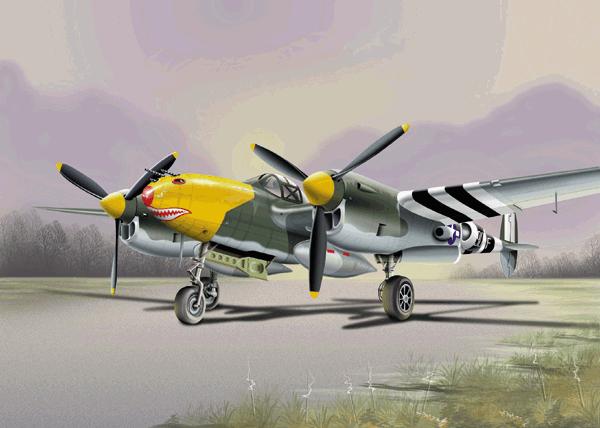
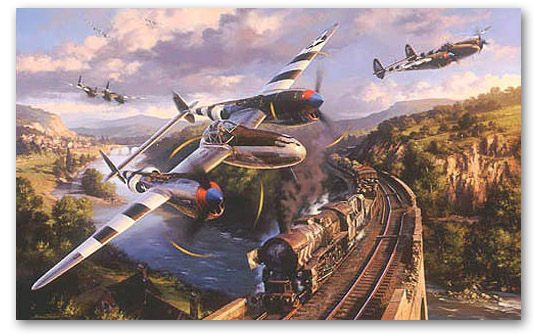
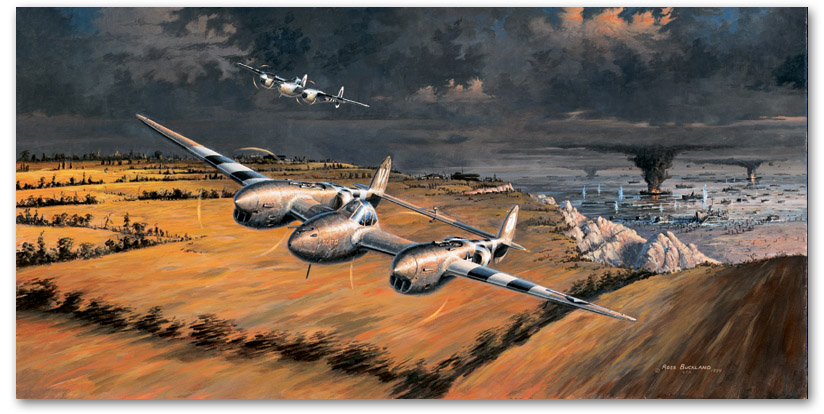
| The 370th Fighter Group formed on 25 May 1943 and activated on 1 Jul 1943. The Ninth AF, equipped with P-47s and then P-38s in Feb., trained until May 1, 1944 when the group entered combat. They dive-bombed radar installations and flak towers, and escorted bombers that attacked bridges and marshalling yards in France as the Allies prepared for the invasion of the Continent. |
| P-38 Lighting USAAF, 485th FS-370th FG. |
 |
|---|
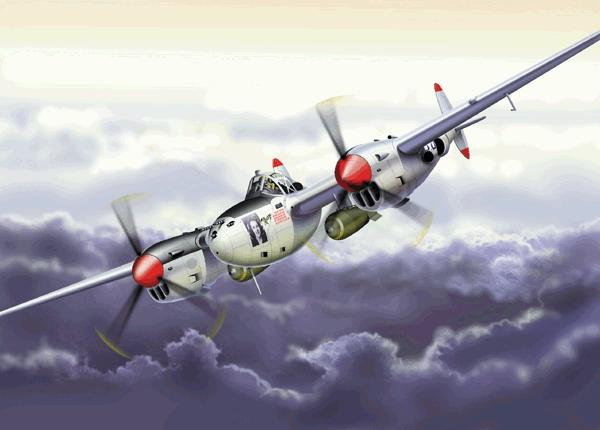
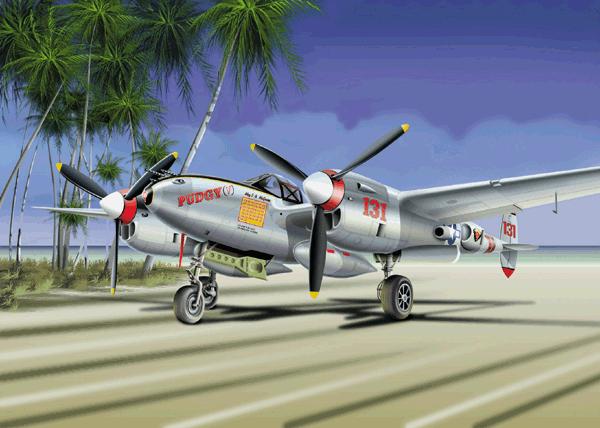
| Richard Bong was America’s all-time leading fighter ace. He held the US record of forty victories in combat. In San Francisco Richard Bong looped-the-loop around the Golden Gate Bridge. He then buzzed Market Street in his Lightning and waved at the stenographers staring in astonishment out of office windows. Though General Kenney had given him a stiff talking to, he knew that Dick Bong had the makings of a first-rate fighter pilot. At the age of 24, Major Richard I. Bong lost his life in the fiery crash of a P-80 jet he was testing for the Air Force On August 6, 1945 (the day the B-29 Enola Gay dropped an atomic bomb on Hiroshima.) |
| P-38 Lighting USAAF, 5th AF, 9th FS-49th FG. Richard Bong. |
 |
|---|
| Major McGuire scored 38 aerial victories in a P-38, making him our nation's second highest scoring ace. Among his many decorations was the Medal of Honor awarded for his actions on December 25-26, 1944 when he shot down seven enemy aircraft. On January 7, 1945, he crashed to his death on Los Negros Island in the Philippines while risking an extremely hazardous maneuver at low altitude in an attempt to save the life of a comrade. McGuire Air Force Base in New Jersey is named in his honor. |
| P-38 Lighting USAAF, 5th AF, 431 FS-457 FG, Maj. Thomas B. McGuire. |
After a Sunday service he turned back to the pulpit and informed his student audience: "In the sermon I have just preached, whenever I said Aristotle, I meant St. Paul."
But Spooner was no featherbrain. In fact his mind was so nimble his tongue couldn't keep up. The Greeks had a word for this type of impediment long before Spooner was born: metathesis. It means the act of switching things around.
Reverend Spooner's tendency to get words and sounds crossed up could happen at any time, but especially when he was agitated. He reprimanded one student for "fighting a liar in the quadrangle" and another who "hissed my mystery lecture." To the latter he added in disgust, "You have tasted two worms."
Patriotic fervour excited Spooner as well. He raised his toast to Her Highness Victoria: "Three cheers for our queer old dean!" During WW1 he reassured his students, "When our boys come home from France, we will have the hags flung out." And he lionised Britian's farmers as "noble
tons of soil."His goofs at chapel were legendary. "Our Lord is a shoving leopard," he once intoned. He quoted 1 Corinthians 13:12 as, "For now we see through a dark, glassly..." Officiating at a wedding, he prompted a hesitant bridegroom, "Son, it is now kisstomary to cuss the bride." And to a stranger seated in the wrong place: "I believe you're occupewing my pie. May I sew you to another sheet?"
More about the Good Reverand and Spoonerisms
Thanks for always posting your On This Day in History thread, Valin.
Shouldn't that have been:
Who is Alex Trebek Sudbury of Ontario.
Salerno is a classic example of what you can accomplish in war while fighting on a shoestring. Clark's army was understrength for its job but still fulfilled its objectives. In fact, and perhaps SAM will agree with me, most of the Italian campaign was characterized by not enough Allied troops making hard-fought gains against German forces in ideal defensive terrain.
The only way to outflank the Germans was by amphibious landing (i.e. Anzio), at a time when Normandy had priority on both troops and landing craft. For Clark's forces to accomplish what they did was quite an achievement.
You are so clever! LOL!
Disclaimer: Opinions posted on Free Republic are those of the individual posters and do not necessarily represent the opinion of Free Republic or its management. All materials posted herein are protected by copyright law and the exemption for fair use of copyrighted works.


