|
 are acknowledged, affirmed and commemorated.
|
Posted on 03/04/2003 5:34:02 AM PST by SAMWolf
|
are acknowledged, affirmed and commemorated.
|

| Our Mission: The FReeper Foxhole is dedicated to Veterans of our Nation's military forces and to others who are affected in their relationships with Veterans. We hope to provide an ongoing source of information about issues and problems that are specific to Veterans and resources that are available to Veterans and their families. In the FReeper Foxhole, Veterans or their family members should feel free to address their specific circumstances or whatever issues concern them in an atmosphere of peace, understanding, brotherhood and support.  To list previous Foxhole Threads or to add The Foxhole to your sidebar Click on the Logo
|
|
|
|
Landbased airplanes sank every ship in the Japanese convoy. No supplies or reinforcements got through to New Guinea.  Few Americans had ever heard of it or knew where it was. However, it was to be the scene of a major victory for landbased aircraft over warships--one that would have made Billy Mitchell, the old champion of airpower, very proud. The three-day battle had its origins in the US plan to take the initiative from Japan and push the network of Allied air bases away from Australia toward Japanese-dominated areas--Gen. Douglas MacArthur's "island-hopping" strategy. First, however, the Allies had to deal with Japanese forces on New Guinea. From March 1942 to January 1943, the Japanese had been able to send convoys from Rabaul, on New Britain, across the Bismarck Sea to New Guinea with few losses. No Allied naval presence existed, and Allied airpower was to weak to halt Japan's warships. Allied forces operated from Port Moresby on the south side of the giant island to prevent Japanese forces from moving closer to Australia.  Lt General George C. Kenney In late February 1943, when Japanese ships attempted to reinforce and resupply their New Guinea garrisons, they had to be attacked and stopped if the Allies were to have a chance to carry out MacArthur's bypass strategy. Buna, across the Owen Stanley Range, about 100 miles northeast of Port Moresby, was a worrisome enemy base and had to be neutralized first. In the June 1944 issue of Air Force, Lt. Gen. George C. McKenney, commanding general of Allied Air Forces in the southwest Pacific, explained what happened there. "Our fighters began to patrol over Buna. If [a Japanese pilot] came up, we shot him down. If he did not come up, we strafed him on the ground. In between times, heavies, mediums, and light bombers dug holes in his runways, battered down his revetments, burned up his stores, and strafed his personnel. The [Japanese] kept filling up the bomb craters, and we kept making new ones. He replaced his airplanes, and we promptly shot them out of the air or burned them on the ground. Before long, he tired of the game and didn't bother to fill in the holes on the runway. It had cost him around seventy-five planes, and he decided that it was too expensive." However, the Japanese wanted the base back in operation and staged their main forces from Rabaul on the Bismarck Sea coast off New Britain, 500 air miles from Port Moresby. Enemy convoys from there had tried to relieve Buna, but it finally fell to Allied ground forces in January 1943. It cost the enemy about 300,000 tons of shipping sunk or damaged and scores of planes destroyed by Fifth Air Force bombers and fighters.  While ground forces continued to clean up enemy stragglers, General Kenney's air units began to carry out almost daily attacks on enemy concentrations farther up the New Guinea coast. There were three chief targets:
Japan's bases and shipping throughout the nearby Bismarck Archipelago were also attacked in order to isolate that area. On February 25, Allied radio intercepts revealed that a large enemy convoy, traveling to Lae, was scheduled to arrive in the Bismarck Sea early in March. The exact size and composition of the convoy were unknown, but the Allies were confident that they would be carrying both troops and supplies to support an expected push to retake the areas of New Guinea that had been lost. What was to be called the Battle of the Bismarck Sea began with the sighting of the expected Japanese convoy off the north coast of New Britain on March 1.  General Kenney knew the battle would show what land based airpower could do against naval forces. He had arrived in the southwest Pacific in July 1942 as commanding general of Allied Air Forces under General MacArthur. While he was en route to the Pacific to his assignment as MacArthur's chief air officer, he and his aide, Maj. William Benn, commander of the 63d Bomb Squadron, discussed low-altitude bombing of ships. Kenney recalled: "It looked as though there might be something in dropping a bomb with a five-second-delay fuze from level flight at an altitude of about fifty feet and a few hundred feet away from a vessel, with the idea of having the bomb skip along the water until it bumped into the side of the ship. In the few seconds remaining, the bomb should sink just about far enough so that when it went off it would blow the bottom out of the ship. In the meantime, the airplane would have hurdled the enemy vessel and would get far enough away so that it would not be vulnerable to the explosion." When Kenney arrived in Australia, he found that his flying assets were about 200 fighters--mostly P-39s and P-40s--along with an assortment of A-20s, B-25s, B-26s, B-17s, and C-47s; a high percentage were out of commission for maintenance and parts. His air force units grew during the next few months as he reorganized them and put men in charge who knew how to innovate, improvise, and make do with the supplies available. 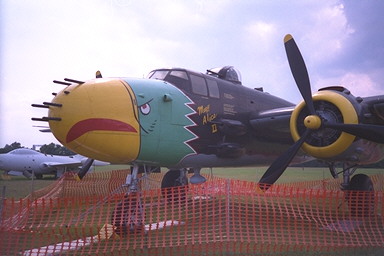 In the air, they began to show what could be achieved with a mix of bombardment and fighter aircraft.. With the number of Japanese ships of all types plying their resupply routes, there would be plenty of opportunities to experiment with low-altitude bombing tactics against them. Major Benn is credited by General Kenney with developing skip bombing into a fine art. He experimented with different bomb sizes, timed fuses, and approaches to targets. He led one skip-bombing raid with a half-dozen B-17s at low altitude and sent six enemy ships to the bottom. According to Kenney, "Skip bombing became the standard, sure way of destroying shipping, not only in Bill's bombardment squadron but throughout the Fifth Air Force."  Maj. Paul I. "Pappy" Gunn Meanwhile, General Kenney called on Maj. Paul I. "Pappy" Gunn, a pilot whose unorthodox solutions to maintenance problems became legendary. Gunn developed a package of four .50-caliber machine guns for the nose of A-20 light bombers. This impressed Kenney. He directed Gunn to "pull the bombardier and everything else out of the nose of a B-25 medium bomber and fill it full of .50-caliber guns, with 500 rounds of ammunition per gun." Kenney said, "I told him I wanted him then to strap some more on the sides of the fuselage to give all the forward firepower possible. I suggested four guns in the nose, two on each side of the fuselage, and three underneath. If, when he had made the installation, the airplane still flew and the guns would shoot, I figured I'd have a skip bomber that could overwhelm the deck defenses of a [Japanese] vessel as the plane came in for the kill with its bombs. With a commerce destroyer as effective as I believed this would be, I'd be able to maintain an air blockade. . . anywhere within the radius of action of the airplane."
|
Does that come in a German Model? They need one too! LOL
We have to many politico's who don't remember the reason that they have been able to become what they are. It's a real shame, but it's true.
Way to go, that had to be just awsome.

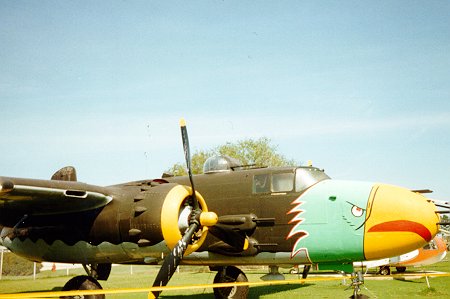
B-25's figured in the Bay of Pigs invasion attempt.
Up to twelve were used, having six .50 cal. machine guns in their noses according to E. Howard Hunt, Give Us This Day, 1973.
Their raids on Cuba had successfully eliminated all Castro's air force but three T-33's armed with .50 cal. machine guns. Permission was sought for one final raid to strafe these on the ground.
Permission was denied. Hunt indicates JFK was not contacted, that Bundy would not relay the request.
Gen. Maxwell Taylor in Operation Zapata indicates only one air strike was withheld, the second air strike requested by the CIA to destroy three remaining Cuban fighter planes that had not been taken out in a first planned air strike that had been designed so it would not appear to be conducted by U.S. forces. Upon the urgings of the State Department, Kennedy (and McNamara) refuse to approve the second strike because it would have revealed U.S. involvement. It was McGeorge Bundy who relayed this refusal to the military and the CIA. Noel Twyman, Bloody Treason, Laurel, 1997, pp 505-506.
Consequently JFK took responsibility for the failure by stepping down in Dallas.
As a result China has two sigint bases on Cuba. One of these recently spoofed NYC air traffic control into thinking it was U.S. military.
Regarding the Cuba-China axis:
There are three main areas of concern for us in the new and dangerous axis formed by China and Cuba: radio frequency weapons, computer technology, missile capabilities. The problem with the Chinese Cuban rapprochment is that it is driven by by mutual hostility towards the United States.
Radio frequency weapons are a new radical class of weapons. Radio frequency weapons can utilize either high energy radio frequency (HERF), or low energy radio frequency(LERF) technology. HERF is advanced technology. It is based on concentrating large amounts of RF EM energy in within a small space, narrow frequency range, and a very short period of time. The result is an overpowering RF EM impulse capable of causing substantial damage to electronic components.
LERF utilizes relatively low energy, which is spread over a wide frequency spectrum. It can be no less effective in disrupting normal functioning of computers as HERF due to the wider range of frequencies it occupies. LERF does not require time compression neither high tech components. LERF impact on computers and computer networks could be devastating.

That's what I am doing tonight, hehehe.


http://www.military.com/NewContent?file=Galloway_030303&ESRC=army.nl
How are you doing?
Disclaimer: Opinions posted on Free Republic are those of the individual posters and do not necessarily represent the opinion of Free Republic or its management. All materials posted herein are protected by copyright law and the exemption for fair use of copyrighted works.
