|
Posted on 07/06/2004 12:00:27 AM PDT by SAMWolf
|
|
 are acknowledged, affirmed and commemorated.
|

| Our Mission: The FReeper Foxhole is dedicated to Veterans of our Nation's military forces and to others who are affected in their relationships with Veterans. In the FReeper Foxhole, Veterans or their family members should feel free to address their specific circumstances or whatever issues concern them in an atmosphere of peace, understanding, brotherhood and support. The FReeper Foxhole hopes to share with it's readers an open forum where we can learn about and discuss military history, military news and other topics of concern or interest to our readers be they Veteran's, Current Duty or anyone interested in what we have to offer. If the Foxhole makes someone appreciate, even a little, what others have sacrificed for us, then it has accomplished one of it's missions. We hope the Foxhole in some small way helps us to remember and honor those who came before us.
|
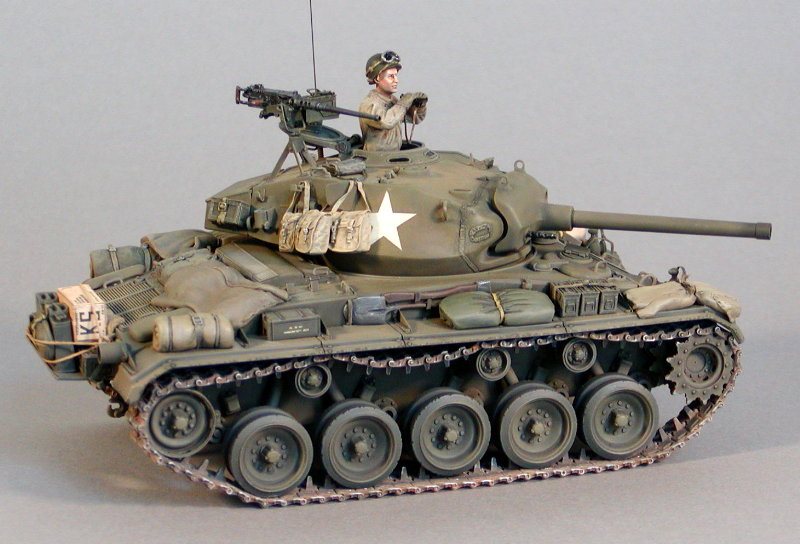
 The M24 arrived in WWII Europe in late 1944 just in time for the German's last great offensive, the Battle of the Bulge. But the Chaffee would not see its finest hour for another 6 years, and then it would be in East Asia. During the Korean conflict the Chaffee was one of the first and only US tanks available from US forces in Japan to face the North Korean T-34/85s in their initial armored attacks toward Seoul in the summer of '50. The little M24 tank was outgunned and not equal to the task, but it was quick and nimble and the crews did what they could to slow the North Korean advance South. The ensuing battles proved again that the M24 was of excellent design, and when used within the constraints of its light armor, it was an able and powerful light armored vehicle. During the long US retreat down the Korean peninsula, the M24 fought a number of delaying actions, often as dug-in artillery, and allowed many of the beleaguered ground forces to withdraw to Pusan. During the first week of August, the few remaining Chaffee tanks were finally joined by much needed heavier reinforcements, in the shape of M4A3E8 Sherman and M26 Pershing tanks. From that point on many of the M24s were gradually withdrawn and some later rebuilt in Japan for use by the fledgling Japan Defense Force.  The M24 was named for Adna R. Chaffee after his death during WWII, as Chaffee was well known as one of the founders and designers of US armored forces. Originally, the vehicle was planned as the replacement for the famous M3/5 Stuart line of light US tanks which the US Armor Board decided were obsolete by 1943. In reality, the M3 line of little tanks had been truely ancient designs before the US entered the war. The Board determined the major shortcomings of the M5 series to be a small main gun, limited turret size, poor vehicle floatation, lack of engine power, and inadequate engine cooling. The first replacement vehicle design (T7) was begun in 1943 at Cadillac Motor Car Division of General Motors Corporation, the producers of the M5A1. After this new vehicle's failure and subsequent elimination from consideration, a new Cadillac design did progress, and soon proved far superior, with prototype tests of the T24 occurring in October of 1943. The test results were so promising that a limited procurement of 1000 vehicles was immediately authorized, later raised to 5000 after the adoption of the M24 name.  This US Army section drawing illustrates the basic layout of the interior of the M24. At first glance, there is little obvious difference from previous US light tanks in the basic design. The standard US crew layout includes two forward drivers (the right one equipped with a hull MG), a turret crew of three in the center of the hull, and a powerpack set tightly in the hull rear. But now notice that there is no turret basket in the M24 and the transmission, actually two transmissions, are sitting in the rear with the engines, not up front between the drivers. Another interesting design concept was an initial decision to provide only a four man crew in the tank, with the co-driver moving back into the turret as loader when the vehicle entered combat. Eventually, this idea was dropped and five men, in their traditional positions, manned the Chaffee for most of its service life.  Most of the 48 fixed rounds of 75mm main gun ammo were housed in storage bins between the armored hull floor and the fighting compartment subfloor, in an attempt to decrease the possibility of their cooking off if there was a small internal fire. This was an important lesson learned from both the US light and medium tanks previously in service, as only a small fire would often prove catastrophic if ammo was stored in open bins high in the hull or in the turret. The floor bins (four on the left of the hull and three on the right) were surrounded by water jackets that would at least retard heat and fire entering them. Each bin held 6 rounds, on three shelves, each shelf holding two 75mm rounds side by side. The shelves were simply made of stout bent wire that would lift and turn out of the way when the rounds were used and access to lower level shelves was needed.  Because the Chaffee still maintained the front sprocket drive, the drive shaft from the rear engines/transmissions passed forward along the floor to the bow along the hull's centerline. Both drivers had full controls at their positions, allowing them to replace the other for driving duty, therefore joining both the M5 Light Tank and the M18 Hellcat Tank Destroyer with this dual driving control option. On the other hand, driving a Chaffee was far easier than an M3/M5, as it required less brute strength to push/pull the steering levers and the transmission was automatic, not a clutch shift as in the earliest Stuarts.  Another detail was the inclusion of a belly escape hatch, located just behind the co-driver's seat. The turret ring diameter of 60in is nearly one third wider than the earlier M5/M5A1 light tank's 46.75in, allowing greater space in the turret for weapons and positions for three crewmen.  The co-driver's hull mounted .30cal M1919 Browning machine gun was installed in a simple flexible mount at the right front of the hull. Secured in a simple armored rotating ball, the gunner was not provided with any sight to aim the gun, but used his over-head hatch periscope to follow the tracer lines of his .30cal ball ammo. In command configured vehicles the assistant driver was also a second radio operator, with the SCR 506 radio mounted directly in front of him, next to the .30cal. The main vehicle radios were mounted back in the turret bustle. Over 3700 rounds of .30cal ammo were stored in the vehicle, used in both this weapon and the coaxial .30cal in the turret. One ammo box was stored up by the hull gun, one just behind the seat to its left, and most of the rest is found down in the floor, just in front of the rear engine bulkhead. The normal M1 ammo cans held around 250 .30cal rounds, depending on who packed the can. Both the .30cal and .50cal Browning machine guns could be configured to load from either side of the receiver, but most units used left loading only.  The green floor of the fighting compartment consisted of a number of hinged door panels, except for the section directly behind the co-driver, which was free for access to the belly escape hatch. The floor plates over the ammo bins are covered with a herringbone non-slip surface. Individual access plates were provided for the ammo bins below, and the handles to open the panels were made simply of bent metal rods, rotating in sleeves welded to the plates, and laying flat on the panels when not in use. The escape hatch was released by pulling up on the long lever handle, which then released the heavy plate to drop down.  The armor throughout the M24 was welded homogeneous plate. The plates on the hull front are one inch thick, angled to provide protection equal to 2.5 inches of armor. The angle of the hull front plates was also an advance over the earlier light tanks. The advances in US armor vehicle design and technology during this period of time is remarkable. Consider that during the five years between 1939 and 1944, US military ground forces quickly transitioned from the initial M3 Stuart to the M24 Chaffee. The development difference is just as about as pronounced as the evolution in US medium tank design, from the M3 Grant (or even the M4 Sherman) to the M26 Pershing. War places great demands on military design personnel and is the primary driving force in AFV design evolution. Unfortunately for the American forces in WWII, they started the war with tanks designed in the late 1920s, and in the case of the medium tank, a number of people in high places put the M26 project on slow simmer for most of the war.  During WWII a few Chaffees were provided through Lend-Lease arrangements to England and the USSR. But, after the war, many countries rebuilt their light armored units with M24s from US stocks, particularly since over 4,400 of the vehicles had been built and the bulk of them were now surplus. One of the countries that received surplus M24s was France- perhaps as many as 1200 vehicles were provided by the US as military aid. A number of these found action in Vietnam until the French withdrew in 1955. The French vehicles illustrate here show typical stowage on the hulls and turrets during this time, with both the TC and loader standing in their hatches and the bustle mounted .50cal MG in clear view. Other countries that received the M24 Chaffee included Austria, Belgium (130), Cambodia, Ethiopia, Greece (170), Iran (180), Iraq, Italy, Japan, Laos, Netherlands, Norway, Pakistan (282), Portugal, Saudi Arabia, Spain (180), Taiwan (292), Thailand, Turkey (114), Uruguay, and South Vietnam. Some of these countries continue to field the vehicles, updated and improved. The Chaffee was indeed a fierce fighter and was probably the best light tank design to come out of WWII.
|
Afternoon Light Speed. The only good thing about the movie "Battle of the Bulge" was getting to see the Chaffee's running around.
You bet!
Wasn't that awful. They refused to call it a war for so long.
I suppose it's to late to warn you. It sounds like you are smitten, and she's got you wrapped around her little finger.
Yep, a "police action" is never the answer. :)

Have been re-painting a RC M1A1..useing the photo above as template for color and add ons.
Desert Sand color is a bit too yellow...other tans still too brown/yellow.
A fellow at a Hobby shop showed me an Ivory color to use as base..then "Dirty it up darker".
It worked well.
Working on the tow cables and bags for the basket.
The RC kit can be found thru *Hobbyzone..
The unit has a sound chip...turret makes a neat wirring sound when moving..it also moves slow.
Gun Tube recoils when fired...also..a machine gun sound on a seperate button.
Hobbyzone has a green/black Abrams....looks good as is.
Jason Patric is a great actor..one of his best accomplishments was playing LT Charles B Gatewood in the Movie..*Geronimo..which also features Wes Studi,Robert Duvall and Gene Hackman.
Charles Gatewood is buried in Arlington National Cemetery,
went googling on him...He has an amazing Military record with the 6th Cavalry during the Apache wars and other Indian wars in the west.
Would make for an interesting Foxhole thread.

Robert Duvall .... Al Sieber
"You get into a fight with the Apache.....you save the last bullet for yourself"
I love Wes Studi ... also Fred Ward.
Thanks for the suggestion on Charles Gatewood.
Although it seems the Count of Monte Cristo took twenty years to do this model, he says, "two weekends."
Earl Scheib: Any tank, any color--as long as it's o.d.:

Our 1945 Chaffee Right out of the Paint Shop.

How the Chaffee Looked When it Arrived at our Museum.

The plaque reads:
This M24 Chaffee Light Tank is placed here to enforce the No-Smoking symbol on the steel post at your left.I'm John Kerry, and I voted against this weapons system as it is still too dangerous for use without United Nations supervision.

A nice quartet of close-up photos on this page: M24 Chaffee BE pictures by Federico Collada ~ Brussels War Museum
Mick's Trigger Happy restoration

Exceptionally detailed photos--que bella--scroll down.
Just in:
John Kerry Bakery Specialties announces cream-filled leftists in the popular two-pack:

HAPPY BIRTHDAY AND NOW
BLOW OUT THEIR CANDLES,
PRESIDENT BUSH
Happy treadhead Tuesday. Interesting read about the benifits of a lightweight tank. Hey, I gotta question . . . (ugh oh)
INCOMING!
I did quick Foxhole search on the Bradley Fighting Vehicle and couldn't find anything. How does the BFV fit in (purpose/function) with the M1A1/M1A2 and M60A3 Abrams Main Battle Tank? And did the M24 lead to the BFV type armoured fighting vehicles?
BTW, apologies if an article was done on the BFV and my search missed it.

Agree with you there, really nice profile on an Abrams!


Fred Ward is good. Loved him in "Tremors". :-)
This M24 Chaffee Light Tank is placed here to enforce the No-Smoking symbol on the steel post at your left.
I'm John Kerry, and I voted against this weapons system as it is still too dangerous for use without United Nations supervision.
LOL! What the heck color is that Chaffee? Sure doesn't look like OD Green.
Hi, I'm John and this is my other candidate, John.
Evening w_over_w. We haven't covered the Bradley yet, it's on my "to-do" list I do have the Soviet BMP's coming up soon. IIRC, the Bradley idea came from the development of the BMPs. They allowed infantry to accompany the tanks, while provided some firepower and armored protection.
Evening Victoria. Looks good in that flight suit.
Disclaimer: Opinions posted on Free Republic are those of the individual posters and do not necessarily represent the opinion of Free Republic or its management. All materials posted herein are protected by copyright law and the exemption for fair use of copyrighted works.


