|
Posted on 06/24/2004 12:00:41 AM PDT by SAMWolf
|
|
 are acknowledged, affirmed and commemorated.
|

| Our Mission: The FReeper Foxhole is dedicated to Veterans of our Nation's military forces and to others who are affected in their relationships with Veterans. In the FReeper Foxhole, Veterans or their family members should feel free to address their specific circumstances or whatever issues concern them in an atmosphere of peace, understanding, brotherhood and support. The FReeper Foxhole hopes to share with it's readers an open forum where we can learn about and discuss military history, military news and other topics of concern or interest to our readers be they Veteran's, Current Duty or anyone interested in what we have to offer. If the Foxhole makes someone appreciate, even a little, what others have sacrificed for us, then it has accomplished one of it's missions. We hope the Foxhole in some small way helps us to remember and honor those who came before us.
|
|
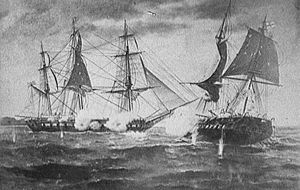
On June 23rd 1812 at 6:00 a.m. the British frigate "Belvidera" moves close to check out what she believes to be an American squadron. The crew had been informed by a merchant ship that war may have been declared. One half hour later the British crew sees three large American frigates and tries to steer the "Belvidera" away.  USS President Commodore Rodgers is commanding the U.S. squadron. The "President" and the "Congress" both make sail and go after the "Belvidera". The "President" is much faster and closes with the British frigate first, while the "Congress" follows. The British commander, Captain Byron orders the "Belvidera" ready for battle. Commodore Rodgers fires the bow gun of the "President" himself. The "President" fires again from their main-deck guns. Three shot have all found their mark killing or wounding nine men. This battle would have most likely ended with the next few shots fired except that the "Presidents" main-deck gun blew up when it fired for the second time, killing or wounding sixteen men. Commodore Rodgers himself was injured with a broken leg. The "Belvidera" opened fire with her stern guns killing or wounding six men. The "President" responded with a port broadside that did minor damage to the British frigate's rigging. The "Belvidera" continued to fire. The "President" moved close and fired her bow-chasers damaging the main top mast and cross-jack yard of the British ship. The "President" fell back a short distance and fired another broadside, this did little damage. Again the Americans closed and fired the bow-chasers, these shots did much more damage than the broadsides.  Escape of H.M.S. Belvidera from the U.S. Frigate President Thomas Buttersworth The crew of the British frigate worked hard and repaired the damage quickly. But the damage to the sails gave the "Congress" the time it needed to catch up. The "Congress" opened fire, these shots splashed harmlessly into the ocean. The "Belvidera" changed coarse and escaped. Three days later reaching Halifax Harbour.  It must be pointed out that had the American gun not burst on the "President" this battle surely would have been over quickly. It also should be pointed out that the repairs made by the British crew while under fire enabled them to make their escape. On August 2nd 1812 the "Constitution" set sail departing from Boston and sailed east in hopes of finding some British ships. After meeting no British ships, the "Constitution" sailed along the coast of Nova Scotia, and then New Foundland, finally stationing off Cape Race in the Gulf of the St. Lawrence. It was here that the Americans captured and burned two brigs of little value. On August 15th the "Constitution" recaptured an American brig from the British ship-sloop "Avenger", however the British ship managed to escape. Captain Issac Hull put a crew on the brig and they sailed it back to an American port.  Action between USS Constitution and HMS Guerriere, 19 August 1812: "In Action" Oil on canvas, 32" x 48", by Michel Felice Corne (1752-1845), depicting the two frigates firing on each other, as Guerriere's mizzen mast goes over the side. At 2:00 p.m. on August 19th the crew of the "Constitution" made out a large sail which proved to be the British frigate "Guerriere" captained by James Dacres. At 4:30 p.m. the two ships began to position themselves and hoisted their flags (colours). At 5:00 p.m. the "Guerriere" opened fire with her weather guns, the shots splashed in the water short of the American ship. The British then fired her port broadsides, two of these shots hit the American ship, the rest went over and through her rigging. As the British prepared to fire again the "Constitution" fired her port guns. The two ships were a fair distance apart, and for the next 60 minutes or so they continued like this with very little damage being done to either party.  Action between USS Constitution and HMS Guerriere, 19 August 1812: "Dropping Astern" Oil on canvas, 32" x 48", by Michel Felice Corne (1752-1845), depicting the Guerriere's main and fore masts collapsing from the effects of Constitution's fire. At 6:00 p.m. they moved closer, at 6:05 p.m. the two ships were within pistol-shot of each other. A furious cannonade began, at 6:20 p.m. the "Constitution" shot away the "Guerriere's" mizzen-mast, the British ship was damaged. The "Constitution" came around the "Guerriere's" bow and delivered a heavy raking fire which shot away the British frigate's main yard. The Americans came around yet again and raked the "Guerriere". The mizzen-mast of the British ship was now dragging in the water and the two ships came in close to each other. The British bow guns did some damage to the captain's cabin of the "Constitution", a fire even started there. An American officer by the name of Lieutenant Hoffmann put the fire out.  Action between USS Constitution and HMS Guerriere, 19 August 1812 Painting by Anton Otto Fischer, depicting Guerriere's masts going over the side as Constitution rakes her from ahead. It was about here that both crews tried to board the others ship, or at least thought about it. And it was also here where most of the "Constitution's" casualties were taken. In fact both sides suffered greatly from musketry at this point. On the "Guerriere" the loss was much greater. Captain James Dacres was shot in the back while cheering on his crew to fight. The ships finally worked themselves free of each other, and then the "Guerriere's" foremast and main-mast came crashing down leaving the British ship defenseless.  USS Constitution At 6:30 p.m. the "Constitution" ran off a little and made repairs which only took minutes to complete. Captain Isaac Hull stood and watched at 7:00 p.m. as the battered British ship surrendered, unable to continue the fight.  Action between USS Constitution and HMS Guerriere, 19 August 1812 Oil on canvas, 46" x 64", attributed to Thomas Birch (1779-1851). It depicts Constitution standing off the dismasted British frigate's bow, as the latter strikes her flag in surrender. The "Constitution" had a crew of 456 and carried 44 guns. The Guerriere had a crew of 272 men and carried 38 guns. The American casualties were 14, which included Lieutenant William S. Bush, of the marines, and six seamen killed. And her first lieutenant, Charles Morris, Master, John C. Alwyn, four seamen, and one marine wounded. Total seven killed and seven wounded. Almost all the American casualties came from the enemy musketry when the two ships came together. The British lost 23 killed and mortally wounded, including her second lieutenant, Henry Ready, and 56 wounded severely and slightly, including Captain Dacres for a total of 79. The rest of the British crew became prisoners.
|

:-)
Great news. Please come to Oregon sometime!
Snippy, I'd love to visit Oregon once again. Haven't been over that way since 96 on a Honeymoon drive down highway 1. You can be sure I'd look you folks up.
Lee
Nice looking Hobbit Lass and aircraft you have there. Is the plane/engine 40 sized?
I wish I could.
Good place for a SnippySpankenTruppen recruitment drive, eh?
Nice painting.
Oh boy wouldn't I love to!
West Point is on my list of threads we need to cover.
;-)
Hi Ya ! Just home from working another long day..


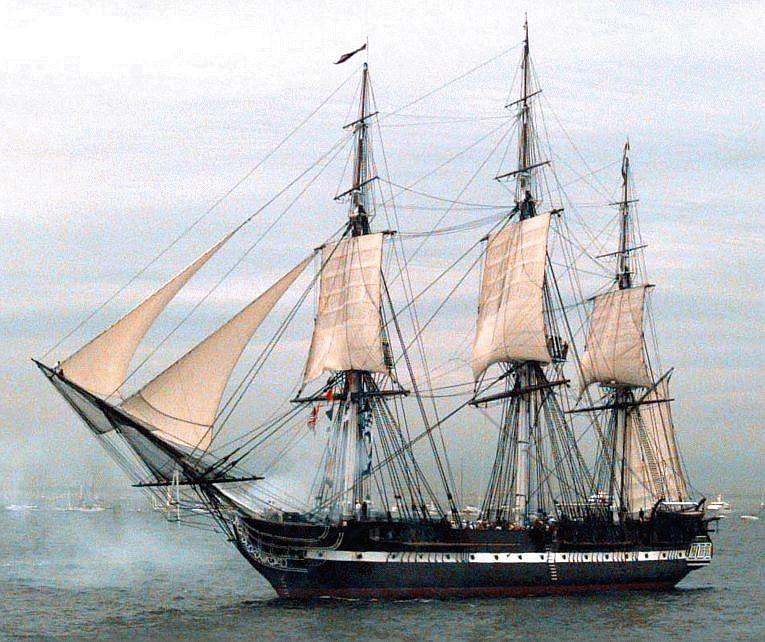
In March 1794 Congress passed a naval act that called for the construction of a half-dozen frigates -- the 44-gun frigates Constitution, United States, and President and the 36-gun frigates Congress, Constellation, and Chesapeake. The Constellation, launched in 1797, was the first of the US Navy's original six frigates to go to sea, in June 1798. Joshua Humphreys designed these frigates to be the Navy's capital ships, larger and more heavily armed than the standard run of frigate. Humphreys had two criteria to satisfy, to out gun the next rate ship and to out-sail adversaries. Humphreys understood that optimization of the two criteria became mutually exclusive when building a hull. Combining the weight of the guns and the buoyancy curve of a fast sailing hull results in a force that distorts the hull. The distortion known as "hog" is the bending along the length of the keel. With minimal buoyancy, the ends of the ship tend to drop down under the weight loads of the guns, while the center midbody, being more buoyant, rises upward.
Humphreys recognized the need to stiffen the hull to resist the forces causing hogging. The successful integration of the two design criteria demanded an innovated technical solution to the problems of strength of materials and hull design. Built in Boston of resilient live oak, Paul Revere forged the copper spikes and bolts that held the planks in place and the copper sheathing that protected the hull. Thus armed, she first put to sea in July 1798 and saw her first service patrolling the southeast coast of the United States during the Quasi-War with France. In 1803 she was designated flagship for the Mediterranean squadron under Captain Edward Preble and went to serve against the Barbary States of North Africa.
By early 1812, relations with Great Britain had deteriorated and the Navy began preparing for war, which was declared June 20. Cruising off the Gulf of St. Lawrence on 19 August under the command ofCaptain Isaac Hull, Constitution encountered the Guerriere, , a fast British frigate mounting 49 guns. Twenty minutes later Guerriere was a dismasted hulk, so badly damaged that she was not worth towing to port. Hull had used his heavier broadsides and his ship’s superior sailing ability, while the British, to their astonishment, saw that their shot seemed to rebound harmlessly off Constitution’s hull — giving her the nickname 'Old Ironsides'. It was a dramatic victory for America and for Constitution. In this battle of only half an hour the United States "rose to the rank of a first-class power"; the country was fired with fresh confidence and courage; and union among the States was greatly strengthened.
An examination in 1830 found her unfit for sea, but the American public expressed great indignation at the recommendation that she be scrapped, especially after publication of Oliver Wendell Holmes’ poem 'Old Ironsides'. Decommissioned in 1882, she was used as a receiving ship at Portsmouth, N.H. She returned to Boston to celebrate her centennial in 1897.
In 1905, public sentiment saved her once more from scrapping. In 1925 she was restored, through the donations of school children and patriotic groups, and recommissioned in 1931. In 1941, she was placed in permanent commission, and an act of Congress in 1954 made the Secretary of the Navy responsible for her upkeep.
Now the oldest US warship still in commission, Constitution remains a powerful reminder of the nation’s earliest steps into dominance of the sea.


USS United States (1797-1861), later CSS United StatesUSS United States (1797-1861), later CSS United States USS United States, a 1576-ton sailing frigate, was built at Philadelphia, Pennsylvania, as one of the first warships of the new United States Navy. Commissioned in July 1797, she cruised vigorously during the 1798-1800 Quasi-War with France, taking several prizes. United States was again active in the 1812-13, this time against the British, and captured the Royal Navy frigate Macedonian on 25 October 1812. Following the War of 1812, United States was employed in the western Atlantic, the Mediterranean, the eastern Pacific and off Africa. She was laid up at the Norfolk Navy Yard in 1849 and was captured by the Confederates when they seized that facility in April 1861. Placed in Southern service as CSS United States, she was used as a receiving ship but was sunk when the Confederates abandoned Norfolk in May 1862. Though subsequently salvaged by the U.S. Navy, she was not worth repairing and was broken up following the Civil War. USS United States, a 1576-ton sailing frigate, was built at Philadelphia, Pennsylvania, as one of the first warships of the new United States Navy. Commissioned in July 1797, she cruised vigorously during the 1798-1800 Quasi-War with France, taking several prizes. United States was again active in the 1812-13, this time against the British, and captured the Royal Navy frigate Macedonian on 25 October 1812.
Following the War of 1812, United States was employed in the western Atlantic, the Mediterranean, the eastern Pacific and off Africa. She was laid up at the Norfolk Navy Yard in 1849 and was captured by the Confederates when they seized that facility in April 1861. Placed in Southern service as CSS United States, she was used as a receiving ship but was sunk when the Confederates abandoned Norfolk in May 1862. Though subsequently salvaged by the U.S. Navy, she was not worth repairing and was broken up following the Civil War.

I called in a witness (the brains of the operation) to be sure it wasn't an MK-ULTRA trick. Remember, you did not get this link from me--look at this pen--FLASH
Michael Moore received a standing ovation from the cheese-eating degenerate America-haters at Cannes.

She ought to enjoy these from my own hanger.
A 1/12 scale Messerschmidt 109 for R/C combat.


Samwolf, notice the aircraft drawing on the wall.

Cockpit detail with Head-Up-Display.

Aye Cap'n, surely only a dead ship would allow such abuse of her guns.
A good day at work is a short one. ;-)
To test the liberal thesis that the Constitution is living, I would volunteer to ram Al Gore down one of its cannon.
LOL! Can I light the fuse???
Thanks for all the background info on the US ships.
Remember, you did not get this link from me
What link?
B-17!! Yeah!
Any particular camo pattern desided on yet for the Me-109?
Dunno. When I started building it several years ago, I was planning to use the Swiss coloring and markings. All black with white crosses over a sqaure of red.

You could always go with the Abbeville Boys, JG26
From the collection of naval historian Salmon Snippy
LOL. Is it any wonder why we love you!

Disclaimer: Opinions posted on Free Republic are those of the individual posters and do not necessarily represent the opinion of Free Republic or its management. All materials posted herein are protected by copyright law and the exemption for fair use of copyrighted works.


