 button.
Posted on 07/02/2002 4:52:04 PM PDT by Lady In Blue
<! Created by Bryan J. Walsh. Please forward comments to: bjw1106@aol.com>
 "Papal Insignia"
The apparitions and visions that occassionally occur to the successors of Peter are difficult to definitively verify. For a variety of reasons, members of the Vatican's heirarchy do not like to broadcast the mystical experiences of the head of the Catholic Church. Despite this reluctance, from time to time details of such incidents do surface, almost always without attribution. Unfortunately, these episodes are nearly impossible to independently follow-up and evaluate. Nonetheless, the reality of these visions appears to be supported by the multiple sources that report a remarkably similar set of information describing the circumstanmces of the purported vision.
On October 13, 1884 Leo XIII had just completed a celebration of Mass in one of the Vatican's private chapels. Standing at the foot of the altar, he suddenly turned ashen and collapsed to the floor, apparently the victim of a stroke or heart attack. However, neither malady was the cause of his collapse. For he had just been given a vision of the future of the Church he loved so much. After a few minutes spent in what seemed like a coma, he revived and remarked to those around him, "Oh, what a horrible picture I was permitted to see!"
What Leo XIII apparently saw, as described later by those who talked to him at the time of his vision, was a period of about one hundred years when the power of Satan would reach its zenith. That period was to be the twentieth century. Leo was so shaken by the spectre of the destruction of moral and spiritual values both inside and outside the Church, that he composed a prayer which was to be said at the end of each Mass celebrated anywhere in the Catholic Church. This prayer to Michael the Archangel was said continuously until the Mass was restructured in the Second Vatican council. The prayer is as follows:
"Saint Michael the Archangel, defend us in battle; be our defense against the wickedness and snares of the devil. May God rebuke him, we humbly pray; and do you, O Prince of the heavenly host, by the power of God, thrust into hell Satan and the other evil spirits who prowl about the world for the ruin of souls. Amen."
While this prayer may now seem quaint and mildly embarassing to the modern reader with its reference to Satan and evil spirits, it should be noted that virtually all measures of social pathology and moral decline (things like the crime rate, percentage of unwed mothers, abortion rate, divorce rate, etc.) each started to rise sharply as the 1960's ended...a few years after this prayer had ceased being used in Church liturgies. Regardless, while the precise details of Leo's visions are not known, it would certainly appear that his concern about the coming difficulties in his Church and the world in which it found itself were well founded.
 "Pius XII"
He expressed dismay at what he saw facing humanity in the not so distant future, describing those times as "the darkest since the deluge". He described the times that were unfolding as a period of great spiritual conflict, noting, "The hour has struck - the battle, the most widespread, bitter and ferocious the world has ever known, has been joined. It must be fought to the finish." He made these comments having communicated with Sister Lucia, the surviving visionary of Fatima, a correspondence which he conducted through intermediaries. Apparently as a result of these contacts, he consecrated the entire Church and the world to Mary's heart in 1942 implicitly accepting Sister Lucia's visions at Tuy and Pontevedra in the late 1920's. In the late 1940's he learned from Sr. Lucia that, failing a Church-wide collegial consecration of Russia by the bishops in unison with the Pope, the tribulations prophecized at Fatima might still be ameliorated if the world could be consecrated to Mary's Immaculate Heart. If such a consecration could be again be performed, this time with the bishops of the Church and with a special mention of Russia in the words of dedication, then the tribulations which he saw in his visions could be mitigated.
To reaffirm the trust he exhibited in the Mother of God, he also witnessed the inexplicable solar phenomena of Fatima while walking in the Vatican gardens. He wrote to one of his cardinals,
"Having lifted the papers I had in my hand, I was struck by a phenomenon I had never seen before. The sun, which was fairly high, looked like a pale yellow opaque globe completely surrounded by a luminous halo, which nevertheless did not prevent me at all from staring attentively at the sun without the slightest discomfort. A very light cloud was before it. The opaque globe began moving outward, slowly turning over upon itself, and going from left to right and vice-versa. But within the globe very strong movements could be seen in all clarity and without interruption.".
After nearly 1,500 years as a common belief of many of the faithful and after nearly fifty years of intensive theological study, two days after his experiences in the Vatican garden Pius XII formally declared as Catholic Dogma that Mary was Assumed body and soul into Heaven - a doctrine known as the Assumption.
 "John Paul II"
Another intriguing vision occurred only once and only to one individual - in Rome in August of 1981. On May 13, 1981, during an open-air papal audience in St. Peter's Square, the Polish Pope who had dedicated his papacy to Mary, bent down to hug a young girl who was wearing a small likeness of Our Lady of Fatima. At that precise moment, Mehmet Ali Agca, a Turkish assassin, fired two shots at his head at close range. The bullets missed the Pope but hit two pilgrims standing nearby. Agca fired again hitting the Pope in the abdomen. Had he not bent down to hug that little girl wearing the picture of Mary, those two bullets would have ripped through his skull probably killing him instantly.
As it was, it would take him six months to fully recover from the wounds. As he convalesced at the Policlinico in Rome, John Paul became even more prayerful. He prayed to Our Lady of Fatima since he was convinced that it was her direct intercession that saved his life. He reread the three Secrets that the Lady of Fatima gave the three children in 1917 and which were finally recorded in written form by Sister Lucia in the late '30's and he instructed Bishop Pavol Hnilica, a Slovak bishop who was secretly ordained while a priest in communist Czechoslovakia, to send all the Church's documents on the events at Fatima for his review. The Pope also dispatched Sister Mary Ludovica to Fatima to meet with its retired Bishop John Venancio. The purpose of this meeting was never disclosed.
It was while he was in this state of mind at the Policlinico that John Paul reportedly witnessed the inexplicable phenomenon of the sun first seen at Fatima sixty five years earlier. Moreover, he reportedly received a vision of the future related to the third Fatima Secret at the same time the phenomenon of the sun took place.
What were the contents of his vision? Only John Paul knows. However, Bishop Hnilica reported at the time of the Pope's release from the Policlinico, that the Pope told him: "I have come to understand that the only way to save the world from war, to save it from atheism, is the conversion of Russia according to the message of Fatima." It is reasonable to suspect that, since the time of this vision, he has been acting in accord with what he believes are Heaven's wishes.
John Paul II has dedicated his papacy to Mary, the Mother of Jesus. His personal motto, Totus Tuus (Completely Yours), is a term illustrating the consecration of his life to the Blessed Virgin, a consecration that took place while he was still a Polish bishop.
The assassination attempt and the vision that followed it serve to affirm Mary's unique role for this Pope. He called the assassination attempt a "mysterious coincidence with the anniversary of the first apparition at Fatima" in a speech he gave as a pilgrim to Fatima on May 13, 1982. During this pilgrimage, John Paul also conducted a service where he consecrated the world and, indirectly, Russia, to the Immaculate Heart of Mary. His actions since his recovery appear to confirm that he is operating on a timetable established by Heaven; he acts as if what he does and how successful it will be are dependent on conforming to the sequence of events established by the Lord of history and provided to him by Our Lady of Fatima. A partial confirmation of this is based on the consecration of Russia and the World to the Immaculate Heart of Mary that John Paul performed on March 25, 1984. This act was an attempt to fulfil Mary's request to Sister Lucia, first in 1917 at Fatima, and again at Pontevedra, Spain on December 10, 1929. At Pontevedra, Sister Lucia was again visited by the Blessed Virgin. During this apparition, Our Lady told her that God wanted "the Pope, together with all the bishops of the world, to make the consecration of Russia to her Immaculate Heart." In a previous apparition at Tuy, Spain on December 10, 1925, the Blessed Virgin told Sister Lucia:
" Look, my daughter, at my Heart encircled by these thorns with which men pierce it at every moment by their blasphemies and ingratitude. You, at least, strive to console me, and so I announce: I promise to assist at the hour of death with the grace necessary for salvation all those who, with the intention of making reparation to me, will, on the first Saturday of five consecutive months, go to confession, receive Holy Communion, say five dacades of the beads, and keep me company for fifteen minutes while meditating on the fifteen mysteries of the rosary."
In 1989, Sister Lucia told one of her relatives that the Consecration conducted by Pope John Paul and the bishops in 1984 was accepted by Heaven and Russia would be converted. (She did not say when this would occur.) The statement by the Mother of God that she could assure that sufficient graces would be available to anyone who made reparation to her Immaculate Heart combined with her promise that the dedication of Russia to her Immaculate Heart would lead to the conversion of Russia places Mary squarely at the heart of the world in which we now find ourselves. Our responses to her requests will determine the course of history - not in some far away future, but right now in the last half of the last decade of the second millenia after the birth of her Son.
It is astounding then, that in light of this, there has been a dramatic decline in all forms of devotion to Mary during the last thirty years just at a time when the world desperately needs it. John Paul's dedication to the Blessed Virgin, reinvigorated by the vision he had at the Policlinico, represents a real hope in mitigating against a near-term global period of stress.
button.Last updated on 12/4/96
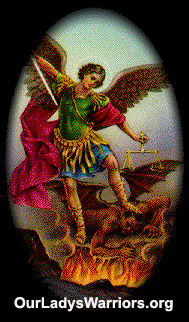
"Saint Michael the Archangel, defend us in battle; be our defense against the wickedness and snares of the devil. May God rebuke him, we humbly pray; and do you, O Prince of the heavenly host, by the power of God, thrust into hell Satan and the other evil spirits who prowl about the world for the ruin of souls. Amen."
We should all add this prayer back into our daily rosary. May our Lord and His beloved Mother watch over and guide their servant, Pope John Paul II during this time of trial in the church.
I like the idea behind this prayer A LOT, but I think it would be more effective if we prayed it this way:
"Dear Heavenly Father, defend us in battle; be our defense against the wickedness and snares of the devil. May You rebuke him, we humbly pray; and do You, O God of Mercy, thrust into hell Satan and the other evil spirits who prowl about the world for the ruin of souls. In the name of Your Son, Jesus Christ, Amen."
Not a sermon, just a thought . . . I know I will be praying this prayer often. By the way, nice picture.
SANCTE Michael Archangele, defende nos in proelio, contra nequitiam et insidias diaboli esto praesidium. Imperet illi Deus, supplices deprecamur: tuque, Princeps militiae coelestis, Satanam aliosque spiritus malignos, qui ad perditionem animarum pervagantur in mundo, divina virtute, in infernum detrude. Amen.
The scriptural basis for such a prayer.
Revelation 8:3 And another angel came and stood at the altar, having a golden censer; and there was given unto him much incense, that he should offer [it] with THE PRAYERS OF ALL SAINTS upon the golden altar which was before the throne. 4 And the smoke of the incense, [which came] with the PRAYERS OF THE SAINTS, ascended up before God out of the angel's hand.
... and an excellent one at that! The prayer used to be said at the end of mass but was removed after Vatican II.
Thanks for the input. We truly need to call on St. Michael now, more than ever.
I think we got "your point" which is actually Loraine Boettner's point, and Dave Hunt's point, and Jack Chick's point etc. But, sadly, you totally missed ours.
In case you haven't noticed, this is a Catholic thread dedicated to the "Prayer to St. Michael the Archangel." Catholics invoke the intercessory prayers of the living on earth and also, the even more efficacious, intercessions of those angels and saints in eternity who are living in the presence of the Almighty.
Quite frankly, it takes a lot of nerve for a non Catholic Christian to come onto a thread such as this, and impugn the practice and then try to defend the act once they are called on it.
Have a good day.
by James Akin

Q: Why do Catholics pray to saints?
A: Well first, it isn't just Catholics. It is all of the historic groups of Christians (Catholics, Eastern Orthodox, Armenians, Copts, etc.) except for Protestants. Asking the saints for their intercession is a basic part of all of historic Christianity, which brings us to the answer for why Christians pray to saints: In order to ask them to pray to God and Christ for us.
Q: Why not pray directly to Jesus?
A: One should pray directly to Jesus. Praying to Jesus is absolutely indispensable to the Christian's prayer life. However, asking others to pray with one is entirely appropriate and beneficial. The Apostle Paul set us an example of this by repeatedly asking for others to pray on his behalf.
Consider the following verses where Paul requests that people pray for him, exhorts people to pray for him, and even assumes people will be praying for him:
The principle of intercessory prayer is most clearly set forth by Paul in the following passage:
Q: But doesn't the Bible says Jesus is the only Mediator between God and man?
A: Yes, it does; in 1 Timothy 2:5 ("For there is one God, and there is one mediator between God and men, the man Christ Jesus"), but we just quoted the four verses immediately preceding this one, and you will remember that in them Paul said: "I urge that supplications, prayers, intercessions, and thanksgivings be made for all men."
So the fact that Jesus is the one Mediator between God and man does not prevent other people from acting as intercessors. And we know intercessory prayer certainly does not displease God, for in the same passage we just cited, Paul tells us: "This is good, and it is acceptable in the sight of God our Savior."
I am sometimes stunned at how people can hop up and down about what Paul says in 1 Timothy 2:5 and yet miss the subject of intercessory prayer, which is not only the topic of the preceding four verses, but the segue into the discussion of Jesus' unique Mediatorship.
Jesus is the only Mediator between God and man in two senses. First, because he is the only God-man, the only Person who himself forms a living bridge between the earth and heaven (something Jesus himself pictured when he represented himself as Jacob's Ladder; John 1:51), but this does not prevent other people from praying for us.
Second, he is the only Mediator between God and man because he is the Mediator of the New Covenant, by which we obtain salvation. This sense of his unique Mediatorship, however, does not prevent other people from being mediators in a parallel sense, for Moses is described as the mediator of the Old Covenant (Galatians 3:19-20), just as Jesus is the Mediator of the New Covenant (Hebrews 8:6, 9:15, 12:24; note that the Greek word used in the Galatians and Hebrews passages, mesites = mediator, is the same as in 1 Timothy 2:5). However, since the Mosaic covenant is now defunct, that leaves Jesus as the only covenant Mediator today.
But there can certainly be no doubt that Jesus' Mediatorship in no way prevents intercessory prayer, for Jesus himself describes this as an essential part of being a son of God:
The unique Mediatorship of Christ thus no more prevents our brother and sister Christians in heaven from praying for us than it prevents our brother and sister Christians here on earth from praying for us. It is intercessory prayer in both cases.
Q: Why not just ask other Christians here on earth to pray for you, then?
A: Again, one can and should ask other Christians here on earth to pray for one. However, the more people one has praying for one, the better, as their devotion to God is added to ours.
In fact, the saints in heaven are even more suited to this than living Christians (the saints on earth) because they have undivided devotion toward God. Here on earth we are afflicted with lethargy, distractions, difficulty in concentration, and lack of fervor in prayer, but in heaven none of these are the case. Our brothers and sisters in heaven are the perfect prayer warriors, having been freed of the distractions of the body.
One may also cite in this regard admonition of James:
The saints in heaven, having been perfectly sanctified (saintified), are even more righteous than us, and so their prayers should have corresponding power in its effects. They are even better able to pray for us than we ourselves.
Q: But doesn't the Bible say that it is the job of the Holy Spirit to intercede for us?
A: It certainly says that the Holy Spirit intercedes for us (Romans 8:26-27), and for this we are to be very thankful. But it nowhere says that this is exclusively his task.
In fact, the very same chapter in Romans also says that Jesus himself makes intercession for us (Romans 8:34), a fact which is emphasized elsewhere in the New Testament (e.g., Hebrews 7:25, 1 John 2:1).
And one certainly cannot cite the intercessory role of the Holy Spirit as evidence against the universal intercession of all Christians for each other, which we have already documented so clearly.
Q: Okay, I'm convinced that intercessory prayer is okay, but I'm confused. You've been talking about asking the saints to pray for you. Why do you call this praying to the saints?
A: Because the verb "to pray" means "to ask." The English word "pray" originally simply meant "ask," and so when one would ask God for something, one was praying to God, and in the same way when one asked another to ask on your behalf, you were praying to them to pray for you.
This usage began to change in English after the Protestant Reformation, when the people running the English language became Protestants. The idealized form of English is "the King's English," and the king of England was the head of the Protestant Church of England. In the same way, all of the universities in England went Protestant, and so English began to take on a Protestant ideological bent (see our discussion of this in the FAQ "What is a Saint?").
One of the Protestantisms that was introduced into English was to begin to restrict the verb "to pray" to God alone, and the semantic range of the word began to shrink in most circumstances. Still, however, there were survivals of the older, broader usage.
One of them is found, for example, in the British expression, "prithee," as in "Prithee, fetch the book" or "Prithee, do tell." "Prithee" is a contraction of "I pray thee" or, more contemporarily, "I ask you." (There are a lot of English contractions like that; "goodbye" is a contraction of "God be with ye" and "zounds!" is a contraction of "by God's [Christ's] wounds!" Check a dictionary.)
In America, where the movers and shakers of the English language were also Protestants, even this usage dropped off, but even here there are survivals of the older, broader use of the term, for example, in court documents.
Once back when I was a Protestant I had occasion to file a motion with a court, and when I got the paperwork my lawyer had submitted, I was stunned to see him writing things like "My client prays that the court will do thus and so." My Protestant sensibilities were shocked! "Your client does nothing of the sort!" I thought. But I was only encountering a survival of the older, broader use of the word "pray," of which I was at that time unaware, thanks to the efforts of my Protestant forebears in amputating it from the English language.
Another survival of the older usage of "pray," and the one which concerns us here, is of course its use in Catholic circles. English-speaking Catholics never dropped the older usage when the Protestants around them began to restrict its meaning, and so Catholics still today speak of praying to the saints and meaning by it simply asking the saints to intercede for us.
Q: Isn't prayer an act of worship?
A: In modern Protestant religious usage, yes, but as we have said, that is not the basic meaning of the term, and that is certainly not the meaning of the term in all circumstances.
It is the same with other concepts as well. Honoring God, for example, is an act of worship, but in other contexts honoring a person is by no means an act of worship. For example, Jesus himself reminded us of the duty to "Honor your father and mother" (Mark 7:10), yet he certainly was not commanding us to worship our father and mother.
Praying to God certainly can include acts of worship (praising him and proclaiming his greatness for example), but one could also simply ask God for help in a prayer.
The bottom line is that, when used in reference to the saints, prayer is certainly not an act of worship but is, as we have said, simply a request for their intercession.
For anyone who wishes to be cantankerous about this, all I can say is that there is something very different happening in my heart, and the heart of every Catholic, when one says, "Saints Peter and Paul, pray for me" than when one says, "O Lord God, you are truly supreme, you are the Infinitely-Holy, the All-Powerful, the All-Perfect Father of creation."
And I can further only say that unless one has been personally experienced with praying to the saints, one is not qualified to judge what is going on in the heart of another as one has no done it oneself. And, in fact, one should not be judging the hearts of others to begin with, but should take them at their word when they say there is a marked difference between the two. One should always remember Paul's injunction:
Q: What are patron saints? What are they all about?
A: Patron saints are saints that people pray to in specific circumstances. During their lives, all of the saints were in particular situations that gave them empathy for those in related situations. It therefore is reasonable to pray to them in those cases.
For example, if a saint lived in your town or country, you might pray to that saint as someone who could be expected to have a special concern for people of your area. Similarly, if a saint had held your occupation during life, you might pray to him as someone who could be expected to have sympathy for people in your occupation (having been acquainted with its trials and difficulties, firsthand). And if a saint had a similar life experience to yours, you might pray to him (e.g., a widower who wishes to remarry might ask Abraham to pray for a new wife for him, as Abraham was himself a widower who desired to and was remarried; Genesis 25:1-4).
Q: Many saints are officially declared to be the patron saint of something. What if someone was accidentally declared the patron of something for which their life did not give them any special concern?
A: The saints, being endowed with perfect divine love, would not mind at all, would still care for the situations of those praying to them, and would pray just as fervently for those asking for their intercession. In other words, they would in divine love assume the patronage of that thing.
Q: Won't we forget everything concerning this life in heaven? Doesn't that mean that the saints won't remember us and our troubles?
A: The Bible clearly indicates that we will not forget everything about this life when we are in the next.
Consider the parable of Lazarus and the Rich Man, in which Abraham and the rich man talk and both display a clear awareness of the fact that the rich man's brothers are still alive and not with them in the afterlife, and the rich man remembers that they were not followers of God (Luke 16:27-31). Abraham and the rich man certainly have not forgotten about earthly life or the people left behind in it.
The same is illustrated by other passages we will quote below.
Q: Won't the saints be so caught up in God they have no time to think of us?
A: Again, the Bible shows Abraham being able to think about something other than God, and if one objects that he was at that time not in heaven (it being before the resurrection of Christ), then one should simply note that the book of Revelation also pictures those in heaven being aware of what is transpiring on earth.
For example, consider the following verses and the concern they show those in heaven having for what happens on earth:
Q: Wouldn't it ruin heaven for the saints if they were aware of our troubles?
A: It doesn't ruin God's heaven, and he is certainly aware of our sufferings. Neither does it ruin heaven for the angels, and they are aware of our sufferings (in fact, the Bible indicates that God sends them to alleviate our sufferings). In the same way, it does not ruin heaven for the saints. They may be concerned at our sufferings, but their beatitude in heaven is not disturbed or ruined. They feel concern and compassion, but without pain.
I imagine that our departed loved ones, for example, will see our sorrow rather like we see the anxiety of an toddler who is alarmed that one of his parents is leaving the house but is too young to understand that this is really nothing to worry about. They will see our sorrow and feel compassionate and touched and flattered, and wish we understood that there is nothing to worry about and everything is okay, the same way we feel when a small child doesn't want us to leave. They will feel tender toward us in our anxiety, but not hurt or injured by it.
One final example should make the point that in the beatified state we will simply not feel pain, and that is all there is to it: We will be aware of the sufferings of the damned, and those are much more intense than any trials we face during this life. God is not going to cut out the part of our minds that is aware of the existence of hell (in fact we would not appreciate the fullness of God's justice or his mercy toward us unless we realized the alternative to being in heaven), but he won't let it ruin our beatitude for us, either.
Q: How do you know the saints in heaven are praying for us?
A: Because the Bible tells us. One passage in which this is made clear is in 2 Maccabees, where Judah has had a vision in which St. Onias the high priest shows him Jeremiah the prophet, now in heaven, and we read:
Protestants will not tend to like that passage since it is from one of the deuterocanonical books-the seven books of the Old Testament that Martin Luther cut out of the Bible-but the same is taught in the New Testament, for in the book of Revelation we read:
This shows us the twenty-four elders, who represent the leaders of the people of God in heaven, offering to God the prayers of the saints on earth. They therefore must be interceding with God by presenting to him our prayer needs.
And it almost goes without saying that the angels intercede on our behalf (the angels also being saints; see the paper "What is a saint?"):
And Jesus himself told us that the guardian angels of little children have guaranteed access to the Father to intercede on behalf of their charges:
Q: What makes you think the saints can hear our prayers?
A: The very verses we just quoted. It goes without saying, for example, that our guardian angels are aware of what we are doing. It is their job to guard us, after all, so we can be sure they know what we are doing and when we are asking them to pray for us.
And in the same way, when we read of the saints in heaven offering our prayers to God in the form of incense (Revelation 5:8, 8:3-4), we know they are aware of our prayers.
Remember: Most of the saints don't have physical bodies right now. They furthermore don't have physical prayer request cards or physical incense or anything like that. This means that when they are pictured as presenting God with our prayers, they are not physically presenting him with our prayers, so they must be mentally presenting them to him. But if they are mentally presenting our prayers to God then they must be aware of our prayers.
If one objects that these prayers weren't directed to them but to God then one only digs oneself in deeper, because in that case they would be aware of prayers which weren't even directed to them, but they still take them up and intercede for us on the basis of them.
Either way you go, the saints are aware of our prayers.
Q: How can the saints hear our prayers? Aren't you making them out to be omniscient and omnipresent?
A: Certainly not! That is a canard often tossed out by anti-Catholics who are not acquainted with the Catholic view of the saints.
The saints certainly have more knowledge than we do in this life:
We will never be omniscient, and certainly we will not be omnipresent, but we will be aware of many things which we are not now cognizant of.
The standard account for how the saints are aware of our prayers is that, because they have the beatific vision of God, they see in God all of the knowledge they need, all of the knowledge that is relevant to them, and so they see our prayers to them. On the standard account is thus by the omniscience of God that they become aware of our prayers, though they themselves are never omniscient and never take in the full scope of God's knowledge, only those parts that are relevant to them.
However that may be, there is simply a big, huge difference-in fact, an infinitely huge difference-between being "multiscient" (knowing many things) and "omniscient" (knowing all things). We will never cross from the one to the other, and it is simply a straw man of anti-Catholic posturing to represent the expanded knowledge of those in heaven as if it were infinite knowledge. It is a classic case of triumphalistically bashing a position that nobody holds.
Q: Don't the more popular saints would receive too many prayers to hear?
A: This is another common anti-Catholic canard. However, consider the following points:
First, even if a saint couldn't answer your prayer due to too much volume, God knows your prayer, so don't sweat it.
Second, even if a saint couldn't personally pray for you due to too much volume, he or she could still pray for you generally-e.g., "Lord, please aid all those who are asking for my intercession."
Third, when you write the head of a major ministry, who receives too many letters to personally answer, even if that person himself doesn't read the letter, someone on his staff will. Since heaven is at least as efficient as earthly organizations, if you sent a prayer to a popular saints-the Virgin Mary, let's say-and she for some reason wasn't able to answer it, someone on her staff would.
Fourth, time doesn't work the same way in the afterlife. Those in heaven have all the "time" they need to do every thing they need.
Fifth, and most importantly, it is simply totally false that those in heaven can be overloaded with too many prayers. The information processing capacity of the glorified human intellect and our current intellects is greater than the difference between that of a capacity of a state of the art supercomputer and a primitive abacus.
Consider the following:
a) Paul says that whereas now we know partially, then we will know fully (1 Corinthians 13:9-12)
b) Jesus tells us that on Judgment Day we will have a review of our entire lives, every action that we have performed. This extends down even to the most trivial of our actions, for he tells us:
But unless Judgment Day is as long as our entire lives (and longer, in fact, since we will know and understand everything we did and its significance better than we do now), then our information processing capacity must be far, far larger.
c) Furthermore, we will not only know everything that we have done, we will know everything that everyone around us has done, for Jesus tells us:
This means that we will not only be able to process every single action of our own lives and its significance, we will be able to do the same for every single action of the lives of those around us, indicating a truly astronomical amount of information processing power for our intellects once freed of our current conditions.
d) Note how the New Testament describes Jesus as interceding for us:
In these passages, Jesus is said to be interceding for us in his capacity as Christ and as priest-not just as God the Son. Because Christ and priest are two roles he took on as a result of the Incarnation, he is interceding for us in his human capacity as Messiah and high priest. These passages thus speak of him interceding for us via his glorified human intellect, not his divine intellect. As a result, if Jesus-the man with more prayer requests sent to him than anyone else-is able to intercede for us with his glorified human intellect, there can be no doubt that every other saints, who receives fewer prayers, will be able to do so as well.
Q: Doesn't the Bible forbids contact with the dead?
A: No, the Bible forbids conjuring up the dead. God forbade the people of Israel to use the pagan practice of mediumship as a means of getting supernatural information, telling them instead that he would send them prophets. Conjuring up the dead to get information out of them was thus right out:
There is a big difference between humbly asking a departed loved one to pray for you and trying to conjure them up to pump them for information. Saying, "Honey, please pray for me because I need help right now" is not the same as holding a seance, and that is all there is to it.
Only conjuring up saints and angels is forbidden by the Bible. Talking to those in heaven is not forbidden. In fact, it is encouraged, for in the Psalms we pray to the angels to ask them to join us in worshipping God:
Q: Did the early Church Fathers support praying to the saints?
A: They sure did! See the following link.
Q: Where does it say in the Bible that we should pray to saints?
A: This question presupposes that there needs to be a place in the Bible to tell us it is okay to pray to the saints.
Not only have we showed in this series of questions that the principle are all in place to ask them to pray for us--so that we can infer a permission from the principles--but the supposition that we need a passage to tell us something is okay is the very essence of legalism-the idea that one must have special permission before one is allowed to do something, the principle "Whatever is not expressly permitted is prohibited."
A fundamental principle of all law-a principle which legalism rejects-is that whatever is not expressly prohibited is permitted. God gave us intellects and expects us to use them. The function of his law is to set boundaries to make sure we know what we are not permitted do. His law is not meant to create pockets of freedom so that there will be something we are permitted to do.
Nothing can be more legalistic than the idea you have to have an express biblical permission before you can do something, and you will search all day to find permissions to do most of the things we do every day.
This legalistic, soul-scarring misunderstanding is a key part of the Pharisaical mindset that Jesus condemned, for if one follows this principle consistently, one will most assuredly "tie up heavy loads and put them on men's shoulders" (Matthew 23:4), and the words of Jesus will surely apply to you:
That being said, it only remains to be pointed out that in this series of questions we have already shown verses where we are encouraged to pray to those in heaven. As we stated, in the Psalms we pray to the angels to ask them to join us in worshipping God:
These may be prayers in which we are not seeking to get any benefit for ourselves-just asking them to worship with us-but they are requests, and thus prayers, none the less.
And if there is nothing wrong with humbly and sincerely asking God for benefits for ourselves, not anything wrong with asking for others to pray on our behalf, then the same principle applies here. Once it has been shown that it is okay to ask those in heaven to pray for us then there are no restrictions on what we may ask in these prayers, so long as the subject is not otherwise unworthy of a prayer.
The bottom line: Praying to the saints is totally biblical. Period.
Q: I see what you are saying, but am not yet comfortable praying to saints. How can I start?
A: When I was becoming Catholic, I too faced this problem-recognizing that praying to the saints was okay in principle but not yet feeling comfortable with it. To solve it, I began by talking to someone I knew was aware of my situation and who was assigned to intercede for me-my guardian angel.
I then broadened out to cover biblical saints-in particular Saints Peter and Paul-and asked them for their prayers as well.
I also began to pray to the saints of the parishes I attended, figuring they would have special concern for those who attended these parishes.
And I asked departed relatives who I had reason to believed were saved.
By this point I was just comfortable with asking any of the saints for help, and I suspect a similar program would help just about anybody gain comfort with the practice after they have seen its intellectual foundations.
God bless you, and good luck!

Home | File Library | Offsite Files | Catechism | Today's Question | Question Box | Links | About
All material copyright © 1997 by James Akin unless otherwise noted. All rights reserved.
Disclaimer: Opinions posted on Free Republic are those of the individual posters and do not necessarily represent the opinion of Free Republic or its management. All materials posted herein are protected by copyright law and the exemption for fair use of copyrighted works.