Skip to comments.
IT IS BY GRACE WE ARE SAVED, AFTER ALL WE CAN DO
THE SCRIPTURES ^
Posted on 06/10/2002 10:59:32 AM PDT by restornu
2 Nephi 2
Redemption cometh through the Holy Messiah—Freedom of choice (agency) is essential to existence and progression—Adam fell that men might be—Men are free to choose liberty and eternal life. [Between 588 and 570 B.C.]
1 AND now, Jacob, I speak unto you: Thou art my first-born in the days of my tribulation in the wilderness. And behold, in thy childhood thou hast suffered afflictions and much sorrow, because of the rudeness of thy brethren.
2 Nevertheless, Jacob, my first-born in the wilderness, thou knowest the greatness of God; and he shall consecrate thine afflictions for thy gain.
3 Wherefore, thy soul shall be blessed, and thou shalt dwell safely with thy brother, Nephi; and thy days shall be spent in the service of thy God. Wherefore, I know that thou art redeemed, because of the righteousness of thy Redeemer; for thou hast beheld that in the fulness of time he cometh to bring salvation unto men.
4 And thou hast beheld in thy youth his glory; wherefore, thou art blessed even as they unto whom he shall minister in the flesh; for the Spirit is the same, yesterday, today, and forever. And the way is prepared from the fall of man, and salvation is free.
5 And men are instructed sufficiently that they know good from evil. And the law is given unto men. And by the law no flesh is justified; or, by the law men are cut off. Yea, by the temporal law they were cut off; and also, by the spiritual law they perish from that which is good, and become miserable forever.
6 Wherefore, redemption cometh in and through the Holy Messiah; for he is full of grace and truth.
7 Behold, he offereth himself a sacrifice for sin, to answer the ends of the law, unto all those who have a broken heart and a contrite spirit; and unto none else can the ends of the law be answered.
8 Wherefore, how great the importance to make these things known unto the inhabitants of the earth, that they may know that there is no flesh that can dwell in the presence of God, save it be through the merits, and mercy, and grace of the Holy Messiah, who layeth down his life according to the flesh, and taketh it again by the power of the Spirit, that he may bring to pass the resurrection of the dead, being the first that should rise.
9 Wherefore, he is the firstfruits unto God, inasmuch as he shall make intercession for all the children of men; and they that believe in him shall be saved.
10 And because of the intercession for all, all men come unto God; wherefore, they stand in the presence of him, to be judged of him according to the truth and holiness which is in him. Wherefore, the ends of the law which the Holy One hath given, unto the inflicting of the punishment which is affixed, which punishment that is affixed is in opposition to that of the happiness which is affixed, to answer the ends of the atonement—
11 For it must needs be, that there is an opposition in all things. If not so, my first-born in the wilderness, righteousness could not be brought to pass, neither wickedness, neither holiness nor misery, neither good nor bad. Wherefore, all things must needs be a compound in one; wherefore, if it should be one body it must needs remain as dead, having no life neither death, nor corruption nor incorruption, happiness nor misery, neither sense nor insensibility.
12 Wherefore, it must needs have been created for a thing of naught; wherefore there would have been no purpose in the end of its creation. Wherefore, this thing must needs destroy the wisdom of God and his eternal purposes, and also the power, and the mercy, and the justice of God.
13 And if ye shall say there is no law, ye shall also say there is no sin. If ye shall say there is no sin, ye shall also say there is no righteousness. And if there be no righteousness there be no happiness. And if there be no righteousness nor happiness there be no punishment nor misery. And if these things are not there is no God. And if there is no God we are not, neither the earth; for there could have been no creation of things, neither to act nor to be acted upon; wherefore, all things must have vanished away.
14 And now, my sons, I speak unto you these things for your profit and learning; for there is a God, and he hath created all things, both the heavens and the earth, and all things that in them are, both things to act and things to be acted upon.
15 And to bring about his eternal purposes in the end of man, after he had created our first parents, and the beasts of the field and the fowls of the air, and in fine, all things which are created, it must needs be that there was an opposition; even the forbidden fruit in opposition to the tree of life; the one being sweet and the other bitter.
16 Wherefore, the Lord God gave unto man that he should act for himself. Wherefore, man could not act for himself save it should be that he was enticed by the one or the other.
17 And I, Lehi, according to the things which I have read, must needs suppose that an angel of God, according to that which is written, had fallen from heaven; wherefore, he became a devil, having sought that which was evil before God.
18 And because he had fallen from heaven, and had become miserable forever, he sought also the misery of all mankind. Wherefore, he said unto Eve, yea, even that old serpent, who is the devil, who is the father of all lies, wherefore he said: Partake of the forbidden fruit, and ye shall not die, but ye shall be as God, knowing good and evil.
19 And after Adam and Eve had partaken of the forbidden fruit they were driven out of the garden of Eden, to till the earth.
20 And they have brought forth children; yea, even the family of all the earth.
21 And the days of the children of men were prolonged, according to the will of God, that they might repent while in the flesh; wherefore, their state became a state of probation, and their time was lengthened, according to the commandments which the Lord God gave unto the children of men. For he gave commandment that all men must repent; for he showed unto all men that they were lost, because of the transgression of their parents.
22 And now, behold, if Adam had not transgressed he would not have fallen, but he would have remained in the garden of Eden. And all things which were created must have remained in the same state in which they were after they were created; and they must have remained forever, and had no end.
23 And they would have had no children; wherefore they would have remained in a state of innocence, having no joy, for they knew no misery; doing no good, for they knew no sin.
24 But behold, all things have been done in the wisdom of him who knoweth all things.
25 Adam fell that men might be; and men are, that they might have joy.
26 And the Messiah cometh in the fulness of time, that he may redeem the children of men from the fall. And because that they are redeemed from the fall they have become free forever, knowing good from evil; to act for themselves and not to be acted upon, save it be by the punishment of the law at the great and last day, according to the commandments which God hath given.
27 Wherefore, men are free according to the flesh; and all things are given them which are expedient unto man. And they are free to choose liberty and eternal life, through the great Mediator of all men, or to choose captivity and death, according to the captivity and power of the devil; for he seeketh that all men might be miserable like unto himself.
28 And now, my sons, I would that ye should look to the great Mediator, and hearken unto his great commandments; and be faithful unto his words, and choose eternal life, according to the will of his Holy Spirit;
29 And not choose eternal death, according to the will of the flesh and the evil which is therein, which giveth the spirit of the devil power to captivate, to bring you down to hell, that he may reign over you in his own kingdom.
30 I have spoken these few words unto you all, my sons, in the last days of my probation; and I have chosen the good part, according to the words of the prophet. And I have none other object save it be the everlasting welfare of your souls. Amen.
******************************************************************
2 Nephi 25
Nephi glories in plainness—Isaiah’s prophecies shall be understood in the last days—The Jews shall return from Babylon, crucify the Messiah, and be scattered and scourged—They shall be restored when they believe in the Messiah—He shall first come six hundred years after Lehi left Jerusalem—Nephites keep the law of Moses and believe in Christ, who is the Holy One of Israel. [Between 559 and 545 B.C.]
20 And now, my brethren, I have spoken plainly that ye cannot err. And as the Lord God liveth that brought Israel up out of the land of Egypt, and gave unto Moses power that he should heal the nations after they had been bitten by the poisonous serpents, if they would cast their eyes unto the serpent which he did raise up before them, and also gave him power that he should smite the rock and the water should come forth; yea, behold I say unto you, that as these things are true, and as the Lord God liveth, there is none other name given under heaven save it be this Jesus Christ, of which I have spoken, whereby man can be saved.
21 Wherefore, for this cause hath the Lord God promised unto me that these things which I write shall be kept and preserved, and handed down unto my seed, from generation to generation, that the promise may be fulfilled unto Joseph, that his seed should never perish as long as the earth should stand.
22 Wherefore, these things shall go from generation to generation as long as the earth shall stand; and they shall go according to the will and pleasure of God; and the nations who shall possess them shall be judged of them according to the words which are written.
23 For we labor diligently to write, to persuade our children, and also our brethren, to believe in Christ, and to be reconciled to God; for we know that it is by grace that we are saved, after all we can do.
24 And, notwithstanding we believe in Christ, we keep the law of Moses, and look forward with steadfastness unto Christ, until the law shall be fulfilled.
25 For, for this end was the law given; wherefore the law hath become dead unto us, and we are made alive in Christ because of our faith; yet we keep the law because of the commandments.
26 And we talk of Christ, we rejoice in Christ, we preach of Christ, we prophesy of Christ, and we write according to our prophecies, that our children may know to what source they may look for a remission of their sins.
27 Wherefore, we speak concerning the law that our children may know the deadness of the law; and they, by knowing the deadness of the law, may look forward unto that life which is in Christ, and know for what end the law was given. And after the law is fulfilled in Christ, that they need not harden their hearts against him when the law ought to be done away.
28 And now behold, my people, ye are a stiffnecked people; wherefore, I have spoken plainly unto you, that ye cannot misunderstand. And the words which I have spoken shall stand as a testimony against you; for they are sufficient to teach any man the right way; for the right way is to believe in Christ and deny him not; for by denying him ye also deny the prophets and the law.
29 And now behold, I say unto you that the right way is to believe in Christ, and deny him not; and Christ is the Holy One of Israel; wherefore ye must bow down before him, and worship him with all your might, mind, and strength, and your whole soul; and if ye do this ye shall in nowise be cast out.
30 And, inasmuch as it shall be expedient, ye must keep the performances and ordinances of God until the law shall be fulfilled which was given unto Moses.
Matthew 25(Jesus gives the parables of the ten virgins, the talents, and the sheep and the goats.)
1 THEN shall the kingdom of heaven be likened unto ten virgins, which took their lamps, and went forth to meet the bridegroom.
2 And five of them were wise, and five were foolish.
3 They that were foolish took their lamps, and took no oil with them:
4 But the wise took oil in their vessels with their lamps.
5 While the bridegroom tarried, they all slumbered and slept.
6 And at midnight there was a cry made, Behold, the bridegroom cometh; go ye out to meet him.
7 Then all those virgins arose, and trimmed their lamps.
8 And the foolish said unto the wise, Give us of your oil; for our lamps are gone out.
9 But the wise answered, saying, Not so; lest there be not enough for us and you: but go ye rather to them that sell, and buy for yourselves.
10 And while they went to buy, the bridegroom came; and they that were ready went in with him to the marriage: and the door was shut.
11 Afterward came also the other virgins, saying, Lord, Lord, open to us.
12 But he answered and said, Verily I say unto you, I know you not.
13 Watch therefore, for ye know neither the day nor the hour wherein the Son of man cometh.
********
14 For the kingdom of heaven is as a man travelling into a far country, who called his own servants, and delivered unto them his goods.
15 And unto one he gave five talents, to another two, and to another one; to every man according to his several ability; and straightway took his journey.
16 Then he that had received the five talents went and traded with the same, and made them other five talents.
17 And likewise he that had received two, he also gained other two.
18 But he that had received one went and digged in the earth, and hid his lord’s money.
19 After a long time the lord of those servants cometh, and reckoneth with them.
20 And so he that had received five talents came and brought other five talents, saying, Lord, thou deliveredst unto me five talents: behold, I have gained beside them five talents more.
21 His lord said unto him, Well done, thou good and faithful servant: thou hast been faithful over a few things, I will make thee ruler over many things: enter thou into the joy of thy lord.
22 He also that had received two talents came and said, Lord, thou deliveredst unto me two talents: behold, I have gained two other talents beside them.
23 His lord said unto him, Well done, good and faithful servant; thou hast been faithful over a few things, I will make thee ruler over many things: enter thou into the joy of thy lord.
24 Then he which had received the one talent came and said, Lord, I knew thee that thou art an hard man, reaping where thou hast not sown, and gathering where thou hast not strawed:
25 And I was afraid, and went and hid thy talent in the earth: lo, there thou hast that is thine.
26 His lord answered and said unto him, Thou wicked and slothful servant, thou knewest that I reap where I sowed not, and gather where I have not strawed:(lack of Faith and works)
27 Thou oughtest therefore to have put my money to the exchangers, and then at my coming I should have received mine own with usury.
28 Take therefore the talent from him, and give it unto him which hath ten talents.
29 For unto every one that hath shall be given, and he shall have abundance: but from him that hath not shall be taken away even that which he hath.
30 And cast ye the unprofitable servant into outer darkness: there shall be weeping and gnashing of teeth.(lack of Faith and works)
******
31 When the Son of man shall come in his glory, and all the holy angels with him, then shall he sit upon the throne of his glory:
32 And before him shall be gathered all nations: and he shall separate them one from another, as a shepherd divideth his sheep from the goats:
33 And he shall set the sheep on his right hand, but the goats on the left.
34 Then shall the King say unto them on his right hand, Come, ye blessed of my Father, inherit the kingdom prepared for you from the foundation of the world:
35 For I was an hungred, and ye gave me meat: I was thirsty, and ye gave me drink: I was a stranger, and ye took me in:
36 Naked, and ye clothed me: I was sick, and ye visited me: I was in prison, and ye came unto me.
37 Then shall the righteous answer him, saying, Lord, when saw we thee an hungred, and fed thee? or thirsty, and gave thee drink?
38 When saw we thee a stranger, and took thee in? or naked, and clothed thee?
39 Or when saw we thee sick, or in prison, and came unto thee?
40 And the King shall answer and say unto them, Verily I say unto you, Inasmuch as ye have done it unto one of the least of these my brethren, ye have done it unto me.
41 Then shall he say also unto them on the left hand, Depart from me, ye cursed, into everlasting fire, prepared for the devil and his angels:
42 For I was an hungred, and ye gave me no meat: I was thirsty, and ye gave me no drink:
43 I was a stranger, and ye took me not in: naked, and ye clothed me not: sick, and in prison, and ye visited me not.
44 Then shall they also answer him, saying, Lord, when saw we thee an hungred, or athirst, or a stranger, or naked, or sick, or in prison, and did not minister unto thee?
45 Then shall he answer them, saying, Verily I say unto you, Inasmuch as ye did it not to one of the least of these, ye did it not to me.
46 And these shall go away into everlasting punishment: but the righteous into life eternal.
Matthew 5
14 Ye are the light of the world. A city that is set on an hill cannot be hid.
15 Neither do men light a candle, and put it under a bushel, but on a candlestick; and it giveth light unto all that are in the house.
16 Let your light so shine before men, that they may see your good works, and glorify your Father which is in heaven.
48 Be ye therefore perfect, even as your Father which is in heaven is perfect.( It is not possible to be perfect in this temporal stage, yet the Lord exspect us to strive to do our best,)
23 For we labor diligently to write, to persuade our children, and also our brethren, to believe in Christ, and to be reconciled to God; for we know that it is by grace that we are saved, after all we can do.
TOPICS: General Discusssion
KEYWORDS: charity; exercingfaith; faith; freewill; fruits; godpromise; grace; hope; lds; noflaming; perfect; saved; works
Navigation: use the links below to view more comments.
first 1-20, 21-24 next last
Bt their fruits ye shall know them. This is just another way to show that works is a testimony to our Lord, or if we have faith than are we not to act on it? For we have faith in the Lord and that he will help us to carry out his commandments it is done in His name every thing we do is in His name for it we do or perform with the Lord, it is dead.
WE ARE COMMANDED TO EXERCISE FAITH! BY THIS ACTING IN THE NAME OF THE LORD IT IS MANIFESTED BY THE POWER OF THE LORD.
1
posted on
06/10/2002 10:59:32 AM PDT
by
restornu
To: scottiewottie;Some Hope Remaining;White Mountain
CTR
2
posted on
06/10/2002 11:10:00 AM PDT
by
restornu
To: restornu
The thief on the cross believed and was saved, without any works. Salvation is by faith, alone. True faith will lead to works, and our works will FOLLOW us, not preceed us, to heaven, Rev 14:13.
3
posted on
06/10/2002 12:51:21 PM PDT
by
aimhigh
To: aimhigh
No, "that day" the theif was not in heaven with Christ, Christ was not in heaven "that day". Jesus did ascend to heaven three days later, but the theif went somewhere other than heaven that day, a place known clearly to jews as paradise. Paradise to the jew at that time was not heaven.
To: aimhigh
Oh, you are right though, the theif was saved, and that without any works. By grace you are saved, after all that you can do. It should also be noted that "all that you can do" is also a gift from God, so basically nothing that you "do" is yours, and what you "do" cannot save you.
Yet we are commanded to "do" the good works that God has given us.
To: aimhigh;scottiewottie
The thief on the cross believed and was saved, without any works. Salvation is by faith, alone. True faith will lead to works, and our works will FOLLOW us, not preceed us, to heaven, Rev 14:13.(aimhigh)
********************************************************************
Well the Bible rendering is incorrect
PARADISE
A Persian word meaning a garden. It is not found in the O.T. In the N.T. it occurs in Luke 23: 43, 2 Cor. 12: 4, and Rev. 2: 7. See also 2 Ne. 9: 13; Alma 40: 12, 14; 4 Ne. 1: 14; Moro. 10: 34; D&C 77: 2, 5; cf. A of F 10. Paradise is that part of the spirit world in which the righteous spirits who have departed from this life await the resurrection of the body. It is a condition of happiness and peace. However, the scriptures are not always consistent in the use of the word, especially in the Bible. For example, when Jesus purportedly said to the thief on the cross, “To day shalt thou be with me in Paradise” (Luke 23: 43), the Bible rendering is incorrect. The statement would more accurately read, “Today shalt thou be with me in the world of spirits” since the thief was not ready for paradise (see HC 5: 424-25). Possibly 2 Cor. 12: 4 should also not use paradise in the sense of meaning the spirit world, as much as meaning the celestial kingdom. The “paradisiacal glory” of A of F 10 refers to the glorified millennial state of the earth rather than the spirit world.
6
posted on
06/10/2002 2:29:47 PM PDT
by
restornu
To: restornu
..since the thief was not ready for paradise..It's obvious your commentary is clouded by a preconsived doctrine.
7
posted on
06/10/2002 6:02:05 PM PDT
by
aimhigh
To: aimhigh
These folks must be very proud of the works they accomplish in order to obtain the "grace" of God.
8
posted on
06/10/2002 6:50:28 PM PDT
by
week 71
To: aimhigh;scottiewottie;White Mountain
..since the thief was not ready for paradise.. It's obvious your commentary is clouded by a preconsived doctrine.
Well if one were to search the Bible, we can see that there are glaring contradictons in many of the doctrines taught today.
FATAL FLAWS IN THE "EVANGELICAL" THEORY OF SALVATION by Eugene Seaich
1. Wrenching the doctrine of "salvation by grace" (Eph. 2:8-9) from the doctrine of "judgment and reward according to works" (Mt. 16:27; Rom. 2:6; 2 Cor. 5:10). The purpose of "salvation by grace" (i.e. from Adam's First Death, Rom. 5:15) was in fact to make it possible for men to perform the "good works" which God intended (Eph. 2:10; Rom. 8:8-10), and for which they will be variously judged and rewarded (Mt. 13:8, 23; 1 Cor. 3:11-15; 15:41). Those who fail to live worthy lives may actually suffer a Second Death (Heb. 10:39; Rev. 2:11; 20:6, 14).
2. Failure to take into account the dual processes of justification and sanctification. One is not "saved" instantly, but only justified, in anticipation of a successful sanctification by the Holy Spirit (Eph. 1:14: "That Spirit is the pledge that we shall enter upon our heritage, when God has redeemed what is his own," NEB). The transformation of our residual "Old Man" will in fact be completed only at the time of the Resurrection (1 Cor. 15:52-54), for none has yet become perfect while in the world (Mt. 19:17; Rom. 3:12). Even Martin Luther called the justified "both righteous and sinner" (simul justus ac peccator), for his sanctification is still an on-going process (Gal. 4:19), the results of which are yet to be "confirmed" by the sinner's personal "diligence" in incorporating the gifts of the Spirit into his life (2 Pet. 1:10; Gal. 5:25). Thus, during our earthly life, we have only the power to become "sons of God" (John 1:12), a process which requires a life-long process of sanctification, and may be interrupted before it is completed by a fall from grace. Failure to understand this dual process leads to flaw number 3:
3. The notion of instant and irrevocable salvation: Once reborn as a "son of God," one can never become unborn, even if one returns to sin. He may be "chastised," but he always remains God's son - just as an earthly son remains the offspring of his earthly father. Scripture, however, is replete with warnings that one may fall from grace and lose his salvation altogether (1 Cor. 9:27; 10:12; 1 Tim. 1:19; Heb. 6:4-6; 12:15). The New Testament therefore contains no such thing as "eternal security" ("Once saved, always saved").
4. Ignoring the importance of baptism. The false notion that being "born of water" (John 3:5) refers to a "natural birth" from the mother's amniotic fluid - later to be followed by a "spiritual birth" (vs. 6) - is found nowhere in Scripture. It is in fact contradicted by the context of the preceding verses, which clearly speak of a "rebirth," not an "initial birth." This is elsewhere specified as a "rebirth in water" (dia loutrou palingenesias, Titus 3:5), and baptism (baptizo) as the act of "immersion" (see Mt. 3:16 and Mk. 1:10, for Jesus' example; also Mk. 1:5; Acts 8:38, for the practice of the early church). Finally, baptism is not merely a outward sign ("like a wedding ring") that one already belongs to Christ, but the means of joining Christ ("Baptized into Jesus Christ," Rom. 6:3; "Baptized into Christ," Gal. 3:27; "Made to drink into one Spirit," 1 Cor. 12:13; etc.). Baptismal Rebirth was therefore the scriptural method of "washing away" one's sinful condition (Rom. 6:5-7; Acts 2:38; 22:16; Tit. 3:5), and was commanded by Jesus himself (Mt. 28:19; Mk. 16:16). It was then followed by the laying-on-of-hands for the gift of the Spirit (see no. 5):
5. Failure to see the difference between an initial conversion by the Spirit and the permanent gift of the Spirit through the laying-on-of-hands (compare Acts 2:4 with 2:38: "They were filled with the Holy Ghost... Then Peter said unto them, Repent and be baptized... and ye shall receive the gift of the Holy Ghost"). Furthermore, this gift could only be given by the laying-on-of-hands by those having apostolic authority (Acts 8:14-17; 9:17-18; 19:2-6; 1 Tim. 4:14; 5:22; 2 Tim. 1:6; Heb. 6:1-2).
6. Ignoring the importance of an organized church (the "Body of Christ," Eph. 1:22-23) as a means of receiving Christ's Spirit and fullness, and of being perfected (1 Cor. 12:1-13; Eph. 4:11-13; Col. 1:18-19 and 2:9-10).. The view that men can be saved simply by a "private" or "personal relationship with Christ" is nowhere contained in Scripture.
9
posted on
06/10/2002 7:00:35 PM PDT
by
restornu
To: week 71;aimhigh
These folks must be very proud of the works they accomplish in order to obtain the "grace" of God. 1.What is the purpose of comming to earth? if you are already home free!
2.Is there not through out the Bible where the Lord ask us to keep his commandments?
3.What are those commandments?
4.Did not Jesus Tell us to feed His Sheep?
5.What are the request in the Sermon on the Mound?
6.What did Jesus ask us to do with the talents or gifts he gave us?
7.What dose that mean to make sure when he returns that there is oil in our Lamps?
In Matt. 5
(why would the Lord scold those who disobeyed and deny them access into His Kingdow if they were slothful?
26 His lord answered and said unto him, Thou wicked and slothful servant, thou knewest that I reap where I sowed not, and gather where I have not strawed:(lack of Faith and works)
30 And cast ye the unprofitable servant into outer darkness: there shall be weeping and gnashing of teeth.(lack of Faith and works)
HOW DO YOU FOLKS ANSWER THESE SCRIPTURES?
10
posted on
06/10/2002 8:41:53 PM PDT
by
restornu
To: restornu
I'll read your response more carefully upon returning from work, however I will say that born-again Christians do good works
because of the grace of God demostrated at calvary some 2000 years ago. All other religions and cults calling themselves by Christ's name do good works because they fear God and hope to gain grace(which is no grace at all) or to become gods themselves in the afterlife .
We could get into a scripture war about all the passages that mention one is saved by belief in Jesus only, not belief plus works, or about angels preaching another gospel, but I'm sure you've been scripted like the 18 year boys (I'm sorry...elders) who knock on my door every year. It is unbeneficial.
11
posted on
06/10/2002 10:04:44 PM PDT
by
week 71
To: week 71
All I am saying is that the Lord said those things are commanded of you, so grace is gift, but there are commandments and to think you don't need to be baptized is not true as far as the Bible said if you read more carefully.
The Lord showed us the Way and he was sinless and was baptized, else wise our Lord, Jesus Christ did it in vain?
As one is cleansed of from the world they also received the second comforter.
You are fooling yourselves if you think all you have to do, is say I believe.
2. You tell me When this Angel is coming we are pretty close to the end?-
Rev. 14:6
And I saw another angel fly in the midst of heaven, having the everlasting gospel to preach unto them that dwell on the earth, and to every nation, and kindred, and tongue, and people,
It is not the Koran, they demoted Jesus to a prophet.
3.Scripture war would not be in the spirit of learning, but reading and praying to the Lord is the instruction the Lord gave all of us, the world contents over things, but those things of the Lord are acquired by the Spirit of the Holy Ghost.
Just things to ponder!
BTW I have not been scripted, the Holy Spirit witness to me.
PEACE!
12
posted on
06/10/2002 11:05:12 PM PDT
by
restornu
To: restornu
My friend, I would be fooling myself if thought or taught all one has to do is say they believe and are saved. One must understand what saving faith is...for as you can probably quote the demons believe and shutter. One needs to examine closely when Jesus teaches that whomever believes in Him will not perish.. (notice not believe plus works)
Who is Jesus? Is He just savior as many are fond of clinging to, no. He is our Lord, Messiah, Sheperd, Prophet, Priest, Creator, Judge, King, redeemer, just to rattle off a few. The Gospel is that this Jesus died, was buried and rose again, and by believing in the finished work on the cross one is saved. What kind of "believer" believes this, I mean really believes this and does not endeavor to let God work through Him to do good works. I believe the answer is none.
What people fail to understand is that there is not one good work, no not one, that earns them grace. That message is what seperates Biblical Christianity from every other system of belief. All religions except Christianity teach what man must do for God while Biblical Christianity teaches what God did for man. "It is Finished"
13
posted on
06/10/2002 11:33:14 PM PDT
by
week 71
To: restornu
Commandments are kept through a faith that has already saved. Have you studied New Testament commands? For instance, does your church keep the command in 1 Cor 14:37?
14
posted on
06/11/2002 12:38:43 PM PDT
by
aimhigh
To: aimhigh
Why yes we do. Which commandments do you omit? Faith in the Lord Jesus Christ? Repentance for the remission of sins? Baptism by ones with authority, by immersion, for the forgiveness of sins? Laying on of hands for the Gift of the Holy Ghost? Submission to priesthood authority?
It is difficult to discuss things with you because the words "Have you been saved" have several biblical connotations to them. Here is a summary of them all.
|
|
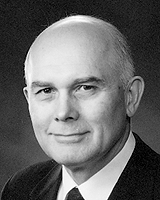
Have You Been Saved? by Elder Dallin H. Oaks of the Quorum of the Twelve Apostles |
What do we say when someone asks us, "Have you been saved?" This question, so common in the conversation of some Christians, can be puzzling to members of The Church of Jesus Christ of Latter-day Saints because it is not our usual way of speaking. We tend to speak of "saved" or "salvation" as a future event rather than something that has already been realized.
Good Christian people sometimes attach different meanings to some key gospel terms like saved or salvation. If we answer according to what our questioner probably means in asking if we have been "saved," our answer must be "yes." If we answer according to the various meanings we attach to the terms saved or salvation, our answer will be either "yes" or "yes, but with conditions."
I.
As I understand what is meant by the good Christians who speak in these terms, we are "saved" when we sincerely declare or confess that we have accepted Jesus Christ as our personal Lord and Savior. This meaning relies on words the Apostle Paul taught the Christians of his day:
"If thou shalt confess with thy mouth the Lord Jesus, and shalt believe in thine heart that God hath raised him from the dead, thou shalt be saved.
"For with the heart man believeth unto righteousness; and with the mouth confession is made unto salvation" (Rom. 10:910).
To Latter-day Saints, the words saved and salvation in this teaching signify a present covenant relationship with Jesus Christ in which we are assured salvation from the consequences of sin if we are obedient. Every sincere Latter-day Saint is "saved" according to this meaning. We have been converted to the restored gospel of Jesus Christ, we have experienced repentance and baptism, and we are renewing our covenants of baptism by partaking of the sacrament.
II.
As Latter-day Saints use the words saved and salvation, there are at least six different meanings. According to some of these, our salvation is assured--we are already saved. In others, salvation must be spoken of as a future event (e.g., 1 Cor. 5:5) or as conditioned upon a future event (e.g., Mark 13:13). But in all of these meanings, or kinds of salvation, salvation is in and through Jesus Christ.
First, all mortals have been saved from the permanence of death through the Resurrection of Jesus Christ. "For as in Adam all die, even so in Christ shall all be made alive" (1 Cor. 15:22).
As to salvation from sin and the consequences of sin, our answer to the question of whether or not we have been saved is "yes, but with conditions." Our third article of faith declares our belief:
"We believe that through the Atonement of Christ, all mankind may be saved, by obedience to the laws and ordinances of the Gospel" (A of F 1:3).
Many Bible verses declare that Jesus came to take away the sins of the world (e.g., John 1:29; Matt. 26:28). The New Testament frequently refers to the grace of God and to salvation by grace (e.g., John 1:17; Acts 15:11; Eph. 2:8). But it also has many specific commandments on personal behavior, and many references to the importance of works (e.g., Matt. 5:16; Eph. 2:10; James 2:1417). In addition, the Savior taught that we must endure to the end in order to be saved (see Matt. 10:22; Mark 13:13).
Relying upon the totality of Bible teachings and upon clarifications received through modern revelation, we testify that being cleansed from sin through Christ's Atonement is conditioned upon the individual sinner's faith, which must be manifested by obedience to the Lord's command to repent, be baptized, and receive the Holy Ghost (see Acts 2:3738). "Verily, verily, I say unto thee," Jesus taught, "Except a man be born of water and of the Spirit, he cannot enter into the kingdom of God" (John 3:5; see also Mark 16:16; Acts 2:3738). Believers who have had this required rebirth at the hands of those having authority have already been saved from sin conditionally, but they will not be saved finally until they have completed their mortal probation with the required continuing repentance, faithfulness, service, and enduring to the end.
Some Christians accuse Latter-day Saints who give this answer of denying the grace of God through claiming they can earn their own salvation. We answer this accusation with the words of two Book of Mormon prophets. Nephi taught, "For we labor diligently . . . to persuade our children . . . to believe in Christ, and to be reconciled to God; for we know that it is by grace that we are saved, after all we can do" (2 Ne. 25:23). And what is "all we can do"? It surely includes repentance (see Alma 24:11) and baptism, keeping the commandments, and enduring to the end. Moroni pleaded, "Yea, come unto Christ, and be perfected in him, and deny yourselves of all ungodliness; and if ye shall deny yourselves of all ungodliness, and love God with all your might, mind and strength, then is his grace sufficient for you, that by his grace ye may be perfect in Christ" (Moro. 10:32).
We are not saved in our sins, as by being unconditionally saved through confessing Christ and then, inevitably, committing sins in our remaining lives (see Alma 11:3637). We are saved from our sins (see Hel. 5:10) by a weekly renewal of our repentance and cleansing through the grace of God and His blessed plan of salvation (see 3 Ne. 9:2022).
The question of whether a person has been saved is sometimes phrased in terms of whether that person has been "born again." Being "born again" is a familiar reference in the Bible and the Book of Mormon. As noted earlier, Jesus taught that except a man was "born again" (John 3:3), of water and of the Spirit, he could not enter into the kingdom of God (see John 3:5). The Book of Mormon has many teachings about the necessity of being "born again" or "born of God" (Mosiah 27:25; see vv. 2426; Alma 36:24, 26; Moses 6:59). As we understand these scriptures, our answer to whether we have been born again is clearly "yes." We were born again when we entered into a covenant relationship with our Savior by being born of water and of the Spirit and by taking upon us the name of Jesus Christ. We can renew that rebirth each Sabbath when we partake of the sacrament.
Latter-day Saints affirm that those who have been born again in this way are spiritually begotten sons and daughters of Jesus Christ (see Mosiah 5:7; 15:913; 27:25). Nevertheless, in order to realize the intended blessings of this born-again status, we must still keep our covenants and endure to the end. In the meantime, through the grace of God, we have been born again as new creatures with new spiritual parentage and the prospects of a glorious inheritance.
A fourth meaning of being saved is to be saved from the darkness of ignorance of God the Father and His Son, Jesus Christ, and of the purpose of life, and of the destiny of men and women. The gospel made known to us by the teachings of Jesus Christ has given us this salvation. "I am the light of the world," Jesus taught; "he that followeth me shall not walk in darkness, but shall have the light of life" (John 8:12; also see John 12:46).
For Latter-day Saints, being "saved" can also mean being saved or delivered from the second death (meaning the final spiritual death) by assurance of a kingdom of glory in the world to come (see 1 Cor. 15:40-42). Just as the Resurrection is universal, we affirm that every person who ever lived upon the face of the earth--except for a very few--is assured of salvation in this sense. As we read in modern revelation:
"And this is the gospel, the glad tidings . . .
"That he came into the world, even Jesus, to be crucified for the world, and to bear the sins of the world, and to sanctify the world, and to cleanse it from all unrighteousness;
"That through him all might be saved whom the Father had put into his power and made by him;
"Who glorifies the Father, and saves all the works of his hands, except those sons of perdition who deny the Son after the Father has revealed him" (D&C 76:40-43; emphasis added).
The prophet Brigham Young taught that doctrine when he declared that "every person who does not sin away the day of grace, and become an angel to the Devil, will be brought forth to inherit a kingdom of glory" (Teachings of Presidents of the Church: Brigham Young [1997], 288). This meaning of saved ennobles the whole human race through the grace of our Lord and Savior, Jesus Christ. In this sense of the word, all should answer: "Yes, I have been saved. Glory to God for the gospel and gift and grace of His Son!"
Finally, in another usage familiar and unique to Latter-day Saints, the words saved and salvation are also used to denote exaltation or eternal life (see Abr. 2:11). This is sometimes referred to as the "fulness of salvation" (Bruce R. McConkie, The Mortal Messiah, 4 vols. [197981], 1:242). This salvation requires more than repentance and baptism by appropriate priesthood authority. It also requires the making of sacred covenants, including eternal marriage, in the temples of God, and faithfulness to those covenants by enduring to the end. If we use the word salvation to mean "exaltation," it is premature for any of us to say that we have been "saved" in mortality. That glorious status can only follow the final judgment of Him who is the Great Judge of the living and the dead.
I have suggested that the short answer to the question of whether a faithful member of The Church of Jesus Christ of Latter-day Saints has been saved or born again must be a fervent "yes." Our covenant relationship with our Savior puts us in that "saved" or "born again" condition meant by those who ask this question. Some modern prophets have also used "salvation" or "saved" in that same present sense. President Brigham Young declared:
"It is present salvation and the present influence of the Holy Ghost that we need every day to keep us on saving ground. . . .
"I want present salvation. . . . Life is for us, and it is for us to receive it today, and not wait for the Millennium. Let us take a course to be saved today" (Discourses of Brigham Young, sel. John A. Widtsoe [1954], 1516). President David O. McKay spoke of the revealed gospel of Jesus Christ in that same present sense of "salvation here--here and now" (Gospel Ideals [1953], 6).
III.
I will conclude by discussing another important question members and leaders of The Church of Jesus Christ of Latter-day Saints are asked by others: "Why do you send missionaries to preach to other Christians?" Sometimes this is asked with curiosity and sometimes with resentment.
My most memorable experience with that question occurred some years ago in what we then called the Eastern Bloc. After many years of Communist hostility to religion, these countries were suddenly and miraculously given a measure of religious freedom. When that door opened, many Christian faiths sent missionaries. As part of our preparation to do so, the First Presidency sent members of the Quorum of the Twelve Apostles to meet with government and church leaders in these countries. Our assignment was to introduce ourselves and to explain what our missionaries would be doing.
Elder Russell M. Nelson and I called on the leader of the Orthodox Church in one of these countries. Here was a man who had helped keep the light of Christianity burning through the dark decades of Communist repression. I noted in my journal that he was a warm and gracious man who impressed me as a servant of the Lord. I mention this so that you will not think there was any spirit of arrogance or contention in our conversation of nearly an hour. Our visit was pleasant and cordial, filled with the goodwill that should always characterize conversations between men and women who love the Lord and seek to serve Him, each according to his or her own understanding.
Our host told us about the activities of his church during the period of Communist repression. He described the various difficulties his church and its work were experiencing as they emerged from that period and sought to regain their former position in the life of the country and the hearts of the people. We introduced ourselves and our fundamental beliefs. We explained that we would soon be sending missionaries into his country and told him how they would perform their labors.
He asked, "Will your missionaries preach only to unbelievers, or will they also try to preach to believers?" We replied that our message was for everyone, believers as well as unbelievers. We gave two reasons for this answer--one a matter of principle and the other a matter of practicality. We told him that we preached to believers as well as unbelievers because our message, the restored gospel, makes an important addition to the knowledge, happiness, and peace of all mankind. As a matter of practicality, we preach to believers as well as unbelievers because we cannot tell the difference. I remember asking this distinguished leader, "When you stand before a congregation and look into the faces of the people, can you tell the difference between those who are real believers and those who are not?" He smiled wryly, and I sensed an admission that he had understood the point.
Through missionaries and members, the message of the restored gospel is going to all the world. To non-Christians, we witness of Christ and share the truths and ordinances of His restored gospel. To Christians we do the same. Even if a Christian has been "saved" in the familiar single sense discussed earlier, we teach that there remains more to be learned and more to be experienced. As President Hinckley recently said, "[We are] not argumentative. We do not debate. We, in effect, simply say to others, 'Bring all the good that you have and let us see if we can add to it'" ("The BYU Experience," BYU devotional address, 4 Nov. 1997).
The Church of Jesus Christ of Latter-day Saints offers all of the children of God the opportunity to learn the fulness of the gospel of Jesus Christ as restored in these latter days. We offer everyone the privilege of receiving all of the ordinances of salvation and exaltation.
We invite all to hear this message, and we invite all who receive the confirming witness of the Spirit to heed it. These things are true, I testify in the name of Jesus Christ, amen.
To: scottiewottie
You exalt your church. I will exalt Jesus Christ.
16
posted on
06/13/2002 12:41:04 PM PDT
by
aimhigh
To: aimhigh;scottiewottie
You exalt your church. I will exalt Jesus Christ. You just can't admit truth, so you distort the reply when it is all build on the Word of Jesus Christ. You folks are not honest in your souls, there no need to continue the discussion.
17
posted on
06/13/2002 12:46:49 PM PDT
by
restornu
To: restornu
Presented with absolute, undeniable proof that the teaching of Joseph Smith and all the past and current leaders of the LDS were false and based on heretical beliefs, would you repudiate your belief in the LDS? Or would you dismiss the proof as examples of gain-sayers and haters of the LDS?
18
posted on
06/13/2002 12:50:22 PM PDT
by
Wrigley
To: aimhigh
Not my church. So again, which Biblical doctrines do you deny?
To: Wrigley
Presented with absolute, undeniable proof that the teaching of Joseph Smith and all the past and current leaders of the LDS were false and based on heretical beliefs, would you repudiate your belief in the LDS? The mainstream Christian world has been presented with absolute, undeniable proof that apostasy has overcome those responsible for maintaining the purity of the Christian faith and doctrine during the last 2000 years, and yet, somehow, mainstream Christians never repudiate their belief in mainstream Christianity.
You might have more success with convincing us "Mormons" of how bad off we really are, except you have no place for us to go that's any better. If Joseph Smith taught false doctrine, good luck on convincing us that we'd be better off by joining ourselves to the followers of Luther or Wesley or any of the other Reformers, let alone going back to the Roman Catholic or Orthodox churches.
From our vantage point, the argument you seem to be making is "our version of apostasy is better than yours". We remain unconvinced.
Navigation: use the links below to view more comments.
first 1-20, 21-24 next last
Disclaimer:
Opinions posted on Free Republic are those of the individual
posters and do not necessarily represent the opinion of Free Republic or its
management. All materials posted herein are protected by copyright law and the
exemption for fair use of copyrighted works.
FreeRepublic.com is powered by software copyright 2000-2008 John Robinson