Posted on 11/23/2026 10:46:18 AM PST by annalex
Monday of week 34 in Ordinary Time Basilica of San Clemente, Rome Readings at MassThis is a preview of Universalis. The Universalis app gives you every day of every year, not just the single week you’re seeing now, and it doesn’t need the Internet. It gives you the official New American Bible version for the readings at Mass. As well as the Mass, it gives you the Liturgy of the Hours. It costs $9.99-12.99 on your phone, or £19.99 (about $26.50) on your computer. Get it now. Liturgical Colour: Green. Year: A(II).
The redeemed have Christ and his Father's name written on their foreheadsIn my vision I, John, saw Mount Zion, and standing on it a Lamb who had with him a hundred and forty-four thousand people, all with his name and his Father’s name written on their foreheads. I heard a sound coming out of the sky like the sound of the ocean or the roar of thunder; it seemed to be the sound of harpists playing their harps. There in front of the throne they were singing a new hymn in the presence of the four animals and the elders, a hymn that could only be learnt by the hundred and forty-four thousand who had been redeemed from the world; they follow the Lamb wherever he goes; they have been redeemed from amongst men to be the first-fruits for God and for the Lamb. They never allowed a lie to pass their lips and no fault can be found in them.
Such are the men who seek your face, O Lord. The Lord’s is the earth and its fullness, the world and all its peoples. It is he who set it on the seas; on the waters he made it firm. Such are the men who seek your face, O Lord. Who shall climb the mountain of the Lord? Who shall stand in his holy place? The man with clean hands and pure heart, who desires not worthless things. Such are the men who seek your face, O Lord. He shall receive blessings from the Lord and reward from the God who saves him. Such are the men who seek him, seek the face of the God of Jacob. Such are the men who seek your face, O Lord.
Alleluia, alleluia! Even if you have to die, says the Lord, keep faithful, and I will give you the crown of life. Alleluia!
Alleluia, alleluia! Stay awake and stand ready, because you do not know the hour when the Son of Man is coming. Alleluia!
The widow's miteAs Jesus looked up, he saw rich people putting their offerings into the treasury; then he happened to notice a poverty-stricken widow putting in two small coins, and he said, ‘I tell you truly, this poor widow has put in more than any of them; for these have all contributed money they had over, but she from the little she had has put in all she had to live on.’ Christian Art![]() Each day, The Christian Art website gives a picture and reflection on the Gospel of the day. The readings on this page are from the Jerusalem Bible, which is used at Mass in most of the English-speaking world. The New American Bible readings, which are used at Mass in the United States, are available in the Universalis apps, programs and downloads. |

|
Click here: to donate by Credit Card Or here: to donate by PayPal Or by mail to: Free Republic, LLC - PO Box 9771 - Fresno, CA 93794 Thank you very much and God bless you. |
KEYWORDS: catholic; lk21; ordinarytime; prayer;

Please FReepmail me to get on/off the Alleluia Ping List.
| Luke | |||
| English: Douay-Rheims | Latin: Vulgata Clementina | Greek NT: Byzantine/Majority Text (2000) | |
| Luke 21 | |||
| 1. | AND looking on, he saw the rich men cast their gifts into the treasury. | Respiciens autem, vidit eos qui mittebant munera sua in gazophylacium, divites. | αναβλεψας δε ειδεν τους βαλλοντας τα δωρα αυτων εις το γαζοφυλακιον πλουσιους |
| 2. | And he saw also a certain poor widow casting in two brass mites. | Vidit autem et quamdam viduam pauperculam mittentem æra minuta duo. | ειδεν δε τινα και χηραν πενιχραν βαλλουσαν εκει δυο λεπτα |
| 3. | And he said: Verily I say to you, that this poor widow hath cast in more than they all: | Et dixit : Vere dico vobis, quia vidua hæc pauper plus quam omnes misit. | και ειπεν αληθως λεγω υμιν οτι η χηρα η πτωχη αυτη πλειον παντων εβαλεν |
| 4. | For all these have of their abundance cast into the offerings of God: but she of her want, hath cast in all the living that she had. | Nam omnes hi ex abundanti sibi miserunt in munera Dei : hæc autem ex eo quod deest illi, omnem victum suum quem habuit, misit. | απαντες γαρ ουτοι εκ του περισσευοντος αυτοις εβαλον εις τα δωρα του θεου αυτη δε εκ του υστερηματος αυτης απαντα τον βιον ον ειχεν εβαλεν |

1. And he looked up, and saw the rich men casting their gifts into the treasury.
2. And he saw also a certain poor widow casting in thither two mites.
3. And he said, Of a truth I say unto you, that this poor widow hath cast in more than they all:
4. For all these have of their abundance cast in unto the offerings of God: but she of her penury hath cast in all the living that she had.
GLOSS. (non occ.) Our Lord having rebuked the covetousness of the Scribes who devoured widows’ houses, commends the almsgiving of a widow; as it is said, And he looked up, and saw the rich men casting into the treasury, & c.
BEDE. In the Greek language, φυλάξαι signifies to keep, and gaza in Persian means riches, hence gazophylacium is used for the name of the place in which money is kept. Now there was a chest with an opening at the top placed near the altar, on the right hand of those entering the house of God, into which the Priests cast all the money, which was given for the Lord’s temple. But our Lord as He overthrows those who trade in His house, so also He remarks those who bring gifts, giving praise to the deserving, but condemning the bad. Hence it follows, And he saw also a certain poor widow casting in thither two mites.
CYRIL OF ALEXANDRIA. She offered two oboli, which with the sweat of her brow she had earned for her daily living, or what she daily begs for at the hands of others she gives to God, shewing that her poverty is fruitful to her. Therefore does she surpass the others, and by a just award receives a crown from God; as it follows, Of a truth I say unto you, that this poor widow hath cast in more, &c.
BEDE. For whatever we offer with an honest heart is well pleasing to God, who hath respect unto the heart, not the substance, nor does He weigh the amount of that which is given in sacrifice, but of that from which it is taken; as it follows, For all these have cast in of their abundance, but she all that she had.
CHRYSOSTOM. (Hom. 1. in Ep. ad Heb., Hom. 28.) For God regarded not the scantiness of the offering, but the overflowing of the affection. Almsgiving is not the bestowing a few things out of many, but it is that of the widow emptying, herself of her whole substance. But if you cannot offer as much as the widow, at least give all that remains over.
BEDE. Now mystically, the rich men who cast their gifts into the treasury signify the Jews puffed up with the righteousness of the law; the poor widow, the simplicity of the Church which is called poor, because it has either cast away the spirit of pride, or its sins, as if they were worldly riches. But the Church is a widow, because her Husband endured death for her. She cast two mites into the treasury, because in God’s sight, in whose keeping are all the offerings of our works, she presents her gifts, whether of love to God and her neighbour, or of faith and prayer. And these excel all the works of the proud Jews, for they of their abundance cast into the offerings of God, in that they presume on their righteousness, but the Church casts in all her living, for every thing that hath life she believes to be the gift of God.
THEOPHYLACT. Or the widow may be taken to mean any soul bereft as it were of her first husband, the ancient law, and not worthy to be united to the Word of God. Who brings to God instead of a dowry faith and a good conscience, and so seems to offer more than those who are rich in words, and abound in the moral virtues of the Gentiles.
Catena Aurea Luke 21
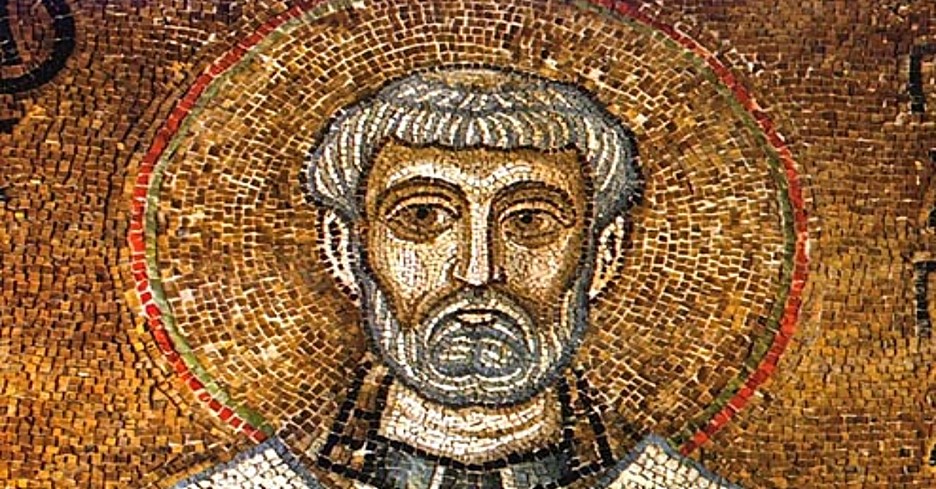
Clement of Rome was the third successor of Saint Peter, reigning as pope during the last decade of the first century. He’s known as one of the Church’s five “Apostolic Fathers,” those who provided a direct link between the Apostles and later generations of Church Fathers.
Clement’s First Epistle to the Corinthians was preserved and widely read in the early Church. This letter from the bishop of Rome to the Church in Corinth concerns a split that alienated a large number of the laity from the clergy. Deploring the unauthorized and unjustifiable division in the Corinthian community, Clement urged charity to heal the rift.
Today many in the Church experience polarization regarding worship, how we speak of God, and other issues. We’d do well to take to heart the exhortation from Clement’s Epistle: “Charity unites us to God. It knows no schism, does not rebel, does all things in concord. In charity all the elect of God have been made perfect.”
Rome’s Basilica of St. Clement, one of the city’s earliest parish churches, is probably built on the site of Clement’s home. History tells us that Pope Clement was martyred either in the year 99 or in 101. His liturgical feast is celebrated on November 23.
Marble Workers
Mariners
Tanners

I visited the basilica in Rome, the excavations are incredible https://www.basilicasanclemente.com/eng/
Disclaimer: Opinions posted on Free Republic are those of the individual posters and do not necessarily represent the opinion of Free Republic or its management. All materials posted herein are protected by copyright law and the exemption for fair use of copyrighted works.