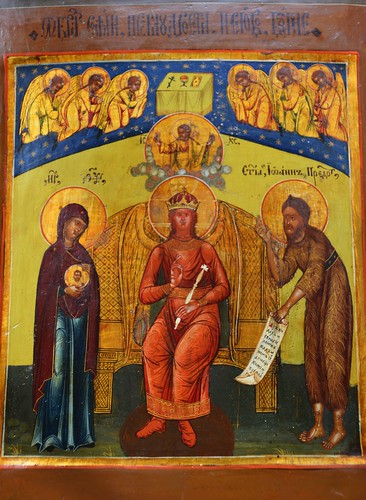
Catena Aurea by St. Thomas Aguinas
18:1–8
1. And he spake a parable unto them to this end, that men ought always to pray, and not to faint;
2. Saying, There was in a city a judge, which feared not God, neither regarded man:
3. And there was a widow in that city; and she came unto him, saying, Avenge me of mine adversary.
4. And he would not for a while: but afterwards he said within himself, Though I fear not God, nor regard man;
5. Yet because this widow troubleth me, I will avenge her, lest by her continual coming she weary me.
6. And the Lord said, Hear what the unjust judge saith.
7. And shall not God avenge his own elect, which cry day and night unto him, though he bear long with them?
8. I tell you that he will avenge them speedily. Nevertheless when the Son of man cometh, shall he find faith on the earth?
THEOPHYLACT. Our Lord having spoken of the trials and dangers which were coming, adds immediately afterward their remedy, namely, constant and earnest prayer.
CHRYSOSTOM. He who hath redeemed thee, hath shewn thee what He would have thee do. He would have thee be instant in prayer, He would have thee ponder in thy heart the blessings thou art praying for, He would have thee ask and receive what His goodness is longing to impart. He never refuses His blessings to them that pray, but rather stirs men up by His mercy not to faint in praying. Gladly accept the Lord’s encouragement: be willing to do what He commands, not to do what He forbids. Lastly, consider what a blessed privilege is granted thee, to talk with God in thy prayers, and make known to Him all thy wants, while He though not in words, yet by His mercy, answers thee, for He despiseth not petitions, He tires not but when thou art silent.
BEDE. We should say that he is always praying, and faints not, who never fails to pray at the canonical hours. Or all things which the righteous man does and says towards God, are to be counted as praying.
AUGUSTINE. (lib. ii. qu. 45.) Our Lord utters His parables, either for the sake of the comparison, as in the instance of the creditor, who when forgiving his two debtors all that they owed him was most loved by him who owed him most; or on account of the contrast, from which he draws his conclusion; as, for example, if God so clothe the grass of the field, which to-day is, and tomorrow is cast into the oven, shall he not much more clothe you, O ye of little faith. So also here when he brings forward the case of the unjust judge.
THEOPHYLACT. We may observe, that irreverence towards man is a token of a greater degree of wickedness. For as many as fear not God, yet are restrained by their shame before men, are so far the less sinful; but when a man becomes reckless also of other men, the burden of his sins is greatly increased.
It follows, And there was a widow in that city.
AUGUSTINE. The widow may be said to resemble the Church, which appears desolate until the Lord shall come, who now secretly watches over her. But in the following words, And she came unto him, saying, Avenge me, &c. we are told the reason why the elect of God pray that they may be avenged; which we find also said of the martyrs in the Revelations of St. John, (Rev. 6:10.) though at the same time we are very plainly reminded to pray for our enemies and persecutors. This avenging of the righteous then we must understand to be, that the wicked may perish. And they perish in two ways, either by conversion to righteousness, or by punishment having lost the opportunity of conversion. Although, if all men were converted to God, there would still remain the devil to be condemned at the end of the world. And since the righteous are longing for this end to come, they are not unreasonably said to desire vengeance.
CYRIL OF ALEXANDRIA. Or else; Whenever men inflict injury upon us, we must then think it a noble thing to be forgetful of the evil; but when they offend against the glory of God by taking up arms against the ministers of God’s ordinance, we then approach God imploring His help, and loudly rebuking them who impugn His glory.
AUGUSTINE. (ut sup.) If then with the most unjust judge, the perseverance of the suppliant at length prevailed even to the fulfilment of her desire, how much more confident ought they to feel who cease not to pray to God, the Fountain of justice and mercy? And so it follows. And the Lord said, Hear what, &c.
THEOPHYLACT. As if He said, If perseverance could melt a judge defiled with every sin, how much more shall our prayers incline to mercy God the Father of all mercies! But some have given a more subtle meaning to the parable, saying, that the widow is a soul that has put off the old man, (that is, the devil,) who is her adversary, because she approaches God, the righteous Judge, who neither fears (because He is God alone) nor regards man, for with God there is no respect of persons. Upon the widow then, or soul ever supplicating Him against the devil, God shews mercy, and is softened by her importunity. After having taught us that we must in the last days resort to prayer because of the dangers that are coming, our Lord adds, Nevertheless, when the Son of man cometh, shall he find faith on the earth?
AUGUSTINE. (Serm. 115.) Our Lord speaks this of perfect faith, which is seldom found on earth. See how full the Church of God is; were there no faith, who would enter it? Were there perfect faith, who would not move mountains?
BEDE. When the Almighty Creator shall appear in the form of the Son of man, so scarce will the elect be, that not so much the cries of the faithful as the torpor of the others will hasten the world’s fall. Our Lord speaks then as it were doubtfully, not that He really is in doubt, but to reprove us; just as we sometimes, in a matter of certainty, might use the words of doubt, as, for instance, in chiding a servant, “Remember, am I not thy master?”
AUGUSTINE. (ut sup.) Our Lord adds this to shew, that when faith fails, prayer dies. In order to pray then, we must have faith, and that our faith fail not, we must pray. Faith pours forth prayer, and the pouring forth of the heart in prayer gives stedfastness to faith.
Catena Aurea Luke 18
St Lawrence O’Toole, also called Lorcán Ua Tuathail, was a twelfth-century Irish abbot and archbishop of Dublin. He cared for the poor, reformed religious life and sought peace amid conflict between Irish rulers and the Anglo-Normans. He died on November 14, 1180, and is honored on that date.

Early life and Glendalough
Lawrence was born around 1128 into an important family in the region of Kildare. As a boy he was given as a hostage to Diarmait Mac Murchada during a conflict between families. After his release he entered the religious community at Glendalough, a center of Irish monastic life. The experience of political violence in childhood helps explain the urgency of his later work for reconciliation.
He studied and embraced the disciplined life of the monastery. In 1154, while still young, he became abbot of Glendalough. He worked to restore order and care for the community and its dependents. When the see of Glendalough became vacant, he declined the episcopal office, preferring to continue his service as abbot.
Archbishop of Dublin
After the death of Archbishop Gregory, Lawrence was chosen to lead the Church in Dublin and was consecrated in 1162. He was the first native-born Irishman to hold that archbishopric. He renewed the common religious life of the canons of Christ Church Cathedral and lived austerely himself. His pastoral work included preaching, worship and practical help for people in need.
Dublin endured serious upheaval during the Anglo-Norman advance. Lawrence remained with his people through the siege and its aftermath, tending the wounded and helping the vulnerable. His position required him to deal with rival Irish leaders and the expanding power of Henry II of England. He tried to protect his people and secure agreements that could limit further bloodshed.
Missions for peace
Lawrence took part in the Third Lateran Council in 1179. He also served as an intermediary between the Irish high king Ruaidrí O’Conchobair and Henry II; his diplomacy is associated with the Treaty of Windsor. Political agreements did not end Ireland’s troubles, and Lawrence continued to travel on difficult missions.
During a journey to meet Henry II, Lawrence became ill in Normandy. He died at the abbey of Eu on November 14, 1180. Pope Honorius III canonized him in 1225. His memory has long been cherished in Dublin and beyond.
Legacy and prayer
Lawrence combined the prayer of a monk with the responsibilities of a bishop. His life shows how spiritual leadership can include the patient work of feeding people, reforming institutions and seeking peace when political loyalties divide a community.
God of mercy, through the intercession of St Lawrence O’Toole, help bishops and community leaders care for the poor and work honestly for peace. Give us courage to serve those caught in conflict. Amen.
Sources
Catholic Encyclopedia: St Lawrence O’Toole; Catholic Online: St Lawrence O’Toole.
catholicreadings.org