Catena Aurea by St. Thomas Aguinas
18. Then said he, Unto what is the kingdom of God like? and whereunto shall I resemble it?
19. It is like a grain of mustard seed, which a man took, and cast into his garden; and it grew, and waxed a great tree; and the fowls of the air lodged in the branches of it.
20. And again he said, Whereunto shall I liken the kingdom of God?
21. It is like leaven, which a woman took and hid in three measures of meal, till the whole was leavened.
GLOSS. While His adversaries were ashamed, and the people rejoiced, at the glorious things that were done by Christ, He proceeds to explain the progress of the Gospel under certain similitudes, as it follows, Then said he, Unto what is the kingdom of God like? It is like a grain of mustard seed, &c. (Mat. 17:19.)
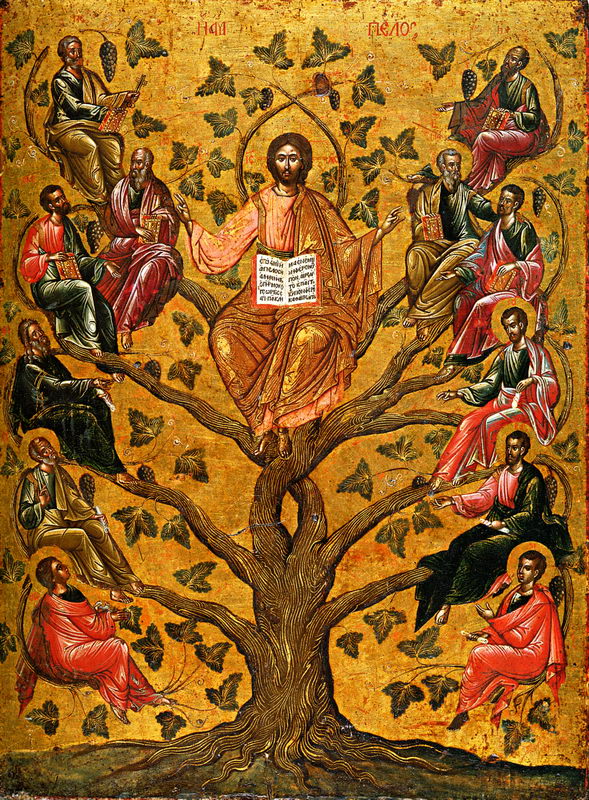
AMBROSE. In another place, a grain of mustard seed is introduced where it is compared to faith. If then the mustard seed is the kingdom of God, and faith is as the grain of mustard seed; faith is truly the kingdom of heaven, which is within us. (Luke 17:21.) A grain of mustard seed is indeed a mean and trifling thing, but as soon as it is crushed, it pours forth its power. And faith at first seems simple, but when it is buffeted by adversity, pours forth the grace of its virtue. The martyrs are grains of mustard seed. They have about them the sweet odour of faith, but it is hidden. Persecution comes; they are smitten by the sword; and to the farthest boundaries of the whole world they have scattered the seeds of their martyrdom. The Lord Himself also is a grain of mustard seed; He wished to be bruised that we might see that we are a sweet savour of Christ. (2 Cor. 2:15.) He wishes to be sown as a grain of mustard seed, which when a man takes he puts it into his garden. For Christ was taken and buried in a garden, where also He rose again and became a tree, as it follows, And it waxed into a great tree. For our Lord is a grain when He is buried in the earth, a tree when He is lifted up into the heaven. He is also a tree overshadowing the world, as it follows, And the fowls of the air rested in his branches; that is, the heavenly powers and they whoever (for their spiritual deeds) have been thought worthy to fly forth. Peter is a branch, Paul is a branch, into whose arms, by certain hidden ways of disputation, we who were a far off now fly, having taken up the wings of the virtues. Sow then Christ in thy garden; a garden is truly a place full of flowers, wherein the grace of thy work may blossom, and the manifold odour of thy different virtues be breathed forth. Wherever is the fruit of the seed, there is Christ.
CYRIL OF ALEXANDRIA. Or else; The kingdom of God is the Gospel, through which we gain the power of reigning with Christ. As then the mustard seed is surpassed in size by the seeds of other herbs, yet so increases as to become the shelter of many birds; so also the life-giving doctrine was at first in the possession only of a few, but afterwards spread itself abroad.
BEDE. Now the man, is Christ, the garden, His Church, to be cultivated by His discipline. He is well said to have taken the grain, because the gifts which He together with the Father gave to us from His divinity, He took from His humanity. But the preaching of the Gospel grew and was disseminated throughout the whole world. It grows also in the mind of every believer, for no one is suddenly made perfect. But in its growth, not like the grass, (which soon withers,) but it rises up like the trees. The branches of this tree are the manifold doctrines, on which the chaste souls, soaring upwards on the wings of virtue, build and repose.
THEOPHYLACT. Or, any man receiving a grain of mustard seed, that is, the word of the Gospel, and sowing it in the garden of his soul, makes it a great tree, so as to bring forth branches, and the birds of the air (that is, they who soar above the earth) rest in the branches, (that is, in sublime contemplation.) For Paul received the instruction of Ananias (Acts 9:17.) as it were a small grain, but planting it in his garden, he brought forth many good doctrines, in which they dwell who have high heavenly thoughts, as Dionysius, Hierotheus, and many others.
He next likens the kingdom of God to leaven, for it follows, And again he says, Whereunto shall I liken it? It is like to leaven, &c.
AMBROSE. Many think Christ is the leaven, for leaven which is made from meal, excels its kind in strength, not in appearance. So also Christ (according to the Fathers) shone forth above others equal in body, but unapproachable in excellence. The Holy Church therefore represents the type of the woman, of whom it is added, Which a woman, took and hid in three measures (sata) of meal, till the whole was leavened.
BEDE. The Satum is a kind of measure in use in the province of Palestine, holding about a bushel and a half.
AMBROSE. But we are the meal of the woman which hide the Lord Jesus in the secrets of our hearts, until the heat of heavenly wisdom penetrates our innermost recesses. And since He says it was hid in three measures, it seems fitting that we should believe the Son of God to have been hid in the Law, veiled in the Prophets, manifested in the preaching of the Gospel. Here however I am invited to proceed farther, because our Lord Himself has taught us, that the leaven is the spiritual teaching of the Church. Now the Church sanctifies with its spiritual leaven the man who is renewed in body, soul, and spirit, seeing that these three are united in a certain equal measure of desire, and there breathes forth a complete harmony of the will. If then in this life the three measures abide in the same person until they are leavened and become one, there will be hereafter an incorruptible communion with them that love Christ.
THEOPHYLACT. Or, for the woman you must understand the soul; but the three measures, its three parts, the reasoning part, the affections, and the desires. If then any one has hidden in these three the word of God, he will make the whole spiritual, so as not by his reason to lie in argument, nor by his anger or desire to be transported beyond control, but to be conformed to the word of God.
AUGUSTINE. (Serm. 111.) Or, the three measures of meal are the race of mankind, which was restored out of the three sons of Noah. The woman who hid the leaven is the wisdom of God.
EUSEBIUS. Or else, by the leaven our Lord means the Holy Spirit, the Sower proceeding (as it were) from the seed, which is the word of God. But the three measures of meal, signify the knowledge of the Father, and the Son, and the Holy Spirit, which the woman, that is, Divine wisdom, and the Holy Spirit, impart.
BEDE. Or, by the leaven He speaks of love, which kindles and stirs up the heart; the woman, that is, the Church, hides the leaven of love in three measures, because she bids us love God with all our hearts, all our minds, and all our strength. And this until the whole is leavened, that is, until love moves the whole soul into the perfection of itself, which begins here, but will be completed hereafter.
Catena Aurea Luke 13
Who Was Saint Frumentius of Ethiopia?
Saints
The shipwrecked Phoenician youth who became the first bishop of Axum and is honored as the apostle who brought Christianity to Ethiopia.
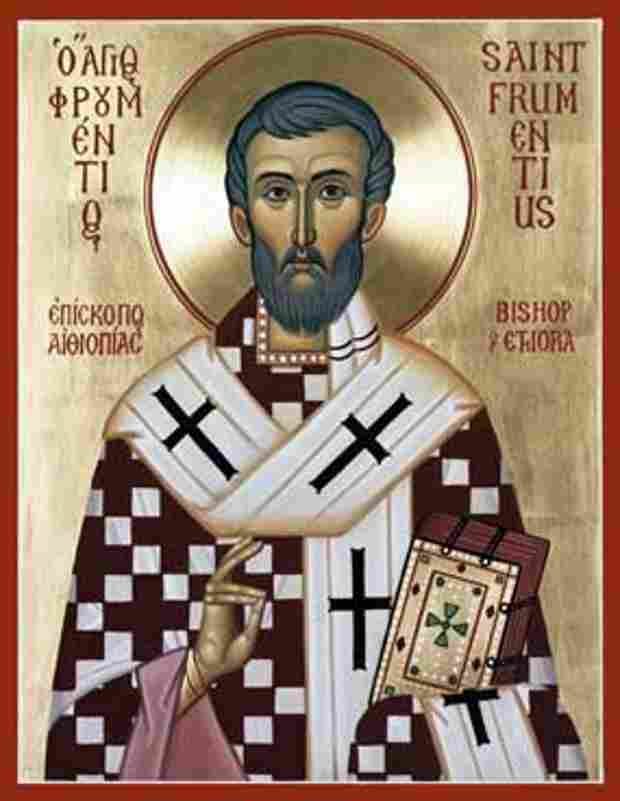
Saint Frumentius was consecrated the first bishop of Axum by Saint Athanasius of Alexandria and died there around 383. Tradition holds he was shipwrecked as a young man on the Red Sea coast, rose to influence at the Aksumite royal court, and used that position to plant the seeds of a Christian community that grew into one of the oldest continuously Christian nations on earth.
Quick Facts
- Died: c. 383, Axum, Ethiopia
- Role: First Bishop of Axum
- Known in Ethiopian tradition as: Abba Selama, ‘Father of Peace’
- Venerated as: Apostle of Ethiopia
Who Was Saint Frumentius of Ethiopia?
According to the early historian Rufinus, who says he heard the account directly from Frumentius’s companion Aedesius, Frumentius was a young Phoenician or Tyrian traveler shipwrecked on the Red Sea coast of the Aksumite kingdom. Taken into the royal household, he rose to a position of trust, eventually serving as tutor and later regent-adviser to the young king. Using his influence, he encouraged Roman and other Christian merchants already present in the kingdom to practice their faith openly and, in time, requested that Athanasius of Alexandria, then patriarch, send a bishop for the growing Christian community — Athanasius consecrated Frumentius himself for the task.
Historical Setting
Fourth-century Axum was a major trading power linking the Roman Mediterranean world to the Red Sea, India, and beyond, which made it a natural conduit for the spread of Christianity even as the faith was still consolidating within the Roman Empire itself. Frumentius’s consecration by Athanasius, one of the towering theological figures of the century, tied the young Ethiopian Church from its very beginning to the wider communion of the apostolic sees, a bond the Ethiopian Church has maintained in its own distinctive form ever since.
Why the Church Remembers Frumentius of Ethiopia
The Church remembers Frumentius as the founding bishop of a Christian nation, still called Abba Selama, ‘Father of Peace,’ in Ethiopian tradition. Under his ministry the Aksumite royal house itself converted, making Ethiopia one of the very first states in the world to adopt Christianity as a matter of public life, alongside Armenia, and centuries before most of Europe.
Canonization and Feast Day
No formal Latin canonization process applies to a fourth-century missionary bishop working outside the structures that later developed such processes; Frumentius’s veneration is ancient, shared across the Ethiopian, Coptic, and wider Christian traditions, and received into the Roman Martyrology as an honored bishop and evangelist.
What Catholics Can Learn Today
Frumentius’s path to sainthood began with a shipwreck — a disaster he had no say in, turned by grace into the opening for an entire nation’s evangelization. Catholics today can take real comfort from that: circumstances we never chose and would never have chosen can still become, in God’s hands, the very means by which good is done far beyond what we could have planned.
A Prayer to Saint Frumentius of Ethiopia
Saint Frumentius, apostle of Ethiopia, you turned shipwreck and captivity into an opening for the Gospel. Help us trust that God can use even our hardest circumstances for a purpose larger than ourselves. Amen.
Sources
- Rufinus of Aquileia, Ecclesiastical History, Book X
- New Advent Catholic Encyclopedia, ‘Ethiopia’
- Roman Martyrology, entry for 27 October
catholic-repository.org