Posted on 10/20/2026 2:23:31 PM PDT by ebb tide
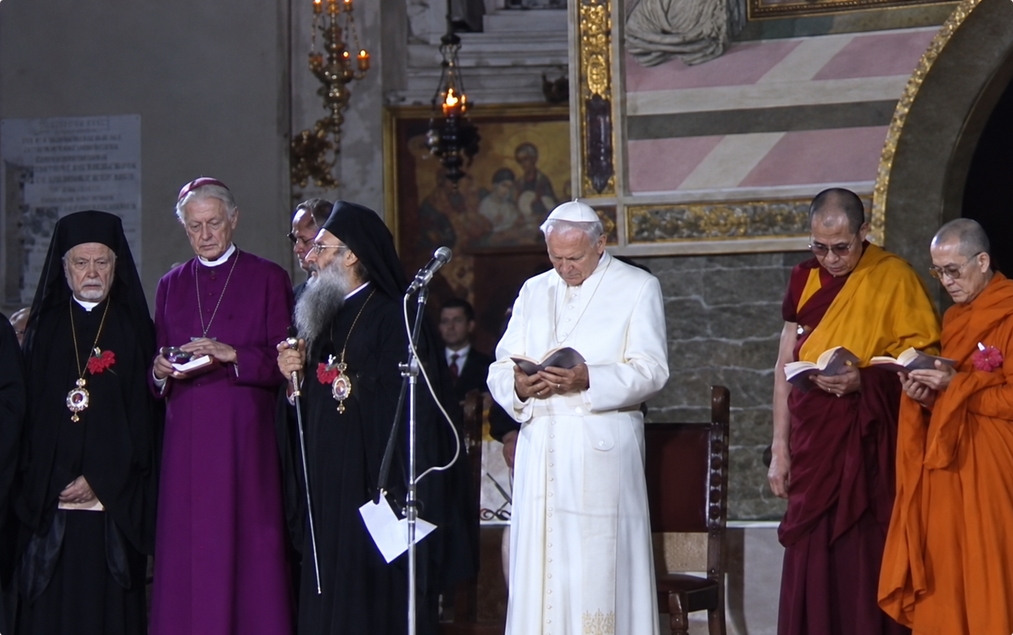
The Prefect of the Dicastery for Interreligious Dialogue has said that Catholic opposition to the controversial 1986 Assisi interreligious prayer meeting contributed to a “schismatic rupture” and argued that the event now forms part of the Church’s ordinary Magisterium.
Speaking at the Pontifical University Antonianum in Rome on earlier this month, Cardinal George Jacob Koovakad presented the gathering convened by Pope Saint John Paul II as a prophetic moment for interreligious dialogue, arguing that its legacy should serve as a criterion for interpreting contemporary Church teaching.
“With these words, 27 October 1986 enters into the ordinary teaching of the Magisterium. It is no longer merely an event to remember: it is a criterion through which to interpret the present,” Cardinal Koovakad said, connecting the meeting to Pope Leo XIV’s encyclical Magnifica Humanitas.
The remarks were delivered during the opening meeting of a lecture series entitled The Spirit of Assisi between Memory and Prophecy, organised by the Franciscan Institute of Spirituality at the Antonianum’s Faculty of Theology. Dedicated to the memory of Mgr Luigi Padovese, the series forms part of the preparations marking the 40th anniversary of the World Day of Prayer for Peace held in Assisi on 27 October 1986.
Cardinal Koovakad’s address, entitled The Meeting of 27 October 1986 and Leo XIV’s Magnifica Humanitas, sought to establish a direct connection between the gathering organised by John Paul II and the present pontificate’s teaching on fraternity, peace and relations between religions.
The cardinal recalled how 160 religious leaders assembled in Assisi in 1986 “to pray: each faithful to his own tradition, all before the Mystery”. He maintained that the meeting had been intended to bring religious representatives together without merging their distinct beliefs or practices.
“The happiest formula to describe what happened, years later, was this: in Assisi one found oneself together to pray, not to ‘pray together’,” His Eminence said.
“Being together to pray: each faithful to his own tradition, all before the Mystery. There was no mixing of rites nor ambiguous common prayer.”
Cardinal Koovakad invoked John Paul II’s address to the Roman Curia on 22 December 1986, in which the Polish Pope defended the gathering against accusations of religious syncretism. According to Cardinal Koovakad, the meeting had been “conceived and lived without any shadow of syncretism”.
“Praying beside one another does not mean extinguishing differences,” His Eminence said. “It means recognising, each from the root of his own faith, that peace is a gift we do not possess and must ask for.”
The cardinal’s insistence on the organisers’ stated intentions comes amid longstanding Catholic objections to the Assisi gathering, particularly among traditionalists who have argued that the event risked suggesting that different religions could be placed on an equal footing.
The placement of a statue of Buddha on top of the tabernacle of the Church of St Peter in Assisi has been cited as evidence of the religious ambiguity surrounding the event. Cardinal Koovakad, however, maintained that the gathering had been free from syncretism, emphasising the distinction between praying alongside representatives of other religions and participating in a common religious rite.
Cardinal Koovakad stressed the compatibility of what he presented as maximum fidelity to one’s own tradition with dialogue between religions. However, the cardinal also directly addressed opposition to the gathering, placing criticism of Assisi within the history of divisions in the Church.
“Not everyone understood it. Integrist circles contested that day, even making it one of the reasons for a schismatic rupture; others feared syncretism or relativism, as they still do today,” Cardinal Koovakad said.
He argued that the meeting responded to a wider historical need, pointing to “the search for peace, the overcoming of the logic of the blocs, the ecumenical movement, interreligious dialogue, the rediscovery of the common root in the faith of Abraham”.
By linking objections to the Assisi gathering with a subsequent schismatic break, the cardinal presented traditionalist resistance as part of a failure to understand the event’s intended purpose. He also suggested that concerns about syncretism and relativism remained present in contemporary Catholic debate.
Drawing on Magnifica Humanitas, the cardinal said that the “spirit of Assisi”, initiated by John Paul II and carried forward through the commitment of Pope Francis, demonstrated that believers could remain faithful to their own religious traditions while rejecting hostility in the name of religion.
“The ‘spirit of Assisi,’ brought forth by Saint John Paul II and continued through the commitment of Pope Francis, shows that believers can draw anew from the most authentic sources of their own traditions, where there is no room for sacralized hatred,” the prefect said.
Cardinal Koovakad previously spoke to AdVaticanum in an interview about the relationship between interreligious dialogue and evangelisation, insisting that the two were “interrelated yet not interchangeable”. Asked whether dialogue could coexist with proclaiming the Gospel without inherent conflict, the cardinal cited the document Dialogue and Proclamation, arguing that dialogue did not replace evangelisation and that the Church must continue to proclaim Jesus Christ as Lord and Saviour.
His Eminence also discussed Pope Leo XIV’s April visit to Africa, including the Pope’s encounter with a mosque, maintaining that entering a non-Christian place of worship should be understood as a gesture of “respect, dialogue, peace, and shared human solidarity”, rather than religious relativism or syncretism.
Referring to the distinction between “praying together” and “being together for prayer”, Cardinal Koovakad argued that such gestures could promote fraternity and mutual understanding without denying the uniqueness of Christ.
Really, Cardinal?
The placement of a statue of Buddha on top of the tabernacle of the Church of St Peter in Assisi has been cited as evidence of the religious ambiguity surrounding the event.
These Assisi “love-fests” are a slap in the face to all the Catholic missionary martyrs who gave their lives to spread the true faith.
Ping
I spent a month in Italy many years ago. Assisi was the only place that felt really holy to me, though I’d seen Vatican City . So now they’re going to screw that up too?
Sounds like Groucho Marx is running the Church now. See my tag line for Grouch’s most favorite quote.
An “event” cannot be part of Church teaching. The violation of priestly celibacy and poisonings by the Borgias were acts of papacies, and they are not part of the Church’s teaching authority (Magisterium) either.
There is a BIG difference between praying side by side with a person of another religion and The Pope praying beside several persons of other religions in public with the press present.
This is the sin of Scandal. This is the Pope showing Indifferentism to the public. Even if it is not his intension most of the public will see it that way.
The new Magisterium: All religions are the same. There is no
“One True Church”.
This is not the Middle Ages. Get with the modern world and stop being so rigid!
/s
“If you start to fight, ‘my religion is more important than yours, mine is true and yours isn’t’, where will that lead us?” he asked aloud. “There’s only one God, and each of us has a language to arrive at God. Some are Sikh, Muslim, Hindu, Christian, and they are different paths [to God].”
I am the Way, the Truth, and the Light. No one comes unto the Father, but by me.
We can just scratch that part out.
Disclaimer: Opinions posted on Free Republic are those of the individual posters and do not necessarily represent the opinion of Free Republic or its management. All materials posted herein are protected by copyright law and the exemption for fair use of copyrighted works.