Free Republic
Browse · Search
Religion
Topics · Post Article

Skip to comments.

Catholic Caucus: Daily Mass Readings 19-October-2026
Universalis/Jerusalem Bible ^

Posted on 10/19/2026 3:31:40 PM PDT by annalex

19 October 2026

Saints John de Brébeuf and Isaac Jogues, priests, and their Companions, Martyrs


St. Jean Brébeuf Church, Lakefield, Ontario

Readings at Mass

This is a preview of Universalis. The Universalis app gives you every day of every year, not just the single week you’re seeing now, and it doesn’t need the Internet. It gives you the official New American Bible version for the readings at Mass.
As well as the Mass, it gives you the Liturgy of the Hours.
It costs $9.99-12.99 on your phone, or £19.99 (about $26.50) on your computer. Get it now.

Liturgical Colour: Red. Year: A(II).

Readings for the feria

Readings for the memorial

These are the readings for the feria


First reading
Ephesians 2:1-10

Sinners are saved in Christ Jesus

You were dead through the crimes and the sins in which you used to live when you were following the way of this world, obeying the ruler who governs the air, the spirit who is at work in the rebellious. We all were among them too in the past, living sensual lives, ruled entirely by our own physical desires and our own ideas; so that by nature we were as much under God’s anger as the rest of the world. But God loved us with so much love that he was generous with his mercy: when we were dead through our sins, he brought us to life with Christ – it is through grace that you have been saved – and raised us up with him and gave us a place with him in heaven, in Christ Jesus.
  This was to show for all ages to come, through his goodness towards us in Christ Jesus, how infinitely rich he is in grace. Because it is by grace that you have been saved, through faith; not by anything of your own, but by a gift from God; not by anything that you have done, so that nobody can claim the credit. We are God’s work of art, created in Christ Jesus to live the good life as from the beginning he had meant us to live it.


Responsorial PsalmPsalm 99(100)
He made us, we belong to him.
Cry out with joy to the Lord, all the earth.
  Serve the Lord with gladness.
  Come before him, singing for joy.
He made us, we belong to him.
Know that he, the Lord, is God.
  He made us, we belong to him,
  we are his people, the sheep of his flock.
He made us, we belong to him.
Go within his gates, giving thanks.
  Enter his courts with songs of praise.
  Give thanks to him and bless his name.
He made us, we belong to him.
Indeed, how good is the Lord,
  eternal his merciful love.
  He is faithful from age to age.
He made us, we belong to him.

Gospel AcclamationPs24:4,5
Alleluia, alleluia!
Teach me your paths, my God,
make me walk in your truth.
Alleluia!
Or:Mt5:3
Alleluia, alleluia!
How happy are the poor in spirit:
theirs is the kingdom of heaven.
Alleluia!

GospelLuke 12:13-21

Fool! This very night your soul will be demanded of you

A man in the crowd said to Jesus, ‘Master, tell my brother to give me a share of our inheritance.’ ‘My friend,’ he replied, ‘who appointed me your judge, or the arbitrator of your claims?’ Then he said to them, ‘Watch, and be on your guard against avarice of any kind, for a man’s life is not made secure by what he owns, even when he has more than he needs.’
  Then he told them a parable: ‘There was once a rich man who, having had a good harvest from his land, thought to himself, “What am I to do? I have not enough room to store my crops.” Then he said, “This is what I will do: I will pull down my barns and build bigger ones, and store all my grain and my goods in them, and I will say to my soul: My soul, you have plenty of good things laid by for many years to come; take things easy, eat, drink, have a good time.” But God said to him, “Fool! This very night the demand will be made for your soul; and this hoard of yours, whose will it be then?” So it is when a man stores up treasure for himself in place of making himself rich in the sight of God.’

Continue

These are the readings for the memorial


First reading
2 Corinthians 4:7-15

Such an overwhelming power comes from God and not from us

We are only the earthenware jars that hold this treasure, to make it clear that such an overwhelming power comes from God and not from us. We are in difficulties on all sides, but never cornered; we see no answer to our problems, but never despair; we have been persecuted, but never deserted; knocked down, but never killed; always, wherever we may be, we carry with us in our body the death of Jesus, so that the life of Jesus, too, may always be seen in our body. Indeed, while we are still alive, we are consigned to our death every day, for the sake of Jesus, so that in our mortal flesh the life of Jesus, too, may be openly shown. So death is at work in us, but life in you.
  But as we have the same spirit of faith that is mentioned in scripture – I believed, and therefore I spoke – we too believe and therefore we too speak, knowing that he who raised the Lord Jesus to life will raise us with Jesus in our turn, and put us by his side and you with us. You see, all this is for your benefit, so that the more grace is multiplied among people, the more thanksgiving there will be, to the glory of God.


Responsorial Psalm
Psalm 125(126):1-6
Those who are sowing in tears will sing when they reap.
When the Lord delivered Zion from bondage,
  it seemed like a dream.
Then was our mouth filled with laughter,
  on our lips there were songs.
Those who are sowing in tears will sing when they reap.
The heathens themselves said: ‘What marvels
  the Lord worked for them!’
What marvels the Lord worked for us!
  Indeed we were glad.
Those who are sowing in tears will sing when they reap.
Deliver us, O Lord, from our bondage
  as streams in dry land.
Those who are sowing in tears
  will sing when they reap.
Those who are sowing in tears will sing when they reap.
They go out, they go out, full of tears,
  carrying seed for the sowing:
they come back, they come back, full of song,
  carrying their sheaves.
Those who are sowing in tears will sing when they reap.

Gospel AcclamationMt28:19,20
Alleluia, alleluia!
Go, make disciples of all the nations.
I am with you always; yes, to the end of time.
Alleluia!

Gospel
Matthew 28:16-20

Go and make disciples of all nations

The eleven disciples set out for Galilee, to the mountain where Jesus had arranged to meet them. When they saw him they fell down before him, though some hesitated. Jesus came up and spoke to them. He said, ‘All authority in heaven and on earth has been given to me. Go, therefore, make disciples of all the nations; baptise them in the name of the Father and of the Son and of the Holy Spirit, and teach them to observe all the commands I gave you. And know that I am with you always; yes, to the end of time.’

Continue


Christian Art

Illustration

Each day, The Christian Art website gives a picture and reflection on the Gospel of the day.

The readings on this page are from the Jerusalem Bible, which is used at Mass in most of the English-speaking world. The New American Bible readings, which are used at Mass in the United States, are available in the Universalis apps, programs and downloads.

You can also view this page with the Gospel in Greek and English.


TOPICS: Catholic; General Discusssion; Prayer; Worship
KEYWORDS: catholic; lk12; mt28; ordinarytime; prayer

Click here: to donate by Credit Card

Or here: to donate by PayPal

Or by mail to: Free Republic, LLC - PO Box 9771 - Fresno, CA 93794

Thank you very much and God bless you.

For your reading, reflection, faith-sharing, comments, questions, discussion.

1 posted on 10/19/2026 3:31:40 PM PDT by annalex
[ Post Reply | Private Reply | View Replies]

To: All

KEYWORDS: catholic; lk12; mt28; ordinarytime; prayer


2 posted on 10/19/2026 3:32:20 PM PDT by annalex (fear them not)
[ Post Reply | Private Reply | To 1 | View Replies]

To: nickcarraway; NYer; ELS; Pyro7480; livius; ArrogantBustard; Catholicguy; RobbyS; marshmallow; ...


Alleluia Ping

Please FReepmail me to get on/off the Alleluia Ping List.


3 posted on 10/19/2026 3:34:25 PM PDT by annalex (fear them not)
[ Post Reply | Private Reply | To 2 | View Replies]

To: annalex
Chris Robinson: My Dad [our Jim Robinson] Passed Away Peacefully Monday Night (October 27th) In Our Home.
Jim still needs our prayers. Thread 2
Prayer thread for Salvation's recovery
Pray for Ukraine
Prayer thread for Fidelis' recovery
Update on Jim Robinson's health issues
4 posted on 10/19/2026 3:34:46 PM PDT by annalex (fear them not)
[ Post Reply | Private Reply | To 3 | View Replies]

To: annalex
Luke
 English: Douay-RheimsLatin: Vulgata ClementinaGreek NT: Byzantine/Majority Text (2000)
 Luke 12
13. And one of the multitude said to him: Master, speak to my brother that he divide the inheritance with me. Ait autem ei quidam de turba : Magister, dic fratri meo ut dividat mecum hæreditatem.ειπεν δε τις αυτω εκ του οχλου διδασκαλε ειπε τω αδελφω μου μερισασθαι μετ εμου την κληρονομιαν
14. But he said to him: Man, who hath appointed me judge, or divider, over you? At ille dixit illi : Homo, quis me constituit judicem, aut divisorem super vos ?ο δε ειπεν αυτω ανθρωπε τις με κατεστησεν δικαστην η μεριστην εφ υμας
15. And he said to them: Take heed and beware of all covetousness; for a man's life doth not consist in the abundance of things which he possesseth. Dixitque ad illos : Videte, et cavete ab omni avaritia : quia non in abundantia cujusquam vita ejus est ex his quæ possidet.ειπεν δε προς αυτους ορατε και φυλασσεσθε απο της πλεονεξιας οτι ουκ εν τω περισσευειν τινι η ζωη αυτω εστιν εκ των υπαρχοντων αυτου
16. And he spoke a similitude to them, saying: The land of a certain rich man brought forth plenty of fruits. Dixit autem similitudinem ad illos, dicens : Hominis cujusdam divitis uberes fructus ager attulit :ειπεν δε παραβολην προς αυτους λεγων ανθρωπου τινος πλουσιου ευφορησεν η χωρα
17. And he thought within himself, saying: What shall I do, because I have no room where to bestow my fruits? et cogitabat intra se dicens : Quid faciam, quia non habeo quo congregam fructus meos ?και διελογιζετο εν εαυτω λεγων τι ποιησω οτι ουκ εχω που συναξω τους καρπους μου
18. And he said: This will I do: I will pull down my barns, and will build greater; and into them will I gather all things that are grown to me, and my goods. Et dixit : Hoc faciam : destruam horrea mea, et majora faciam : et illuc congregabo omnia quæ nata sunt mihi, et bona mea,και ειπεν τουτο ποιησω καθελω μου τας αποθηκας και μειζονας οικοδομησω και συναξω εκει παντα τα γενηματα μου και τα αγαθα μου
19. And I will say to my soul: Soul, thou hast much goods laid up for many years take thy rest; eat, drink, make good cheer. et dicam animæ meæ : Anima, habes multa bona posita in annos plurimos : requiesce, comede, bibe, epulare.και ερω τη ψυχη μου ψυχη εχεις πολλα αγαθα κειμενα εις ετη πολλα αναπαυου φαγε πιε ευφραινου
20. But God said to him: Thou fool, this night do they require thy soul of thee: and whose shall those things be which thou hast provided? Dixit autem illi Deus : Stulte, hac nocte animam tuam repetunt a te : quæ autem parasti, cujus erunt ?ειπεν δε αυτω ο θεος αφρον ταυτη τη νυκτι την ψυχην σου απαιτουσιν απο σου α δε ητοιμασας τινι εσται
21. So is he that layeth up treasure for himself, and is not rich towards God. Sic est qui sibi thesaurizat, et non est in Deum dives.ουτως ο θησαυριζων εαυτω και μη εις θεον πλουτων

5 posted on 10/19/2026 3:37:24 PM PDT by annalex (fear them not)
[ Post Reply | Private Reply | To 4 | View Replies]

To: annalex

Catena Aurea by St. Thomas Aguinas

12:13–15

13. And one of the company said unto him, Master, speak to my brother, that he divide the inheritance with me.

14. And he said unto him, Man, who made me a judge or a divider over you?

15. And he said unto them, Take heed, and beware of covetousness: for a man’s life consisteth not in the abundance of the things which he possesseth.

AMBROSE. The whole of the former passage is given to prepare us for undergoing suffering for confessing the Lord, or for contempt of death, or for the hope of reward, or for denunciation of the punishment that will await him to whom pardon will never be granted. And since covetousness is generally wont to try virtue, for destroying this also, a precept and example is added, as it is said, And one of the company said to him, Speak to my brother, that he divide the inheritance with me.

THEOPHYLACT. As these two brothers were contending concerning the division of their paternal inheritance, it follows, that one meant to defraud the other; but our Lord teaches us that we ought not to be set on earthly things, and rebukes him that called Him to the division of inheritance; as it follows, And he said unto him, Man, who made me a judge or a divider over you?

BEDE. He who wills to impose the trouble of division of lands upon the Master who is commending the joys of heavenly peace, is rightly called man, according to that, whereas there is envying, strife, and divisions among you, are ye not men? (1 Cor. 3:3.)

CYRIL OF ALEXANDRIA. Now the Son of God, when He was made like unto us, was appointed by God the Father to be King and Prince upon his holy Mount of Sion, to make known the Divine command.

AMBROSE. Well then does He avoid earthly things who had descended for the sake of divine things, and deigns not to be a judge of strifes and arbiter of laws, having the judgment of the quick and dead and the recompensing of works. You should consider then, not what you seek, but from whom you ask it; and you should not eagerly suppose that the greater are to be disturbed by the less. Therefore is this brother deservedly disappointed who desired to occupy the steward of heavenly things with corruptible, seeing that between brothers no judge should intervene, but natural affection should be the umpire to divide the patrimony, although immortality not riches should be the patrimony which men should wait for.

BEDE. He takes occasion from this foolish petitioner to fortify both the multitudes and His disciples alike by precept and example against the plague of covetousness. Whence it follows, He said to them, Take heed, and beware of all covetousness; and he says, of all, because some things seem to be honestly done, but the internal judge decides with what intention they are done.

CYRIL OF ALEXANDRIA. Or he says, of all covetousness, that is, great and little. For covetousness is unprofitable, as the Lord says, Ye shall build houses of hewn stone, and shall not dwell in them. (Amos 5:11, Isa. 5:10.) And elsewhere, Yea ten acres of vineyards shall yield one bath, and the seed of an homer shall yield an ephah. But also in another way it is unprofitable, as he shews, adding, For a man’s life consisteth not in the abundance, &c.

THEOPHYLACT. This our Lord says to rebuke the motives of the covetous, who seem to heap up riches as if they were going to live for a long time. But will wealth ever make thee long lived? Why then dost thou manifestly undergo evils for the sake of an uncertain rest? For it is doubtful whether thou oughtest to attain to an old age, for the sake of which thou art collecting treasures.

12:16–21

16. And he spake a parable unto them, saying, The ground of a certain rich man brought forth plentifully:

17. And he thought within himself, saying, What shall I do, because I have no room where to bestow my fruits?

18. And he said, This will I do: I will pull down my barns, and build greater; and there will I bestow all my fruits and my goods.

19. And I will say to my soul, Soul, thou hast much goods laid up for many years; take thine ease, eat, drink, and be merry.

20. But God said unto him, Thou fool, this night thy soul shall be required of thee: then whose shall those things be, which thou hast provided?

21. So is he that layeth up treasure for himself, and is not rich toward God.

THEOPHYLACT. Having said that the life of man is not extended by abundance of wealth, he adds a parable to induce belief in this, as it follows, And he spake a parable unto them, saying, The ground of a certain rich man brought forth plentifully.

BASIL. (in Hom. de Avar.) Not indeed about to reap any good from his plenty of fruits, but that the mercy of God might the more appear, which extends its goodness even to the bad; sending down His rain upon the just and the unjust. But what are the things wherewith this man repays his Benefactor? He remembered not his fellow-creatures, nor deemed that he ought to give of his superfluities to the needy. His barns indeed bursting from the abundance of his stores, yet was his greedy mind by no means satisfied. He was unwilling to put up with his old ones because of his covetousness, and not able to undertake new ones because of the number, for his counsels were imperfect, and his care barren. Hence it follows, And he thought. His complaint is like that of the poor. Does not the man oppressed with want say, What shall I do, whence can I get food, whence clothing? Such things also the rich man utters. For his mind is distressed on account of his fruits pouring out from his storehouse, lest perchance when they have come forth they should profit the poor; like the glutton who had rather burst from eating, than give any thing of what remains to the starving.

GREGORY. (Mor. 15. c. 13.) O adversity, the child of plenty. For saying, What shall I do, he surely betokens, that, oppressed by the success of his wishes, he labours as it were under a load of goods.

BASIL. (ubi sup.) It was easy for him to say, I will open my barn, I will call together the needy, but he has no thought of want, only of amassing; for it follows, And he said, This will I do, I will pull down my barns. Thou doest well, for the storehouses of iniquity are worthy of destruction. Pull down thy barns, from which no one receives comfort. He adds, I will build greater. But thou shalt complete these, wilt thou again destroy them? What more foolish than labouring on for ever. Thy barns, if thou wilt, are the home of the poor. But thou wilt say, Whom do I wrong by keeping what is my own? For it follows also, And there will I bestow all my fruits and my goods. Tell me what is thine, from whence didst thou get it and bring it into life? As he who anticipates the public games, injures those who are coming by appropriating to himself what is appointed for the common use, so likewise the rich who regard as their own the common things which they have forestalled. For if every one receiving what is sufficient for his own necessity would leave what remains to the needy, there would be no rich or poor.

CYRIL OF ALEXANDRIA. Observe also in another respect the folly of his words, when he says, I will gather all my fruits, as if he thought that he had not obtained them from God, but that they were the fruits of his own labours.

BASIL. (ubi sup.) But if thou confessest that those things have come to thee from God, is God then unjust in distributing to us unequally. Why dost thou abound while another begs? unless that thou shouldest gain the rewards of a good stewardship, and be honoured with the meed of patience. Art not thou then a robber, for counting as thine own what thou hast received to distribute? It is the bread of the famished which thou receivest, the garment of the naked which rots in thy possession, the money of the pennyless which thou hast buried in the earth. Wherefore then dost thou injure so many to whom thou mightest be a benefactor.

CHRYSOSTOM. (Hom. 8. in 2 ad Tim.) But in this he errs, that he thinks those things good which are indifferent. For there are some things good, some evil, some between the two. The good are chastity, and humility, and the like, which when a man chooses he becomes good. But opposed to these are the evil, which when a man chooses he becomes bad; and there are the neutral, as riches, which at one time indeed are directed to good, as to almsgiving, at other times to evil, as to covetousness. And in like manner poverty at one time leads to blasphemy, at another to wisdom, according to the disposition of the user.

CYRIL OF ALEXANDRIA. The rich man then builds barns which last not, but decay, and what is still more foolish, reckons for himself upon a long life; for it follows, And I will say unto my soul, Soul, thou hast much goods laid up for many years. But, O rich man, thou hast indeed fruits in thy barns, but as for many years whence canst thou obtain them?

ATHANASIUS. (non occ.) Now if any one lives so as to die daily, seeing that our life is naturally uncertain, he will not sin, for the greater fear destroys very much pleasure, but the rich man on the contrary, promising to himself length of life, secks after pleasures, for he says, Rest, that is, from toil, eat, drink, and be merry, that is, with great luxury.

BASIL. (ubi sup.) Thou art so careless with respect to the goods of the soul, that thou ascribest the meats of the body to the soul. If indeed it has virtue, if it is fruitful in good works, if it clings to God, it possesses many goods, and rejoices with a worthy joy. But because thou art altogether carnal and subject to the passions, thou speakest from thy belly, not from thy soul.

CHRYSOSTOM. (Hom. 39, 8. in 1 ad Cor.) Now it behoves us not to indulge in delights which fattening the body make lean the soul, and bring a heavy burden upon it, and spread darkness over it, and a thick covering, because in pleasure our governing part which is the soul becomes the slave, but the subject part, namely the body, rules. But the body is in need not of luxuries but of food, that it may be nourished, not that it may be racked and melt away. For not to the soul alone are pleasures hurtful, but to the body itself, because from being a strong body it becomes weak, from being healthy diseased, from being active slothful, from being beautiful unshapely, and from youthful old.

BASIL. (Hom. in loc.) But he was permitted to deliberate in every thing, and to manifest his purpose, that he might receive a sentence such as his inclinations deserved. But while he speaks in secret, his words are weighed in heaven, from whence the answers come to him. For it follows, But God said unto him, Thou fool, this night thy soul shall they require of thee. Hear the name of folly, which most properly belongs to thee which not man has imposed, but God Himself.

GREGORY. (22. Mor. c. 2.) The same night he was taken away, who had expected many years, that he indeed who had in gathering stores for himself looked a long time forward, should not see even the next day.

CHRYSOSTOM. (Concio. 2. de Lazar.) They shall require of thee, for perhaps certain dread powers were sent to require it, since if when going from city to city we want a guide, much more will the soul when released from the body, and passing to a future life, need direction. On this account many times the soul rises and sinks into the deep again, when it ought to depart from the body. For the consciousness of our sins is ever pricking us, but most of all when we are going to be dragged before the awful tribunal. For when the whole accumulation of crimes is brought up again, and placed before the eyes, it astounds the mind. And as prisoners are always indeed sorrowful, but particularly at the time when they are going to be brought before the judge; so also the soul at this time is greatly tormented by sin and afflicted, but much more after it has been removed.

GREGORY. (ubi sup.) But in the night the soul was taken away which had gone forth in the darkness of its heart, being unwilling to have the light of consideration, so as to foresee what it might suffer. But He adds, Then whose shall those things be which thou hast provided?

CHRYSOSTOM. (Hom. 23. in Gen.) For here shalt thou leave those things, and not only reap no advantage from them, but carry a load of sins upon thy own shoulders. And these things which thou hast laid up will for the most part come into the hands of enemies, but of thee shall an account of them be required. It follows, So is he that layeth up treasure for himself, and is not rich toward God.

BEDE. For such a one is a fool, and will be taken off in the night. He then who wishes to be rich toward God, will not lay up treasures for himself, but distribute his possessions to the poor.

AMBROSE. For in vain he amasses wealth who knows not how to use it. Neither are these things ours which we cannot take away with us. Virtue alone is the companion of the dead, mercy alone follows us, which gains for the dead an everlasting habitation.


Catena Aurea Luke 12
6 posted on 10/19/2026 3:39:00 PM PDT by annalex (fear them not)
[ Post Reply | Private Reply | To 5 | View Replies]

To: annalex


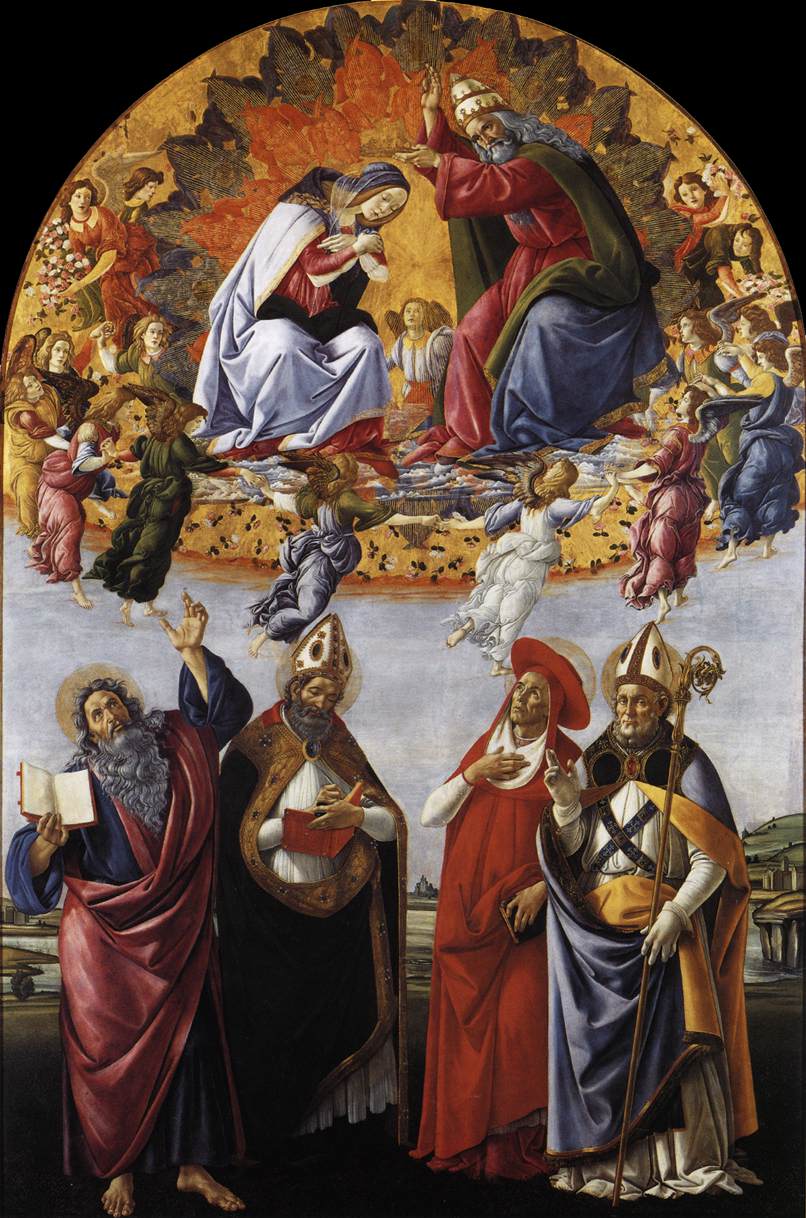
Coronation of the Virgin (San Marco Altarpiece)

Sandro Botticelli

1490-92
Tempera on panel, 378 x 258 cm
Galleria degli Uffizi, Florence

7 posted on 10/19/2026 3:39:15 PM PDT by annalex (fear them not)
[ Post Reply | Private Reply | To 6 | View Replies]

To: annalex
Matthew
 English: Douay-RheimsLatin: Vulgata ClementinaGreek NT: Byzantine/Majority Text (2000)
 Matthew 28
16. And the eleven disciples went into Galilee, unto the mountain where Jesus had appointed them. Undecim autem discipuli abierunt in Galilæam in montem ubi consituerat illis Jesus.οι δε ενδεκα μαθηται επορευθησαν εις την γαλιλαιαν εις το ορος ου εταξατο αυτοις ο ιησους
17. And seeing them they adored: but some doubted. Et videntes eum adoraverunt : quidam autem dubitaverunt.και ιδοντες αυτον προσεκυνησαν αυτω οι δε εδιστασαν
18. And Jesus coming, spoke to them, saying: All power is given to me in heaven and in earth. Et accedens Jesus locutus est eis, dicens : Data est mihi omnis potestas in cælo et in terra :και προσελθων ο ιησους ελαλησεν αυτοις λεγων εδοθη μοι πασα εξουσια εν ουρανω και επι γης
19. Going therefore, teach ye all nations; baptizing them in the name of the Father, and of the Son, and of the Holy Ghost. euntes ergo docete omnes gentes : baptizantes eos in nomine Patris, et Filii, et Spiritus Sancti :πορευθεντες μαθητευσατε παντα τα εθνη βαπτιζοντες αυτους εις το ονομα του πατρος και του υιου και του αγιου πνευματος
20. Teaching them to observe all things whatsoever I have commanded you: and behold I am with you all days, even to the consummation of the world.docentes eos servare omnia quæcumque mandavi vobis : et ecce ego vobiscum sum omnibus diebus, usque ad consummationem sæculi.διδασκοντες αυτους τηρειν παντα οσα ενετειλαμην υμιν και ιδου εγω μεθ υμων ειμι πασας τας ημερας εως της συντελειας του αιωνος αμην

(*) The final "Amen" (αμην) is missing in the translations.

8 posted on 10/19/2026 3:41:05 PM PDT by annalex (fear them not)
[ Post Reply | Private Reply | To 7 | View Replies]

To: annalex

Catena Aurea by St. Thomas Aguinas

28:16–20

16. Then the eleven disciples went away into Galilee, into a mountain where Jesus had appointed them.

17. And when they saw him, they worshipped him: but some doubted.

18. And Jesus came and spake unto them, saying, All power is given unto me in heaven and in earth.

19. Go ye therefore, and teach all nations, baptizing them in the name of the Father, and of the Son, and of the Holy Ghost:

20. Teaching them to observe all things whatsoever I have commanded you: and, lo, I am with you alway, even unto the end of the world. Amen.

BEDE. ‘Beda, in Hom.’ non occ.) When Saint Matthew has vindicated the Lord’s Resurrection as declared by the Angel, he relates the vision of the Lord which the disciples had, Then the eleven disciples went into Galilee into a mountain where Jesus had appointed them. For when coming to His Passion the Lord had said to His disciples, After I am risen I will go before you into Galilee; (Matt. 26:32.) and the Angel said the same to the women. Therefore the disciples obey the command of their Master. Eleven only go, for one had already perished.

JEROME. After His Resurrection, Jesus is seen and worshipped in the mountain in Galilee; though some doubt, their doubting confirms our faith.

REMIGIUS. This is more fully told by Luke; how when the Lord after the Resurrection appeared to the disciples, in their terror they thought they saw a spirit.

BEDE. (Hom. Æst. in Fer. vi. Pasch.)b. The Lord appeared to them in the mountain to signify, that His Body which at His Birth He had taken of the common dust of the human race, He had by His Resurrection exalted above all earthly things; and to teach the faithful that if they desire there to see the height of His Resurrection, they must endeavour here to pass from low pleasures to high desires. And He goes before His disciples into Galilee, because Christ is risen from the dead, the first fruits of them that slept. (1 Cor. 15:20.) And they that are Christ’s follow Him, and pass in their order from death to life, contemplating Him as He appears with His proper Divinity. And it agrees with this that Galilee is interpreted ‘revelation.’

AUGUSTINE. (de Cons. Ev. iii. 25.) But it is to be considered, how the Lord could be seen bodily in Galilee. For that it was not the day of the Resurrection is manifest; for He was seen that day in Jerusalem in the beginning of the night, as Luke and John evidently agree. Nor was it in the eight following days, after which John says that the Lord appeared to His disciples, and when Thomas first saw Him, who had not seen Him on the day of the Resurrection. For if within these eight days the eleven had seen Him on a mountain in Galilee, Thomas, who was one of the eleven, could not have seen Him first after the eight days. Unless it be said, that the eleven there spoken of were eleven out of the general body of the disciples, and not the eleven Apostles. But there is another difficulty. John having related that the Lord was seen not in the mountain, but at the sea of Tiberias, by seven who were fishing, adds, This is now the third time that Jesus shewed himself to his disciples after he was risen from the (John 21:14.) dead. (Mark 16:14.) So that if we understand the Lord to have been seen within those eight days by eleven of the disciples, this manifestation at the sea of Tiberias will be the fourth, and not the third, appearance. Indeed, to understand John’s account at all it must be observed, that he computes not each appearance, but each day on which Jesus appeared, though He may have appeared more than once on the same day; as He did three times on the day of His Resurrection. We are then obliged to understand that this appearance to the eleven disciples on the mountain in Galilee took place last of all. In the four Evangelists we find in all ten distinct appearances of Our Lord after His Resurrection. 1. At the sepulchre to the women. 2. To the same women on their way back from the sepulchre. 3. To Peter. 4. To two disciples as they went into the country. 5. To many together in Jerusalem; 6. when Thomas was not with them. 7. At the sea of Tiberias. 8. At the mountain in Galilee, according to Matthew. 9. To the eleven as they sat at meat, because they should not again eat with Him upon earth, related by Mark. 10. On the day of His Ascension, no longer on the earth, but raised aloft in a cloud, as related by both Mark and Luke. But all is not written, as John confesses, for He had much conversation with them during forty days before His ascension, being seen of them, and speaking unto them of the things pertaining to the kingdom of God. (Acts 1:3.)

REMIGIUS. The disciples then, when they saw Him, knew the Lord; and worshipped Him, bowing their faces to the ground. And He their affectionate and merciful Master, that He might take away all doubtfulness from their hearts, coming to them, strengthened them in their belief; as it follows, And Jesus came and spake to them, saying, All power is given unto me in heaven and in earth.

JEROME. Power is given to Him, Who but a little before was crucified, Who was buried, but Who afterwards rose again.

BEDE. (ubi sup.) This He speaks not from the Deity coeternal with the Father, but from the Humanity which He took upon Him, according to which He was made a little lower than the Angels. (Heb. 2:9.)

CHRYSOLOGUS. (Serm. 80.) The Son of God conveyed to the Son of the Virgin, the God to the Man, the Deity to the Flesh, that which He had ever together with the Father.

JEROME. Power is given in heaven and in earth, that He who before reigned in heaven, should now reign on earth by the faith of the believers.

REMIGIUS. What the Psalmist says of the Lord at His rising again, Thou madest him to have dominion over the works of thy hands (Ps. 8:6.), this the Lord now says of Himself, All power is given unto me in heaven and in earth. And here it is to be noted, that even before His resurrection the Angels knew that they were subjected to the man Christ. Christ then desiring that it should be also known to men that all power was committed to Him in heaven and in earth, sent preachers to make known the word of life to all nations; whence it follows, Go ye therefore, and teach all nations.

BEDE. (‘Beda; in Hom.’ non occ.) He who before His Passion had said, Go not into the way of the Gentiles, (Matt. 10:5.) now, when rising from the dead, says, Go and teach all nations. Hereby let the Jews be put to silence, who say that Christ’s coming is to be for their salvation only. Let the Donatists also blush, who, desiring to confine Christ to one place, have said that He is in Africa only, and not in other countries.

JEROME. They first then teach all nations, and when taught dip them in water. For it may not be that the body receive the sacrament of Baptism, unless the soul first receive the truth of the Faith. In the name of the Father, the Son, and the Holy Ghost, that they whose Godhead is one should be conferred at once, to name this Trinity, being to name One God.

CHRYSOLOGUS. (Serm. 80.) Thus all nations are created a second time to salvation by that one and the same Power, which created them to being.

JEROME. (Didymi Lib. ii. de Spir. Sanct.) And though some one there may be of so averse a spirit as to undertake to baptize in such sort as to omit one of these names, therein contradicting Christ Who ordained this for a law, his baptism will effect nothing; those who are baptized by him will not be at all delivered from their sins. From these words we gather how undivided is the substance of the Trinity, that the Father is verily the Father of the Son, and the Son verily the Son of the Father, and the Holy Spirit the Spirit of both the Father and the Son, and also the Spirit of wisdom and of truth, that is, of the Son of God. This then is the salvation of them that believe, and in this Trinity is wrought the perfect communication of ecclesiastical discipline.

HILARY. (de Trin. ii. 1 &c.) For what part of the salvation of men is there that is not contained in this Sacrament? All things are full and perfect, as proceeding from Him who is full and perfect. The nature of His relation is expressed in the title Father; but He is nothing but Father; for not after the manner of men does He derive from somewhat else that He is Father, being Himself Unbegotten, Eternal, and having the source of His being in Himself, known to none, save the Son. The Son is the Offspring of the Unbegotten, One of the One, True of the True, Living of the Living, Perfect of the Perfect, Strength of Strength, Wisdom of Wisdom, Glory of Glory; the Image of the Unseen God, the Form of the Unbegotten Father. Neither can the Holy Spirit be separated from the confession of the Father and the Son. And this consolation of our longing desires is absent from no place. He is the pledge of our hope in the effects of His gifts, He is the light of our minds, He shines in our souls. These things as the heretics cannot change, they introduce into them their human explanations. As Sabellius who identifies the Father with the Son, thinking the distinction to be made rather in name than in person, and setting forth one and the same Person as both Father and Son. As Ebion, who deriving the beginning of His existence from Mary, makes Him not Man of God, but God of man. As the Arians, who derive the form, the power, and the wisdom of God out of nothing, and in time. What wonder then that men should have diverse opinions about the Holy Spirit, who thus rashly after their own pleasure create and change the Son, by whom that Spirit is bestowed?

JEROME. Observe the order of these injunctions. He bids the Apostles first to teach all nations, then to wash them with the sacrament of faith, and after faith and baptism then to teach them what things they ought to observe; Teaching them to observe all things whatsoever I have commanded you.

RABANUS. For as the body without the spirit is dead, so faith without works is dead also. (James 2:26.)

CHRYSOSTOM. And because what He had laid upon them was great, therefore to exalt their spirits He adds, And, lo, I am with you alway, even unto the end of the world. As much as to say, Tell Me not of the difficulty of these things, seeing I am with you, Who can make all things easy. A like promise He often made to the Prophets in the Old Testament, to Jeremiah who pleaded his youth, to Moses, and to Ezekiel, when they would have shunned the office imposed upon them. And not with them only does He say that He will be, but with all who shall believe after them. For the Apostles were not to continue till the end of the world, but He says this to the faithful as to one body.

RABANUS. Hence we understand that to the end of the world shall not be wanting those who shall be worthy of the Divine indwelling.

CHRYSOSTOM. He brings before them the end of the world, that He may the more draw them on, and that they may not look merely to present inconveniences, but to the infinite goods to come. As much as to say, The grievous things which you shall undergo, terminate with this present life, seeing that even this world shall come to an end, but the good things which ye shall enjoy endure for ever.

BEDE. (‘Beda in Hom.’ non occ.) It is made a question how He says here, I am with you, John 16:5. when we read elsewhere that He said, I go unto him that sent me. What is said of His human nature is distinct from what is said of His divine nature. He is going to His Father in His human nature, He abides with His disciples in that form in which He is equal with the Father. When He says, to the end of the world, He expresses the infinite by the finite; for He who remains in this present world with His elect, protecting them, the same will continue with them after the end, rewarding them.

JEROME. He then who promises that He will be with His disciples to the end of the world, shews both that they shall live for ever, and that He will never depart from those that believe.

LEO. (Serm. 72. 3.) For by ascending into heaven He does not desert His adopted; but from above strengthens to endurance, those whom He invites upwards to glory.

Of which glory may Christ make us partakers,

Who is the King of glory,

God blessed for ever,

AMEN.

Catena Aurea Matthew 28

9 posted on 10/19/2026 3:42:18 PM PDT by annalex (fear them not)
[ Post Reply | Private Reply | To 8 | View Replies]

To: annalex


Laudario of the Compagnia di Sant'Agnese

Pacino di Bonaguida

1320s
Tempera and gold on parchment, 444 x 318 mm
Private collection


10 posted on 10/19/2026 3:42:35 PM PDT by annalex (fear them not)
[ Post Reply | Private Reply | To 9 | View Replies]

To: annalex

Saints Isaac Jogues, Jean de Brébeuf, and Companions’ Story

Isaac Jogues and his companions were the first martyrs of the North American continent officially recognized by the Church. As a young Jesuit, Isaac Jogues, a man of learning and culture, taught literature in France. He gave up that career to work among the Huron Indians in the New World, and in 1636, he and his companions, under the leadership of Jean de Brébeuf, arrived in Quebec.

The Hurons were constantly warred upon by the Iroquois, and in a few years Father Jogues was captured by the Iroquois and imprisoned for 13 months. His letters and journals tell how he and his companions were led from village to village, how they were beaten, tortured, and forced to watch as their Huron converts were mangled and killed.

An unexpected chance for escape came to Isaac Jogues through the Dutch, and he returned to France, bearing the marks of his sufferings. Several fingers had been cut, chewed, or burnt off. Pope Urban VIII gave him permission to offer Mass with his mutilated hands: “It would be shameful that a martyr of Christ not be allowed to drink the Blood of Christ.”

Welcomed home as a hero, Father Jogues might have sat back, thanked God for his safe return, and died peacefully in his homeland. But his zeal led him back once more to the fulfillment of his dreams. In a few months he sailed for his missions among the Hurons.

In 1646, he and Jean de Lalande, who had offered his services to the missioners, set out for Iroquois country in the belief that a recently signed peace treaty would be observed. They were captured by a Mohawk war party, and on October 18, Father Jogues was tomahawked and beheaded. Jean de Lalande was killed the next day at Ossernenon, a village near Albany, New York.

The first of the Jesuit missionaries to be martyred was René Goupil who with Lalande, had offered his services as an oblate. He was tortured along with Isaac Jogues in 1642, and was tomahawked for having made the sign of the cross on the brow of some children.

Father Anthony Daniel, working among Hurons who were gradually becoming Christian, was killed by Iroquois on July 4, 1648. His body was thrown into his chapel, which was set on fire.

Jean de Brébeuf was a French Jesuit who came to Canada at the age of 32 and labored there for 24 years. He went back to France when the English captured Quebec in 1629 and expelled the Jesuits, but returned to his missions four years later. Although medicine men blamed the Jesuits for a smallpox epidemic among the Hurons, Jean remained with them.

He composed catechisms and a dictionary in Huron, and saw 7,000 converted before his death in 1649. Having been captured by the Iroquois at Sainte Marie, near Georgian Bay, Canada, Father Brébeuf died after four hours of extreme torture.

Gabriel Lalemant had taken a fourth vow—to sacrifice his life for the Native Americans. He was horribly tortured to death along with Father Brébeuf.

Father Charles Garnier was shot to death in 1649 as he baptized children and catechumens during an Iroquois attack.

Father Noel Chabanel also was killed in 1649, before he could answer his recall to France. He had found it exceedingly hard to adapt to mission life. He could not learn the language, and the food and life of the Indians revolted him, plus he suffered spiritual dryness during his whole stay in Canada. Yet he made a vow to remain in his mission until death.

These eight Jesuit martyrs of North America were canonized in 1930.


Reflection

Faith and heroism planted belief in Christ’s cross deep in our land. The Church in North America sprang from the blood of martyrs, as has been true in so many places. The ministry and sacrifices of these saints challenges each of us, causing us to ask just how deep is our faith and how strong our desire to serve even in the face of death.


Saints Isaac Jogues, Jean de Brébeuf, and Companions are the Patron Saints of:

North America
Norway


franciscanmedia.org
11 posted on 10/19/2026 3:45:26 PM PDT by annalex (fear them not)
[ Post Reply | Private Reply | To 10 | View Replies]

To: annalex

12 posted on 10/19/2026 3:46:53 PM PDT by annalex (fear them not)
[ Post Reply | Private Reply | To 11 | View Replies]

Disclaimer: Opinions posted on Free Republic are those of the individual posters and do not necessarily represent the opinion of Free Republic or its management. All materials posted herein are protected by copyright law and the exemption for fair use of copyrighted works.

Free Republic
Browse · Search
Religion
Topics · Post Article

FreeRepublic, LLC, PO BOX 9771, FRESNO, CA 93794
FreeRepublic.com is powered by software copyright 2000-2008 John Robinson