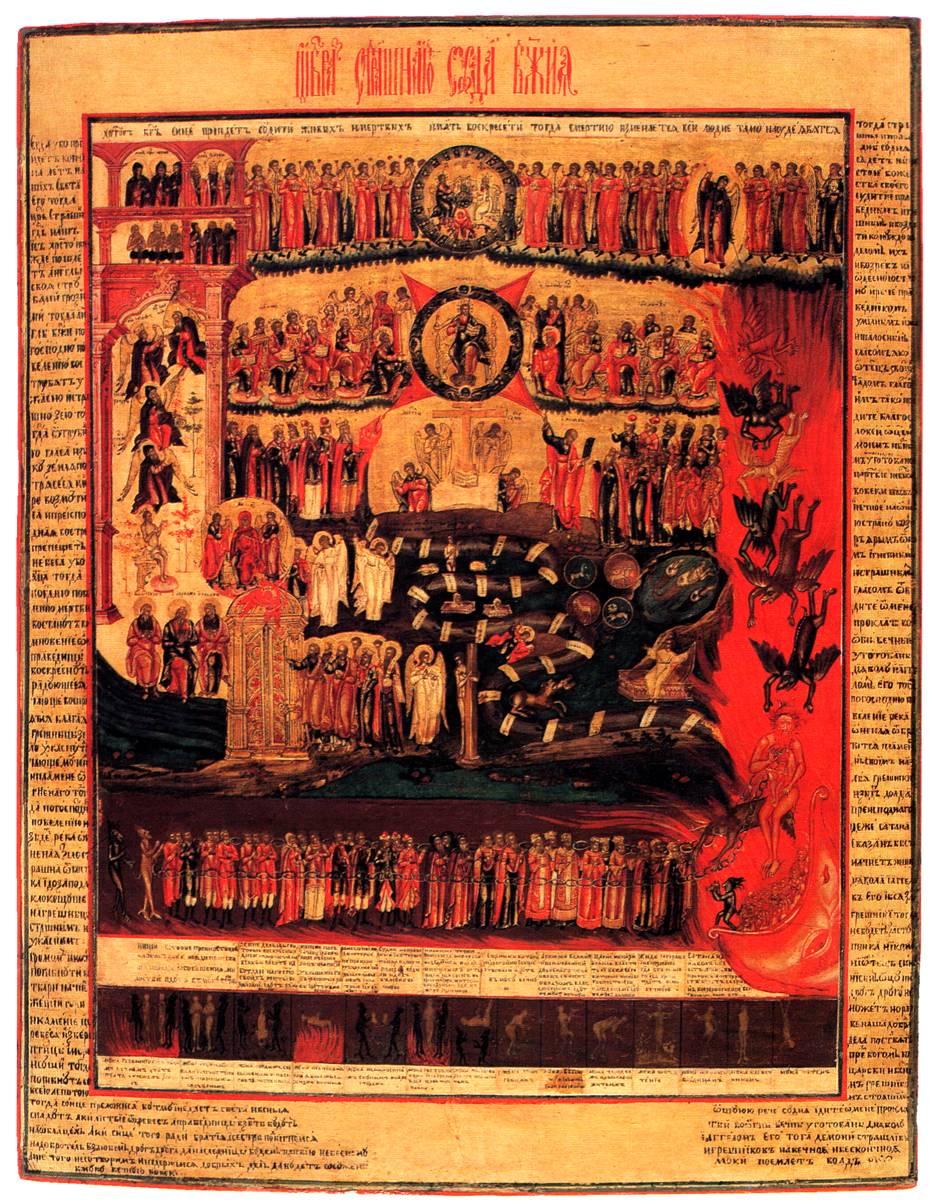
Catena Aurea by St. Thomas Aguinas
CHAP. 1212:1–3
1. In the mean time, when there were gathered together an innumerable multitude of people, insomuch that they trode one upon another, he began to say unto his disciples first of all, Beware ye of the leaven of the Pharisees, which is hypocrisy.
2. For there is nothing covered, that shall not be revealed; neither hid, that shall not be known.
3. Therefore whatsoever ye have spoken in darkness shall be heard in the light; and that which ye have spoken in the ear in closets shall be proclaimed upon the housetops.
THEOPHYLACT. The Pharisees sought indeed to catch Jesus in His talk, that they might lead away the people from Him. But this design of theirs is reversed. For the people came all the more unto Him gathered together by thousands, and so desirous to attach themselves to Christ, that they pressed one upon another. So mighty a thing is truth, so feeble every where deceit. Whence it is said, And when there were gathered together a great multitude, insomuch that they trode upon one another, he began to sag unto his disciples, Beware ye of the leaven of the Pharisees, which is hypocrisy.
CYRIL OF ALEXANDRIA. For they were false accusers; therefore Christ warned His disciples against them.
GREGORY NAZIANZEN. When leaven is praised it is as composing the bread of life, but when blamed it signifies a lasting and bitter maliciousness.
THEOPHYLACT. He calls their hypocrisy leaven, as perverting and corrupting the intentions of the men in whom it has sprung up. For nothing so changes the characters of men as hypocrisy.
BEDE. For as a little leaven leaveneth a whole lump of meal, (1 Cor. 5:6.) so hypocrisy will rob the mind of all the purity and integrity of its virtues.
AMBROSE. Our Lord has introduced a most forcible argument for preserving simplicity, and being zealous for the faith, that we should not after the manner of faithless Jews put one thing in practice, while in words we pretend another, namely, that at the last day the hidden thoughts accusing or else excusing one another, shall be seen to reveal the secrets of our mind. Whence it is added, There is nothing hid which shall not be revealed.
ORIGEN. He either then says this concerning that time when God shall judge the secrets of men, or He says it because however much a man may endeavour to hide the good deeds of another by discredit, good of its own nature cannot be concealed.
CHRYSOSTOM. (Hom. 34. in Matt.) As if He says to His disciples, Although now some call you deceivers and wizards, time shall reveal all things and convict them of calumny, while it makes known your virtue. Therefore whatsoever things I have spoken to you in the small corner of Palestine, these boldly and with open brow, casting away all fear, proclaim to the whole world. And therefore He adds, Whatsoever ye have spoken in darkness shall be heard in light.
BEDE. Or He says this, because all the things which the Apostles of old spoke and suffered amid the darkness of oppression and the gloom of the prison, arc now that the Church is made known through the world and their acts are read, publicly proclaimed. The words, shall be proclaimed on the housetops, are spoken according to the manner of the country of Palestine, where they are accustomed to live on the housetops. For their roofs were not after our way raised to a point, but flat shaped, and level at the top. Therefore He says, proclaimed on the housetops; that is, spoken openly in the hearing of all men.
THEOPHYLACT. Or this is addressed to the Pharisees; as if He said, O Pharisees, what you have spoken in darkness, that is, all your endeavours to tempt me in the secrets of your hearts, shall be heard in the light, for I am the light, and in My light shall be known whatsoever your darkness devises. And what you have spoken in the ear and in closets, that is, whatsoever in whispers you have poured into one another’s ears, shall be proclaimed on the housetops, that is, was as audible to me as if it had been cried aloud on the housetops. Herein also you may understand that the light is the Gospel, but the housetop the lofty souls of the Apostles. But whatever things the Pharisees plotted together, were afterwards divulged and heard in the light of the Gospel, the great Herald, the Holy Spirit, presiding over the souls of the Apostles.
12:4–7
4. And I say unto you my friends, Be not afraid of them that kill the body, and after that have no more that they can do.
5. But I will forewarn you whom ye shall fear: Fear him, which after he hath killed hath power to cast into hell; yea, I say unto you, Fear him.
6. Are not five sparrows sold for two farthings, and not one of them is forgotten before God?
7. But even the very hairs of your head are all numbered. Fear not therefore: ye are of more value than many sparrows.
AMBROSE. Since unbelief springs from two causes, either from a deeply-seated malice or a sudden fear; lest any one from terror should be compelled to deny the God whom he acknowledges in his heart, He well adds, And I say unto you my friends, Be not afraid of them that kill the body, &c.
CYRIL OF ALEXANDRIA. For it is not absolutely to every one that this discourse seems to apply, but to those who love God with their whole heart to whom it belongs to say, Who shall separate us from the love of Christ? (Rom. 8:3.) But they who are not such, are tottering, and ready to fall down. Moreover our Lord says, Greater love hath no man than this, that a man lay down his life for his friends. (John 15:13.) How then is it not most ungrateful to Christ not to repay Him what we receive?
AMBROSE. He tells us also, that that death is not terrible for which at a far more costly rate of interest immortality is to be purchased.
CYRIL OF ALEXANDRIA. We must then consider that crowns and honours are prepared for the labours of those upon whom men are continually venting forth their indignation, and to them the death of the body is the end of their persecutions. Whence He adds, And after this have nothing more that they can do.
BEDE. Their rage then is but useless raving, who cast the lifeless limbs of martyrs to be torn in pieces by wild beasts and birds, seeing that they can in no wise prevent the omnipotence of God from quickening and bringing them to life again.
CHRYSOSTOM. (Hom. 22. in Matt.) Observe how our Lord makes His disciples superior to all, by exhorting them to despise that very death which is terrible to all. At the same time also he brings them proofs of the immortality of the soul: adding, I will forewarn you whom ye shall fear: fear him, which after he hath killed hath power to cast into hell.
AMBROSE. For our natural death is not the end of punishment: and therefore He concludes that death is the cessation of bodily punishment, but the punishment of the soul is everlasting. And God alone is to be feared, to whose power nature prescribes not, but is herself subject; adding, Yea, I say unto you, Fear him.
THEOPHYLACT. Here observe, that upon sinners death is sent as a punishment, since they are here tormented by destruction, and afterwards thrust down into hell. But if you will sift the words you will understand something farther. For He says not, “Who casts into hell,” but has power to cast. For not every one dying in sin is forthwith thrust down into hell, but there is sometimes pardon given for the sake of the offerings and prayers which are made for the deada.
AMBROSE. Our Lord then had instilled the virtue of simplicity, had awakened a courageous spirit. Their faith alone was wavering, and well did He strengthen it by adding with respect to things of less value, Are not five sparrows sold for two farthings? and not one of them is forgotten before God. As if He said, If God forgets not the sparrows, how can He man?
BEDE. The dipondius is a coin of the lightest weight, and equal to two asses.
GLOSS. (ordin.) Now that which in number is one is in weight an ass, but that which is two is a dipondius.
AMBROSE. But perhaps some one will say, How is it that the Apostle says, Does the Lord care for oxen? (1 Cor. 9:9.) whereas an ox is of more value than a sparrow; but to care for is one thing, to have knowledge another.
ORIGEN. Literally, hereby is signified the quickness of the Divine foresight, which reaches even to the least things. But mystically, the five sparrows justly represent the spiritual senses, which have perception of high and heavenly things: beholding God, hearing the Divine voice, tasting of the bread of life, smelling the perfume of Christ’s anointing, handling the Word of Life. And these being sold for two farthings, that is, being lightly esteemed by those who count as perishing whatever is of the Spirit, are not forgotten before God. But God is said to be forgetful of some because of their iniquities.
THEOPHYLACT. Or these five senses are sold for two farthings, that is, the New and Old Testament, and are therefore not forgotten by God. Of those whose senses are given up to the word of life that they may be fit for the spiritual food, the Lord is ever mindful.
AMBROSE. Or else; A good sparrow is one which nature has furnished with the power of flying; for nature has given us the grace of flying, pleasure has taken it away, which loads with meats the soul of the wicked, and moulds it towards the nature of a fleshly mass. The five senses of the body then, if they seek the food of earthly alloy, cannot fly back to the fruits of higher actions. A bad sparrow therefore is one which has lost its habit of flying through the fault of earthly grovelling; such are those sparrows which are sold for two farthings, namely, at the price of worldly luxury. For the enemy sets up his, as it were, captive slaves, at the very lowest price. But the Lord, being the fit judge of His own work, has redeemed at a great price us, His noble servants, whom He hath made in His own image.
CYRIL OF ALEXANDRIA. It is His care then diligently to know the life of the saints. Whence it follows, But the hairs of your heads are all numbered; by which He means, that of all things which relate to them He has most accurate knowledge, for the numbering manifests the minuteness of the care exercised.
AMBROSE. Lastly, the numbering of the hairs is not to be taken with reference to the act of reckoning, but to the capability of knowing. Yet they are well said to be numbered, because those things which we wish to preserve we number.
CYRIL OF ALEXANDRIA. Now mystically, indeed, the head of a man is his understanding, but his hairs the thoughts, which are open to the eye of God.
THEOPHYLACT. Or, by the head of each of the faithful, you must understand a conversation meet for Christ, but by his hair, the works of bodily mortification which are numbered by God, and are worthy of the Divine regard.
AMBROSE. If then such is the majesty of God, that a single sparrow or the number of our hair is not beside His knowledge, how unworthy is it to suppose that the Lord is either ignorant of the hearts of the faithful, or despises them so as to account them of less value. Hence He proceeds to conclude, Fear not then, ye are of more value than many sparrows.
BEDE. We must not read, Ye are more, which relates to the comparison of number, but ye are of more value, that is, of greater estimation in the sight of God.
ATHANASIUS. (pluris estis) Now I ask the Arians, if God, as if disdaining to make all other things, made only His Son, but deputed all things to His Son; how is it that He extends His providence even to such trifling things as our hair, and the sparrows? For upon whatever things He exercises His providence, of these is He the Creator by His own word.
Catena Aurea Luke 12
NAVARRE BIBLE COMMENTARY(RSV)
Ad Majorem Dei Gloriam (To the Greater Glory of God)
Today’s First Reading
From: Ephesians 1:11-14
Hymn of Praise
--------------
[11] In him, according to the purpose of him who accomplishes all things according to the counsel of his will, [12] we who first hoped in Christ have been destined and appointed to live for the praise of his glory. [13] In him you also, who have heard the word of truth, the gospel of your salvation, and have believed in him, were sealed with the promised Holy Spirit, [14] who is the guarantee of our inheritance until we acquire possession of it, to the praise of his glory.
***********************************************************************
Commentary:
3-14. Verses 3-14 are a hymn of praise to God for the plan of salvation he has devised and brought to fulfillment in benefit of men and all creation. It is written in a liturgical style of rhythmic prose, similar to that in Colossians 1:15-20. In the Greek it is one long complex sentence full of relative pronouns and clauses which give it a designed unity; we can, however, distinguish two main sections.
The first (v. 3-10), divided into four stanzas, describes the blessings contained in God's salvific plan; St Paul terms this plan the "mystery" of God's will. The section begins by praising God for his eternal design, a plan, pre-dating creation, to call us to the Church, to form a community of saints (first stanza: vv. 3f) and receive the grace of being children of God through Jesus Christ (second stanza: vv. 5f). It then reflects on Christ's work of redemption which brings this eternal plan of God to fulfillment (third stanza: vv. 7f). This section reaches its climax in the fourth stanza (vv. 9f) which proclaims Christ as Lord of all creation, thereby revealing the full development of God's salvific plan.
The second section, which divides into two stanzas, deals with the application of this plan--first to the Jews (fifth stanza: vv. 11f) and then to the Gentiles, who are also called to share what God has promised: Jews and Gentiles join to form a single people, the Church (sixth stanza: vv. 13f).
Hymns in praise of God, or "eulogies", occur in many parts of Sacred Scripture (cf. Ps 8; Ps 19; Dan 2:20-23; Lk 1:46-54, 68-78; etc.); they praise the Lord for the wonders of creation or for spectacular interventions on behalf of his people. Inspired by the Holy Spirit, St Paul here praises God the Father for all Christ's saving work, which extends from God's original plan which he made before he created the world, right up to the very end of time and the recapitulation of all things in Christ.
We too should always have this same attitude of praise of the Lord. "Our entire life on earth should take the form of praise of God, for the never-ending joy of our future life consists in praising God, and no one can become fit for that future life unless he train himself to render that praise now" (St Augustine, "Enarrationes in Psalmos", 148).
Praise is in fact the most appropriate attitude for man to have towards God: "How can you dare use that spark of divine intelligence—your mind--in anything but in giving glory to your Lord?" (St J. Escriva, "The Way", 782).
11-14. The Apostle now contemplates a further divine blessing—the implementation of the "mystery" through the Redemption wrought by Christ: God calls the Jews (vv. 11f) and the Gentiles (v. 13) together, to form a single people (v. 14). Paul first refers to the Jewish people, of which he himself is a member, which is why he uses the term "we" (v. 12). He then speaks of the Gentile Christians and refers to them as "you" (v. 13).
11-12. The Jewish people's expectations have been fulfilled in Christ: he has brought the Kingdom of God and the messianic gifts, designed in the first instance for Israel as its inheritance (cf. Mt 4:17; 12:28; Lk 4:16-22). God's intention in selecting Israel was to form a people of his own (cf. Ex 19:5) that would glorify him and proclaim to the nations its hope in a coming Messiah. "God, with loving concern contemplating, and making preparation for, the salvation of the whole human race, in a singular undertaking chose for himself a people to whom he would entrust his promises. By his covenant with Abraham (cf. Gen 15:18) and, through Moses, with the race of Israel (cf. Ex 24:8), he did acquire a people for himself, and to them he revealed himself in words and deeds as the one, true, living God, so that Israel might experience the ways of God with men. Moreover, by listening to the voice of God speaking to them through the prophets, they had steadily to understand his ways more fully and more clearly, and make them more widely known among the nations (cf. Ps 21:28-9; 95:1-3; Is 2:1-4; Jer 3:17)" (Vatican II, "Dei Verbum", 14).
St Paul emphasizes that even before the coming of our Lord Jesus Christ, the just of the Old Testament acted in line with their belief in the promised Messiah (cf. Gal 3:11; Rom 1:17); not only did they look forward to his coming but their hope was nourished by faith in Christ as a result of their acceptance of God's promise. As later examples of this same faith we might mention Zechariah and Elizabeth; Simeon and Anna; and, above all, St Joseph. St Joseph's faith was "full, confident, complete", St J. Escriva comments. "It expressed itself in an effective dedication to the will of God and an intelligent obedience. With faith went love. His faith nurtured his love of God, who was fulfilling the promises made to Abraham, Jacob an d Moses, and his affection for Mary his wife and his fatherly affection for Jesus. This faith, hope and love would further the great mission which God was beginning in the world through, among others, a carpenter in Galilee--the redemption of mankind" ("Christ Is Passing By", 42).
13-14. If St Paul recognizes the magnificence of God's saving plan in the fulfillment, through Jesus, of the ancient promises to the Jews, he is even more awed by the fact that the Gentiles are being called to share in God's largesse. This call of the Gentiles is, as it were, a further blessing from God.
It is through the preaching of the Gospel that the Gentiles come to form part of the Church: faith coming initially through hearing the word of God (cf. Rom 10:17). Once a person has accepted that word, God seals the believer with the promised Holy Spirit (cf. Gal 3:14); this seal is the pledge or guarantee of divine inheritance and proves that we have been accepted by God, incorporated into his Church, and given access to that salvation which had previously been reserved to Israel. Here we can see a parallelism between the "seal" of circumcision which made the Old Covenant believer a member of the people of Israel, and the "seal" of the Holy Spirit in Baptism which, in the New Testament, makes people members of the Church (Rom 4:22; 2 Cor 1:22; Eph 4:30). The "efficient cause" of our justification is "the merciful God, who freely washes and sanctifies (cf. 1 Cor 6:11), sealing and anointing with the Holy Spirit of the promise, who is the pledge of our inheritance" (Council of Trent, "De Justificatione", chap. 7).
A seal or pledge was the mark used in business to betoken or guarantee future payment of the agreed price in full. In this case it represents a firm commitment on God's part, to grant the believer full and permanent possession of eternal blessedness, an anticipation of which is given at Baptism and thereafter (cf. 2 Cor 1:22; 5:5). Through Christ, St Basil comments, "Paradise is restored to us; we are enabled to ascend to the kingdom of heaven; we are given back our adoption as sons, our confidence to call God himself our Father; we become partakers of Christ's grace, and are called children of light; we are enabled to share in the glory of heaven, to be enveloped in a plenitude of blessings both in this world and in the world to come [...]. If this be the promise, what will the final outcome not be? If this, the beginning, is so wonderful, what will the final consummation not be?" ("De Spiritu Sancto", 15, 36).
The gift of the Holy Spirit, who, through faith, dwells in the soul of the Christian in grace, represents, in this last stanza of the hymn, the high point in the implementation of God's salvific plan. The Holy Spirit, who gathered together the Church at Pentecost (cf. Acts 2: 14), continues to guide and inspire the apostolate of the members of the new people of God down through the centuries. The Magisterium of the Church reminds us that "throughout the ages the Holy Spirit makes the entire Church 'one in communion and ministry; and provides her with different hierarchical and charismatic gifts' ("Lumen Gentium", 4), giving life to ecclesiastical structures, being as it were their soul, and inspiring in the hearts of the faithful that same spirit of mission which impelled Christ himself. He even at times visibly anticipates apostolic action, just as in various ways he unceasingly accompanies and directs it" (Vatican II, "Ad Gentes", 4).
God has acquired his new people at the cost of his Son's blood. This people made up of believers in Christ has replaced the people of the Old Testament, regardless of background. As the Second Vatican Council puts it, "As Israel according to the flesh which wandered in the desert was already called the Church of God (cf. 2 Ezra 13:1; Num 20:4; Deut 23:1ff), so too, the new Israel, which advances in this present era in search of a future and permanent city (cf. Heb 13:14), is called also the Church of Christ (cf. Mt 16:18). It is Christ indeed who has purchased it with his own blood (cf. Acts 20:28); he has filled it with his spirit; he has provided means adapted to its visible and social union. All those who in faith look towards Jesus, the author of salvation and the principle of unity and peace, God has gathered together and established as the Church, that it may be for each and every one the visible sacrament of this saving unity" ("Lumen Gentium", 9).