Posted on 10/16/2026 9:57:45 AM PDT by annalex
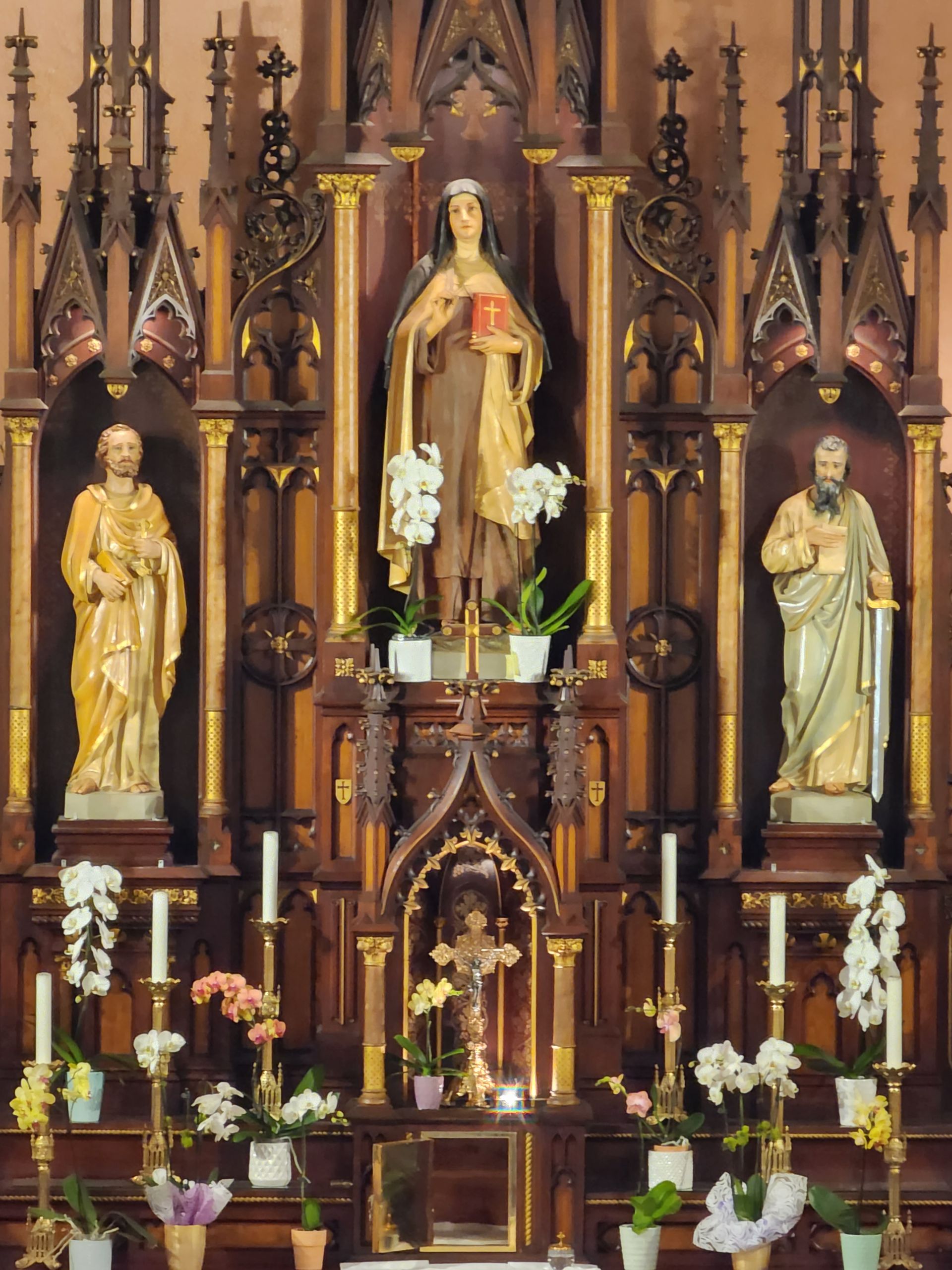
Saint Teresa of Ávila, Virgin, Doctor on Thursday of week 28 in Ordinary Time ![]() St. Teresa of Ávila Church, Los Angeles Readings at MassThis is a preview of Universalis. The Universalis app gives you every day of every year, not just the single week you’re seeing now, and it doesn’t need the Internet. It gives you the official New American Bible version for the readings at Mass. As well as the Mass, it gives you the Liturgy of the Hours. It costs $9.99-12.99 on your phone, or £19.99 (about $26.50) on your computer. Get it now. Liturgical Colour: White. Year: A(II). These are the readings for the feria
Before the world was made, God chose us in ChristFrom Paul, appointed by God to be an apostle of Christ Jesus, to the saints who are faithful to Christ Jesus. Grace and peace to you from God our Father and from the Lord Jesus Christ. Blessed be God the Father of our Lord Jesus Christ, who has blessed us with all the spiritual blessings of heaven in Christ. Before the world was made, he chose us, chose us in Christ, to be holy and spotless, and to live through love in his presence, determining that we should become his adopted sons, through Jesus Christ for his own kind purposes, to make us praise the glory of his grace, his free gift to us in the Beloved, in whom, through his blood, we gain our freedom, the forgiveness of our sins. Such is the richness of the grace which he has showered on us in all wisdom and insight. He has let us know the mystery of his purpose, the hidden plan he so kindly made in Christ from the beginning to act upon when the times had run their course to the end: that he would bring everything together under Christ, as head, everything in the heavens and everything on earth.
The Lord has shown his salvation. Sing a new song to the Lord for he has worked wonders. His right hand and his holy arm have brought salvation. The Lord has shown his salvation. The Lord has made known his salvation; has shown his justice to the nations. He has remembered his truth and love for the house of Israel. The Lord has shown his salvation. All the ends of the earth have seen the salvation of our God. Shout to the Lord, all the earth, ring out your joy. The Lord has shown his salvation. Sing psalms to the Lord with the harp with the sound of music. With trumpets and the sound of the horn acclaim the King, the Lord. The Lord has shown his salvation.
Alleluia, alleluia! Your precepts, O Lord, are all of them sure; they stand firm for ever and ever. Alleluia!
Alleluia, alleluia! I am the Way, the Truth and the Life, says the Lord; No one can come to the Father except through me. Alleluia!
You have not gone in yourselves and have prevented others who wanted toJesus said: ‘Alas for you who build the tombs of the prophets, the men your ancestors killed! In this way you both witness what your ancestors did and approve it; they did the killing, you do the building. ‘And that is why the Wisdom of God said, “I will send them prophets and apostles; some they will slaughter and persecute, so that this generation will have to answer for every prophet’s blood that has been shed since the foundation of the world, from the blood of Abel to the blood of Zechariah, who was murdered between the altar and the sanctuary.” Yes, I tell you, this generation will have to answer for it all. ‘Alas for you lawyers who have taken away the key of knowledge! You have not gone in yourselves, and have prevented others going in who wanted to.’ When he left the house, the scribes and the Pharisees began a furious attack on him and tried to force answers from him on innumerable questions, setting traps to catch him out in something he might say. These are the readings for the memorial
The Spirit himself expresses our plea in a way that could never be put into wordsFrom the beginning till now the entire creation, as we know, has been groaning in one great act of giving birth; and not only creation, but all of us who possess the first-fruits of the Spirit, we too groan inwardly as we wait for our bodies to be set free. For we must be content to hope that we shall be saved – our salvation is not in sight, we should not have to be hoping for it if it were – but, as I say, we must hope to be saved since we are not saved yet – it is something we must wait for with patience. The Spirit too comes to help us in our weakness. For when we cannot choose words in order to pray properly, the Spirit himself expresses our plea in a way that could never be put into words, and God who knows everything in our hearts knows perfectly well what he means, and that the pleas of the saints expressed by the Spirit are according to the mind of God.
The decrees of the Lord are truth and all of them just. or Your words are spirit, Lord, and they are life. The law of the Lord is perfect, it revives the soul. The rule of the Lord is to be trusted, it gives wisdom to the simple. The decrees of the Lord are truth and all of them just. or Your words are spirit, Lord, and they are life. The precepts of the Lord are right, they gladden the heart. The command of the Lord is clear, it gives light to the eyes. The decrees of the Lord are truth and all of them just. or Your words are spirit, Lord, and they are life. The fear of the Lord is holy, abiding for ever. The decrees of the Lord are truth and all of them just. The decrees of the Lord are truth and all of them just. or Your words are spirit, Lord, and they are life. They are more to be desired than gold, than the purest of gold and sweeter are they than honey, than honey from the comb. The decrees of the Lord are truth and all of them just. or Your words are spirit, Lord, and they are life.
Alleluia, alleluia! Remain in my love, says the Lord; whoever remains in me, with me in him, bears fruit in plenty. Alleluia!
I am the vine, you are the branchesJesus said to his disciples: ‘I am the true vine, and my Father is the vinedresser. Every branch in me that bears no fruit he cuts away, and every branch that does bear fruit he prunes to make it bear even more. You are pruned already, by means of the word that I have spoken to you. Make your home in me, as I make mine in you. As a branch cannot bear fruit all by itself, but must remain part of the vine, neither can you unless you remain in me. I am the vine, you are the branches. Whoever remains in me, with me in him, bears fruit in plenty; for cut off from me you can do nothing. Anyone who does not remain in me is like a branch that has been thrown away – he withers; these branches are collected and thrown on the fire, and they are burnt. If you remain in me and my words remain in you, you may ask what you will and you shall get it. It is to the glory of my Father that you should bear much fruit, and then you will be my disciples.’
The readings on this page are from the Jerusalem Bible, which is used at Mass in most of the English-speaking world. The New American Bible readings, which are used at Mass in the United States, are available in the Universalis apps, programs and downloads. |
|
Click here: to donate by Credit Card Or here: to donate by PayPal Or by mail to: Free Republic, LLC - PO Box 9771 - Fresno, CA 93794 Thank you very much and God bless you. |
KEYWORDS: catholic; jn15; lk11; ordinarytime; prayer

Please FReepmail me to get on/off the Alleluia Ping List.
| Luke | |||
| English: Douay-Rheims | Latin: Vulgata Clementina | Greek NT: Byzantine/Majority Text (2000) | |
| Luke 11 | |||
| 47. | Woe to you who build the monuments of the prophets: and your fathers killed them. | Væ vobis, qui ædificatis monumenta prophetarum : patres autem vestri occiderunt illos. | ουαι υμιν οτι οικοδομειτε τα μνημεια των προφητων οι δε πατερες υμων απεκτειναν αυτους |
| 48. | Truly you bear witness that you consent to the doings of your fathers: for they indeed killed them, and you build their sepulchres. | Profecto testificamini quod consentitis operibus patrum vestrorum : quoniam ipsi quidem eos occiderunt, vos autem ædificatis eorum sepulchra. | αρα μαρτυρειτε και συνευδοκειτε τοις εργοις των πατερων υμων οτι αυτοι μεν απεκτειναν αυτους υμεις δε οικοδομειτε αυτων τα μνημεια |
| 49. | For this cause also the wisdom of God said: I will send to them prophets and apostles; and some of them they will kill and persecute. | Propterea et sapientia Dei dixit : Mittam ad illos prophetas, et apostolos, et ex illis occident, et persequentur : | δια τουτο και η σοφια του θεου ειπεν αποστελω εις αυτους προφητας και αποστολους και εξ αυτων αποκτενουσιν και εκδιωξουσιν |
| 50. | That the blood of all the prophets which was shed from the foundation of the world, may be required of this generation, | ut inquiratur sanguis omnium prophetarum, qui effusus est a constitutione mundi a generatione ista, | ινα εκζητηθη το αιμα παντων των προφητων το εκχυνομενον απο καταβολης κοσμου απο της γενεας ταυτης |
| 51. | From the blood of Abel unto the blood of Zacharias, who was slain between the alter and the temple: Yea I say to you, It shall be required of this generation. | a sanguine Abel, usque ad sanguinem Zachariæ, qui periit inter altare et ædem. Ita dico vobis, requiretur ab hac generatione. | απο του αιματος αβελ εως του αιματος ζαχαριου του απολομενου μεταξυ του θυσιαστηριου και του οικου ναι λεγω υμιν εκζητηθησεται απο της γενεας ταυτης |
| 52. | Woe to you lawyers, for you have taken away the key of knowledge: you yourselves have not entered in, and those that were entering in, you have hindered. | Væ vobis, legisperitis, quia tulistis clavem scientiæ : ipsi non introistis, et eos qui introibant, prohibuistis. | ουαι υμιν τοις νομικοις οτι ηρατε την κλειδα της γνωσεως αυτοι ουκ εισηλθετε και τους εισερχομενους εκωλυσατε |
| 53. | And as he was saying these things to them, the Pharisees and the lawyers began violently to urge him, and to oppress his mouth about many things, | Cum autem hæc ad illos diceret, cœperunt pharisæi et legisperiti graviter insistere, et os ejus opprimere de multis, | λεγοντος δε αυτου ταυτα προς αυτους ηρξαντο οι γραμματεις και οι φαρισαιοι δεινως ενεχειν και αποστοματιζειν αυτον περι πλειονων |
| 54. | Lying in wait for him, and seeking to catch something from his mouth, that they might accuse him. | insidiantes ei, et quærentes aliquid capere de ore ejus, ut accusarent eum. | ενεδρευοντες αυτον ζητουντες θηρευσαι τι εκ του στοματος αυτου ινα κατηγορησωσιν αυτου |

11:45–54
45. Then answered one of the Lawyers, and said unto him, Master, thus saying thou reproachest us also.
46. And he said, Woe unto you also, ye Lawyers! for ye lade men with burdens grievous to be borne, and ye yourselves touch not the burdens with one of your fingers.
47. Woe unto you! for ye build the sepulchres of the prophets, and your fathers killed them.
48. Truly ye bear witness that ye allow the deeds of your fathers: for they indeed killed them, and ye build their sepulchres.
49. Therefore also said the wisdom of God, I will send them prophets and apostles, and some of them they shall slay and persecute:
50. That the blood of all the prophets, which was shed from the foundation of the world, may be required of this generation;
51. From the blood of Abel unto the blood of Zacharias, which perished between the altar and the temple: verily I say unto you, It shall be required of this generation.
52. Woe unto you, Lawyers! for ye have taken away the key of knowledge: ye enter not in yourselves, and them that were entering in ye hindered.
53. And as he said these things unto them, the Scribes and Pharisees began to urge him vehemently, and to provoke him to speak of many things:
54. Laying wait for him, and seeking to catch something out of his mouth, that they might accuse him.
CYRIL OF ALEXANDRIA. A reproof which exalts the meek is generally hateful to the proud man. When therefore our Saviour was blaming the Pharisees for transgressing from the right path, the body of Lawyers were struck with consternation. Hence it is said, Then answered one of the Lawyers, and said unto him, Master, thus saying thou reproachest us also.
BEDE. In what a grievous state is that conscience, which hearing the word of God thinks it a reproach against itself, and in the account of the punishment of the wicked perceives its own condemnation.
THEOPHYLACT. Now the Lawyers were different from the Pharisees. For the Pharisees being separated from the rest had the appearance of a religious sect; but those skilled in the Law were the Scribes and Doctors who solved legal questions.
CYRIL OF ALEXANDRIA. But Christ brings a severe charge against the Lawyers, and subdues their foolish pride, as it follows, And he said, Woe unto you also, ye Lawyers, for ye lade men, &c. He brings forward an obvious example for their direction. The Law was burdensome to the Jews as the disciples of Christ confess, but these Lawyers binding together legal burdens which could not be borne, placed them upon those under them, taking care themselves to have no toil whatever.
THEOPHYLACT. As often also as the teacher does what he teaches, he lightens the load, offering himself for an example. But when he does none of the things which he teaches others, the loads appear heavy to those who learn his teaching, as being what even their teacher is not able to bear.
BEDE. Now they are rightly told that they would not touch the burdens of the Law even with one of their fingers, that is, they fulfil not in the slightest point that law which they pretend to keep and transmit to the keeping of others, contrary to the practice of their fathers, without faith and the grace of Christ.
GREGORY OF NYSSA. So also are there now many severe judges of sinners, yet weak combatants; burdensome imposers of laws, yet weak bearers of burdens; who wish neither to approach nor to touch strictness of life, though they sternly exact it from their subjects.
CYRIL OF ALEXANDRIA. Having then condemned the burdensome dealing of the Lawyer, He brings a general charge against all the chief men of the Jews, saying, Woe to you who build the tombs of the prophets, and your fathers killed them.
AMBROSE. This is a good answer to the foolish superstition of the Jews, who in building the tombs of the prophets condemned the deeds of their fathers, but by rivalling their fathers’ wickedness, throw back the sentence upon themselves. For not the building but the imitation of their deeds is looked upon as a crime. Therefore He adds, Truly ye bear witness that ye allow, &c.
BEDE. They pretended indeed, in order to win the favour of the multitude, that they were shocked at the unbelief of their fathers, since by splendidly honouring the memories of the prophets who were slain by them they condemned their deeds. But in their very actions they testify how much they coincide with their fathers’ wickedness, by treating with insult that Lord whom the prophets foretold. Hence it is added, Therefore also said the wisdom of God, I will send them prophets and apostles, and some of them they shall slay and persecute.
AMBROSE. The wisdom of God is Christ. The words indeed in Matthew are, Behold I send unto you prophets and wise men.
BEDE. But if the same Wisdom of God sent prophets and Apostles, let heretics cease to assign to Christ a beginning from the Virgin; let them no longer declare one God of the Law and Prophets, another of the New Testament. For although the Apostolic Scripture often calls by the name of prophets not only those who foretell the coming Incarnation of Christ, but those also who foretell the future joys of the kingdom of heaven, yet I should never suppose that these were to be placed before the Apostles in the order of enumeration.
ATHANASIUS. (Apol. 1. de fuga sua.) Now if they kill, the death of the slain will cry out the louder against them; if they pursue, they send forth memorials of their iniquity, for flight makes the pursuit of the sufferers to redound to the great disgrace of the pursuers. For no one flees from the merciful and gentle, but rather from the cruel and evil-minded man. And therefore it follows, That the blood of all the prophets who have been slain from the foundation of the world may be required of this generation.
BEDE. It is asked, How comes it that the blood of all the prophets and just men is required of the single generation of the Jews; whereas many of the saints, both before the Incarnation and after, have been slain by other nations? But it is the manner of the Scriptures frequently to reckon two generations of men, one of the good, and the other of the evil.
CYRIL OF ALEXANDRIA. Although then He says pointedly of this generation, He expresses not merely those who were then standing by Him and listening, but every manslayer. For like is attributed to like.
CHRYSOSTOM. (Hom. 74. in Matt.) But if He means that the Jews are about to suffer worse things, this will not be undeserved, for they have dared to do worse than all. And they have been corrected by none of their past calamities, but when they saw others sin, and punished, they were not made better, but did likewise; yet it will not be that one shall suffer punishment for the sins of others.
THEOPHYLACT. But our Lord shews that the Jews have inherited the malice of Cain, since he adds, From the blood of Abel, to the blood of Zacharias, &c. Abel, inasmuch as he was slain by Cain; but Zacharias, whom they slew between the temple and the altar, some say was the Zacharias of old time, the son of Jehoiadah the Priest.
BEDE. Why He begins from the blood of Abel, who was the first martyr, we need not wonder; but why, to the blood of Zacharias, is a question, since many were slain after him even up to our Lord’s birth, and soon after His birth the Innocents, unless perhaps it was because Abel was a shepherd, Zacharias a Priest. And the one was killed in the field, the other in the court of the temple, martyrs of each class, that is, under their names are shadowed both laymen, and those engaged in the office of the altar.
GREGORY OF NYSSA. (Orat. in Diem Nat. Christi.) But some say that Zacharias, the father of John, by the spirit of prophecy forecasting the mystery of the immaculate virginity of the mother of God, in no wise separated her from the part of the temple set apart for virgins, wishing to shew that it was in the power of the Creator of all things to manifest a new birth, while he did not deprive the mother of the glory of her virginity. Now this part was between the altar and the temple, in which was placed the brazen altar, where for this reason they slew him. It is said also, that when they heard the King of the world was about to come, from fear of subjection they designedly attacked him who bore witness to His coming, and slew the priest in the temple.
GREEK EXPOSITOR. (Geometer.) But others give another reason for the destruction of Zacharias. For at the murder of the children the blessed John was to be slain with the rest of the same age, but Elisabeth, snatching up her son from the midst of the slaughter, sought the desert. And so when Herod’s soldiers could not find Elisabeth and the child, they turn their wrath against Zacharias, killing him as he was ministering in the temple.
It follows, Woe to you, lawyers, for ye have taken away the key of knowledge.
BASIL. (in Esai. 1.) This word woe, which is uttered with pain intolerable, is suited to those who were shortly after to be cast out into grievous punishment.
CYRIL OF ALEXANDRIA. Now we say, the law itself is the key of knowledge. For it was both a shadow and a figure of the righteousness of Christ, therefore it became the Lawyers, as instructors of the Law of Moses and the words of the Prophets, to reveal in a certain measure to the Jewish people the knowledge of Christ. This they did not, but on the contrary detracted from the divine miracles, and spoke against His teaching, Why hear ye him? So then they took away the key of knowledge. Hence it follows, Ye entered not in yourselves, and them that were entered in ye hindered. But faith also is the key of knowledge. For by faith comes also the knowledge of truth, according to that of Isaiah, Unless ye have believed, ye will not understand. (Isa. 7:9. LXX.) The Lawyers then have taken away the key of knowledge, not permitting men to believe in Christ.
AUGUSTINE. (de qu. Ev. l. ii. q. 23.) But the key of knowledge is also the humility of Christ, which they would neither themselves understand, nor let be understood by others.
AMBROSE. Those also are even now condemned under the name of Jews, and made subject to future punishment, who, while usurping to themselves the teaching of divine knowledge, both hinder others, and do not themselves acknowledge that which they profess.
AUGUSTINE. (de con. Ev. lib. ii. c. 75.) Now all these things Matthew records to have been said after our Lord had come into Jerusalem. But Luke relates them here, when our Lord was yet on His journey to Jerusalem. From which they appear to me to be similar discourses, of which Matthew has given one, Luke the other.
BEDE. But how true were the charges of unbelief, hypocrisy, and impiety, brought against the Pharisees and Lawyers they themselves testify, striving not to repent, but to entrap the Teacher of truth; for it follows, And as he said these things to them, the Pharisees and Lawyers began to urge him vehemently.
CYRIL OF ALEXANDRIA. Now this urging is taken to mean pressing upon Him, or threatening Him, or waxing furious against Him. But they began to interrupt His words in many ways, as it follows, And to force him to speak of many things.
THEOPHYLACT. For when several are questioning a man on different subjects, since he can not reply to all at once, foolish people think he is doubting. This also was part of their wicked design against Him; but they sought also in another way to control His power of speech, namely, by provoking Him to say something by which He might be condemned; whence it follows, Laying in wait for him, and seeking to catch something out of his mouth, that they might accuse him. Having first spoken of “forcing,” Luke now says to catch or seize something from His mouth; at one time indeed they asked Him concerning the Law, that they might convict as a blasphemer Him who accused Moses; but at another time concerning Cæsar, that they might accuse Him as a traitor and rebel against the majesty of Cæsar.
Catena Aurea Luke 11

Among the works generally ascribed to Bosch's first period of activity (c. 1470-85) may be included several small biblical scenes: the Epiphany (Adoration of the Magi) in Philadelphia, the Ecce Homo in Frankfurt (with a related version in Boston, Museum of Fine Arts) and an altar wing in Vienna, the Christ Carrying the Cross. Their early date is suggested by their relatively simple compositions and their adherence to traditional compositional types.
In the Ecce Homo, crowned with thorns and his flesh beaten raw by the scourge, Christ stands with Pilate and his companions before the angry mob. The dialogue between Pilate and the crowd is indicated by the Gothic inscriptions. From the mouth of Pilate issue the words Ecce Homo (Behold the Man). There is no need to decipher the inscription Crufige Eum (Crucify Him), the cry which rises from the people below; their animosity is unmistakably conveyed by their facial expressions and threatening gestures. The third inscription Salve nos Christe redemptor (Save us, Christ Redeemer) once emerged from two donors at lower left, but their figures have been painted over. The heathen character of the men surrounding Christ is suggested by their strange dress and headgear, including pseudo-oriental turbans. The scene's essential wickedness is further indicated by such traditional emblems of evil as the owl in the niche above Pilate and the giant toad sprawled on the back of a shield carried by one of the soldiers. In the background appears a city square, the Turkish crescent fluttering from one of its towers. The enemies of Christ have been identified with the power of Islam which in Bosch's day, and long afterwards, controlled the most holy places of Christendom. The buildings, however, are late Gothic; only the oddly bulging tower in the distance evokes a feeling of far-off places.
| John | |||
| English: Douay-Rheims | Latin: Vulgata Clementina | Greek NT: Byzantine/Majority Text (2000) | |
| John 15 | |||
| 1. | I AM the true vine; and my Father is the husbandman. | Ego sum vitis vera, et Pater meus agricola est. | εγω ειμι η αμπελος η αληθινη και ο πατηρ μου ο γεωργος εστιν |
| 2. | Every branch in me, that beareth not fruit, he will take away: and every one that beareth fruit, he will purge it, that it may bring forth more fruit. | Omnem palmitem in me non ferentem fructum, tollet eum, et omnem qui fert fructum, purgabit eum, ut fructum plus afferat. | παν κλημα εν εμοι μη φερον καρπον αιρει αυτο και παν το καρπον φερον καθαιρει αυτο ινα πλειονα καρπον φερη |
| 3. | Now you are clean by reason of the word, which I have spoken to you. | Jam vos mundi estis propter sermonem quem locutus sum vobis. | ηδη υμεις καθαροι εστε δια τον λογον ον λελαληκα υμιν |
| 4. | Abide in me, and I in you. As the branch cannot bear fruit of itself, unless it abide in the vine, so neither can you, unless you abide in me. | Manete in me, et ego in vobis. Sicut palmes non potest fere fructum a semetipso, nisi manserit in vite, sic nec vos, nisi in me manseritis. | μεινατε εν εμοι καγω εν υμιν καθως το κλημα ου δυναται καρπον φερειν αφ εαυτου εαν μη μεινη εν τη αμπελω ουτως ουδε υμεις εαν μη εν εμοι μεινητε |
| 5. | I am the vine; you the branches: he that abideth in me, and I in him, the same beareth much fruit: for without me you can do nothing. | Ego sum vitis, vos palmites : qui manet in me, et ego in eo, hic fert fructum multum, quia sine me nihil potestis facere. | εγω ειμι η αμπελος υμεις τα κληματα ο μενων εν εμοι καγω εν αυτω ουτος φερει καρπον πολυν οτι χωρις εμου ου δυνασθε ποιειν ουδεν |
| 6. | If any one abide not in me, he shall be cast forth as a branch, and shall wither, and they shall gather him up, and cast him into the fire, and he burneth. | Si quis in me non manserit, mittetur foras sicut palmes, et arescet, et colligent eum, et in ignem mittent, et ardet. | εαν μη τις μεινη εν εμοι εβληθη εξω ως το κλημα και εξηρανθη και συναγουσιν αυτα και εις το πυρ βαλλουσιν και καιεται |
| 7. | If you abide in me, and my words abide in you, you shall ask whatever you will, and it shall be done unto you. | Si manseritis in me, et verba mea in vobis manserint, quodcumque volueritis petetis, et fiet vobis. | εαν μεινητε εν εμοι και τα ρηματα μου εν υμιν μεινη ο εαν θελητε αιτησεσθε και γενησεται υμιν |
| 8. | In this is my Father glorified; that you bring forth very much fruit, and become my disciples. | In hoc clarificatus est Pater meus, ut fructum plurimum afferatis, et efficiamini mei discipuli. | εν τουτω εδοξασθη ο πατηρ μου ινα καρπον πολυν φερητε και γενησεσθε εμοι μαθηται |

1. I am the true vine, and my Father is the husbandman.
2. Every branch in me that beareth not fruit he taketh away: and every branch that beareth fruit, he purgeth it, that it may bring forth more fruit.
3. Now ye are clean through the word which I have spoken unto you.
HILARY. (ix. de Trin) He rises in haste to perform the sacrament of His final passion in the flesh, (such is His desire to fulfil His Father’s commandment:) and therefore takes occasion to unfold the mystery of His assumption of His flesh, whereby He supports us, as the vine doth its branches: I am the true vine.
AUGUSTINE. (Tr. lxxx. 2) He says this as being the Head of the Church, of which we are the members, the Man Christ Jesus; for the vine and the branches are of the same nature. When He says, I am the true vine, He does not mean really a vine; for He is only called so metaphorically, not literally, even as He is called the Lamb, the Sheep, and the like; but He distinguishes Himself from that vine to whom it is said, How art thou turned into the degenerate plant of a strange vine unto me. (Jer. 11:21) For how is that a true vine, which when grapes are expected from it, produces only thorns?
HILARY. (ix. de Trin) But He wholly separates this humiliation in the flesh from the form of the Paternal Majesty, by setting forth the Father as the diligent Husbandman of this vine: And My Father is the Husbandman.
AUGUSTINE. (de Verb. Dom. serm. lix) For we cultivate God, and God cultivates us. But our culture of God does not make Him better: our culture is that of adoration, not of ploughing: His culture of us makes us better. His culture consists in extirpating all the seeds of wickedness from our hearts, in opening our heart to the plough, as it were, of His word, in sowing in us the seeds of His commandments, in waiting for the fruits of piety.
CHRYSOSTOM. (Hom. lxxvi) And forasmuch as Christ was sufficient for Himself, but His disciples needed the help of the Husbandman, of the vine He says nothing, but adds concerning the branches, Every branch in Me that beareth not fruit, He taketh away. By fruit is meant life, i. e. that no one can be in Him without good works.
HILARY. (ix. de Trin) The useless and deceitful branches He cuts down for burning.
CHRYSOSTOM. (Hom. lxxvi. 1) And inasmuch as even the best of men require the work of the husbandman, He adds, And every branch that beareth fruit, He purgeth it, that it may bring forth more fruit. He alludes here to the tribulations and trials which were coming upon them, the effect of which would be to purge, and so to strengthen them. By pruning the branches we make the tree shoot out the more.
AUGUSTINE. (Tr. lxxx. 3) And who is there in this world so clean, that he cannot be more and more changed? Here, if we say that we have no sin, we deceive ourselves. (1 John 1:8) He cleanseth then the clean, i. e. the fruitful, that the cleaner they be, the more fruitful they may be. Christ is the vine, in that He saith, My Father is greater than I; but in that He saith, I and My Father are one, He is the husbandman; not like those who carry on an external ministry only; for He giveth increase within. Thus He calls Himself immediately the cleanser of the branches: Now ye are clean through the word, which I have spoken unto you. He performs the part of the husbandman then, as well as of the vine. But why does He not say, ye are clean by reason of the baptism wherewith ye are washed? Because it is the word in the water which cleanseth. Take away the word, and what is the water, but water? Add the word to the element, and you have a sacrament. Whence hath the water such virtue as that by touching the body, it cleanseth the heart, but by the power of the word, not spoken only, but believed? For in the word itself, the passing sound is one thing, the abiding virtue another. This word of faith is of such avail in the Church of God, that by Him who believes, presents, blesses, sprinkles the infant, it cleanseth that infant, though itself is unable to believe.
CHRYSOSTOM. Ye are clean through the word which I have spoken unto you, i. e. ye have been enlightened by My doctrine, and been delivered from Jewish error.
15:4–7
4. Abide in me, and I in you. As the branch cannot bear fruit of itself, except it abide in the vine; no more can ye, except ye abide in me.
5. I am the vine, ye are the branches: He that abideth in me, and I in him, the same bringeth forth much fruit: for without me ye can do nothing.
6. If a man abide not in me, he is cast forth as a branch, and is withered; and men gather them, and cast them into the fire, and they are burned.
7. If ye abide in me, and my words abide in you, ye shall ask what ye will, and it shall be done unto you.
CHRYSOSTOM. (Hom. lxxvi non occ.) Having said that they were clean through the word which He had spoken unto them, He now teaches them that they must do their part.
AUGUSTINE. (Tract. lxxxi. 1) Abide in Me, and I in you: not they in Him, as He in them; for both are for the profit not of Him, but them. The branches do not confer any advantage upon the vine, but receive their support from it: the vine supplies nourishment to the branches, takes none from them: so that the abiding in Christ, and the having Christ abiding in them, are both for the profit of the disciples, not of Christ; according to what follows, As the branch cannot bear fruit of itself, except it abide in the vine, no more can ye, except ye abide in Me. Great display of grace! He strengtheneth the hearts of the humble, stoppeth the mouth of the proud. They who hold that God is not necessary for the doing of good works, the subverters, not the assertors, of free will, contradict this truth. For he who thinks that he bears fruit of himself, is not in the vine; he who is not in the vine, is not in Christ; he who is not in Christ, is not a Christian.
ALCUIN. All the fruit of good works proceeds from this root. He who hath delivered us by His grace, also carries us onward by his help, so that we bring forth more fruit. Wherefore He repeats, and explains what He has said: I am the vine, ye are the branches. He that abideth in Me, by believing, obeying, persevering, and I in Him, by enlightening, assisting, giving perseverance, the same, and none other, bringeth forth much fruit.
AUGUSTINE. (Tract. lxxxi. 3) But lest any should suppose that a branch could bring forth a little fruit of itself, He adds, For without Me ye can do nothing. He does not say, ye can do little. Unless the branch abides in the vine, and lives from the root, it can bear no fruit whatever. Christ, though He would not be the vine, except He were man, yet could not give this grace to the branches, except He were God.
CHRYSOSTOM. (Hom. lxxvi. 1) The Son then contributes no less than the Father to the help of the disciples. The Father changeth, but the Son keepeth them in Him, which is that which makes the branches fruitful. And again, the cleansing is attributed to the Son also, and the abiding in the root to the Father who begat the root. (c. 2.). It is a great loss to be able to do nothing, but He goes on to say more than this: If a man abide not in Me, he is cast forth as a branch, i. e. shall not benefit by the care of the husbandman, and withereth, i. e. shall lose all that it desires from the root, all that supports its life, and shall die.
ALCUIN. And men gather them, i. e. the reapers, the Angels, and cast them into the fire, everlasting fire, and they are burned.
AUGUSTINE. (Tract. lxxxi. 3) For the branches of the vine are as contemptible, if they abide not in the vine, as they are glorious, if they abide. One of the two the branch must be in, either the vine, or the fire: if it is not in the vine, it will be in the fire.
CHRYSOSTOM. (Hom. lxxvi. 2) Then He shews what it is to abide in Him. If ye abide in Me, and My words abide in you, ye shall ask what ye will, and it shall be done unto you. It is to be shewn by their works.
AUGUSTINE. (Tract. lxxxi. 4) For then may His words be said to abide in us, when we do what He has commanded, and love what He has promised. But when His words abide in the memory, and are not found in the life, the branch is not accounted to be in the vine, because it derives no life from its root. So far as we abide in the Saviour we cannot will any thing that is foreign to our salvation. We have one will, in so far as we are in Christ, another, in so far as we are in this world. And by reason of our abode in this world, it sometimes happens that we ask for that which is not expedient, through ignorance. But never, if we abide in Christ, will He grant it us, Who does not grant except what is expedient for us. And here we are directed to the prayer, Our Father. Let us adhere to the words and the meaning of this prayer in our petitions, and whatever we ask will be done for us.
15:8–11
8. Herein is my Father glorified, that ye bear much fruit; so shall ye be my disciples.
9. As the Father hath loved me, so have I loved you: continue ye in my love.
10. If ye keep my commandments, ye shall abide in my love: even as I have kept my Father’s commandments, and abide in his love.
11. These things have I spoken unto you, that my joy might remain in you, and that your joy might be full.
CHRYSOSTOM. (Hom. lxxvi. 2) Our Lord shewed above, that those who plotted against them should be burned, inasmuch as they abode not in Christ: now He shews that they themselves would be invincible, bringing forth much fruit; Herein is My Father glorified, that ye bear much fruit: as if He said, If it appertains to My Father’s glory that ye bring forth fruit, He will not despise His own glory. And he that bringeth forth fruit is Christ’s disciple: So shall ye be My disciples.
THEOPHYLACT. The fruit of the Apostles are the Gentiles, who through their teaching were converted to the faith, and brought into subjection to the glory of God.
AUGUSTINE. (Tract. lxxxii. 1) Made bright or glorified; the Greek word may be translated in either way. Δόξα signifies glory; not our own glory, we must remember, as if we had it of ourselves: it is of His grace that we have it; and therefore it is not our own but His glory. For from whom shall we derive our fruitfulness, but from His mercy preventing us. Wherefore He adds, As My Father hath loved Me, even so love I you. This then is the source of our good works. Our good works proceed from faith which worketh by love: but we could not love unless we were loved first: As My Father hath loved Me, even so love I you. This does not prove that our nature is equal to His, as His is to the Father’s, but the grace, whereby He is the Mediator between God and man, the man Christ Jesus. The Father loves us, but in Him.
CHRYSOSTOM. (Hom. lxxvi. 2) If then I love you, be of good cheer; if it is the Father’s glory that ye bring forth good fruit, bear no evil. Then to rouse them to exertion, He adds, Continue ye in My love; and then shews how this is to be done: If ye keep My commandments, ye shall abide in My love.
AUGUSTINE. (Tract. lxxxii. 3. et seq.) Who doubts that love precedes the observance of the commandments? For who loves not, has not that whereby to keep the commandments. These words then do not declare whence love arises, but how it is shewn, that no one might deceive himself into thinking that he loved our Lord, when he did not keep His commandments. Though the words, Continue ye in My love, do not of themselves make it evident which love He means, ours to Him, or His to us, yet the preceding words do: I love you, He says: and then immediately after, Continue ye in My love. Continue ye in My love, then, is, continue in My grace: and, If ye keep My commandments, ye shall abide in My love, is, Your keeping of My commandments, will be evidence to you that ye abide in My love. It is not that we keep His commandments first, and that then He loves; but that He loves us, and then we keep His commandments. This is that grace, which is revealed to the humble, but hidden from the proud. But what means the next words, Even as I have kept My Father’s commandments, and abide in His love: i. e. the Father’s love, wherewith He loveth the Son. Must this grace, wherewith the Father loves the Son, be understood to be like the grace wherewith the Son loveth us? No; for whereas we are sons not by nature, but by grace, the Only Begotten is Son not by grace, but by nature. We must understand this then to refer to the manhood in the Son, even as the words themselves imply: As My Father hath loved Me, even so love I you. The grace of a Mediator is expressed here; and Christ is Mediator between God and man, not as God, but as man. This then we may say, that since human nature does not pertain to the nature of God, but does by grace pertain to the Person of the Son, grace also pertains to that Person; such grace as has nothing superior, nothing equal to it. For no merits on man’s part preceded the assumption of that nature.
ALCUIN. Even as I have kept My Father’s commandments. The Apostle explains what these commandments were: Christ became obedient unto death, even the death of the cross. (Phil. 2:8)
CHRYSOSTOM. (Hom. lxxvii. 1) Then because the Passion was now approaching to interrupt their joy, He adds, These things have I spoken unto you, that my joy may remain in you: as if He said, And if sorrow fall upon you, I will take it away; so that ye shall rejoice in the end.
AUGUSTINE. (Tract. lxxxiii. 1) And what is Christ’s joy in us, but that He deigns to rejoice on our account? And what is our joy, which He says shall be full, but to have fellowship with Him? He had perfect joy on our account, when He rejoiced in foreknowing, and predestinating us; but that joy was not in us, because then we did not exist: it began to be in us, when He called us And this joy we rightly call our own, this joy wherewith we shall be blessed; which is begun in the faith of them who are born again, and shall be fulfilled in the reward of them who rise again.
Catena Aurea John 15

Saint Teresa of Avila lived in an age of exploration as well as political, social, and religious upheaval. It was the 16th century, a time of turmoil and reform. She was born before the Protestant Reformation and died almost 20 years after the closing of the Council of Trent.
The gift of God to Teresa in and through which she became holy and left her mark on the Church and the world is threefold: She was a woman; she was a contemplative; she was an active reformer.
As a woman, Saint Teresa of Avila stood on her own two feet, even in the man’s world of her time. She was “her own woman,” entering the Carmelites despite strong opposition from her father. She is a person wrapped not so much in silence as in mystery. Beautiful, talented, outgoing, adaptable, affectionate, courageous, enthusiastic, she was totally human. Like Jesus, she was a mystery of paradoxes: wise, yet practical; intelligent, yet much in tune with her experience; a mystic, yet an energetic reformer; a holy woman, a womanly woman.
Teresa was a woman “for God,” a woman of prayer, discipline, and compassion. Her heart belonged to God. Her ongoing conversion was an arduous lifelong struggle, involving ongoing purification and suffering. She was misunderstood, misjudged, and opposed in her efforts at reform. Yet she struggled on, courageous and faithful; she struggled with her own mediocrity, her illness, her opposition. And in the midst of all this she clung to God in life and in prayer. Her writings on prayer and contemplation are drawn from her experience: powerful, practical, and graceful. She was a woman of prayer; a woman for God.
Teresa was a woman “for others.” Though a contemplative, she spent much of her time and energy seeking to reform herself and the Carmelites, to lead them back to the full observance of the primitive Rule. She founded over a half-dozen new monasteries. She traveled, wrote, fought—always to renew, to reform. In herself, in her prayer, in her life, in her efforts to reform, in all the people she touched, she was a woman for others, a woman who inspired and gave life.
Her writings, especially the Way of Perfection and The Interior Castle, have helped generations of believers.
In 1970, the Church gave her the title she had long held in the popular mind: Doctor of the Church. She and St. Catherine of Siena were the first women so honored.
Ours is a time of turmoil, a time of reform, and a time of liberation. Modern women have in Teresa a challenging example. Promoters of renewal, promoters of prayer, all have in Teresa a woman to reckon with, one whom they can admire and imitate.
Relief from headaches

Disclaimer: Opinions posted on Free Republic are those of the individual posters and do not necessarily represent the opinion of Free Republic or its management. All materials posted herein are protected by copyright law and the exemption for fair use of copyrighted works.