
Posted on 09/28/2026 10:42:45 PM PDT by fidelis
Feast of Saints Michael, Gabriel, and Raphael, Archangels
Jesus saw Nathanael coming toward him and said of him, “Here is a true child of Israel. There is no duplicity in him.” Nathanael said to him, “How do you know me?” Jesus answered and said to him, “Before Philip called you, I saw you under the fig tree.” Nathanael answered him, “Rabbi, you are the Son of God; you are the King of Israel.” John 1:47–49
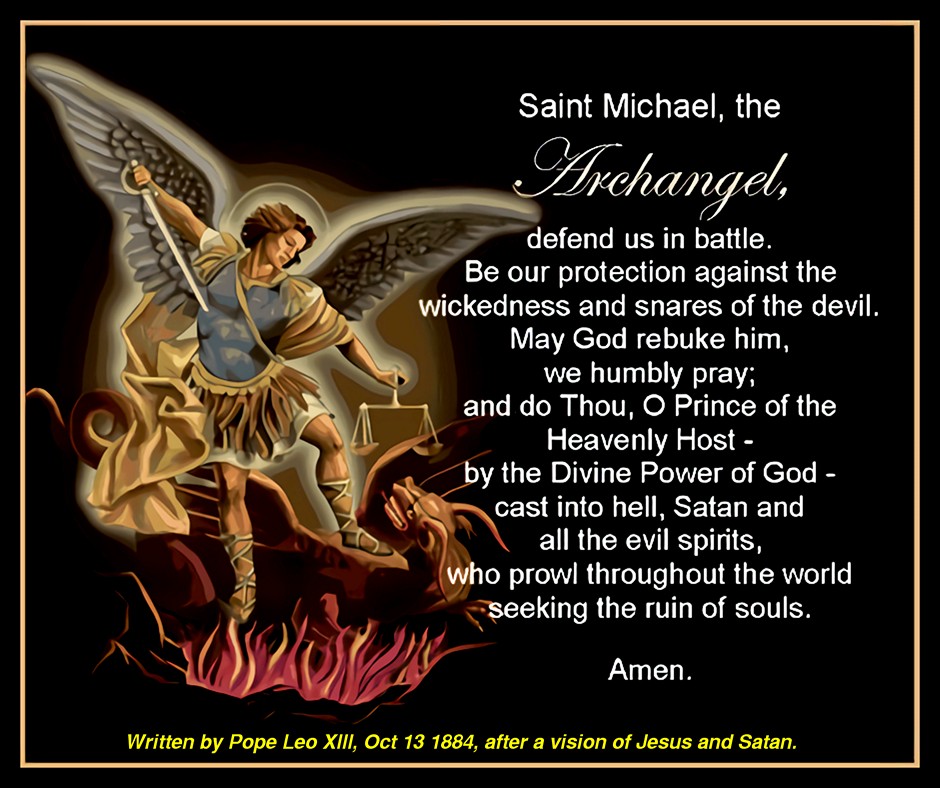
Today we celebrate the only three heavenly spirits given names in Sacred Scripture: Michael, Gabriel, and Raphael. In Heaven, the angels are pure spirits with unique and eternal identities. The names given in Scripture reveal their particular missions to humanity. These three archangels reveal God’s power, presence, and mercy through their heavenly missions, carried out in perfect obedience to His will for the good of souls.
Michael means “Who is like God?” His name is a rhetorical question that reflects his role as the great defender of God’s glory against the pride of the devil. He cast Lucifer from Heaven and continues to defend the Church today.
Gabriel means “God is my strength” and is the herald of divine mysteries, most notably sent to the Blessed Virgin Mary to announce the Incarnation of the Son of God. He strengthens those called to fulfill God’s plan, as he did with Mary and Zechariah.
Raphael means “God heals” and is the guide and healer in the Book of Tobit, sent to bring physical and spiritual restoration. His mission reveals God’s desire to accompany us on our journey, bringing healing to body and soul.
Today’s Gospel offers a profound insight into the role of angels in our lives and in the life of the Church, the Mystical Body of Christ. The passage recounts the call of Nathanael, who is identified with Bartholomew in the Synoptic Gospels. When Nathanael approaches Jesus at Philip’s invitation, Jesus immediately speaks a prophetic truth: “Here is a true child of Israel.”
On a deeper level, the True Child of Israel is Christ Himself—the Son of Man, born of David’s line, descended from the patriarch Jacob, whom God named Israel. In calling Nathanael a true child of Israel, Jesus reveals not only Nathanael’s current disposition of an open and sincere heart, but also what he would become. Over time, through his witness of Christ’s Passion, Resurrection, and Ascension, the outpouring of the Holy Spirit at Pentecost, and his apostolic mission, Nathanael became truly united to Christ—transformed into one in whom Christ lived and acted.
Jesus continues: “Do you believe because I told you that I saw you under the fig tree? You will see greater things than this… you will see heaven opened and the angels of God ascending and descending on the Son of Man” (John 1:50–51). This alludes to Jacob’s dream in Genesis 28:12, in which he saw a ladder reaching from earth to heaven, with angels going up and down upon it.
Reflect today on the heavenly mystery that through Christ, Heaven is opened, and the angels of God continue their ministry among us at His command. Like Nathanael and all the saints who have gone before us, we are invited to rely on the angelic ministry as members of the Body of Christ. Call on Saints Michael, Gabriel, and Raphael to guide, defend, and heal you as you walk this path of holiness in union with Christ.
Saints Michael, Gabriel, and Raphael, defend, strengthen, and heal us as we continue our pilgrimage to Heaven. With Nathanael and all the saints, may we become true children of the Promise, living members of the Body of Christ. Continuously ascend with our prayers to Heaven and return to us with God’s aid, so that we may one day share fully in the life of Heaven. Jesus, I trust in You.
Please keep in mind that this is a Catholic Caucus/Devotional thread for the purpose of prayerful reflection on the Sacred Scriptures and is closed to debate of any kind. Per FR policy on Religion Caucus threads, off-topic, argumentative, and abusive comments are not allowed and will be submitted to the Mods for deletion. Thanks, and God bless you.
The Month of September is Dedicated to Our Lady of Sorrows

“And his father and his mother marveled at what was said about him; and Simeon blessed them and said to Mary his mother, ‘Behold, this child is set for the fall and rising of many in Israel, and for a sign that is spoken against (and a sword will pierce through your own soul also), that thoughts out of many hearts may be revealed.’” (Luke 2:33-35)

Pope Leo XIV’s prayer intention for the month of September, 2026:
For the care of water
Let us pray for a just and sustainable management of water, a vital resource, so that everyone may have equal access to it.

Today’s First Reading
Daniel's Vision
---------------
[9] As I looked, thrones were placed and one that was ancient of days took his seat; his raiment was white as snow, and the hair of his head like pure wool; his throne was fiery flames, its wheels were burning fire. [10] A stream of fire issued and came forth from before him; a thousand thousands served him, and ten thousand times ten thousand stood before him; the court sat in judgment and the books were opened.
[13] I saw in the night visions, and behold, with the clouds of heaven there came one like a son of man, and he came to the Ancient of Days and was presented before him. [14] And to him was given dominion and glory and kingdom, that all peoples, nations, and languages should serve him; his dominion is an everlasting dominion, which shall not pass away, and his kingdom one that shall not be destroyed.
***********************************************************************
Commentary:
7:1-12:13. Up to the end of chapter 6, Daniel has been the interpreter of kings' dreams; now his own dreams are interpreted for him by an angel or heavenly being: the interpreter explains dreams (chaps. 7-8), the meaning of Scripture (chap. 9), and a vision (chaps. 10-12); and Daniel himself notes it all down.
Daniel had announced to Nebuchadnezzar the end of time as part of the interpretation of his dream (cf. 2:28); now Daniel is told when it will happen (cf. 12:5-12); for him (cf. 2:28); he is given a more specific revelation in which the figure of the tyrannical Antiochus IV (described here symbolically) is depicted as the epitome of evil and his death will mark the end of the present age (cf. 11:45-12:1). Earlier, Daniel's wisdom was seen as a divine gift to be used for the benefit of foreign kings; now it is depicted as coming from a revelation in which God speaks to Daniel through heavenly messengers and tells him about the meaning of human history--a revelation that he must commit to writing, as a source of comfort and hope for the chosen people. "Revelation has set within history a point of reference which cannot be ignored if the mystery of human life is to be known. Yet this knowledge refers back constantly to the mystery of God which the human mind cannot exhaust but can only receive and embrace in faith. Between these two poles, reason has its own specific field in which it can enquire and understand, restricted only by its finiteness before the infinite mystery of God" (John Paul II, "Fides Et Ratio", 14).
7:1-28. This chapter marks the end of the part of the book written in Aramaic; in it we again find elements seen in chapter 2 (where the Aramaic part began); these include: the arrangement of history into four periods (symbolized there by metals, here by beasts) and the establishment of an everlasting kingdom at the end. Thus, the chapter closes the Aramaic section and acts as a kind of introduction to the chapters (in Hebrew) in which Daniel receives and writes down divine revelations. Chapter 8 is written in Hebrew and it explains chapter 7; and this pattern continues: chapter 9 is explained by chapter 10; and 11 by 12. Daniel first outlines his dream or vision, and it is then interpreted by an angelic being. In this chapter the content of the dream is given in vv. 1-14, and its interpretation in vv. 15-28. Vision and interpretation constitute a single event, an account of which Daniel writes down, as he mentions at start (cf. v. 1) and finish (cf. v. 28). Daniel's "signature" at beginning and end confirms the truth of his vision and the truthfulness of what he has written for the reader.
7:1-14. In chapter 5 the picture drawn of Belshazzar suggested that he stood figuratively for the sacrilegious King Antiochus IV. It is not surprising, then, that this dream of Daniel's is set in the first year of Belshazzar's reign, given that the climax of the prophecy (the little horn) concerns Antiochus IV. God is going to intervene definitively when irreligion is at its worst. There are two scenes in the vision--the beasts coming out of the sea (vv. 2-8) and the divine court and judgment (vv. 9-14).
7:9-14. Divine judgment is passed on the kingdoms in this scene. God is depicted as being seated on a throne in heaven, his glory flashing out and angels all around. Judgment is about to take place, and it will be followed by execution of the sentence. The books (v. 10) contain all the actions of men (cf. Jer 17:1; Mal 3:16; Ps 56:8; Rev 20:12). The seer is shown history past (not laid out according to chronology: all the empires are included in one glance), and he notes that a more severe sentence is passed on the blasphemous horn than on the other beasts. They had their lives extended (v. 12), that is, their deprivation of power did not spell the end; but the little horn is destroyed forthwith. "Following in the steps of the prophets and John the Baptist, Jesus announced the judgment of the Last Day in his preaching (cf. Dan 7:10; Joel 3-4; Mal 3:19; Mt 3:7-42)" ("Catechism of the Catholic Church", 678).
The one "like a son of man" who comes with the clouds of heaven and who, after the judgment, is given everlasting dominion over all the earth, is the very antithesis of the beasts. He has not risen from a turbulent sea like them; there is nothing ferocious about him. Rather, he has been raised up by God (he comes with the clouds of heaven) and he shares the human condition. The dignity of all mankind is restored through this son of man's triumph over the beasts. This figure, as we will discover later, stands for 'the people of the saints of the Most High' (7:27), that is, faithful Israel. However, he is also an individual (just as the winged lion was an individual, and the little horn), and insofar as he is given a kingdom, he is a king. What we have here is an individual who represents the people. In Jewish circles around the time of Christ, this "son of man" was interpreted as being the Messiah, a real person (cf. "Book of the Parables of Enoch"); but it was a title that became linked to the sufferings of the Messiah and to his resurrection from the dead only when Jesus Christ applied it to himself in the Gospel. "Jesus accepted Peter's profession of faith, which acknowledged him to be the Messiah, by announcing the imminent Passion of the Son of Man (cf. Mt 16:23). He unveiled the authentic content of his messianic kingship both in the transcendent identity of the Son of Man 'who came down from heaven' (Jn 3:13; cf. Jn 6:62; Dan 7:13), and in his redemptive mission as the suffering Servant: 'The Son of Man came not to be served but to serve, and to give his life as a ransom for many' (Mt 20:28; cf. Is 53:10-12)" ("Catechism of the Catholic Church", 440).
When the Church proclaims in the Creed that Christ is seated at the right hand of the Father, she is saying that it was to Christ that dominion was given; "Being seated at the Father's right hand signifies the inauguration of the Messiah's kingdom, the fulfillment of the prophet Daniel's vision concerning the Son of man; 'To him was given domination and glory and kingdom, that all peoples, nations, and languages should serve him; his dominion is an everlasting dominion, which shall not pass away, and his kingdom one that shall not be destroyed' (Dan 7:14). After this event the apostles became witnesses of the 'kingdom [that] will have no end' (Nicene Creed)" ("Catechism of the Catholic Church", 664).
From: John 1:47-51
The Calling of the First Disciples
----------------------------------
[47] Jesus saw Nathaniel coming to Him, and said to him, "Behold, an Israelite indeed, in whom is no guile!" [48] Nathaniel said to Him, "How do you know me?" Jesus answered him, "Before Philip called you, when you were under the fig tree, I saw you." [49] Nathaniel answered Him, "Rabbi, you are the Son of God! You are the King of Israel! [50] Jesus answered him, "Because I said to you, I saw you under the fig tree, do you believe? You shall see greater things than these." [51] And He said to him, "Truly, truly, I say to you, you will see Heaven opened, and the angels of God ascending and descending upon the Son of Man."
***********************************************************************
Commentary:
45-51. The Apostle Philip is so moved that he cannot but tell his friend Nathaniel (Bartholomew) about his wonderful discovery (verse45). "Nathaniel had heard from Scripture that Jesus must come from Bethlehem, from the people of David. This belief prevailed among the Jews and also the prophet had proclaimed it of old, saying: `But you, O Bethlehem, who are little to be among the clans of Judah, from you shall come forth for me one who is to be ruler of Israel' (Micah 5:2). Therefore, when he heard that He was from Nazareth, he was troubled and in doubt, since he found that the announcement of Philip was not in agreement with the words of the prophecy" (St. John Chrysostom, "Hom.on St. John", 20, 1).
A Christian may find that, in trying to communicate his faith to others, they raise difficulties. What should he do? What Philip did--not trust his own explanation, but invite them to approach Jesus personally: "Come and see" (verse 46). In other words, a Christian should bring his fellow-men, his brothers into Jesus' presence through the means of grace which He has given them and which the Church ministers--frequent reception of the sacraments, and devout Christian practices.
Nathaniel, a sincere person (verse 47), goes along with Philip to see Jesus; he makes personal contact with our Lord (verse 48), and the outcome is that he receives faith (the result of his ready reception of grace, which reaches him through Christ's human nature: verse 49).
As far as we can deduce from the Gospels, Nathaniel is the first Apostle to make an explicit confession of faith in Jesus as Messiah and as Son of God. Later on St. Peter, in a more formal way, will recognize our Lord's divinity (cf. Matthew 16:16). Here (verse 51) Jesus evokes a text from Daniel (7:13) to confirm and give deeper meaning to the words spoken by His new disciple.
Disclaimer: Opinions posted on Free Republic are those of the individual posters and do not necessarily represent the opinion of Free Republic or its management. All materials posted herein are protected by copyright law and the exemption for fair use of copyrighted works.


