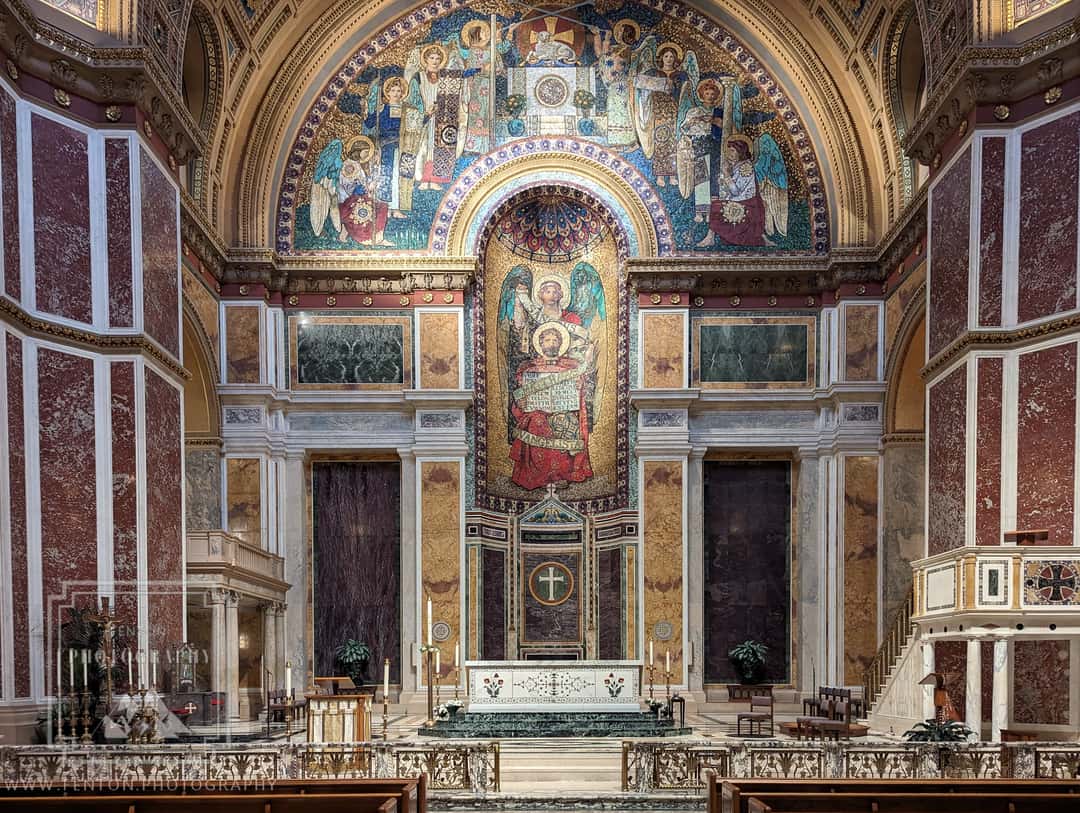
Catena Aurea by St. Thomas Aguinas
9:9–13
9. And as Jesus passed forth from thence, he saw a man, named Matthew, sitting at the receipt of custom: and he saith unto him, Follow me. And he arose, and followed him.
10. And it came to pass, as Jesus sat at meat in the house, behold, many Publicans and sinners came and sat down with him and his disciples.
11. And when the Pharisees saw it, they said unto his disciples, Why eateth your Master with Publicans and sinners?
12. But when Jesus heard that, he said unto them, They that be whole need not a physician, but they that are sick.
13. But go ye and learn what that meaneth, I will have mercy, and not sacrifice: for I am not come to call the righteous, but sinners to repentance.
CHRYSOSTOM. (Hom. xxx.) Having wrought this miracle, Christ would not abide in the same place, lest He should rouse the envy of the Jews. Let us also do thus, not obstinately opposing those who lay in wait for us. And as Jesus departed thence, (namely from the place in which He had done this miracle,) he saw a man sitting at the receipt of custom, Matthew by name.
JEROME. The other Evangelists from respect to Matthew have not called him by his common name, but say here, Levi, for he had both names. Matthew himself, according to that Solomon says. The righteous man accuses himself, (Prov. 18:17.) calls himself both Matthew and Publican, to shew the readers that none need despair of salvation who turn to better things, seeing he from a Publican became an Apostle.
GLOSS. (ap. Anselm.) He says, sitting at the receipt of custom, that is, in the place where the tolls were collected. He was named Telonarius, from a Greek word signifying taxes.
CHRYSOSTOM. Herein he shews the excellent power of Him that called him; while engaged in this dangerous office He rescued him from the midst of evil, as also Paul while he was yet mad against the Church. He saith unto him, Follow me. As you have seen the power of Him that calleth, so learn the obedience of him that is called; he neither refuses, nor requests to go home and inform his friends.
REMIGIUS. He esteems lightly human dangers which might accrue to him from his masters for leaving his accounts in disorder, but, he arose, and followed him. And because he relinquished earthly gain, therefore of right was he made the dispenser of the Lord’s talents.
JEROME. Porphyry and the Emperor Julian insist from this account, that either the historian is to be charged with falsehood, or those who so readily followed the Saviour with haste and temerity; as if He called any without reason. They forget also the signs and wonders which had preceded, and which no doubt the Apostles had seen before they believed. Yea the brightness of effulgence of the hidden Godhead which beamed from His human countenance might attract them at first view. For if the loadstone can, as it is said, attract iron, how much more can the Lord of all creation draw to Himself whom He will!
CHRYSOSTOM. But why did He not call him at the same time with Peter and John and the others? Because he was then still in a hardened state, but after many miracles, and great fame of Christ, when He who knows the inmost secrets of the heart, perceived him more disposed to obedience, then He called him.
AUGUSTINE. (De Cons. Ev. ii. 26.) Or, perhaps it is more probable that Matthew here turns back to relate something that he had omitted; and we may suppose Matthew to have been called before the sermon on the mount; for on the mount, as Luke relates, the twelve, whom He also named Apostles, were chosen.
GLOSS. (non occ.) Matthew places his calling among the miracles; for a great miracle it was, a Publican becoming an Apostle.
CHRYSOSTOM. Why is it then that nothing is said of the rest of the Apostles how or when they were called, but only of Peter, Andrew, James, John, and Matthew? Because these were in the most alien and lowly stations, for nothing can be more disreputable than the office of Publican, nothing more abject than that of fisherman.
GLOSS. (ap. Anselm.) As a meet return for the heavenly mercy, Matthew prepared a great feast for Christ in his house, bestowing his temporal goods on Him of whom he looked to receive everlasting goods. It follows, And it came to pass as he sat at meat in the house.
AUGUSTINE. (De. Cons. Ev. ii. 27.) Matthew has not said in whose house Jesus sat at meat (on this occasion), from which we might suppose, that this was not told in its proper order, but that what took place at some other time is inserted here as it happened to come into his mind; did not Mark and Luke who relate the same shew that it was in Levi’s, that is, in Matthew’s house.
CHRYSOSTOM. Matthew being honoured by the entrance of Jesus into his house, called together all that followed the same calling with himself; Behold many Publicans and sinners came and sat down with Jesus, and with his disciples.
GLOSS. (ap. Anselm.) The Publicans were they who were engaged in public business, which seldom or never can be carried on without sin. And a beautiful omen of the future, that he that was to be an Apostle and doctor of the Gentiles, at his first conversion draws after him a great multitude of sinners to salvation, already performing by his example what he was shortly to perform by word.
GLOSS. (ord.) Tertullian says that these must have been Gentiles, because Scripture says, There shall be no payer of tribute in Israel, as if Matthew were not a Jew. But the Lord did not sit down to meat with Gentiles, being more especially careful not to break the Law, as also He gave commandment to His disciples below, Go not into the way of the Gentiles.
JEROME. But they had seen the Publican turning from sins to better things, and finding place of repentance, and on this account they do not despair of salvation.
CHRYSOSTOM. Thus they came near to our Redeemer, and that not only to converse with Him, but to sit at meat with Him; for so not only by disputing, or healing, or convincing His enemies, but by eating with them, He oftentimes healed such as were ill-disposed, by this teaching us, that all times, and all actions, may be made means to our advantage. When the Pharisees saw this they were indignant; And the Pharisees beholding said to his disciples, Why eateth your Master with Publicans and sinners? It should be observed, that when the disciples seemed to be doing what was sinful, these same addressed Christ, Behold, thy disciples are doing what it is not allowed to do on the Sabbath. (Mat. 12:2.) Here they speak against Christ to His disciples, both being the part of malicious persons, seeking to detach the hearts of the disciple from the Master.
RABANUS. (e Beda.) They are here in a twofold error; first, they esteemed themselves righteous, though in their pride they had departed far from righteousness; secondly, they charged with unrighteousness those who by recovering themselves from sin were drawing near to righteousness.
AUGUSTINE. (ubi sup.) Luke seems to have related this a little differently; according to him the Pharisees say to the disciples, Why do ye eat and drink with Publicans and sinners? (Luke 5:30.) not unwilling that their Master should be understood to be involved in the same charge; insinuating it at once against Himself and His disciples. Therefore Matthew and Mark have related it as said to the disciples, because so it was as much an objection against their Master whom they followed and imitated. The sense therefore is one in all, and so much the better conveyed, as the words are changed while the substance continues the same.
JEROME. For they do not come to Jesus while they remain in their original condition of sin, as the Pharisees and Scribes complain, but in penitence, as what follows proves; But Jesus hearing said, They that be whole need not a physician, but they that are sick.
RABANUS. He calls Himself a physician, because by a wonderful kind of medicine He was wounded for our iniquities that He might heal the wound of our sin. By the whole, He means those who seeking to establish their own righteousness have not submitted to the true righteousness of God. By the sick, (Rom. 10:3.) He means those who, tied by the consciousness of their frailty, and seeing that they are not justified by the Law, submit themselves in penitence to the grace of God.
CHRYSOSTOM. Having first spoken in accordance with common opinion, He now addresses them out of Scripture, saying, Go ye, and learn what that meaneth, I will have mercy and not sacrifice.
JEROME. This text from Osee (Hosea 6:6.) is directed against the Scribes and Pharisees, who, deeming themselves righteous, refused to keep company with Publicans and sinners.
CHRYSOSTOM. As much as to say; How do you accuse me for reforming sinners? Therefore in this you accuse God the Father also. For as He wills the amendment of sinners, even so also do I. And He shews that this that they blamed was not only not forbidden, but was even by the Law set above sacrifice; for He said not, I will have mercy as well as sacrifice, but chooses the one and rejects the other.
GLOSS. (ap. Anselm.) Yet does not God contemn sacrifice, but sacrifice without mercy. But the Pharisees often offered sacrifices in the temple that they might seem to men to be righteous, but did not practise the deeds of mercy by which true righteousness is proved.
RABANUS. He therefore warns them, that by deeds of mercy they should seek for themselves the rewards of the mercy that is above, and, not overlooking the necessities of the poor, trust to please God by offering sacrifice. Wherefore, He says, Go; that is, from the rashness of foolish fault-finding to a more careful meditation of Holy Scripture, which highly commends mercy, and proposes to them as a guide His own example of mercy, saying, I came not to call the righteous but sinners.
AUGUSTINE. (ubi sup.) Luke adds to repentance, which explains the sense; that none should suppose that sinners are loved by Christ because they are sinners; and this comparison of the sick shews what God means by calling sinners, as a physician does the sick to be saved from their iniquity as from a sickness: which is done by penitence.
HILARY. Christ came for all; how is it then that He says He came not for the righteous? Were there those for whom it needed not that He should come? But no man is righteous by the law. He shews how empty their boast of justification, sacrifices being inadequate to salvation, mercy was necessary for all who were set under the Law.
CHRYSOSTOM. Whence we may suppose that He is speaking ironically, as when it is said, Behold now Adam is become as one of us. (Gen. 3:22.) For that there is none righteous on earth Paul shews, All have sinned, and need glory of God. (Rom. 3:23.) By this saying He also consoled those who were called; as though He had said, So far am I from abhorring sinners, that for their sakes only did I come.
GLOSS. (ap. Anselm.) Or; Those who were righteous, as Nathanael and John the Baptist, were not to be invited to repentance. Or. I came not to call the righteous, that is, the feignedly righteous, those who boasted of their righteousness as the Pharisees, but those that owned themselves sinners.
RABANUS. In the call of Matthew and the Publicans is figured the faith of the Gentiles who first gaped after the gain of the world, and are now spiritually refreshed by the Lord; in the pride of the Pharisees, the jealousy of the Jews at the salvation of the Gentiles. Or, Matthew signifies the man intent on temporal gain; Jesus sees him, when He looks on him with the eyes of mercy. For Matthew is interpreted ‘given,’ Levi ‘taken,’ the penitent is taken out of the mass of the perishing, and by God’s grace given to the Church. And Jesus saith unto him, Follow me, either by preaching, or by the admonition of Scripture, or by internal illumination.
Catena Aurea Matthew 9
St. Matthew
Apostle and evangelist.
The name Matthew is derived from the Hebrew Mattija, being shortened to Mattai in post-Biblical Hebrew. In Greek it is sometimes spelled Maththaios, BD, and sometimes Matthaios, CEKL, but grammarians do not agree as to which of the two spellings is the original.
Matthew is spoken of five times in the New Testament; first in Matthew 9:9, when called by Jesus to follow Him, and then four times in the list of the Apostles, where he is mentioned in the seventh (Luke 6:15, and Mark 3:18), and again in the eighth place (Matthew 10:3, and Acts 1:13). The man designated in Matthew 9:9, as "sitting in the custom house", and "named Matthew" is the same as Levi, recorded in Mark 2:14, and Luke 5:27, as "sitting at the receipt of custom". The account in the three Synoptics is identical, the vocation of Matthew-Levi being alluded to in the same terms. Hence Levi was the original name of the man who was subsequently called Matthew; the Maththaios legomenos of Matthew 9:9, would indicate this.
The fact of one man having two names is of frequent occurrence among the Jews. It is true that the same person usually bears a Hebrew name such as "Shaoul" and a Greek name, Paulos. However, we have also examples of individuals with two Hebrew names as, for instance, Joseph-Caiaphas, Simon-Cephas, etc. It is probable that Mattija, "gift of Iaveh", was the name conferred upon the tax-gatherer by Jesus Christ when He called him to the Apostolate, and by it he was thenceforth known among his Christian brethren, Levi being his original name.
Matthew, the son of Alpheus (Mark 2:14) was a Galilean, although Eusebius informs us that he was a Syrian. As tax-gatherer at Capharnaum, he collected custom duties for Herod Antipas, and, although a Jew, was despised by the Pharisees, who hated all publicans. When summoned by Jesus, Matthew arose and followed Him and tendered Him a feast in his house, where tax-gatherers and sinners sat at table with Christ and His disciples. This drew forth a protest from the Pharisees whom Jesus rebuked in these consoling words: "I came not to call the just, but sinners".
No further allusion is made to Matthew in the Gospels, except in the list of the Apostles. As a disciple and an Apostle he thenceforth followed Christ, accompanying Him up to the time of His Passion and, in Galilee, was one of the witnesses of His Resurrection. He was also amongst the Apostles who were present at the Ascension, and afterwards withdrew to an upper chamber, in Jerusalem, praying in union with Mary, the Mother of Jesus, and with his brethren (Acts 1:10 and 1:14).
Of Matthew's subsequent career we have only inaccurate or legendary data. St. Irenæus tells us that Matthew preached the Gospel among the Hebrews, St. Clement of Alexandria claiming that he did this for fifteen years, and Eusebius maintains that, before going into other countries, he gave them his Gospel in the mother tongue. Ancient writers are not as one as to the countries evangelized by Matthew, but almost all mention Ethiopia to the south of the Caspian Sea (not Ethiopia in Africa), and some Persia and the kingdom of the Parthians, Macedonia, and Syria.
According to Heracleon, who is quoted by Clement of Alexandria, Matthew did not die a martyr, but this opinion conflicts with all other ancient testimony. Let us add, however, that the account of his martyrdom in the apocryphal Greek writings entitled "Martyrium S. Matthæi in Ponto" and published by Bonnet, "Acta apostolorum apocrypha" (Leipzig, 1898), is absolutely devoid of historic value. Lipsius holds that this "Martyrium S. Matthæi", which contains traces of Gnosticism, must have been published in the third century.
There is a disagreement as to the place of St. Matthew's martyrdom and the kind of torture inflicted on him, therefore it is not known whether he was burned, stoned, or beheaded. The Roman Martyrology simply says: "S. Matthæi, qui in Æthiopia prædicans martyrium passus est".
Various writings that are now considered apocryphal, have been attributed to St. Matthew. In the "Evangelia apocrypha" (Leipzig, 1876), Tischendorf reproduced a Latin document entitled: "De Ortu beatæ Mariæ et infantia Salvatoris", supposedly written in Hebrew by St. Matthew the Evangelist, and translated into Latin by Jerome, the priest. It is an abridged adaptation of the "Protoevangelium" of St. James, which was a Greek apocryphal of the second century. This pseudo-Matthew dates from the middle or the end of the sixth century.
The Latin Church celebrates the feast of St. Matthew on 21 September, and the Greek Church on 16 November. St. Matthew is represented under the symbol of a winged man, carrying in his hand a lance as a characteristic emblem.
About this page
APA citation. Jacquier, J.E. (1911). St. Matthew. In The Catholic Encyclopedia. New York: Robert Appleton Company. https://www.newadvent.org/cathen/10056b.htm
MLA citation. Jacquier, Jacque Eugène. "St. Matthew." The Catholic Encyclopedia. Vol. 10. New York: Robert Appleton Company, 1911. .
Transcription. This article was transcribed for New Advent by Ernie Stefanik.
Ecclesiastical approbation. Nihil Obstat. October 1, 1911. Remy Lafort, S.T.D., Censor. Imprimatur. +John Cardinal Farley, Archbishop of New York.
Contact information. The editor of New Advent is Kevin Knight. My email address is webmaster at newadvent.org. Regrettably, I can't reply to every letter, but I greatly appreciate your feedback — especially notifications about typographical errors and inappropriate ads.
newadvent.org