
Posted on 08/12/2026 10:33:25 PM PDT by fidelis
Peter approached Jesus and asked him, “Lord, if my brother sins against me, how often must I forgive him? As many as seven times?” Jesus answered, “I say to you, not seven times but seventy-seven times.” Matthew 18:21–22
In the Book of the Prophet Amos, a poetic formula is repeated: “For three crimes of Damascus, and now four—I will not take it back…” (cf. Amos 1). By the time of Jesus, rabbinic tradition had adopted the interpretation of this passage to mean that God forgives three times, but not four and, therefore, so should we: “When a person commits a transgression the first time, he is forgiven; a second time, he is forgiven; a third time, he is forgiven; but the fourth time, he is not forgiven” (Yoma 86b).
In today’s Gospel, Peter’s question is generous but still rooted in human calculation. His question follows immediately after Jesus teaches about fraternal correction. Peter, taking in this instruction and knowing the rabbinic tradition, more than doubles the expected number of times to forgive, suggesting seven. But Jesus immediately corrects him—not to reject his generosity, but to elevate it: “I say to you, not seven times but seventy-seven times.”
This phrase, “seventy-seven times,” is not a literal number; it signifies that forgiveness must be limitless, reflecting the boundless mercy of God. It is not merely a command to repeat acts of forgiveness, but an invitation to let our hearts be formed by Divine Mercy.
The parable Jesus tells in response to Peter’s question offers deeper insight into His meaning. It echoes the fifth petition of the Lord’s Prayer: “Forgive us our trespasses, as we forgive those who trespass against us.” A king has a servant who owes him a huge amount—an unpayable debt, symbolizing the incalculable weight of our sin before God. When the servant begs for patience, the king goes beyond all expectation: he forgives the entire debt out of compassion. But that same servant, having just received mercy, encounters a fellow servant who owes him only a small amount. Rather than extending the mercy he himself had received, he becomes violent, demanding repayment and imprisoning the man. The king, upon hearing this, is enraged—not merely because of injustice, but because of the servant’s utter failure to mirror the mercy he had been shown. Jesus concludes with a sobering warning: “So will my heavenly Father do to you, unless each of you forgives his brother from his heart.”
Limitless forgiveness is very difficult unless we have a deep and abiding gratitude for the Divine Mercy God has shown us. Our debt before God is incalculable. We could never repay it on our own. Though we might be tempted to think, “I’m a good person,” Scripture reminds us: “All have sinned and are deprived of the glory of God” (Romans 3:23). Without Jesus taking on our human condition and paying the debt of our sin through His suffering and death, we could not be saved. Grasping this truth and allowing it to penetrate our hearts is essential to living the Christian life.
Reflect today on how deeply you are aware of the mercy God has shown you. Do you take it for granted, or have you allowed it to transform you? Consider especially those you struggle to forgive. Let gratitude for God’s mercy soften your heart. From that softened heart, choose to forgive—not seven times, but seventy-seven times and beyond. In doing so, you will reflect the very heart of God and become a vessel of His saving grace in the world.
Most merciful Jesus, there is no limit to the love and forgiveness You continuously offer us. We are indebted to You with our very lives. Please give me the grace I need to be truly grateful for Your Divine Mercy and to express that gratitude by showing the same limitless mercy to all. Use me, dear Lord, as a vessel of Your grace and tender care. Jesus, I trust in You.
Please keep in mind that this is a Catholic Caucus/Devotional thread for the purpose of prayerful reflection on the Sacred Scriptures and is closed to debate of any kind. Per FR policy on Religion Caucus threads, off-topic, argumentative, and abusive comments are not allowed and will be submitted to the Mods for deletion. Thanks, and God bless you.
Today’s First Reading
From: Ezekiel 12:1-12
The exiles' departure
------------------------------
[1] The word of the Lord came to me: [2"] Son of man, you dwell in the midst of a rebellious house, who have eyes to see, but see not, who have ears to hear, but hear not [3] for they are a rebellious house. Therefore, son of man, prepare for yourself an exile's baggage, and go into exile by day in their sight; you shall go like an exile from your place to another place in their sight. Perhaps they will understand, though they are a rebellious house. [4] You shall bring out your baggage by day in their sight, as baggage for exile; and you shall go forth yourself at evening in their sight, as men do who must go into exile. [5] Dig through the wall in their sight, and go out through it. [6] In their sight you shall lift the baggage upon your shoulder, and carry it out in the dark; you shall cover your face, that you may not see the land; for I have made you a sign for the house of Israel."
[7] And I did as I was commanded. I brought out my baggage by day, as baggage for exile, and in the evening I dug through the wall with my own hands; I went forth in the dark, carrying my outfit upon my shoulder in their sight.
[8] In the morning the word of the Lord came to me: [9] Son of man, has not the house of Israel, the rebellious house, said to you, 'What are you doing?' [10] Say to them, 'Thus says the Lord God: This oracle concerns the prince in Jerusalem and all the house of Israel who are in it.' [11] Say, 'I am a sign for you: as I have done, so shall it be done to them; they shall go into exile, into captivity.' [12] And the prince who is among them shall lift his baggage upon his shoulder in the dark, and shall go forth; he shall dig through the wall and go out through it; he shall cover his face, that he may not see the land with his eyes."
***************************************************************************
Commentary:
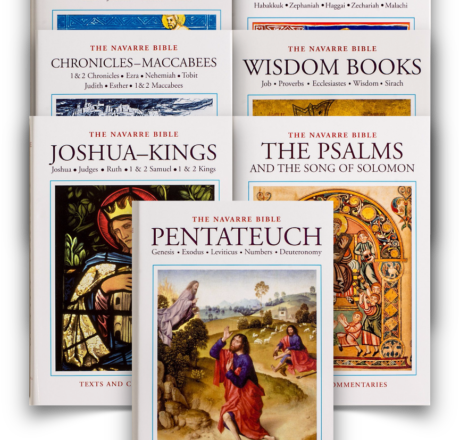
12:1-14:23. Up to this point, the warnings to Jerusalem have been given by way of symbolic actions (chaps. 4-5) and chilling prophecies (chaps. 6-7), and the vision of the outrages committed in the temple (chaps. 8-11). However, neither the people living in Jerusalem nor the exiles seem to accept that a catastrophe is about to happen. In this section of the book Ezekiel speaks out against the people and their refusal to believe by announcing that King Zedekiah is to be deported forthwith (chap. 12) and then by condemning the false prophets who deceive the people by giving them false hopes (chap. 13); he also criticizes pagan beliefs (chap. 14). These oracles are designed to move the listeners' hearts and to get them to put all their trust in the Lord: he can help them in their exile. That is the import of the phrase that recurs in this passage: "You will know that I am the Lord."
12:1-28. The date of the last deportation, which happened in 587 BC (cf. 2 Kings 25:8-21), is announced by five oracles or symbolic gestures, each beginning with the wording, "The word of the Lord came to me" (vv. 1, 8, 17, 21, 26). The first two centre on the detention and deportation of King Zedekiah (vv. 1-16), the next one on the poor circumstances of the exiles (vv. 17-20), and the last two focus on how soon these two events will be brought about (vv. 21-28). The symbolic actions of the prophet are well designed to prove to his listeners the truth of what he says.
12:1-16. The first symbolic action (leaving with an exile's baggage) is calculated to provoke feelings of depression; the deportation that they fear will indeed take place. "Exile" is mentioned six times in five verses; "in their sight", five times; and "rebellious house" twice. The preparations are made in daylight; but the actual leaving is shameful: it takes place at night, the face veiled, without looking back at the city.
Ezekiel's symbolic action stands for what will happen to King Zedekiah (v. 10: cf. 2 Kings 25:2-7), who is not mentioned here by either name or title of king. He is called "the prince in Jerusalem, not "prince of Judah", to indicate that catastrophe will befall the city and its inhabitants.
"I will spread my net over him, and he shall be in my snare' ('v. 13): the net metaphor indicates that deportation is a kind of enslavement. And the use of the first person underlines once again the fact that it is the Lord himself who is the cause of the deportation. Insistence on this helps to strike a very positive note: if God is the cause of the punishment (exile), he too will deliver his people when their imprisonment comes to an end.
The importance of a remnant escaping (v.16) lies in the fact that they will bear witness to their sins and punishment before pagan nations -- so that the latter too may acknowledge the Lord. This positive interpretation of the exile is a feature of the book of Ezekiel.
From: Matthew 18:21-19:2
Forgiveness of Injuries. The Parable of the Unforgiving Servant
--------------------------------------------------------------------------------
[21] Then Peter came up and said to Him (Jesus), "Lord, how often shall my brother sin against me, and I forgive him? As many as seven times?" [22] Jesus said to him, "I do not say to you seven times, but seventy times seven.
[23] "Therefore the Kingdom of Heaven may be compared to a king who wished to settle accounts with his servants. [24] When he began the reckoning, one was brought to him who owed him ten thousand talents; [25] and as he could not pay, his lord ordered him to be sold, with his wife and children and all that he had, and payment to be made. [26] So the servant fell on his knees, imploring him, 'Lord, have patience with me, and I will pay you everything.' [27] And out of pity for him the lord of that servant released him and forgave him the debt. [28] But that same servant, as he went out, came upon one of his fellow servants who owed him a hundred denarii; and seizing him by the throat he said, `Pay what you owe.' [29] So his fellow servant fell down and besought him, `Have patience with me, and I will pay you.' [30] He refused and went and put him in prison till he should pay his debt. [31] When his fellow servants saw what had taken place, they were greatly distressed, and they went and reported to their lord all that had taken place. [32] Then his lord summoned him and said to him, `You wicked servant! I forgave you all that debt because you besought me; [33] and should not you have had mercy on your fellow servant, as I had mercy on you?' [34] And in anger his lord delivered him to the jailers, till he should pay all his debt. [35] So also My Heavenly Father will do to every one of you, if you do not forgive your brother from your heart."
[1] Now when Jesus had finished these sayings, He went away from Galilee and entered the region of Judea beyond the Jordan. [2] and large crowds followed him, and he healed them there.
***********************************************************************
Commentary:
21-35. Peter's question and particularly Jesus' reply prescribe the spirit of understanding and mercy which should govern Christians' behavior.
In Hebrew the figure of seventy times seven means the same as "always" (cf. Genesis 4:24): "Therefore, our Lord did not limit forgiveness to a fixed number, but declared that it must be continuous and forever" (Chrysostom, "Hom. on St. Matthew", 6). Here also we can see the contrast between the man's ungenerous, calculating approach to forgiveness, and God's infinite mercy. The parable also clearly shows that we are totally in God's debt. A talent was the equivalent of six thousand denarii, and a denarius a working man's daily wage. Ten thousand talents, an enormous sum, gives us an idea of the immense value attaching to the pardon we receive from God. Overall, the parable teaches that we must always forgive our brothers, and must do so wholeheartedly.
"Force yourself, if necessary, always to forgive those who offend you, from the very first moment. For the greatest injury or offense that you can suffer from them is nothing compared to what God has pardoned you" (St J. Escriva, "The Way", 452).
The Month of August is Dedicated to the Immaculate Heart of Mary

“In the sixth month the angel Gabriel was sent from God to a city of Galilee named Nazareth, to a virgin betrothed to a man whose name was Joseph, of the house of David; and the virgin’s name was Mary. And he came to her and said, “Hail, full of grace, the Lord is with you!”” (Luke 1:26-28)

Pope Leo XIV’s prayer intention for the month of August, 2026:
For evangelization in the city
Let us pray that in large cities often marked by anonymity and loneliness we find new ways to proclaim the Gospel, discovering creative paths to build community.

Disclaimer: Opinions posted on Free Republic are those of the individual posters and do not necessarily represent the opinion of Free Republic or its management. All materials posted herein are protected by copyright law and the exemption for fair use of copyrighted works.


