
Posted on 08/01/2026 11:43:36 AM PDT by ebb tide
A fortnight ago, I attended the illicit episcopal consecrations in Écône to bid farewell to the SSPX as newly separated brethren (again). I did so because I was in the neighbourhood and I could; more so as an observer than participant, because I was loth to incur the wrath and indignation of the Holy See. Nonetheless, I felt strangely drawn to bid adieu to the remaining remnant of the religion of my childhood, now disgraced, disowned and ironically denied the name and identity of “Catholic” for just continuing to be what we always were. Passing strange it seemed and seems.
Being there, I felt rather like I had stepped onto the set of Peggy-Sue Got Married, or was having a near-death experience, and reliving the nightmare which was post-Vatican II Catholicism for those of us who experienced it as loss and devastation. Moreover, it occurred to me that those in our camp had never really been given a platform for expressing the experience on a level playing field; drowned out in the megaphonic enthusiasm of the champions of the Council as a Great Leap Forward (as it was and we were).
The religion of my childhood now finds itself ironically denied the name ‘Catholic’ for continuing to be what it always was.Tweet this quote
Time moves on, and the Church must adapt or die, we were informed with Darwinian certitude. Whilst the modern-thinking theologians were quietly sweeping Satan, Hell, and Purgatory under the welcome mat, the liturgical Periti were also busy—in committee with Protestant experts—doing the same to the Holy Mass (as it was then known, before Eucharist became the thang): extirpating all traces of anachronistic sacrifice, transcendence, mystery, sanctity, reverence, chantm and mystical beauty, in order to become acceptable to the other Separated Brethren (as they then became): the Protestants of the Reformation (and their scions).
Suddenly we found ourselves dragooned into the new era of The Word: the privilege of compulsory verbal participation in parroting liturgical formulae and petitions in the vernacular. Exchanging handshakes on cue—pretending intimacy with total strangers. Holding hands around the table, singing profoundly meaningful songs such as Joy is like the rain to the accompaniment of badly played guitars. Oh, the blessings of the liturgical experts and their liberating reforms; either oblivious or blissfully ignorant it seems to the counsels of Jesus Christ on the subject:
“When you pray, go into your room, shut the door and pray to your Father who is unseen. Then your Father, who sees what is done in secret, will reward you. And when you pray, do not keep on babbling like pagans, for they think they will be heard because of their many words. Do not be like them, for your Father knows what you need before you ask Him.” (Matt.6:6-8)
Within the Mass of Paul VI there was a paradigm shift from Mythos to Logos (just as the Western Zeitgeist was trending in the opposite direction.) One could no longer retreat to one’s inner room and close the door to the outside world of endless babble. It had now infiltrated the fortress as well, and it was verboten to silently commune only with that still small voice within, amidst the beauty of holiness and enveloped in the odour of sanctity. That was all old hat now. You had to be active and engaged and chattering endlessly like chooks at dusk; and if you didn’t like the changes you had to lump it, because there could only be One normative form of the Roman Rite now (in spite of a plethora before), and it was all about regimental verbal conformity in community going forward—rather like the North Korean Kim-cult—or else you were branded “nostalgic” and “rigid” or “mentally defective” and worst of all: “Anti-Vatican II”! It became all about loyalty in a new conformity and indicting the dissident, rather than respecting and serving the spiritual wants and needs of the faithful who felt no need for and didn’t want radical metamorphosis masquerading as continuity.
I found myself wondering at the time about the wisdom of the changes. I no longer felt refreshed, inspired, or uplifted after going to Mass, but rather like I had just done an hour of housework. I remember my great-aunt lamenting the purchase of her fourth or fifth missal within a year or two of the renewal, moaning about why they needed so many insignificant changes when it all worked well enough before. I hastened to agree. The Mass had lost its magic.
The SSPX simply sees the Novus Ordo as spiritually impoverished—which it is for some.Tweet this quote
Who can remember the agonies of the liturgical commission over whether “brothers and sisters” sounded too effete for Australian ears and should be replaced with “you here present” (which it was, incredibly). Crucial responses like “and also with you” instead of “and with your spirit” which it started out and ended up as. It was all a bit like a dog chasing its tail; so childishly inconsequential the lot of it, but each novel thought requiring a new edition of the Missal. The importance given to triviality was overwhelming, all the while ignoring the ghostly elephant in the room: the almost complete loss and absence of reverence and sanctity and mystical experience to an impoverished pedestrian gabfest.
It wasn’t just about liturgy either; and this is where the SSPX is at variance with those who have capitulated to the Novus Ordo paradigm in the Ecclesia Dei communities. The Declaration on Religious Freedom and revocation/derogation of Concordats opened the doors wide to Evangelical wolverines to enter a newly deregulated market, and Pentecostal poaching in traditionally Catholic countries, which also secularised. Nostra Aetate pulled the rug from under missiology, and the whole enterprise effectively collapsed; after all, all religions contained truth, right? Clergy and Religious jumped ship in droves, and vocations to the priesthood and religious life plummeted, as we were newly informed by Lumen Gentium and Gaudium et Spes that marriage and a family was equal in status and virtue to sacrificial celibacy. Religious houses and seminaries rapidly emptied to try it out. Funny that!
The Council was ostensibly all about renewal, but in trying to fix something that already worked, it ended in mass confusion and desertion, and made a mess that the late Pope Francis could only envy from afar (as his time had not yet come).
In the aftermath I ventured to the USA on a scholarship and was mortified to find academic theology there all about models (you could choose from) and individual conscience as the ultimate authority (if your desires were impinged upon by pesky church doctrines that didn’t understand YOU). Nothing seemed to be objectively right or wrong any more. The seminary was full of regular American guys many of whom dated, and went to night clubs, and subterranean hot-spots, and some of whom were not infrequently seen at breakfast with their new best-friends. After all, “How could they commit to celibacy if they didn’t know what they were giving up?” as one seminary cadre informed me. Thus ran the logic, along with most of the ordinands out the door. Only a relatively small minority there actually got ordained, and many of them were subsequently laicised for various reasons mostly to do with “My right to be me”, and “God loves me as I am”, interspersed with ancillary criminal convictions. Some seminarians of my acquaintance became Protestant ministers within denominations whose moral theology better suited their lifestyle choices. It was enough to drive you spare. I thought at the time that the Church had gone mad and developed a death-wish. I still do.
However, I distinctly remember being repeatedly told at the time, in purported rebuttal of my objections, that all that had happened was that the faith had been restated in language comprehensible to a contemporary audience. I was assured that Vatican II was a pastoral council, not a dogmatic one—no dogmas had been declared, no anathemas sit—so nothing really had changed, and one was at liberty to accept or reject parts thereof, according to one’s conscience (as in everything at that juncture.) Try telling that one to Tucho today!
Had Archbishop Lefebvre not consecrated bishops in 1988, the Traditional Latin Mass might today exist only in history books.Tweet this quote
The fact is that narratives can change by sleight of hand over time, as can papal attitudes to liturgical privileges. A Benedict can become a Francis in the twinkling of an eye, and imagined inalienable rights can vanish with the stroke of a pen. If the audacity of schismatic consecrations in the face of a papal injunction seems insufferably insulting to the Holy See, one has only to look at recent papal caprice and the late Pope Francis’ Dalek-like drive to “Exterminate!” the Vetus Ordo, to understand the SSPX perception of necessity in present circumstances.
Great benefits were predicted from the Council, but exaggerated and imaginary expectations materialised as near-collapse. Even Paul VI lamented ex post facto that “The church itself is undergoing a process of self-destruction”. (Allocution to the Pontifical Lombard Seminary, Rome, 7/12/1968; the third anniversary of the closing of Vatican II). It was less a renewal than a euthanasia. Blind Freddy could see it, but the Periti were (and remain) in denial; insistent upon rigid continuity in an ideological war between the once and future Church. Notwithstanding the recognition of Paul VI of the unintended consequences of the Council, as long as his successors continue to disport themselves in its ideological new clothes, the hierarchy will be in lock-step, and any mavericks like Vigano or Strickland who dare to observe “Hang on mate, he’s naked!” will be cut down and trashed; with stacks-on-the-mill to boot.
“By their fruits you will know them” (Matt7:16-20)
So, what are the fruits of the Vatican II and its metamorphoses? Mass defection of clergy, Religious, and observant faithful, and evaporation of vocations, stand out like the dog’s proverbials. Descent from magnificence to mediocrity in liturgy, mission, art and architecture, inter alia, might be added to the list. In a nutshell, increasing irrelevance and invisibility. To the contrary, ecumenical friendliness has been a boon, compared to the sectarian antagonisms which plagued previous generations; but against that one has to weigh the loss of the sense of unique Truth and resolute confidence in the Catholic faith, which has become one among many.
Champions of the Council retorted that Vatican II was anything but what caused the general malaise we see all around us in the Church of today: it was the Vietnam War, the sexual revolution, the hippie movement, the New Atheists, the secular tide, climate change maybe… All of the above notwithstanding, the incredulous SSXP refused to accept the demise as inevitable, and soldiered on as if in a cocoon, not filled with grey hair like regular parishes (unfilled), but young (rather large) families, stunning liturgical beauty, continuing conspicuous piety and holiness, and increasing vocations year by year, which are all but a memory elsewhere. But the post-Vatican II Church, rather like Sargeant Shultz (of Hogan’s Heroes), sees nothing, knows nothing, and did not even get up this morning! Ignoring the stats; just obstinately obtuse.
Had Archbishop Lefebvre not gone rogue and consecrated his first batch of illegal bishops in 1988, I will bet London to a brick that there would have been no Ecclesia Dei Motu Proprio by John Paul II, and the Latin Mass (as far as the regular Church is concerned) would have been a subject only for ecclesiastical history, taught on a sinking ship. It still is, of course (sinking that is), but everyone is too busy admiring the Pope’s new clothes to notice. Is it cynical politics, or could it be denial, or just invincible ignorance?
Let us live and let live within one communion instead of descending into ‘My Eucharist is bigger than your Mass.Tweet this quote
Meanwhile back at the ranch, last Wednesday week at Écône, these liturgical memories lost in the mists of time, were still on display. The beauty, the gravitas, the mystery were all there is spades, before a packed field of around 15,000 faithful. It was (and is) the quintessential Catholicism of my childhood in its highest form. A moment of nostalgia—yes—but equally and simultaneously a tragic sense of loss of what was consigned to a giant trashcan by Sancrosanctum Concilium, and replaced with the prosaic verbal and vernacular legacy of a committee of liturgical experts. Écône was like standing on the precipice looking out at the Grand Canyon for the first time, or falling in love, and wondering why life couldn’t be just like this all of the time and forever more, rather than merely a relic of the past. I experienced flashbacks of ubiquitous holiness, long since forgotten in the long drought of the liturgical renewal.
I couldn’t but feel that I had entered the Tardis and was standing not only at the foot of the cross (versus a vague recollection ritual), in the company of the brethren (both male and female) throughout the ages in a vision of the celestial banquet. But simultaneously I was aware that I was now also on a dinghy, and fraternising with those who refused to drink the Kool Aid and go down with the Titanic. Hence, they are banished to Coventry.
“Is it overreach for a servant of a servant to dictate the terms of engagement at the banquet, against the wishes of the Master?” a still small voice whispered into my ear.
“Jesus called them together and said: You know that the rulers of the Gentiles lord it over them, and their high officials exercise authority over them. Not so with you. Instead, whoever wants to become great among you must be your servant, and whoever wants to be first must be your slave—just as the Son of Man did not come to be served, but to serve.” (Matt. 20:25-28)
What the Holy See could not see in the supersession of the TLM was clearly seen by scholars, intellectuals, and artists, many of whom were not Catholic at the time, on two occasions. In 1971 the Agatha Christie Indult was granted by Paul VI after 57 British notables petitioned the Pope to save the TLM, including Christie, Kenneth Clark, Malcolm Muggeridge, Iris Murdoch, Philip Toynbee, Cecil Day-Lewis, Vladimir Ashkenazy and Yehudi Menuhin, inter alia, when Paul VI was poised to stamp it out. They pointed out that it had inspired mystical works and poets, philosophers, musicians, architects, painters, and sculptors in all countries and epochs, and therefore reminded the Holy See of
“The appalling responsibility it would incur in the history of the human spirit were it to refuse to allow the Traditional Mass to survive” as a world heritage artefact.
Mark II of the same was sent in 2024 to Pope Francis after Traditiones Custodes (TC) similarly heralded the demise of the TLM and bore the monikers of characters as diverse as Bianca Jagger, Lord Andrew Lloyd-Webber, Sir James MacMillan, Dame Kiri te Kanawa, and Princess Michael of Kent, inter alia.
Maybe the real path to unity isn’t another Synod—but simply letting Catholics be Catholic.Tweet this quote
In TC Pope Francis stipulated that celebrants of the TLM could only be permitted to do so if they recognised the “validity and legitimacy” of the Vatican II liturgical reforms. But even so that is apparently not enough to allow the unfettered celebration licensed by Benedict XVI in Summorum Pontificum. That said, questions of validity seem somewhat beside the point. Graffiti is valid art, but it is hardly Michelangelo.
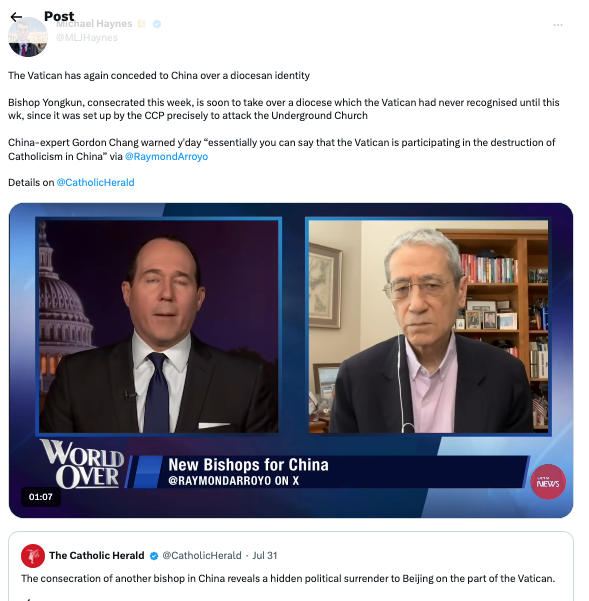
Moreover, one has to wonder where the singling out of the SSPX is coming from if not personal animus. Bishops are regularly appointed by the Communist Government of China, and yet Rome is silent in the face of it, and no penalties ensue to the offending bishops who collaborate. Similarly, the German bishops who hold contrarian views and practices relating to gender and moral issues, and appear poised to go their own way, are not removed from office or even censured. So why is the SSPX exiled for dissenting (in conscience) on some fallible teachings of Vatican II?
The late great mythologist, Joseph Campbell, had this to say on the question of the liturgical wars in the 1988 PBS series, “The Power of Myth”:
“EVEN IN THE Roman Catholic Church, MY GOD: THEY HAVE TRANSLATED THE MASS INTO A VULGAR VERNACULAR LANGUAGE THAT HAS A LOT OF DOMESTIC ASSOCIATIONS. LATIN IS A LANGUAGE THAT THROWS YOU OUT OF THE FIELD OF YOUR DOMESTICITY. THE PRIEST IS TURNED AND WITH HIS BACK TO YOU AND WITH HIM YOUR INNER DIVINITY ADDRESSES THE DIVINE OUTSIDE YOURSELF. NOW THEY HAVE TURNED THE ALTAR AROUND AND GIVING A JULIA CHILD DEMONSTRATION, AND IT IS ALL HOMEY AND COSY, PLAYING A GUITAR. THEY HAVE FORGOTTEN WHAT THE FUNCTION OF A RITUAL IS: TO PITCH YOU OUT, NOT TO WRAP YOU BACK IN TO WHERE YOU HAVE BEEN ALL THE TIME. RITUAL THAT ONCE CONVEYED AN INNER REALITY HAS NOW JUST BECOME A DEAD FORM.” (The Power of Myth: Truth and Theory).
The Stats speak for themselves, and whilst the Red Army in Rome and its satellites are doggedly determined to follow through with the policies of the Council, irrespective of the consequences and outcomes, and will have no truck with those who see disaster in it all, there is a deeper theological question at play here. Just whose spiritual life is it?
Is the hierarchy entitled to dictate the terms of liturgical engagement, as a mere servant class—which is all they are mandated to be. And if they have buggered it up, as they appear to some to have done, should they not be rebuked, and held to account? The game that is being played here is what Jesus Christ identified as the playbook of Pagans and said it would not be so in His Church, and yet it is.
Having said all of that, there is obviously no going back to square one. But the SSPX is not asking for that; it acknowledges the validity of the Novus Ordo but simply experiences it as spiritually impoverished—which it simply is for some. Others may differ and prefer it; so be it. Let us live and let live within a united communion and get on with the business of building the Kingdom of God, and not descend to “My Eucharist is bigger than your Mass” preoccupational interactions.
Rome has room for remarkable diversity… unless your preferred language happens to be Latin.Tweet this quote
The Eastern Church rejects Original Sin and remarries the divorced, but Rome doesn’t excommunicate or anathematise them for that. Similarly questions of predestination and free will have been allowed to coalesce in tension over the millennia without a felt need to anathematise one conviction over the other. So why can’t a group of the faithful conscientiously dissent from the non-infallible decrees of a Pastoral Council, and continue to worship in the same style and manner as the Church always has since time immemorial? What is the unforgivable sin in this?
Whilst the presumption of a right for a religious society to consecrate bishops (especially without Papal mandate) is unique and fanciful in the Church, and therefore the consecrations on 1/7 were legitimately latae sententiae excommunications, I venture to suggest that it is, at a more fundamental level, the insistence that the SSPX must prescind from conscientious objection and conform that is the root cause of schism here. Whilst the former is contrary to canon law, the latter contradicts Vatican II itself: both Gaudium et Spes 16, and Dignitatis Humanae 3.
Perhaps the next Synod of Bishops might more profitably graduate from navel-gazing about Synodality, to exploring more deeply the Servant Model of Ministry to be found in the Gospel and the implications of Lumen Gentium 24.
In the meantime, it is perhaps apposite to let Jesus Christ have the last word:
“I pray that they will all be one, just as you and I are one—as you are in me, Father, and I am in you. And may they be in us so that the world will believe you sent me.” (John 17:21)
Ping
Can’t you post anything that is shorter than War and Peace?
Here is a summary of the source article (GPT):
Here’s a concise three-paragraph summary of the article:
The author reflects on attending the 2025 SSPX episcopal consecrations at Écône, describing the event as a farewell to what he sees as the traditional Catholicism of his youth. He argues that the reforms following the Second Vatican Council fundamentally changed the Church’s liturgy and spirituality, replacing reverence, mystery, and the Latin Mass with a more informal, vernacular style of worship. In his view, these changes left many faithful feeling spiritually impoverished and alienated from the form of Catholicism they had known.
The article contends that Vatican II’s broader reforms also weakened the Church beyond the liturgy. The author attributes declines in priestly and religious vocations, missionary activity, doctrinal confidence, and participation in Mass largely to the Council and its implementation, while acknowledging that supporters instead blame wider cultural changes such as secularization and the social upheavals of the 1960s. He contrasts these trends with the Society of St. Pius X (SSPX), which he portrays as maintaining thriving congregations, large families, strong vocations, and traditional forms of worship.
In conclusion, the author argues that the Church should allow greater liturgical diversity rather than treating attachment to the Traditional Latin Mass as disloyalty. While acknowledging that Archbishop Lefebvre’s unauthorized episcopal consecrations violated canon law, he contends that the deeper cause of the continuing conflict is the Vatican’s insistence that traditionalists accept all post-conciliar reforms without conscientious objection. He calls for reconciliation within the Church, suggesting that Catholics who prefer either the traditional Latin Mass or the Novus Ordo should be able to coexist in full communion.
THAT’s funny.
Too many words, no important content
Even distilled, nothing important.
I’ve never posted anything as long as War and Peace. Apparently you’ve never read the book.
Good post.
You could also have noted the wild teachings of many Catholic groups in Africa.
They include ancestor worship, nature worship (plants and animals) and other strange stuff in their ceremonies.
… same in Central and South America.
The so-called “one true church” has many personalities and varied “traditions” - some of which go back a thousand years, others just a couple decades. And some brand new traditions.
“Tradition” — they use the word but I don’t think they know what it means.
But that’s where they hang their hats.
“The so-called “one true church” has many personalities and varied “traditions””
That has been the key to the growth of the Catholic Church around the world.
They see the demographic situation and know the third world is where the population growth is—so they “let it ride” there...
It is a good business strategy though it leaves some folks out on a limb.
“… out on a limb.”
Or waaay worse.
Agreed.
Thanks for posting.
Disclaimer: Opinions posted on Free Republic are those of the individual posters and do not necessarily represent the opinion of Free Republic or its management. All materials posted herein are protected by copyright law and the exemption for fair use of copyrighted works.