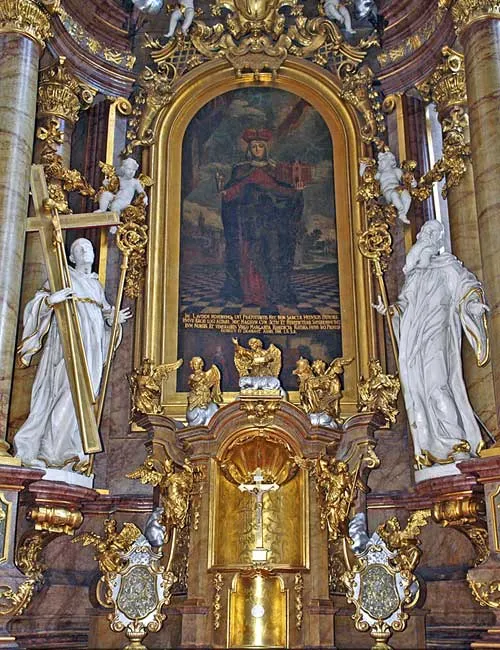
Catena Aurea by St. Thomas Aguinas
12:14–21
14. Then the Pharisees went out, and held a council against him, how they might destroy him.
15. But when Jesus knew it, he withdrew himself from thence: and great multitudes followed him, and he healed them all;
16. And charged them that they should not make him known:
17. That it might be fulfilled which was spoken by Esaias the prophet, saying,
18. Behold my servant, whom I have chosen; my beloved, in whom my soul is well pleased: I will put my spirit upon him, and he shall shew judgment to the Gentiles.
19. He shall not strive, nor cry; neither shall any man hear his voice in the streets.
20. A bruised reed shall he not break, and smoking flax shall he not quench, till he send forth judgment unto victory.
21. And in his name shall the Gentiles trust.
HILARY. The Pharisees are moved with jealousy at what had been done; because beholding the outward body of a man, they did not recognize the God in His works; The Pharisees went out and sought counsel against him, how they might destroy him.
RABANUS. He says, went out because their mind was alien from the Lord. They took counsel how they might destroy life, not how themselves might find life.
HILARY. And He knowing their plots withdrew, that He might be far from the counsels of the evil hearted, as it follows, Jesus knowing it departed thence.
JEROME. Knowing, that is, their designs against Him withdrew Himself, that He might remove from the Pharisees all opportunity of sin.
REMIGIUS. Or, He withdrew from thence as avoiding the designs of His own when they persecuted Him; or because that was not the time or place for Him to suffer, for It cannot he that a Prophet should perish out of Jerusalem, (Luke 13:33) as He Himself spake. The Lord also shunned those who persecuted Him through hatred, and went thither where He found many who were attached to Him from affection, whence it follows, And there followed him many. Him whom the Pharisees with one consent plotted against to destroy, the untaught multitude with one consent love and follow; whence they soon received the fulfilment of their desires, for it follows, And he healed them all.
HILARY. On those whom He healed He enjoined silence, whence it follows, And he charged them that they should not make him known. For his restored health was a witness to each man. And by commanding them to hold their peace, He avoids all ostentation of Himself, and at the same time notwithstanding affords a knowledge of Himself in that very admonition to hold their peace; for the observance of silence proceeds from that very thing which is to be kept silent.
RABANUS. In this also He instructs us, that when we have done any thing great we are not to seek praise abroad.
REMIGIUS. And He also gives them command that they should not make Him known, that they might not by persecuting Him be put into a worse state.
CHRYSOSTOM. And that you may not be troubled at those things which are done, and at the incredible madness of the Pharisees, He introduces the Prophet’s words. For such was the carefulness of the Prophets, that they had not omitted even this, but had noted all His ways and movements, and the meaning with which He did this; that you might learn that He spoke all things by the Holy Spirit, for if it be impossible to know the thoughts of men, much more to know the meaning of Christ, unless the Holy Spirit revealed it. Therefore it follows, That it might be fulfilled which was spoken by Esaias the Prophet, saying, Behold my servant whom I have chosen.
REMIGIUS. The Lord Jesus Christ is called the servant of the Almighty Godb, not in respect of His divinity, but in respect of the dispensation of the flesh which He took upon Him, because by the cooperation of the Holy Spirit He took flesh of the Virgin without stain of sin. Some books have, Elect, whom I have chosen, for He was chosen by God the Father, that is, predestinated that He should be the Son of God, proper, not adopted.
RABANUS. Whom I have chosen, he says, for a work which none else has done, that He should redeem the human race, and make peace between God and the world. It follows, My beloved, in whom my soul is well pleased, for He alone is the Lamb without spot of sin, of whom the Father speaks, This is my beloved Son, in whom I am well pleased. (Mat. 17:5)
REMIGIUS. That he says, My soul, is not to be understood as though God the Father had a soul, but by way of adaptation, shewing how God is disposed towards Him. And it is no wonder that a soul is ascribed to God in this manner, seeing that all other members of the body are likewise.
CHRYSOSTOM. This the Prophet puts in the beginning, that you might learn that that which is here said was according to the counsel of the Father. For he that is beloved does according to his will who loveth him. And again, he that is chosen, does not as an enemy break the law, nor as one being an adversary of the legislator, but as one in agreement with Him. Because therefore He is beloved, I will put my Spirit upon him.
REMIGIUS. Then also God the Father put His Spirit upon Him, when by the working of the Holy Spirit He took flesh of the Virgin; and as soon as He became man, He took the fulness of the Holy Spirit.
JEROME. But the Holy Spirit is put, not on the Word of God, but on the Only-Begotten, who came forth from the bosom of the Father; on Him, that is, of whom it is said, Behold my servant. And what He will do by Him He adds, And he shall declare judgment to the Gentiles.
AUGUSTINE. (De Civ. Dei, xx. 30.) Seeing He preached the judgment to come which was hidden from the Gentiles.
CHRYSOSTOM. Further, to shew His lowliness, He says, He shall not strive; and so He was offered up as the Father had willed, and gave Himself willingly into the hands of His persecutors. Neither shall he cry; so He was dumb as a lamb before his shearer. Nor shall any hear voice in the streets.
JEROME. For the way is broad and wide which leads to destruction, and many walk in it; and being many, they will not hear the voice of the Saviour, because they are not in the narrow but in the broad way.
REMIGIUS. The Greek πλατεῖα, is in Latin called ‘latitudo.’ No one therefore has heard His voice in the streets, because He has not promised pleasant things in this world to those that love Him, but hardships.
CHRYSOSTOM. The Lord sought to heal the Jews by this mildness. But though they rejected Him, yet He did not resist them by destroying them; whence the Prophet, displaying His power and their weakness, says, A bruised reed he shall not break, and a smoking flax he shall not quench.
JEROME. He that holds not out his hand to a sinner, nor bears his brother’s burden, he breaks a bruised reed; and he who despises a weak spark of faith in a little one, he quenches a smoking flax.
AUGUSTINE. (ubi sup) So He neither bruised nor quenched the Jewish persecutors, who are here likened to a bruised reed which has lost its wholeness, and to a smoking flax which has lost its flame; but He spared them because He was not come to judge them, but to be judged by them.
AUGUSTINE. (Quæst. Ev. i. 3.) In the smoking flax it is observed, that when the flame is out it causes a stink.
CHRYSOSTOM. Or this, He shall not break a bruised reed, shews that it was as easy for Him to break them all, as to break a reed, and that a bruised reed. And, He shall not quench a smoking flax, shews that their rage was fired, and that the power of Christ was strong to quench such rage with all readiness; hence in this is shewn the great mercy of Christ.
HILARY. Or, he means this bruised reed that is not broken, to shew that the perishing and bruised bodies of the Gentiles, are not to be broken, but are rather reserved for salvation. He shall not quench a smoking flax, shews the feebleness of that spark which though not quenched, only moulders in the flax, and that among the remnants of that ancient grace, the Spirit is yet not quite taken away from Israel, but power still remains to them of resuming the whole flame thereof in a day of penitence.
JEROME. (Ep. 121.2.) Or, the reverse, He calls the Jews a bruised reed, whom tossed by the wind and shaken from one another, the Lord did not immediately condemn, but patiently endured; and the smoking flax He calls the people gathered out of the Gentiles, who, having extinguished the light of the natural law, were involved in the wandering mazes of thick darkness of smoke, bitter and hurtful to the eyes; this He not only did not extinguish, by reducing them to ashes, but on the contrary from a small spark and one almost dead He raised a mighty flame.
CHRYSOSTOM. But one might say, What then, shall these things be always thus? Will He endure for ever those who thus lay snares, and are mad against Him? Far from it; when His own work shall be all complete, then shall He work these things also. And. this He signifies, saying, Until he shall send forth judgment to victory; as much as to say, When He shall have accomplished all things which are of Himself, then shall He bring in perfect vengeance; then shall they receive punishment when He has made his victory illustrious, that there be not left to them any irreverent opportunity of contradiction,
HILARY. Or, Until he shall send forth judgment to victory, that is, Until He shall take away the power of death, and bring in judgment and the return of His splendour.
RABANUS. Or, Until that judgment which was being done in Him should come forth to victory. For after that by His resurrection He had overcome death, and driven forth the prince of this world, He returned as conqueror to His kingdom to sit on the right hand of the Father, until He shall put all His enemies under His feet.
CHRYSOSTOM. But the things of this dispensation will not rest in this only, that they who have not believed should be punished, but He will also draw the world to Him; whence it follows, And in his name shall the Gentiles hope.
AUGUSTINE. (De Civ. Dei, xx. 30.) This last we now see fulfilled; and thus this which cannot be denied establishes the truth of that which some have denied through ignorance, the last judgment namely, which He will hold upon earth, when he Himself shall come from heaven. For who could have expected that the Gentiles would have hope in Christ’s name, when He was in the hands of His enemies, when He was bound, scourged, set at nought, and crucified; when even His disciples had lost that hope which they had begun to have in Him? That which one thief hardly hoped on the cross, the nations scattered far and wide now hope. And that they may not die for ever, they are marked with that very cross on which he died. Let none then doubt that the last judgment will be by Christ Himself.
REMIGIUS. And it should be known, that the meaning not only of this passage, but of many others also, is supported by this testimony from the Prophet. The words, Behold my servant, may be referred to the place in which the Father had said above, This is my Son. (Mat. 3:17.) The words, I will put my Spirit upon him, is referred to the descent of the Holy Spirit upon the Lord at His baptism; He shall declare judgment to the Gentiles, to that which He says below, When the Son of Man shall sit in the seat of his Majesty. (Mat. 25:31) What he adds, He shall not strive nor cry, refers to the Lord how He answered but little to the Chief Priests, and to Pilate, but to Herod nothing at all. He shall not break the bruised reed, refers to His shunning His persecutors that they might not be made worse; and that In his name shall the Gentiles hope, refers to what Himself says below, Go ye, and teach all nations. (Mat. 28:19)
Catena Aurea Matthew 12