
Posted on 07/13/2026 10:07:15 PM PDT by fidelis
Memorial of Saint Kateri Tekakwitha, Virgin [In the Dioceses of the United States]
Jesus began to reproach the towns where most of his mighty deeds had been done, since they had not repented. “Woe to you, Chorazin! Woe to you, Bethsaida! For if the mighty deeds done in your midst had been done in Tyre and Sidon, they would long ago have repented in sackcloth and ashes.” Matthew 11:20–21
Have you ever felt the urge to publicly rebuke someone, crying out in condemnation, “Woe to you!”? Most of us, at one time or another, have experienced that impulse. When we are hurt, dismissed, or sinned against, pride wells up within us, and our wounded hearts may long to strike back with words of righteous anger.
But this human reaction is not what moved Jesus when He reproached the towns of Chorazin, Bethsaida, and Capernaum in today’s Gospel. He did not condemn them because He was personally offended or emotionally wounded by their failure to repent. His pride was not injured, nor was He overcome by anger. Christ was fully in control, always responding with divine wisdom, offering exactly what each person needed in that moment.
At times, He was gentle, consoling, and compassionate. At other times, He chastised and rebuked. Sometimes He refrained from performing signs and wonders; at other times, He lavished miracles upon the people. At times, He taught in the veiled language of parables, and at other times, He spoke plainly and directly.
Jesus always knew how to love in every situation because every situation called for love expressed in different ways. True love is not defined by the one who gives it; it is defined by the one who receives it. What does that mean? It means that Jesus didn’t offer a “one-size-fits-all” kind of love. He didn’t say, “This is me, and this is how I love. Take it or leave it—I’m not changing for you.” No, Jesus’ love was so pure, so other-focused, that it always sought the good of the one He loved and adjusted its expression in order to achieve that good.
This is clearly seen in Jesus’ rebuke of the people of these three towns, located on the northern shore of the Sea of Galilee, which were central to much of His public ministry. Capernaum was His home base; Chorazin and Bethsaida were places He frequented. Near this region He delivered the Sermon on the Mount and performed many miracles. Yet despite His tireless preaching and countless signs, few repented. And repentance was the very purpose of His mission. By chastising them—“Woe to you!”—Jesus lovingly sought to jolt them out of their complacency so that they might repent and receive the abundant mercy He and His Father so deeply desired to bestow. In this case, the rebuke was the precise expression of love that these towns needed at that time.
Understanding the various expressions of Jesus’ love teaches us much about the nature of divine charity—how God loves us, and how we, in turn, are called to love one another. Though the essence of God’s love is always the same—perfect, complete, selfless, and sacrificial—the expression of that love varies, depending upon what each person most needs and what will most effectively lead them to eternal life.
Reflect today on how God is loving you right now, and ask for the grace to receive that love with trust and humility. Then consider how you are called to extend that same discerning and sacrificial love to others—not merely as you prefer to give it—but as they most need to receive it. Let your love, like Christ’s, always be guided by wisdom and formed by charity, loving others in the way that will best draw them closer to God’s abundant mercy.
Most loving God, Your love is perfect, unwavering, and never changing. Please open my heart to receive the expression of Your love that I need most, so that I may always repent of my sins and turn to Your mercy. Grant me the wisdom to imitate Your perfect love for others, offering not merely what I desire to give, but what they truly need in the moment. Jesus, I trust in You.
Please keep in mind that this is a Catholic Caucus/Devotional thread for the purpose of prayerful reflection on the Sacred Scriptures and is closed to debate of any kind. Per FR policy on Religion Caucus threads, off-topic, argumentative, and abusive comments are not allowed and will be submitted to the Mods for deletion. Thanks, and God bless you.
Today’s First Reading
From: Isaiah 7:1-9
The sign of Immanu-el
--------------------------------
[1] In the days of Ahaz the son of Jotham, son of Uzziah, king of Judah, Rezin the king of Syria and Pekah the son of Remaliah the king of Israel came up to Jerusalem to wage war against it, but they could not conquer it. [2] When the house of David was told, “Syria is in league with Ephraim,” his heart and the heart of his people shook as the trees of the forest shake before the wind.
[3] And the Lord said to Isaiah, “Go forth to meet Ahaz, you and Shear-jashub your son, at the end of the conduit of the upper pool on the highway to the Fuller’s Field, [4] and say to him, ‘Take heed, be quiet, do not fear, and do not let your heart be faint because of these two smouldering stumps of firebrands, at the fierce anger of Rezin and Syria and the son of Remaliah. [5] Because Syria, with Ephraim and the son of Remaliah, has devised evil against you, saying, [6] Let us go up against Judah and terrify it, and let us conquer it for ourselves, and set up the son of Tabe-el as king in the midst of it,” [7] thus says the Lord God:
It shall not stand, and it shall not come to pass. [8] For the head of Syria is Damascus, and the head of Damascus is Rezin. (Within sixty-five years Ephraim will be broken to pieces so that it will no longer be a people.) [9] And the head of Ephraim is Samaria, and the head of Samaria is the son of Remaliah. If you will not believe, surely you shall not be established.”
*************************************************************
Commentary:
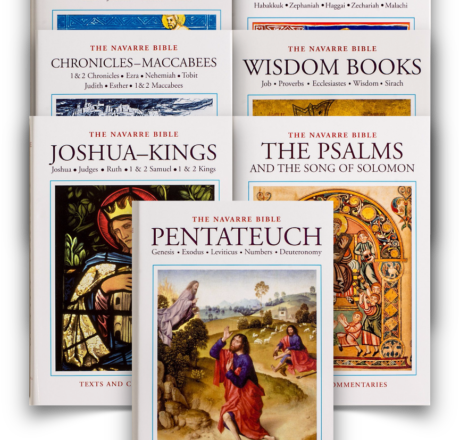
7:1-12:6. This series of oracles and narratives is usually known as the “Book of Immanuel”, because its climax is taken to be the mysterious announcement of a Messiah-Saviour, called “Immanu-el”, which means “God-with-us” (7:14). This “book” is one of the most interesting parts of First Isaiah. Some scholars include in the “book”, as its introduction, the prophet’s vision of God in majesty, and the account of Isaiah’s calling (6:1-13).
The Immanuel prophecy begins with the announcement of a God-given “sign” of salvation -- the “virgin” who will conceive and hear a “son” (7:1-8:22). The “son” is described in such a way that he seems to he no ordinary human child (8:23-9:6). Paradoxically, the joy of salvation that has just been proclaimed is then immediately clouded by announcements about the wrath of God, the collapse of Samaria and the Assyrian threat to Jerusalem (9:7-10:19). But, as often happens in Isaiah, we are told that a “remnant” will he saved, a “shoot from the stump of Jesse” (11:1), that is, a descendant of David on whom “the Spirit of the Lord will rest” (11:2), and that a kingdom of righteousness and peace will emerge and the exiles will return home (10:20-11:16). This leads the prophet to intone a short psalm of thanksgiving (12: I-6).
7:1-9. After the account of Isaiah’s vocation, where we heard that a hardened heart is unable to hear the word of the Lord (cf. 6:9-10), we are now given evidence to that effect. Isaiah has a meeting with King Ahaz, in which the king is in two minds as to what to do in the face of pressure to join the coalition against the Assyrians made up of Israel (here also called Ephraim), whose capital was Samaria, and Syria (Aram), the capital of which was Damascus. Verse 6 mentions Tabeel, about whom nothing more is known; he may have been a senior official in the Southern kingdom who was in favour of joining the coalition. The prophet’s message warns Judah that it should put its trust in God, believing in his word, and not try to take refuge in any political alliance, be it with the Syrians and Ephraimites, or with Assyria. It ends abruptly with the threat that if Ahaz and his supporters fail to listen, their downfall will soon follow (vv. 7-9). The narrative says that a son of Isaiah is present at his exchange with Ahaz -- Shear-jashub (v. 3), a name full of symbolism, for it means “a remnant shall return”. The presence of this son implies, in some way, that God will ensure the permanent survival of the people: there will always be some, a remnant, who will come back to the Lord and recover what has been lost (cf. 10:20-22).
From: Matthew 11:20-24
Jesus Reproaches People for Their Unbelief
------------------------------------------
[20] Then He (Jesus) began to upbraid the cities where most of His mighty works had been done, because they did not repent. [21] "Woe to you, Chorazin! woe to you, Bethsaida! for if the mighty works done in you had been done in Tyre and Sidon, they would have repented long ago in sackcloth and ashes. [22] But I tell you, it shall be more tolerable on the day of judgment for Tyre and Sidon than for you. [23] And you, Capernaum, will you be exalted to Heaven? You shall be brought down to Hades. For if the mighty works done in you had been done in Sodom, it would have remained until this day. [24] But I tell that it shall be more tolerable on the day of judgment for the land of Sodom than for you."
***********************************************************************
Commentary:
21-24. Chorazin and Bethsaida were thriving cities on the northern shore of the lake of Gennesaret, not very far from Capernaum. During His public ministry Jesus often preached in these cities and worked many miracles there; in Capernaum He revealed His teaching about the Blessed Eucharist (cf. John 6:51ff). Tyre, Sidon, Sodom and Gomorrah, the main cities of Phoenicia--all notorious for loose living—were classical examples of divine punishment (cf. Ezekiel 26-28; Isaiah 23).
Here Jesus is pointing out the ingratitude of people who could know Him but who refuse to change: on the day of Judgment (verses 22 and 24) they will have more explaining to do: "Every one to whom much is given, of him will much be required" (Luke 12:48).
The Month of July is Dedicated to the Precious of Jesus

“They triumphed over the devil by the blood of the Lamb and by the word of their testimony; they did not love their lives so much as to shrink from death.” (Revelation 12:11)

Pope Leo XIV’s prayer intention for the month of July, 2026:
For respect for human life
Let us pray for the respect and protection of human life in all its stages, recognizing it as a gift from God.

Disclaimer: Opinions posted on Free Republic are those of the individual posters and do not necessarily represent the opinion of Free Republic or its management. All materials posted herein are protected by copyright law and the exemption for fair use of copyrighted works.


