Skip to comments.
Catholic Caucus: Daily Mass Readings 7-July-2026
Universalis/Jerusalem Bible ^
Posted on 07/07/2026 5:04:53 AM PDT by annalex
7 July 2026
Tuesday of week 14 in Ordinary Time

St. Maelruan's Font, Tallaght, IrelandReadings at MassLiturgical Colour: Green. Year: A(II).
| First reading |
|---|
| Hosea 8:4-7,11-13 |
|---|
They have sown the wind; they will reap the whirlwindThus says the Lord: They have set up kings, but not with my consent, and appointed princes, but without my knowledge. Out of their own silver and gold they have made idols, which are doomed to destruction. I spurn your calf, Samaria, my anger blazes against it. (How long will it be before they purge themselves of this, the sons of Israel?) A workman made the thing, this cannot be God! Yes, the calf of Samaria shall go up in flames. They sow the wind, they will reap the whirlwind; their wheat will yield no ear, the ear will yield no flour, or, if it does, foreigners will swallow it. Ephraim has built altar after altar, they have only served him as occasion for sin. Were I to write out the thousand precepts of my Law for him, they would be paid no more attention than those of a stranger. They love sacrificing; right, let them sacrifice! They love meat; right, let them eat it! The Lord takes no pleasure in these. He is now going to remember their iniquity and punish their sins; they will have to go back to Egypt.
| Responsorial Psalm |
|---|
| Psalm 113B(115):3-10 |
|---|
Sons of Israel, trust in the Lord. or Alleluia! Our God, he is in the heavens; he does whatever he wills. The idols of the heathen are silver and gold, the work of human hands. Sons of Israel, trust in the Lord. or Alleluia! They have mouths but they cannot speak; they have eyes but they cannot see; they have ears but they cannot hear; they have nostrils but they cannot smell. Sons of Israel, trust in the Lord. or Alleluia! With their hands they cannot feel; with their feet they cannot walk. Their makers will come to be like them and so will all who trust in them. Sons of Israel, trust in the Lord. or Alleluia! Sons of Israel, trust in the Lord; he is their help and their shield. Sons of Aaron, trust in the Lord; he is their help and their shield. Sons of Israel, trust in the Lord. or Alleluia!
| Gospel Acclamation | cf.Ep1:17,18 |
|---|
Alleluia, alleluia! May the Father of our Lord Jesus Christ enlighten the eyes of our mind, so that we can see what hope his call holds for us. Alleluia! Alleluia, alleluia! I am the good shepherd, says the Lord; I know my own sheep and my own know me. Alleluia!
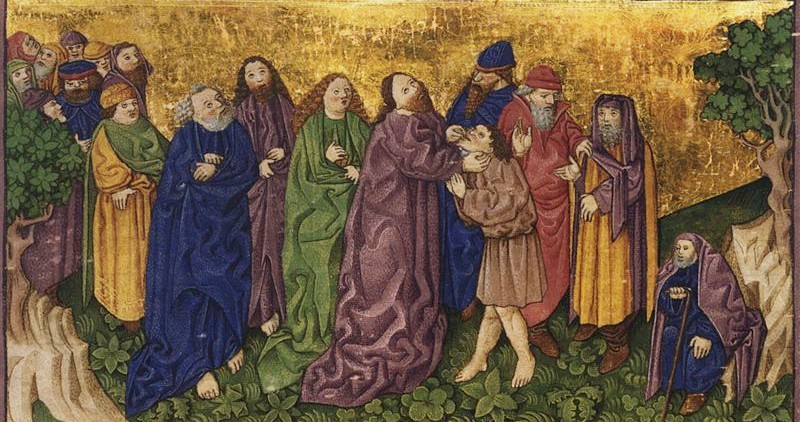
The harvest is rich but the labourers are fewA man was brought to Jesus, a dumb demoniac. And when the devil was cast out, the dumb man spoke and the people were amazed. ‘Nothing like this has ever been seen in Israel’ they said. But the Pharisees said, ‘It is through the prince of devils that he casts out devils.’ Jesus made a tour through all the towns and villages, teaching in their synagogues, proclaiming the Good News of the kingdom and curing all kinds of diseases and sickness. And when he saw the crowds he felt sorry for them because they were harassed and dejected, like sheep without a shepherd. Then he said to his disciples, ‘The harvest is rich but the labourers are few, so ask the Lord of the harvest to send labourers to his harvest.’ Christian Art Each day, The Christian Art website gives a picture and reflection on the Gospel of the day. The readings on this page are from the Jerusalem Bible, which is used at Mass in most of the English-speaking world. The New American Bible readings, which are used at Mass in the United States, are available in the Universalis apps, programs and downloads.
You can also view this page with the Gospel in Greek and English. |
TOPICS: Catholic; General Discusssion; Prayer; Worship
KEYWORDS: catholic; mt9; ordinarytime; prayer
For your reading, reflection, faith-sharing, comments, questions, discussion.
1
posted on
07/07/2026 5:04:53 AM PDT
by
annalex
To: All
KEYWORDS: catholic; mt9; ordinarytime; prayer
2
posted on
07/07/2026 5:05:27 AM PDT
by
annalex
(fear them not)
To: nickcarraway; NYer; ELS; Pyro7480; livius; ArrogantBustard; Catholicguy; RobbyS; marshmallow; ...

Alleluia Ping Please FReepmail me to get on/off the Alleluia Ping List.
3
posted on
07/07/2026 5:06:12 AM PDT
by
annalex
(fear them not)
To: annalex
4
posted on
07/07/2026 5:06:37 AM PDT
by
annalex
(fear them not)
To: annalex
| Matthew |
| | English: Douay-Rheims | Latin: Vulgata Clementina | Greek NT: Byzantine/Majority Text (2000) |
| | Matthew 9
|
| 32. | And when they were gone out, behold they brought him a dumb man, possessed with a devil. | Egressis autem illis, ecce obtulerunt ei hominem mutum, dæmonium habentem. | αυτων δε εξερχομενων ιδου προσηνεγκαν αυτω ανθρωπον κωφον δαιμονιζομενον |
| 33. | And after the devil was cast out, the dumb man spoke, and the multitudes wondered, saying, Never was the like seen in Israel. | Et ejecto dæmonio, locutus est mutus, et miratæ sunt turbæ, dicentes : Numquam apparuit sic in Israël. | και εκβληθεντος του δαιμονιου ελαλησεν ο κωφος και εθαυμασαν οι οχλοι λεγοντες ουδεποτε εφανη ουτως εν τω ισραηλ |
| 34. | But the Pharisees said, By the prince of devils he casteth out devils. | Pharisæi autem dicebant : In principe dæmoniorum ejicit dæmones. | οι δε φαρισαιοι ελεγον εν τω αρχοντι των δαιμονιων εκβαλλει τα δαιμονια |
| 35. | And Jesus went about all the cities, and towns, teaching in their synagogues, and preaching the gospel of the kingdom, and healing every disease, and every infirmity. | Et circuibat Jesus omnes civitates, et castella, docens in synagogis eorum, et prædicans Evangelium regni, et curans omnem languorem, et omnem infirmitatem. | και περιηγεν ο ιησους τας πολεις πασας και τας κωμας διδασκων εν ταις συναγωγαις αυτων και κηρυσσων το ευαγγελιον της βασιλειας και θεραπευων πασαν νοσον και πασαν μαλακιαν εν τω λαω |
| 36. | And seeing the multitudes, he had compassion on them: because they were distressed, and lying like sheep that have no shepherd. | Videns autem turbas, misertus est eis : quia erant vexati, et jacentes sicut oves non habentes pastorem. | ιδων δε τους οχλους εσπλαγχνισθη περι αυτων οτι ησαν εσκυλμενοι και ερριμμενοι ωσει προβατα μη εχοντα ποιμενα |
| 37. | Then he saith to his disciples, The harvest indeed is great, but the labourers are few. | Tunc dicit discipulis suis : Messis quidem multa, operarii autem pauci. | τοτε λεγει τοις μαθηταις αυτου ο μεν θερισμος πολυς οι δε εργαται ολιγοι |
| 38. | Pray ye therefore the Lord of the harvest, that he send forth labourers into his harvest. | Rogate ergo Dominum messis, ut mittat operarios in messem suam. | δεηθητε ουν του κυριου του θερισμου οπως εκβαλη εργατας εις τον θερισμον αυτου |
5
posted on
07/07/2026 5:10:04 AM PDT
by
annalex
(fear them not)
To: annalex

Catena Aurea by St. Thomas Aguinas
9:32–35
32. As they went out, behold, they brought to him a dumb man possessed with a devil.
33. And when the devil was east out, the dumb spake: and the multitudes marvelled, saying, It was never so seen in Israel.
34. But the Pharisees said, He casteth out devils through the prince of the devils.
35. And Jesus went about all the cities and villages, teaching in their synagogues, and preaching the Gospel of the kingdom, and healing every sickness and every disease among the people.
REMIGIUS. Observe the beautiful order of His miracles; how after He had given sight to the blind, He restored speech to the dumb, and healed the possessed of the dæmon; by which He shews Himself the Lord of power, and the author of the heavenly medicine. For it was said by Isaiah, Then shall the eyes of the blind be opened, the ears of the deaf shall be unstopped, and the tongue of the dumb loosed. (Is. 35:6.) Whence it is said, When they were gone forth, they brought unto him a man dumb, and possessed with a dæmon.
JEROME. The Greek word here (κωφὸς) is more frequent in common speech in the sense of ‘deaf,’ but it is the manner of Scripture to use it indifferently as either.
CHRYSOSTOM. This was not a mere natural defect; but was from the malignity of the dæmon; and therefore he needed to be brought of others, for he could not ask any thing of others as living without voice, and the dæmon chaining his spirit together with his tongue. Therefore Christ does not require faith of him, but immediately healed his disorder; as it follows, And when the dæmon was cast out, the dumb spake.
HILARY. The natural order of things is here preserved; the dæmon is first cast out, and there the functions of the members proceed. And the multitude marvelled, saying, It was never so seen in Israel.
CHRYSOSTOM. They set Him thus above others, because He not only healed, but with such ease, and quickness; and cured diseases both infinite in number, and in quality incurable. This most grieved the Pharisees, that they set Him before all others, not only those that then lived, but all who had lived before, on which account it follows, But the Pharisees said, He casteth out dæmons through the Prince of dæmons.
REMIGIUS. Thus the Scribes and Pharisees denied such of the Lord’s miracles as they could deny; and such as they could not they explained by an evil interpretation, according to that, In the multitude of thy excellency thy enemies shall lie unto thee. (Ps. 66:3.)
CHRYSOSTOM. What can be more foolish than this speech of theirs? For it cannot be pretended that one dæmon would cast out another; for they are wont to consent to one another’s deeds, and not to be at variance among themselves. But Christ not only cast out dæmons, but healed the lepers, raised the dead, forgave sins, preached the kingdom of God, and brought men to the Father, which a dæmon neither could nor would do.
RABANUS. Figuratively; As in the two blind men were denoted both nations, Jews and Gentiles, so in the man dumb and afflicted with the dæmon is denoted the whole human race.
HILARY. Or; By the dumb and deaf, and dæmoniae, is signified the Gentile world, needing health in every part; for sunk in evil of every kind, they are afflicted with disease of every part of the body.
REMIGIUS. For the Gentiles were dumb; not being able to open their mouth in the confession of the true faith, and the praises of the Creator, or because in paying worship to dumb idols they were made like unto them. They were afflicted with a dæmon, because by dying in unbelief they were made subject to the power of the Devil.
HILARY. But by the knowledge of God the frenzy of superstition being chased away, the sight, the hearing, and the word of salvation is brought in to them.
JEROME. As the blind receive light, so the tongue of the dumb is loosed, that he may confess Him whom before he denied. The wonder of the multitude is the confession of the nations. The scoff of the Pharisees is the unbelief of the Jews, which is to this day.
HILARY. The wonder of the multitude is followed up by the confession, It was never so seen in Israel; because he, for whom there was no help under the Law, is saved by the power of the Word.
REMIGIUS. They who brought the dumb to be healed by the Lord, signify the Apostles and preachers, who brought the Gentile people to be saved before the face of divine mercy.
AUGUSTINE. (De Cons. Ev. ii. 29.) This account of the two blind men and the dumb dæmon is read in Matthew only. The two blind men of whom the others speak are not the same as these, though something similar was done with them. So that even if Matthew had not also recorded their cure, we might have seen that this present narrative was of a different transaction. And this we ought diligently to remember, that many actions of our Lord are very much like one another, but are proved not to be the same action, by being both related at different times by the same Evangelist. So that when we find cases in which one is recorded by one Evangelist, and another by another, and some difference which we cannot reconcile between their accounts, we should suppose that they are like, but not the same, events.
9:36–38
36. But when he saw the multitudes, he was moved with compassion on them, because they fainted, and were scattered abroad, as sheep having no shepherd.
37. Then saith he unto his disciples, The harvest truly is plenteous, but the labourers are few;
38. Pray ye therefore the Lord of the harvest, that he will send forth labourers into his harvest.
CHRYSOSTOM. The Lord would refute by actions the charge of the Pharisees, who said, He casteth out dæmons by the Prince of the dæmons; for a dæmon having suffered rebuke, does not return good but evil to those who have not shewn him honour. But the Lord on the other hand, when He has suffered blasphemy and contumely, not only does not punish, but does not utter a hard speech, yea He shews kindness to them that did it, as it here follows, And Jesus went about all their towns and villages. Herein He teaches us not to return accusations to them that accuse us, but kindness. For he that ceases to do good because of accusation, shews that his good has been done because of men. But if for God’s sake you do good to your fellow-servants, you will not cease from doing good whatever they do, that your reward may be greater.
JEROME. Observe how equally in villages, cities, and towns, that is to great as well as small, He preaches the Gospel, not respecting the might of the noble, but the salvation of those that believe. It follows, Teaching in their synagogues; this was His meat, going about to do the will of His Father, and saving by His teaching such as yet believed not.
GLOSS. (non occ.) He taught in their synagogues the Gospel of the Kingdom, as it follows, Preaching the Gospel of the Kingdom.
REMIGIUS. Understand, ‘of God;’ for though temporal blessings are also proclaimed, yet they are not called The Gospel. Hence the Law was not called a Gospel, because to such as kept it, it held out not heavenly, but earthly, goods.
JEROME. He first preached and taught, and then proceeded to heal sicknesses, that the works might convince those who would not believe the words. Hence it follows, Healing every sickness and every disease, for to Him alone nothing is impossible.
GLOSS. (ap. Anselm.) By disease we may understand complaints of long standing, by sickness any lesser infirmity.
REMIGIUS. It should be known that those whom He healed outwardly in their bodies, He also healed inwardly in their souls. Others cannot do this of their own power, but can by God’s grace.
CHRYSOSTOM. Nor does Christ’s goodness rest here, but He manifests His care for them, opening the bowels of His mercy towards them; whence it follows, And seeing the multitudes, he had compassion upon them.
REMIGIUS. Herein Christ shews in Himself the disposition of the good shepherd and not that of the hireling. Why He pitied them is added, Because they were troubled1, and sick1 as sheep that have no shepherd—troubled either by dæmons, or by divers sicknesses and infirmities.
GLOSS. (ap. Anselm.) Or, troubled by dæmons, and sick, that is, benumbed and unable to rise; and though they had shepherds, yet they were as though they had them not.
CHRYSOSTOM. This is an accusation against the rulers of the Jews, that being shepherds they appeared like wolves; not only not improving the multitude, but hindering their progress. For when the multitude marvelled and said, It was never so seen in Israel, these opposed themselves, saying, He casteth out dæmons by the prince of the dæmons. (vid. Ps. 102:19.)
REMIGIUS. But when the Son of God looked down from heaven upon the earth, to hear the groans of the captives, straight a great harvest began to ripen; for the multitude of the human race would never have come near to the faith, had not the Author of human salvation looked down from heaven; and it follows, Then said he unto his disciples, The harvest truly is great, but the labourers are few.
GLOSS. (ap. Anselm.) The harvest are those men who can be reaped by the preachers, and separated from the number of the damned, as grain is beaten out from the chaff that it may be laid up in granaries.
JEROME. The great harvest denotes the multitude of the people; the few labourers, the want of instructors.
REMIGIUS. For the number of the Apostles was small in comparison of so great crops to be reaped. The Lord exhorts His preachers, that is, the Apostles and their followers, that they should daily desire an increase of their number; Pray ye therefore the Lord of the harvest, that he would send forth labourers into his harvest.
CHRYSOSTOM. He privately insinuates Himself to be the Lord; for it is He Himself who is Lord of the harvest. For if He sent the Apostles to reap what they had not sown, it is manifest that He sent them not to reap the things of others, but what He had sown by the Prophets. But since the twelve Apostles are the labourers, He said, Pray ye the Lord of the harvest, that he would send labourers into his harvest; and notwithstanding He added none to their number, but rather He multiplied those twelve many times, not by increasing their numbers, but by giving them more abundant grace.
REMIGIUS. Or, He then increased their number when He chose the seventy and two, and then when many preachers were made what time the Holy Spirit descended upon the believers.
CHRYSOSTOM. He shews us that it is a great gift that one should have the power of rightly preaching, in that He tells them that they ought to pray for it. Also we are here reminded of the words of John concerning the threshing-floor, and the fan, the chaff, and the wheat.
HILARY. Figuratively; When salvation was given to the Gentiles, then all cities and towns were enlightened by the power and entrance of Christ, and escaped every former sickness and infirmity. The Lord pities the people troubled with the violence of the unclean Spirit, and sick under the burden of the Law, and having no shepherd at hand to bestow on them the guardianship of the Holy Spirit. But of that gift there was a most abundant fruit, whose plenty far exceeded the multitude of those that drank thereof; how many soever take of it, yet an inexhaustible supply remains; and because it is profitable that there should be many to minister it, He bids us ask the Lord of the harvest, that God would provide a supply of reapers for the ministration of that gift of the Holy Spirit which was made ready; for by prayer this gift is poured out upon us from God.
Catena Aurea Matthew 9
6
posted on
07/07/2026 5:11:54 AM PDT
by
annalex
(fear them not)
To: annalex
7
posted on
07/07/2026 5:12:11 AM PDT
by
annalex
(fear them not)
To: annalex
Máel Ruain
Máel Ruain was remembered as the founder and abbot-bishop of Tallaght in County Dublin and as a major figure in the monastic reform tradition later associated with the Céli Dé. He was chiefly known for establishing Tallaght as a lasting religious community and for shaping monastic instruction and liturgical culture through its educational life. His influence extended beyond the cloister as later texts associated with Tallaght preserved and expanded the memory of his teaching. He was characterized as spiritually purposeful and inclined toward communal stability rather than solitary or outward pilgrimage-driven piety.
Early Life and Education
Direct details of Máel Ruain’s early life were presented as obscure, and the sources treated much of his background as difficult to recover. His monastic name was explained as a designation tied to tonsure and to a place connected with Rúadán, suggesting earlier monastic formation. Evidence for his education appeared less in biographical facts than in later Tallaght writings that preserved memories of how he taught and shaped discipline.
Career
Máel Ruain’s career centered on founding Tallaght in the latter half of the eighth century and becoming its abbot-bishop. The traditions described him as arriving with relics and as establishing the monastery in a way that gave it immediate identity and purpose. He guided disciples such as Óengus the Culdee, and the Tallaght community then produced martyrological and teaching materials associated with his authority. He was remembered as organizing monastic life around liturgical repetition, restraint, and communal stability, including discouraging overseas pilgrimage. After his death in 792, he was succeeded by Airerán, while his influence continued through texts and commemorations tied to Tallaght.
Leadership Style and Personality
Máel Ruain’s leadership was portrayed as strongly educational and institutional, with authority expressed through tutoring, discipline, and the formation of habits. He was associated with practical spirituality: maintaining ordered communal life and turning devotion into daily practice. His personality was implied through repeated emphases on restraint, forbearance, and separation from worldly distraction. His leadership decisions reflected steadiness and an ability to manage spiritual energy toward stable routines.
Philosophy or Worldview
Máel Ruain’s worldview emphasized liturgical discipline, especially daily recitation of the Psalter, alongside ascetic restraint and avoidance of indulgence. He promoted separation from worldly concerns as a necessary condition for monastic focus. The sources also framed his approach as communal rather than itinerant, with a preference for remaining within the monastery instead of pursuing overseas pilgrimage. Overall, his guiding principles treated holiness as trained repetition within a structured religious community.
Impact and Legacy
Máel Ruain’s legacy was institutional and textual: his founding created a monastery remembered for liturgical learning and monastic teaching. Tallaght’s martyrological and instructional traditions carried his influence through preserved precepts and later collections. His name became connected with wider reform currents associated with the Céli Dé, indicating that his model helped define a broader monastic style. His memory was sustained through feast-day commemoration and continued veneration, making him both a founder and a saintly teacher.
Personal Characteristics
Máel Ruain was characterized as disciplined, steady, and spiritually demanding, with leadership expressed through structured mentorship. The teaching tradition linked him to restraint, forbearance, and a deliberate turning away from distractions. Even as the sources emphasized his peaceful death, they presented his life as marked by perseverance and spiritual resolve within communal order.
Máel Ruain was the founder and abbot-bishop of the monastery of Tallaght in County Dublin, and he was remembered as a central figure in the monastic reform movement later associated with the Céli Dé. He was known chiefly for establishing Tallaght as a durable religious community and for shaping devotional and disciplinary culture through the educational life of its school. Over time, his name became inseparably linked with a wider literary and liturgical output associated with Tallaght, especially martyrological and teaching traditions. His character in the sources was presented as practical, spiritually intent, and oriented toward communal stability rather than solitary display.
Early Life and Education
Little direct information about Máel Ruain’s early life survived, and the historical record treated key parts of his background as obscure. His monastic name was explained as a designation connected with tonsure and a place-name element associated with Rúadán, suggesting a formative connection with a preexisting monastic world beyond Tallaght itself. The tradition emphasized that he arrived with a clear purpose, even though the precise circumstances of his earlier training remained unclear.
Tallaght’s later intellectual and liturgical reputation indicated that the community he built had quickly become a teaching center. Evidence for his guidance was recovered less from his own immediate writings than from later ninth-century texts connected to the Tallaght community, which preserved memories of his instruction and discipline. In that sense, Máel Ruain’s “education” was shown to have been carried forward through followers and texts that turned lived practice into teachable norms.
Career
Máel Ruain’s career began in an earlier monastic environment that the sources associated with Rúadán, though the detailed sequence of his training remained unrecorded. The sources did not provide reliable information about his personal origins, but they did present his life as one of purposeful movement toward Tallaght. His monastic identity was repeatedly foregrounded as the foundation for his authority, rather than any secular status.
He later established the monastery of Tallaght in the latter half of the eighth century, and the community that followed became widely known as “Máel Ruain’s Tallaght.” The tradition described him as arriving at Tallaght carrying relics, presented as relics of holy martyrs and virgins, implying an intentional act of founding rather than a gradual drift into a religious site. The narrative also suggested that no comparable institution had existed at Tallaght immediately before his arrival, giving his role a decisive character in the record.
As Tallaght’s abbot-bishop, he was styled with episcopal authority in the annalistic tradition, linking his leadership to both spiritual governance and the prestige of ecclesiastical office. His reputation spread partly through the institutional label “bishop,” but it also deepened through the community’s educational output. In this way, his career developed beyond founding into sustained influence on the formation of disciples.
A prominent thread in his career was his relationship with Óengus the Culdee, the later author associated with the Félire Óengusso and related traditions. Óengus remembered Máel Ruain as a tutor, and that memory framed Tallaght as a place where instruction, discipline, and liturgical attention were taught in recognizable patterns. Even when direct details of daily practice were limited, the sources treated the relationship as evidence of structured mentorship.
Tallaght later produced or gathered martyrological materials and liturgical interests that reinforced the monastery’s learning identity. The Martyrology of Tallaght and related calendrical works were presented as products of the Tallaght milieu associated with Máel Ruain and/or his circle. This marked a shift in his legacy from a founder’s founding act to a sustaining intellectual center whose output helped define how saints were remembered and commemorated.
The sources described ninth-century writings tied to the Tallaght community as preserving Máel Ruain’s precepts and habits, attributed in particular to memory-work done by followers. Among the principal texts, The Monastery of Tallaght was portrayed as listing directives and ways of living remembered by a disciple, turning oral formation into written guidance. Although much of the material survived through later manuscript transmission, it functioned as a bridge between lived monastic practice and later readers seeking a coherent “teaching.”
As part of this transmission, The Teaching of Máel Ruain was treated as an early modern paraphrase of earlier guidance, showing how the community’s instruction continued to be curated long after Máel Ruain’s death. The Rule of Céli Dé was also described as being preserved in later manuscripts and as containing instructions for monastic regulation, especially concerning liturgical matters. The ascription of the rule’s authorship to figures in the Tallaght circle demonstrated how his name remained a focal point for authority, even when texts were shaped over time.
Máel Ruain’s career also carried a distinctive model of monastic priorities, including a preference for communal life over practices that took monks away from the monastery. He was specifically cited as forbidding overseas pilgrimage, redirecting spiritual zeal into stable community observance. That choice defined a practical worldview: holiness expressed as daily discipline within an ordered house rather than through motion toward distant religious destinations.
His influence was further expanded through later texts that enumerated associates and portrayed a network of followers aligned with his teachings. Lucht Óentad Máele Ruain (“Folk of the Unity of Máel Ruain”) was presented as a tradition mapping prominent figures said to have embraced the Tallaght way. This made his career feel larger than his own walls, since the community’s formative model appeared to travel through relationships and reputations.
The hymn Archangelum mirum magnum was also attributed to Máel Ruain in tradition, linking him to devotional culture beyond governance and instruction. The association of his community with St. Michael helped frame Tallaght’s spiritual sensibilities through liturgical art and Hiberno-Latin praise. In that sense, his career continued to be remembered not only through institutional founding but also through the devotional textures that reinforced communal identity.
By the time of his death, the record treated him as both a bishop and a “soldier of Christ,” emphasizing perseverance and spiritual courage. The Annals of Ulster reported a peaceful death in the year 792, establishing a tone for how later generations remembered him at the end of his work. After his death, he was succeeded as abbot of Tallaght by Airerán, marking the transition from founder-teacher to enduring institution.
Leadership Style and Personality
Máel Ruain’s leadership was characterized as founder-like and educational, because he was remembered as someone whose authority was expressed through teaching and through setting an order for others. The Tallaght tradition cast him as a tutor figure, and that framing emphasized mentorship, discipline, and the conversion of doctrine into daily habits. His leadership also appeared oriented toward creating a coherent community identity that could outlast him.
His personality, as implied by the teaching tradition, showed an insistence on restraint and forbearance, especially regarding bodily desires and indulgence. The sources also suggested a temperament that valued separation from worldly distractions, directing attention toward ordered communal observance. Even where the record could not preserve his exact words, his leadership was portrayed as practical and spiritually demanding.
Finally, his decision to forbid overseas pilgrimage implied a leader who managed zeal rather than simply celebrating mobility. He was remembered as choosing steadiness and internal formation, suggesting that he understood spirituality to be strengthened by repeated daily practice within a defined house. That practical spirituality helped explain why later writing associated his name so strongly with the rules and routines of Tallaght.
Philosophy or Worldview
Máel Ruain’s worldview was shown to combine liturgical attention with ascetic restraint and a strong communal orientation. The Tallaght guidance traditions presented his priorities as including daily recitation of the Psalter, self-restraint, and deliberate avoidance of bodily indulgence. In that structure, spiritual growth was not treated as an occasional event but as disciplined repetition.
The teaching materials also placed separation from worldly concerns at the center of monastic life, indicating that his spiritual imagination had limited patience for distraction. His prescriptions mapped inward holiness onto outward practices, especially those that could be repeated reliably within the monastery. This reinforced a vision of spiritual order as a kind of consistent training, not a heroic detour.
At the same time, Máel Ruain’s worldview favored institutional continuity over external pilgrimage. By discouraging overseas pilgrimages, he directed ambition toward the monastery’s internal rhythms and communal learning. The resulting philosophy presented Tallaght as a spiritual engine whose daily life was itself the arena of transformation.
Impact and Legacy
Máel Ruain’s impact was first and foremost institutional, because his founding of Tallaght created a monastery that became associated with a durable tradition of liturgical learning and monastic teaching. His community’s output—especially martyrological and educational texts—made his influence felt through what the monastery taught and preserved. Over time, those texts turned personal instruction into a legacy that readers and disciples could apply.
His legacy also functioned as part of a wider monastic movement associated with the Céli Dé. The sources repeatedly linked his community with practices and concerns that scholars later recognized as characteristic of that reform energy, giving his role a larger historical interpretation. Even when the record of his own direct statements was limited, the teaching traditions tied back to his authority.
In addition, Máel Ruain’s influence extended into networks of disciples and associates, as later texts described a “unity” around his teaching. Such enumerations suggested that his model was carried by people who adapted his monastic vision in new contexts. That wider diffusion made Tallaght’s ethos more than local custom.
Finally, his posthumous veneration helped fix his name within the liturgical calendar and within the memory practices of Irish Christianity. His feast day in the Martyrology of Tallaght and Félire Óengusso demonstrated that he remained not merely a founder of an institution but a saintly figure whose life and teaching were meant to be remembered. Through that commemorative function, his legacy remained active in religious life long after the eighth century.
Personal Characteristics
Máel Ruain’s personal characteristics, as preserved by later teaching traditions, suggested a person who combined spiritual seriousness with a capacity to organize and transmit discipline. His remembered role as a tutor implied attentiveness to discipleship, as well as confidence that instruction could be systematized into practical habits. He was also presented as someone who directed devotion into routine rather than spectacle.
The teachings associated with his authority depicted him as valuing restraint and forbearance, especially in relation to bodily indulgence and worldly distraction. Such emphasis indicated a personality aligned with disciplined self-governance and deliberate simplicity. His leadership choices, including the preference for communal stability, further reinforced an orderly and steady temperament.
Lastly, the annalistic portrayal of him as a “soldier of Christ” and a figure who died peacefully suggested that his personal strength expressed itself through perseverance rather than through dramatic conflict. That combination of steadiness and spiritual resolve helped explain why later writers remembered him as both disciplined and effective.
References
- 1. Wikipedia
- 2. Tallaght Monastery
- 3. Martyrology of Tallaght
- 4. Óengus of Tallaght
- 5. County Dublin Urban Archaeology Survey 1988
- 6. Encyclopedia.com (Tallaght, Abbey of)
- 7. Omnium Sanctorum Hiberniae
- 8. Monastero di Bose (Ecumenical Martyrology entry)
notablepeopleproject.org
8
posted on
07/07/2026 5:17:12 AM PDT
by
annalex
(fear them not)
To: annalex
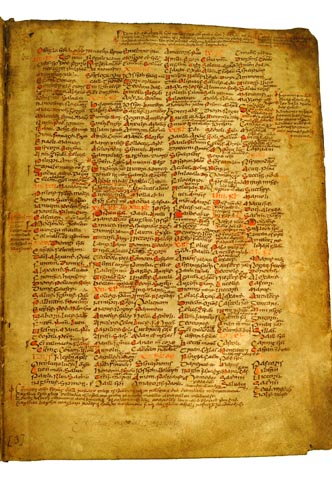
Part of the copy of the Martyrology of Tallaght separated from the Book of Leinster and now at University College, Dublin
9
posted on
07/07/2026 5:21:34 AM PDT
by
annalex
(fear them not)
To: annalex
NAVARRE BIBLE COMMENTARY(RSV)
Ad Majorem Dei Gloriam (To the Greater Glory of God)
Today’s First Reading
From: Hosea 8:4-7, 11-13
Kings and princes condemned
---------------------------------
[4] They made kings, but not through me. They set up princes, but without my knowledge. With their silver and gold they made idols for their own destruction. [5] l have spurned your calf, O Samaria. My anger burns against them. How long will it he till they are pure [6] in Israel?
A workman made it; it is not God. The calf of Samaria shall be broken to pieces. [7] For they sow the wind, and they shall reap the whirlwind. The standing grain has no heads, it shall yield no meal; if it were to yield, aliens would devour it.
Israel ruined by relying on foreign help
-------------------------------------------------------
[11] Because Ephraim has multiplied altars for sinning, they have become to him altars for sinning. [12] Were I to write for him my laws by ten-thousands, they would be regarded as a strange thing. [13] They love sacrifice; they sacrifice flesh and eat it; but the Lord has no delight in them. Now he will remember their iniquity, and punish their sins; they shall return to Egypt.
**************************************************************
Commentary:
8:1-14. This passage begins and ends with imperatives (v. 1; cf. 9:1). The first stanza (vv. 1-7) gives God’s order to Hosea to be his herald (to blow the trumpet or horn), to warn against impending danger: a vulture is hovering over “the house of the Lord”, probably a reference to the shrine at Bethel (v. 1). The people respond (“My God”: v. 2) and back their cry for help by saying that he should hear them because they acknowledge him as their God: “we Israel know thee.”
But the Lord, through the prophet, says that that is not so: Israel does not know him, for it has “spurned the good” (v. 3). The prophet denounces two sins here: they have acted without reference to God, by appointing kings “but not through me” (v. 4); and they have made idols of silver and gold (the golden calf of Samaria gets special mention: vv. 4-5). These are grievous sins; therefore, having sown the wind, “they shall reap the whirlwind”, to quote the proverb, and a short wisdom maxim tells them what punishment awaits them (vv. 6-7).
The punishment announced in v. 7 (being “devoured by aliens”) has already befallen Israel in the first verse of the second stanza (vv. 8-14), which denounces foreign pacts (vv. 9-10) and the idolatry that Israel falls into as a consequence of them (vv. I l-13). The prophet begins by saying that the alliances that Israel tries to make with foreign powers, involving probably tribute to the king of Assyria (vv. 8-10), will be to no avail. What these three verses seem to be saying is that Israel now tries to make alliances that are at odds with its true nature: inevitably, they will take its freedom away. The oracle goes on to denounce the effects that these pacts will have on worship of the Lord: there will he an increased number of places of worship but, because Canaanite rites will he mixed in with Yahwist ones, the religious services, far from expiating sins, will multiply them (v. 11). Moreover, even the offerings that they do make to the Lord will not be pleasing to him, for they will not he backed up by fulfilment of the Law of the Lord (vv. 12-13). The same point is being made as in 6:6: “Outward sacrifice, to he genuine, must be the expression of spiritual sacrifice: ‘The sacrifice acceptable to God is a broken spirit ...‘ (Ps 51:19). The prophets of the Old Covenant often denounced sacrifices that were not from the heart or not coupled with love of neighbour” (Catechism of the Catholic Church, 2100). So, the prophet sees that Israel needs to he cleansed; hence the threat that “they shall return to Egypt”, that is, become enslaved once again.
The last verse re-introduces the idea of “forgetting God”. By building palaces and fortresses, Israel is showing that he “has forgotten his Maker”, that is, does not put his trust in him: if Assyria “devours” part of the nation’s land (vv. 8-9), the fire of God will “devour” the strongholds, on which it had relied (v. 14). “Forgetting God” is a favourite theme of Hosea’s (cf. 2:13; 4:6), but the threat of destruction by fire is repeated a number of times in Amos (cf. Amos 1:4, 7, 10, 12; 2:5).
10
posted on
07/07/2026 7:35:59 AM PDT
by
fidelis
(Ecce Crucem Domini! Fugite partes adversae! Vicit Leo de tribu Juda, Radix David! Alleluia!)
Today’s Gospel Reading From: Matthew 9:32-38
The Dumb Devil
--------------------
[32] As they were going away, behold, a dumb demoniac was brought to Him (Jesus). [33] And when the demon had been cast out, the dumb man spoke; and the crowds marvelled, saying, "Never was anything like this seen in Israel." [34] But the Pharisees said, "He casts out demons by the prince of demons."
The Need for Good Shepherds
---------------------------
[35] And Jesus went about all the cities and villages teaching in their synagogues and preaching the Gospel of the Kingdom, and healing every disease and every infirmity. [36] When He saw the crowds, He had compassion for them, because they were harassed and helpless, like sheep without a shepherd. [37] Then He said to His disciples, "The harvest is plentiful, but the laborers are few; [38] pray therefore the Lord of harvest to send out laborers into His harvest."
***********************************************************************
Commentary:
35. The Second Vatican Council uses this passage when teaching about the message of Christian charity which the Church should always be spreading: "Christian charity is extended to all without distinction of race, social condition or religion, and seeks neither gain nor gratitude. Just as God loves us with a gratuitous love, so too the faithful, in their charity, should be concerned for mankind, loving it with that same love with which God sought man. As Christ went about all the towns and villages healing every sickness and infirmity, as a sign that the Kingdom of God had come, so the Church, through its children, joins itself with men of every condition, but especially with the poor and afflicted, and willingly spends herself for them" ("Ad Gentes", 12).
36. "He had compassion for them": the Greek verb is very expressive; it means "He was deeply moved". Jesus was moved when He saw the people, because their pastors, instead of guiding them and tending them, led them astray, behaving more like wolves than genuine shepherds of their flock. Jesus sees the prophecy of Ezekiel 34 as now being fulfilled; in that passage God, through the prophet, upbraids the false shepherds of Israel and promises to send them the Messiah to be their new leader.
"If we were consistent with our faith when we looked around us and contemplated the world and its history, we would be unable to avoid feeling in our own hearts the same sentiments that filled the heart of our Lord" (St J. Escriva, "Christ Is Passing By", 133). Reflection on the spiritual needs of the world should lead us to be tirelessly apostolic.
37-38. After contemplating the crowds neglected by their shepherds, Jesus uses the image of the harvest to show us that that same crowd is ready to receive the effects of Redemption: "I tell you, lift up your eyes, and see now the fields are already white for harvest" (John 4:35). The field of the Jewish people cultivated by the prophets—most recently by John the Baptist--is full of ripe wheat. In farm work, the harvest is lost if the farmer does not reap at the right time; down the centuries the Church feels a similar need to be out harvesting because there is a big harvest ready to be won.
However, as in the time of Jesus, there is a shortage of laborers. Our Lord tells us how to deal with this: we should pray to God, the Lord of harvest, to send the necessary laborers. If a Christian prays hard, it is difficult to imagine his not feeling urged to play his part in this apostolate. In obeying this commandment to pray for laborers, we should pray especially for there to be no lack of shepherds, who will be able to equip others with the necessary means of sanctification needed to back up the apostolate.
In this connection Pope Paul VI reminds us: "the responsibility for spreading the Gospel that saves belongs to everyone--to all who have received it! The missionary duty concerns the whole body of the Church; in different ways and to different degrees, it is true, but we must all of us be united in carrying out this duty. Now let the conscience of every believer ask himself: Have I carried out my missionary duty? Prayer for the Missions is the first way of fulfilling this duty" ("Angelus Address", 23 October 1977).
11
posted on
07/07/2026 7:36:18 AM PDT
by
fidelis
(Ecce Crucem Domini! Fugite partes adversae! Vicit Leo de tribu Juda, Radix David! Alleluia!)
12
posted on
07/07/2026 7:37:10 AM PDT
by
fidelis
(Ecce Crucem Domini! Fugite partes adversae! Vicit Leo de tribu Juda, Radix David! Alleluia!)
Disclaimer:
Opinions posted on Free Republic are those of the individual
posters and do not necessarily represent the opinion of Free Republic or its
management. All materials posted herein are protected by copyright law and the
exemption for fair use of copyrighted works.
FreeRepublic.com is powered by software copyright 2000-2008 John Robinson