Catena Aurea by St. Thomas Aguinas
9:1–8
1. And he entered into a ship, and passed over, and came into his own city.
2. And, behold, they brought to him a man sick of the palsy, lying on a bed: and Jesus seeing their faith said unto the sick of the palsy, Son, be of good cheer; thy sins be forgiven thee.
3. And, behold, certain of the Scribes said within themselves, This man blasphemeth.
4. And Jesus knowing their thoughts said, Wherefore think ye evil in your hearts?
5. For whether is easier, to say, Thy sins be forgiven thee; or to say, Arise, and walk?
6. But that ye may know that the Son of man hath power on earth to forgive sins, (then saith he to the sick of the palsy,) Arise, take up thy bed, and go unto thine house.
7. And he arose, and departed to his house.
8. But when the multitude saw it, they marvelled, and glorified God, which had given such power unto men.
CHRYSOSTOM. (Hom. xxix.) Christ had above shewn His excellent power by teaching, when he taught them as one having authority; in the leper, when He said, I will, be thou clean; by the centurion, who said to Him, Speak the word, and my servant shall be healed; by the sea which He calmed by a word; by the dæmons who confessed Him; now again, in another and greater way, He compels His enemies to confess the equality of His honour with the Father; to this end it proceeds, And Jesus entered into a ship, and passed over, and came into his own city. He entered a boat to cross over, who could have crossed the sea on foot; for He would not be always working miracles, that He might not take away the reality of His incarnation.
CHRYSOLOGUS. (Serm. 50.) The Creator of all things, the Lord of the world, when He had for our sakes straitened Himself in the bonds of our flesh, began to have His own country as a man, began to be a citizen of Judæa, and to have parents, though Himself the parent of all, that affection might attach those whom fear had separated.
CHRYSOSTOM. By his own city is here meant Capharnaum. For one town, to wit, Bethlehem, had received Him to be born there; another had brought Him up, to wit, Nazareth; and a third received Him to dwell there continually, namely, Capharnaum.
AUGUSTINE. (De Cons. Ev. ii. 25.) That Matthew here speaks of his own city, and Mark calls it Capharnaum, would be more difficult to be reconciled if Matthew had expressed it Nazareth. But as it is, all Galilee might be called Christ’s city, because Nazareth was in Galilee; just as all the Roman empire, divided into many states, was still called the Roman city1. Who can doubt then that the Lord in coming to Galilee is rightly said to come into his own city, whatever was the town in which He abode, especially since Capharnaum was exalted into the metropolis of Galilee?
JEROME. Or; This city may be no other than Nazareth, whence He was called a Nazarene.
AUGUSTINE. (ubi sup.) And if we adopt this supposition, we must say that Matthew has omitted all that was done from the time that Jesus entered into His own city till He came to Capharnaum, and has proceeded on at once to the healing of the paralytic; as in many other places they pass over things that intervened, and carry on the thread of the narrative, without noticing any interval of time, to something else; so here, And, lo, they bring unto him a paralytic laying on a bed.
CHRYSOSTOM. This paralytic is not the same as he in John. For he lay by the pool, this in Capharnaum; he had none to assist him, this was borne on a bed.
JEROME. On a bed, because he could not walk.
CHRYSOSTOM. He does not universally demand faith of the sick, as, for example, when they are mad, or from any other sore sickness are not in possession of their minds; as it is here, seeing their faith;
JEROME. not the sick man’s, but theirs that bare him.
CHRYSOSTOM. Seeing then that they shewed so great faith, He also shews His excellent power; with full power forgiving sin, as it follows, He said to the paralytic, Be of good courage, son, thy sins are forgiven thee.
CHRYSOLOGUS. (ubi sup.) Of how great power with God must a man’s own faith be, when that of others here availed to heal a man both within and without. The paralytic hears his pardon pronounced, in silence uttering no thanks, for he was more anxious for the cure of his body than his soul. Christ therefore with good reason accepts the faith of those that bare him, rather than his own hardness of heart.
CHRYSOSTOM. Or, we may suppose even the sick man to have had faith; otherwise he would not have suffered himself to be let down through the roof as the other Evangelist relates.
JEROME. O wonderful humility! This man feeble and despised, crippled in every limb, He addresses as son. The Jewish Priests did not deign to touch him. Even therefore His son, because his sins were forgiven him. Hence we may learn that diseases are often the punishment of sin; and therefore perhaps his sins are forgiven him, that when the cause of his disease has been first removed, health may be restored.
CHRYSOSTOM. The Scribes in their desire to spread an ill report of Him, against their will made that which was done be more widely known; Christ using their envy to make known the miracle. For this is of His surpassing wisdom to manifest His deeds through His enemies; whence it follows, Behold, some of the Scribes said among themselves, This man blasphemeth.
JEROME. We read in prophecy, I am he that blolleth out thy transgressions; (Is. 43:25.) so the Scribes regarding Him as a man, and not understanding the words of God, charged Him with blasphemy. But He seeing their thoughts thus shewed Himself to be God, Who alone knoweth the heart; and thus, as it were, said, By the same power and prerogative by which I see your thoughts, I can forgive men their sins. Learn from your own experience what the paralytic has obtained. When Jesus perceived their thoughts, he said, Why think ye evil in your hearts?
CHRYSOSTOM. He did not indeed contradict their suspicions so far as they had supposed Him to have spoken as God. For had He not been equal to God the Father, it would have behoved Him to say, I am far from this power, that of forgiving sin. But He confirms the contrary of this, by His words and His miracle; Whether is it easier to say, Thy sins are forgiven thee, or to say, Arise, and walk? By how much the soul is better than the body, by so much is it a greater thing to forgive sin than to heal the body. But forasmuch as the one may be seen with the eyes, but the other is not sensibly perceived, He does the lesser miracle which is the more evident, to be a proof of the greater miracle which is imperceptible.
JEROME. Whether or no his sins were forgiven He alone could know who forgave; but whether he could rise and walk, not only himself but they that looked on could judge of; but the power that heals, whether soul or body, is the same. And as there is a great difference between saying and doing, the outward sign is given that the spiritual effect may be proved; But that ye may know that the Son of Man hath power on earth to forgive sins.
CHRYSOSTOM. Above, He said to the paralytic, Thy sins are forgiven thee, not, I forgive thee thy sins; but now when the Scribes made resistance, He shews the greatness of His power by saying, The Son of Man hath power on earth to forgive sins. And to shew that He was equal to the Father, He said not that the Son of Man needed any to forgive sins, but that He hath power.
GLOSS. (ap. Anselm.) These words That ye may know, may be either Christ’s words, or the Evangelist’s words. As though the Evangelist had said, They doubted whether He could remit sins, But that ye may know that the Son of Man hath the power to remit sins, he saith to the paralytic. If they are the words of Christ, the connexion will be as follows; You doubt that I have power to remit sins, But that ye may know that the Son of Man hath power to remit sins—the sentence is imperfect, but the action supplies the place of the consequent clause, he saith to the paralytic, Rise, take up thy bed.
CHRYSOLOGUS. (ubi sup.) That that which had been proof of his sickness, should now become proof of his recovered health. And go to thy house, that having been healed by Christian faith, you may not die in the faithlessness of the Jews.
CHRYSOSTOM. This command He added, that it might be seen there was no delusion in the miracle; so it follows to establish the reality of the cure, And he arose, and went away to his own house. But they that stood by yet grovel on the earth, whence it follows, But the multitude seeing it were afraid, and glorified God, who had bestowed such power among men. For had they rightly considered among themselves, they would have acknowledged Him to be the Son of God. Meanwhile it was no little matter to esteem Him as one greater than men, and to have come from God.
HILARY. Mystically; When driven out of Judæa, He returns into His own city; the city of God is the people of the faithful; into this He entered by a boat, that is, the Church.
CHRYSOLOGUS. (ubi sup.) Christ has no need of the vessel, but the vessel of Christ; for without heavenly pilotage the bark of the Church cannot pass over the sea of the world to the heavenly harbour.
HILARY. In this paralytic the whole Gentile world is offered for healing, he is therefore brought by the ministration of Angels; he is called Son, because he is God’s work; the sins of his soul which the Law could not remit are remitted him; for faith only justifies. Lastly, he shews the power of the resurrection, by taking up his bed, teaching that all sickness shall then be no more found in the body.
JEROME. Figuratively; the soul sick in the body, its powers palsied, is brought by the perfect doctor to the Lord to be healed. For every one when sick, ought to engage some to pray for his recovery, through whom the halting footsteps of our acts may be reformed by the healing power of the heavenly word. These are mental monitors, who raise the soul of the hearer to higher things, although sick and weak in the outward body.
CHRYSOLOGUS. (ubi sup.) The Lord requires not in this world the will of those who are without understanding, but looks to the faith of others; as the physician does not consult the wishes of the patient, when his malady requires other things.
RABANUS. His rising up is the drawing off the soul from carnal lusts; his taking up his bed is the raising the flesh from earthly desires to spiritual pleasures; his going to his house is his returning to Paradise, or to internal watchfulness of himself against sin.
GREGORY. (Mor. xxiii. 24.) Or by the bed is denoted the pleasure of the body. He is commanded now he is made whole to bear that on which he had lain when sick, because every man who still takes pleasure in vice is laid as sick in carnal delights; but when made whole he bears this because he now endures the wantonness of that flesh in whose desires he had before reposed.
HILARY. It is a very fearful thing to be seized by death while the sins are yet unforgiven by Christ; for there is no way to the heavenly house for him whose sins have not been forgiven. But when this fear is removed, honour is rendered to God, who by His word has in this way given power to men, of forgiveness of sins, of resurrection of the body, and of return to Heaven.
Catena Aurea Matthew 9
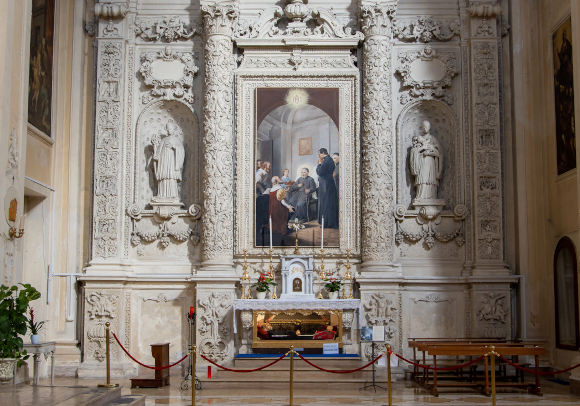
St. Bernardino Realino a JESUIT COLLEGE RECTORFeast Day : July 2
Born : Modena, Italy, in 1530
Canonized:1947 by Pope Pius XII
Patron Saint of: Lecce, Italy Bernardino Realino was born on December 1st, 1530 in Carpi in the province of Emilia in Northern Italy.
The First Thirty-Four years (1530-1564)
His mother was mainly responsible for his early training in piety and profane knowledge. She chose the tutors who for sixteen years taught Bernardino at home, as was the custom with rich families in those days. His father was often away from home, as his services were in constant demand by several ruling princes, who inisisted on his attendance on them.When he was sixteen, he left the paternal home in order to complete his literary studies and for further studies in medicine.
While he was at Bologna, another woman began to play an important part in his life, a beautiful girl, Signorina Calindra, who became eventually his betrothed. Apparently this young lady did not like men of the medical profession; and Bernardino, anxious to please his lady-love switched over to the study of law.
He took his degree in civil and canon law in 1561. He was doing well. However the sunshine soon went out of his life, for about that time his long courtship with Calindra suddenly came to an end with the premature death of his beloved.
In those days, Bernardino was a practising Catholic, but by no means an exemplary one. He was hot-tempered, and when he considered himself offended, he was liable to go to extremes. He also foolishly thought that when insulted, the proper thing for him to do was to challenge the offender to fight it out with deadly weapons.
The Parting of the Ways
It would seem that one day he saw in the streets of Naples two young religious who impressed him by their modest exterior. He enquired who they were, and was told that they were members of a new Order, founded by Ignatius of Loyola and called the Society of Jesus. Bernardino, who had never heard of the Society of Jesus, wanted to know more about it. On the following Sunday he went to hear Mass in the Jesuit church, and also listened to the sermon.
This sermon and the grace of God were the first seeds of Bernardino’s spiritual awakening. He sought an interview with the preacher, discussed matters with him, spent a few days in recollection and prayer, and made up his mind to enter the Society, not without some hesitation, because he was anxious about his old father. The poor man would get a great shock, he might even have a stroke and die suddenly.
Divine Light!
While he was in that disturbed frame of mind, Bernardino earnestly prayed for light. One day as he was saying his rosary – it was in the month of September 1564- another woman entered into his life, the Mother of God. Our Lady and her Holy Child appeared to him. Her holy presence filled his heart with overflowing joy, and swept from his mind the cobwebs of procrastination. The question was settled there and then, Bernardino entered the novitiate of Naples on October 13th, 1564. He was ordained a Priest in 1567
Bernardino in Lecce, Italy- a long life
On the request of the General, Father Everard Mercurian, Fr. Bernardino was required in Lecce, Rome. In Lecce, Fr. Bernardino’s name became a household word. He endeared himself to all, young and old, rich and poor alike. He preached to the grown-ups, he taught the catechism to the little ones, he heard confessions for hours on end, he visited the sick in their houses and in the hospitals, he took a special interest in the prisoners and the slaves. He became the spiritual guide of priests, religious men and women including lay people. His saintly life deeply impressed the inhabitants of Lecce, and soon all sorts of rumours began to spread.The poor, whom he cherished above all others, began to spread marvellous stories. The Lord permitted him to work wonders and miracles.
As years went by, the Jesuit college at Lecce saw many changes of personnel. Rectors came and Rectors went, but Fr. Bernardino remained. Of course, the inhabitants knew that sooner or later Fr. Bernardino would die. On July 2nd, 1616, Father Bernardino was heard to whisper Oh Santisima Signora Mia, “O Most Holy Lady Mine”. With Mary’s name on his lips, he breathed his last.
He was beatified by Pope Leo XII in 1895 and canonzied on June 23rd, 1947, by Pope Pius XII.
Saint Bernardino is thepatron of Lecce-Italy and we celebrate his feast on July 2nd.Shared from http://deepenyourfaith.in/
catholicnewsworld.com
NAVARRE BIBLE COMMENTARY(RSV)
Ad Majorem Dei Gloriam (To the Greater Glory of God)
Today’s First Reading
From: Amos 7:10-17
Dispute with Amaziah
--------------------------------
[10] Then Amaziah the priest of Bethel sent to Jeroboam king of Israel, saying, "Amos has conspired against you in the midst of the house of Israel; the land is not able to bear all his words. [11] For thus Amos has said, 'Jeroboam shall die by the sword, and Israel must go into exile away from his land.'" [12] And Amaziah said to Amos, "O seer, go, flee away to the land of Judah, and eat bread there, and prophesy there; [13] but never again prophesy at Bethel, for it is the king's sanctuary, and it is a temple of the kingdom.”
[14] Then Amos answered Amaziah, "I am no prophet, nor a prophet's son; but I am a herdsman, and a dresser of sycamore trees, [15] and the Lord took me from following the flock, and the Lord said to me, "Go, prophesy to my people Israel.' [16] "Now therefore hear the word of the LORD. You say, 'Do not prophesy against Israel, and do not preach against the house of Isaac.' [17] Therefore thus says the LORD: 'Your wife shall be a harlot in the city, and your sons and your daughters shall fall by the sword, and your land shall be parceled out by line; you yourself shall die in an unclean land, and Israel shall surely go into exile away from its land.'"
****************************************************************************
Commentary:
7:1-9:10. This section is the third part of the book. It consists of five visions, with a doxology that comes near the end (9:5-6). Mixed in are some interesting details about Amos and his teaching -- the account of his call (7:14-15), a dramatic description of the "day of the Lord” (8:9-14), etc. The passage ends with an announcement of punishment (9:7-10) that serves to underscore the optimism of the final oracle, which is about future restoration.
Most of this passage is taken up with the "five visions of Amos”; these are written to a fairly fixed pattern, in a mixture of prose and verse. The visions mean that Amos' ministry includes that of "seer” as well as prophet. The message of the visions is clear: the Lord cannot be appeased by external, schismatic rites that fail to touch men's hearts or move them to conversion.
7:7-17. The vision of the plumb line (vv. 7-9) exposes the rottenness within the people. They are not level, not right; when they are checked, they are found to be askew (v. 7). From now on, the Lord is not going to overlook their infidelities; what is out of line will be destroyed (v. 9). That may be why the prophet no longer intercedes; he simply notes something that will happen inexorably.
The vision is followed by an account of Amos' altercation with Amaziah, the priest of the sanctuary of Bethel (vv. 10-17). Amaziah, a supporter of King Jeroboam, sees in Amos a prophet who is only going to cause trouble in the kingdom: he has no interest in trying to understand Amos' message -- which in fact exposes injustices and deceit to which Amaziah is party.
Amaziah calls Amos a "seer” (a translation of one of the Hebrew terms used to designate a prophet). But Amos does not regard himself as a prophet in the normal sense, a "son of a prophet” (v. 14), that is, a member of a group or fraternity of prophets, of which there were many in Israel, at least from the time of King Saul onwards (cf. 1 Sam 10:10-13; 19:20-24), nor is he an "official” prophet, a member of the staff of the royal household. Amos' reply is clear: he is a herdsman and a dresser of sycamores. But the Lord sent him to "prophesy” to Israel (v. 15). Amos, then, was an ordinary man (not a prophet, not a priest) who was commissioned by the Lord, out of the blue, to proclaim a message. A call from God is something so imperative that no one should refuse it (cf. 3:8), but at the same time it gives meaning and strength to the person's life: it confers on him a sense of authority even over institutions such as temple and king. He therefore has the last word (v. 17): "God's calling gives us a mission: it invites us to share in the unique task of the Church, to bear witness to Christ before our fellow men and so draw all things toward God. Our calling discloses to us the meaning of our existence. It means being convinced, through faith, of the reason for our life on earth. Our life -- present, past and future -- acquires a new dimension, a depth we did not perceive before. All happenings and events now fall within their true perspective: we understand where God is leading us, and we feel ourselves borne along by this task entrusted to us” (St Josemaria Escrivá, "Christ is Passing By", 45).
Today’s Gospel Reading From: Matthew 9:1-8
The Curing of a Paralytic
-------------------------
[1] And getting into a boat He (Jesus) crossed over and came to His own city. [2] And behold, they brought to Him a paralytic, lying on his bed; and when Jesus saw their faith He said to the paralytic, "Take heart, My son; your sins are forgiven." [3] And behold, some of the scribes said to themselves, "This man is blaspheming." [4] But Jesus, knowing their thoughts, said, "Why do you think evil in your hearts? [5] For which is easier to say, `Your sins are forgiven', or to say, `Rise and walk'? [6] But that you may know that the Son of Man has authority on earth to forgive sins"--He then said to the paralytic-- "Rise, take up your bed and go home." [7] And He rose and went home. [8] When the crowds saw it, they were afraid, and they glorified God, who had given such authority to men.
***********************************************************************
Commentary:
1. "His own city": Capernaum (cf. Matthew 4:13 and Mark 2:1).
2-6. The sick man and those who bring him to Jesus ask Him to cure the man's physical illness; they believe in His supernatural powers. As in other instances of miracles, our Lord concerns Himself more with the underlying cause of illness, that is, sin. With divine largesse He gives more than He is asked for, even though people do not appreciate this. St. Thomas Aquinas says that Jesus Christ acts like a good doctor: He cures the cause of the illness (cf. "Commentary on St. Matthew", 9, 1-6).
2. The parallel passage of St. Mark adds a detail which helps us understand this scene better and explains why the text refers to "their faith": in Mark 2:2-5 we are told that there was such a crowd around Jesus that the people carrying the bed could not get near Him. So they had the idea of going up onto the roof and making a hole and lowering the bed down in front of Jesus. This explains His "seeing their faith".
Our Lord was pleased by their boldness, a boldness which resulted from their lively faith which brooked no obstacles. This nice example of daring indicates how we should go about putting charity into practice--as also how Jesus feels towards people who show real concern for others: He cures the paralytic who was so ingeniously helped by his friends and relatives; even the sick man himself showed daring by not being afraid of the risk involved.
St. Thomas comments on this verse as follows: "This paralytic symbolizes the sinner lying in sin"; just as the paralytic cannot move, so the sinner cannot help himself. The people who bring the paralytic along represent those who, by giving him good advice, lead the sinner to God" ("Commentary on St. Matthew", 9, 2). In order to get close to Jesus the same kind of holy daring is needed, as the Saints show us. Anyone who does not act like this will never take important decisions in his life as a Christian.
3-7. Here "to say" obviously means "to say and mean it", "to say producing the result which your words imply". Our Lord is arguing as follows" which is easier--to cure the paralytic's body or to forgive the sins of his soul? Undoubtedly, to cure his body; for the soul is superior to the body and therefore diseases of the soul are the more difficult to cure. However, a physical cure can be seen, whereas a cure of the soul cannot. Jesus proves the hidden cure by performing a visible one.
The Jews thought that any illness was due to personal sin (cf. John 9:1-3); so when they heard Jesus saying, "Your sins are forgiven", they reasoned in their minds as follows: only God can forgive sins (cf. Luke 5:21); this man says that He has power to forgive sins; therefore, He is claiming a power which belongs to God alone--which is blasphemy. Our Lord, however, forestalls them, using their own arguments: by curing the paralytic by saying the word, He shows them that since He has the power to cure the effects of sin (which is what they believe disease to be), then He also has power to cure the cause of illness (sin); therefore, He has divine power.
Jesus Christ passed on to the Apostles and their successors in the priestly ministry the power to forgive sins: "Receive the Holy Spirit. If you forgive sins of any, they are forgiven; if you retain the sins of any, they are retained" (John 20:22-23). "Truly, I say to you, whatever you bind on earth shall be bound in Heaven, and whatever you loose on earth shall be loosed in Heaven" (Matthew 18:18). Priests exercise this power in the Sacrament of Penance: in doing so they act not in their own name but in Christ's--"in persona Christi", as instruments of the Lord.
Hence the respect, the veneration and gratitude with which we should approach Confession: in the priest we should see Christ Himself, God Himself, and we should receive the words of absolution firmly believing that it is Christ who is uttering them through the priest. This is why the minister does not say: "Christ absolves you...", but rather "I absolve you from your sins..." He speaks in the first person. So fully is he identified with Jesus Christ Himself (cf. "St. Pius V Catechism", II, 5, 10).