
Catena Aurea by St. Thomas Aguinas
8:23–27
23. And when he was entered into a ship, his disciples followed him.
24. And, behold, there arose a great tempest in the sea, insomuch that the ship was covered with the waves: but he was asleep.
25. And his disciples came to him, and awoke him, saying, Lord, save us: we perish.
26. And he saith unto them, Why are ye fearful, O ye of little faith? Then he arose, and rebuked the winds and the sea; and there was a great calm.
27. But the men marvelled, saying, What manner of man is this, that even the winds and the sea obey him!
PSEUDO-ORIGEN. (Hom. in div. vii.) Christ having performed many great and wonderful things on the land, passes to the sea, that there also He might shew forth His excellent power, presenting Himself before all men as the Lord of both earth and sea. And when he was entered into a boat, his disciples followed him, not being weak but strong and established in the faith. Thus they followed Him not so much treading in His footsteps, as accompanying Him in holiness of spirit.
CHRYSOSTOM. (Hom. xxviii.) He took His disciples with Him, and in a boat, that they might learn two lessons; first, not to be confounded in dangers, secondly, to think lowly of themselves in honour. That they should not think great things of themselves because He kept them while He sent the rest away, He suffers them to be tossed by the waves. Where miracles were to be shewn, He suffers the people to be present; where temptations and fears were to be stilled, there He takes with Him only the victors of the world, whom He would prepare for strife.
PSEUDO-ORIGEN. (ubi sup.) Therefore, having entered into the boat He caused the sea to rise; And, lo, there arose a great tempest in the sea, so that the boat was covered by the waves. This tempest did not arise of itself, but in obedience to the power of Him Who gave commandment, who brings the winds out of his treasures. (Jer. 10:13.) There arose a great tempest, that a great work might be wrought; because by how much the more the waves rushed into the boat, so much the more were the disciples troubled, and sought to be delivered by the wonderful power of the Saviour.
CHRYSOSTOM. They had seen others made partakers of Christ’s mercies, but forasmuch as no man has so strong a sense of those things that are done in the person of another as of what is done to himself, it behoved that in their own bodies they should feel Christ’s mercies. Therefore He willed that this tempest should arise, that in their deliverance they might have a more lively sense of His goodness. This tossing of the sea was a type of their future trials of which Paul speaks, I would not have you ignorant, brethren, how that we were troubled beyond our strength. (2 Cor. 1:8.) But that there might be time for their fear to arise, it follows, But he was asleep. For if the storm had arisen while He was awake, they would either not have feared, or not have prayed Him, or would not have believed that He had the power to still it.
PSEUDO-ORIGEN. (ubi sup.) Wonderful, stupendous event! He that never slumbereth nor sleepeth, is said to be asleep. He slept with His body, but was awake in His Deity, shewing that He bare a truly human body which He had taken on Him, corruptible. He slept with the body that He might cause the Apostles to watch, and that we all should never sleep with our mind. With so great fear were the disciples seized, and almost beside themselves, that they rushed to Him, and did not modestly or gently rouse Him, but violently awakened Him, His disciples came to him, and awoke him, saying, Lord, save us, we perish.
JEROME. Of this miracle we have a type in Jonah, who while all are in danger is himself unconcerned, sleeps, and is awakened.
PSEUDO-ORIGEN. (ubi sup.) O ye true disciples! ye have the Saviour with you, and do ye fear danger? Life itself is among you, and are ye afraid of death? They would answer, We are yet children, and weak, and are therefore afraid; whence it follows, Jesus saith unto them, Why are ye afraid, O ye of little faith? As though He had said, If ye have known me mighty upon earth, why believe ye not that I am also mighty upon the sea? And even though death were threatening you, ought ye not to support it with constancy? He who believes a little will be reasoned with; he who believes not at all will be neglected.
CHRYSOSTOM. If any should say, that this was a sign of no small faith to go and rouse Jesus; it is rather a sign that they had not a right opinion concerning Him. They knew that when wakened He could rebuke the waves, but they did not yet know that He could do it while sleeping. For this cause He did not do this wonder in the presence of the multitudes, that they should not be charged with their little faith; but He takes His disciples apart to correct them, and first stills the raging of the waters. Then he arose, and rebuked the winds and the sea, and there was a great calm.
JEROME. From this passage we understand, that all creation is conscious of its Creator; for what may be rebuked and commanded is conscious of the mind commanding. I do not mean as some heretics hold, that the whole creation is animatec—but by the power of the Maker things which to us have no consciousness have to Him.
PSEUDO-ORIGEN. (ubi sup.) Therefore He gave commandment to the winds and the sea, and from a great storm it became a great calm. For it behoves Him that is great to do great things; therefore He who first greatly stirred the depths of the sea, now again commands a great calm, that the disciples who had been too much troubled might have great rejoicing.
CHRYSOSTOM. Observe also that the storm is stilled at once entirely, and no trace of disturbance appears; which is beyond nature; for when a storm ceases in the course of nature, yet the water is wont to be agitated for some time longer, but here all is tranquillity at once. Thus what is said of the Father, He spake, and the storm of wind ceased, (Ps. 107:25.) this Christ fulfilled in deed; for by His word and bidding only He stayed and checked the waters. For from His appearance, from His sleeping, and His using a boat, they that were present supposed Him a man only, and on this account they fell into admiration of Him; And the men marvelled, saying, What manner of man is this, for the winds and the sea obey him?
GLOSS. (non occ.) Chrysostom explains thus, What manner of man is this? His sleeping and His appearance shewed the man; the sea and the calm pointed out the God.
PSEUDO-ORIGEN. (ubi sup.) But who were the men that marvelled? You must not think that the Apostles are here meant, for we never find the Lord’s disciples mentioned with disrespect; they are always called either the Disciples or the Apostles. They marvelled then who sailed with Him, whose was the boat.
JEROME. But if any shall contend that it was the disciples who wondered, we shall answer they are rightly spoken of as ‘the men,’ seeing they had not yet learnt the power of the Saviour.
PSEUDO-ORIGEN. (ubi sup.) This is not a question, What manner of man is this? but an affirmation that He is one whom the winds and the sea obey. What manner of man then is this? that is, how powerful, how mighty, how great! He commands every creature, and they transgress not His law; men alone disobey, and are therefore condemned by His judgment. Figuratively; We are all embarked in the vessel of the Holy Church, and voyaging through this stormy world with the Lord. The Lord Himself sleeps a merciful sleep while we suffer, and awaits the repentance of the wicked.
HILARY. Or; He sleeps, because by our sloth He is cast asleep in us. This is done that we may hope aid from God in fear of danger; and that hope though late may be confident that it shall escape danger by the might of Christ watching within.
PSEUDO-ORIGEN. Let us therefore come to Him with joy, saying with the Prophet, Arise, O Lord, why sleepest thou? (Ps. 44:23.) And He will command the winds, that is, the dæmons, who raise the waves, that is, the rulers of the world, to persecute the saints, and He shall make a great calm around both body and spirit, peace for the Church, stillness for the world.
RABANUS. Otherwise; The sea is the turmoil of the world; the boat in which Christ is embarked is to be understood the tree of the cross, by the aid of which the faithful having passed the waves of the world, arrive in their heavenly country, as on a safe shore, whither Christ goes with His own; whence He says below, He that will come after me, let him deny himself, and take up his cross, and follow me. (Mat. 16:24.) When then Christ was fixed on the cross, a great commotion was raised, the minds of His disciples being troubled at His passion, and the boat was covered by the waves. For the whole strength of persecution was around the cross of Christ, on which He died; as it is here, But he was asleep. His sleep is death. The disciples awaken the Lord, when troubled at His death; they seek His resurrection with earnest prayers, saying, Save us, by rising again; we perish, by our trouble at Thy death. He rises again, and rebukes the hardness of their hearts, as we read in other places. He commands the winds, in that He overthrew the power of the Devil; He commanded the sea, in that He disappointed the malice of the Jews; and there was a great calm, because the minds of the disciples were calmed when they beheld His resurrection.
BEDE. (in loc.) Or; The boat is the present Church, in which Christ passes over the sea of this world with His own, and stills the waves of persecution. Wherefore we may wonder, and give thanks.
Catena Aurea Matthew 8
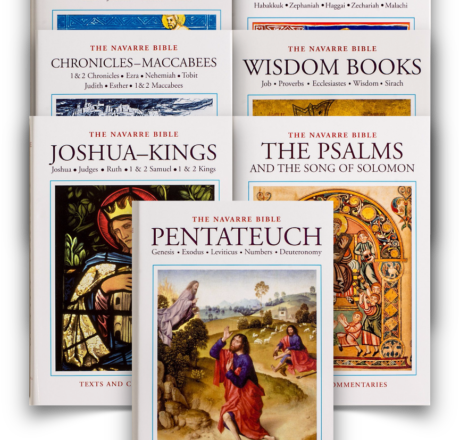
NAVARRE BIBLE COMMENTARY(RSV)
Ad Majorem Dei Gloriam (To the Greater Glory of God)
Today’s First Reading
From: Amos 3:1-8, 4:11-12
Election and punishment of Israel
-----------------------------------------
[1] Hear this word that the Lord has spoken against you, O people of Israel, against the whole family which I brought up out of the land of Egypt: [2] “You only have I known of all the families of the earth; therefore I will punish you for all your iniquities.
The prophet, a messenger of the Lord
----------------------------------------------
[3] Do two walk together, unless they have made an appointment? [4] Does a lion roar in the forest, when he has no prey? Does a young lion cry out from his den, if he has taken nothing? [5] Does a bird fall in a snare on the earth, when there is no trap for it? Does a snare spring up from the ground. when it has taken nothing? [6] Is a trumpet blown in a city, and the people are not afraid? Does evil befall a city, unless the Lord has done it’? [7] Surely the Lord God does nothing, without revealing his secret to his servants the prophets. [8] The lion has roared; who will not fear? The Lord God has spoken; who can but prophesy?”
The Lord’s warnings have gone unheeded
---------------------------------------------------
[11] I overthrew some of you, as when God overthrew Sodom and Gomorrah, and you were as a brand plucked out of the burning: yet you did not return to me,” says the Lord.
[12] Therefore thus I will do to you, O Israel; because I will do this to you, prepare to meet your God, O Israel!”
**********************************************************************
Commentary:
3:1-6:14. The second (and longest) part of the book contains denunciations of Israel and predictions about how her sins will be punished. It consists of three oracles, each beginning with “Hear this word . . . “ (3:1; 4:1; 5:1), and three others containing the words “O you . . . “or “Woe to you” (5:7, 18; 6:1). In terms of content, all these oracles are a development of the oracle against Israel that closed the previous section (2:6-16).
This part begins with a new interpretation of the meaning of God’s choice of Israel. The oracles are about that election. The Israelites think that their pilgrimages to the popular shrines of Bethel and Gilgal (where they make voluntary offerings and give tithes, 4:4-5, and assemble for festivals, 5:21-25) mean that they have fulfilled their religious duties and are in a good standing before God. They are living in prosperous times: what better proof that God is pleased with them. Material prosperity was more marked in Israel than in Judah, but, still, life was reasonably good under Uzziah. However, this material well-being went hand in hand with social injustice -- oppression of the poor and needy, and a contradiction between formal religious acts and personal morality.
This is the context in which Amos preaches and utters his prophetic denouncements: quite a lot of people are getting richer, but the ranks of the poor are being swelled all the time; the rich and powerful are exploiting the poor, and are refusing them justice; attendance at religious ceremonies in Bethel and Gilgal (schismatic sanctuaries, for the temple of Jerusalem was the only proper place of worship) did not affect people’s hearts; it did not provoke them to resolve to amend their lives; they were deceiving themselves, trusting in God without having grounds for doing so, and believed (wrongly) that they were absolved from their sins.
3:1-8. God’s choice of Israel is very vividly described here. Amos does not use the term “covenant” or “steadfast love” to describe God’s attitude towards Israel (those are terms often found in other prophetical texts); but he does make it clear that the Lord’s commitment to his people is a single-minded one: “You only have I known of all the families of the earth” (v. 2). This election means that Israel has special duties towards God -- and that God takes special care of Israel (cf. v. 3). And so St Jerome comments on the verse as follows: “You only I have known of all the people of the earth; therefore I will visit your iniquities upon you (cf. Amos 3:2): ‘For the Lord disciplines him whom he loves, and chastises every son whom he receives’ (Heb 12:6). God says that I will visit, not ‘I will punish’, for the coming of the Lord is both punishment and cure; and, he says, I will visit all of their iniquities: all shall be chastised and none shall remain uncured” (Commentarii in Amos, 3, 1-2).
A little further on, this teaching is rounded off with a sapiential consideration (vv. 3-8). The Lord addresses Israel by means of his prophets. All events have a cause that one cannot perceive, but they do point to their cause: when two people go walking together it is a sign that they have previously arranged to do so (v. 3); the roar of the lion shows that he has caught his prey or is about to do so (v. 4), etc. So, the conclusion to be drawn is clear (cf. v. 8): if Amos is prophesying, he is doing so because the Lord has spoken and man must take heed. In a way, this verse is a kind of parallel to what Amos says to the priest of Bethel (cf. 7:14-15): it is the Lord who has sent him to prophesy; God is the one who has taken the initiative: “The literal meaning of these words is as follows: If all the animals of the earth are terrified and tremble at the sound of the lion’s roar, how can we not prophesy when the Lord bids us speak and tell the people of the torments that await them?” (St Jerome, Commentarii in Amos, 3, 3-8).
4:6-12. This oracle has a regular rhythm to it -- each of the Lord’s actions ends with the sort of refrain you find in a poem: “... yet you did not return to me, says the Lord” (vv. 6, 8, 9, 10, 11). The actions taken by the Lord (withdrawing food, drought, blight, destruction of cities) are reminiscent of the plagues of Egypt; but, most of all, they demonstrate the Lord’s sovereignty over nature. This is the same message as is contained in the doxologies: God, the Lord of Israel, is the only one who has power over all creation: no Baal, no Canaanite god, has any such power. The point is also made that the punishment sent by God is aimed at bringing about the people’s conversion. When they saw all these awful things happen, the Israelites should have had a change of heart. But they did not: Israel’s sin is that of pride and self-sufficiency; therefore, it is time to get ready for judgment and punishment (v. 12; cf. 3:1).


