Skip to comments.
Catholic Caucus: Daily Mass Readings 4-June-2026
Universalis/Jerusalem Bible ^
Posted on 06/04/2026 5:25:18 AM PDT by annalex
4 June 2026
Thursday of week 9 in Ordinary Time

Bridgettine Sisters Chapel and Retreat House, Columbus, OH Readings at MassLiturgical Colour: Green. Year: A(II).
| First reading |
|---|
| 2 Timothy 2:8-15 |
|---|
If we have died with Christ then we shall live with ChristRemember the Good News that I carry, ‘Jesus Christ risen from the dead, sprung from the race of David’; it is on account of this that I have my own hardships to bear, even to being chained like a criminal – but they cannot chain up God’s news. So I bear it all for the sake of those who are chosen, so that in the end they may have the salvation that is in Christ Jesus and the eternal glory that comes with it. Here is a saying that you can rely on: If we have died with him, then we shall live with him. If we hold firm, then we shall reign with him. If we disown him, then he will disown us. We may be unfaithful, but he is always faithful, for he cannot disown his own self. Remind them of this; and tell them in the name of God that there is to be no wrangling about words: all that this ever achieves is the destruction of those who are listening. Do all you can to present yourself in front of God as a man who has come through his trials, and a man who has no cause to be ashamed of his life’s work and has kept a straight course with the message of the truth.
| Responsorial Psalm |
|---|
| Psalm 24(25):4-5,8-10,14 |
|---|
Lord, make me know your ways. Lord, make me know your ways. Lord, teach me your paths. Make me walk in your truth, and teach me: for you are God my saviour. Lord, make me know your ways. In you I hope all day long The Lord is good and upright. He shows the path to those who stray, He guides the humble in the right path, He teaches his way to the poor. Lord, make me know your ways. His ways are faithfulness and love for those who keep his covenant and law. The Lord’s friendship is for those who revere him; to them he reveals his covenant. Lord, make me know your ways.
| Gospel Acclamation | cf.Jn6:63,68 |
|---|
Alleluia, alleluia! Your words are spirit, Lord, and they are life; you have the message of eternal life. Alleluia! Alleluia, alleluia! Our Saviour Jesus Christ abolished death and he has proclaimed life through the Good News. Alleluia!
'You are not far from the kingdom of God'One of the scribes came up to Jesus and put a question to him, ‘Which is the first of all the commandments?’ Jesus replied, ‘This is the first: Listen, Israel, the Lord our God is the one Lord, and you must love the Lord your God with all your heart, with all your soul, with all your mind and with all your strength. The second is this: You must love your neighbour as yourself. There is no commandment greater than these.’ The scribe said to him, ‘Well spoken, Master; what you have said is true: that he is one and there is no other. To love him with all your heart, with all your understanding and strength, and to love your neighbour as yourself, this is far more important than any holocaust or sacrifice.’ Jesus, seeing how wisely he had spoken, said, ‘You are not far from the kingdom of God.’ And after that no one dared to question him any more. Universalis podcast: The week ahead – from 7 to 13 JuneCorpus Christi: ‘Eat my flesh’ and the Last Supper. The work of the Holy Spirit and how the feast of Corpus Christi was born. St Thomas Aquinas and transubstantiation. The power of the Body of Christ. The Sacred Heart: the birth of the feast of love, and what it does for us. (23 minutes)
Episode notes.Play Christian Art Each day, The Christian Art website gives a picture and reflection on the Gospel of the day. The readings on this page are from the Jerusalem Bible, which is used at Mass in most of the English-speaking world. The New American Bible readings, which are used at Mass in the United States, are available in the Universalis apps, programs and downloads.
You can also view this page with the Gospel in Greek and English. |
TOPICS: Catholic; General Discusssion; Prayer; Worship
KEYWORDS: catholic; mk12; ordinarytime; prayer
For your reading, reflection, faith-sharing, comments, questions, discussion.
1
posted on
06/04/2026 5:25:18 AM PDT
by
annalex
To: All
KEYWORDS: catholic; mk12; ordinarytime; prayer
2
posted on
06/04/2026 5:26:03 AM PDT
by
annalex
(fear them not)
To: nickcarraway; NYer; ELS; Pyro7480; livius; ArrogantBustard; Catholicguy; RobbyS; marshmallow; ...

Alleluia Ping Please FReepmail me to get on/off the Alleluia Ping List.
3
posted on
06/04/2026 5:27:03 AM PDT
by
annalex
(fear them not)
To: annalex
4
posted on
06/04/2026 5:27:58 AM PDT
by
annalex
(fear them not)
To: annalex
| Mark |
| | English: Douay-Rheims | Latin: Vulgata Clementina | Greek NT: Byzantine/Majority Text (2000) |
| | Mark 12
|
| 28. | And there came one of the scribes that had heard them reasoning together, and seeing that he had answered them well, asked him which was the first commandment of all. | Et accessit unus de scribis, qui audierat illos conquirentes, et videns quoniam bene illis responderit, interrogavit eum quod esset primum omnium mandatum. | και προσελθων εις των γραμματεων ακουσας αυτων συζητουντων ειδως οτι καλως αυτοις απεκριθη επηρωτησεν αυτον ποια εστιν πρωτη παντων εντολη |
| 29. | And Jesus answered him: The first commandment of all is, Hear, O Israel: the Lord thy God is one God. | Jesus autem respondit ei : Quia primum omnium mandatum est : Audi Israël, Dominus Deus tuus, Deus unus est : | ο δε ιησους απεκριθη αυτω οτι πρωτη παντων των εντολων ακουε ισραηλ κυριος ο θεος ημων κυριος εις εστιν |
| 30. | And thou shalt love the Lord thy God, with thy whole heart, and with thy whole soul, and with thy whole mind, and with thy whole strength. This is the first commandment. | et diliges Dominum Deum tuum ex tota corde tuo, et ex tota anima tua, et ex tota mente tua, et ex tota virtute tua. Hoc est primum mandatum. | και αγαπησεις κυριον τον θεον σου εξ ολης της καρδιας σου και εξ ολης της ψυχης σου και εξ ολης της διανοιας σου και εξ ολης της ισχυος σου αυτη πρωτη εντολη |
| 31. | And the second is like to it: Thou shalt love thy neighbour as thyself. There is no other commandment greater than these. | Secundum autem simile est illi : Diliges proximum tuum tamquam teipsum. Majus horum aliud mandatum non est. | και δευτερα ομοια αυτη αγαπησεις τον πλησιον σου ως σεαυτον μειζων τουτων αλλη εντολη ουκ εστιν |
| 32. | And the scribe said to him: Well, Master, thou hast said in truth, that there is one God, and there is no other besides him. | Et ait illi scriba : Bene, Magister, in veritate dixisti, quia unus est Deus, et non est alius præter eum. | και ειπεν αυτω ο γραμματευς καλως διδασκαλε επ αληθειας ειπας οτι εις εστιν και ουκ εστιν αλλος πλην αυτου |
| 33. | And that he should be loved with the whole heart, and with the whole understanding, and with the whole soul, and with the whole strength; and to love one's neighbour as one's self, is a greater thing than all holocausts and sacrifices. | Et ut diligatur ex toto corde, et ex toto intellectu, et ex tota anima, et ex tota fortitudine, et diligere proximum tamquam seipsum, majus est omnibus holocautomatibus, et sacrificiis. | και το αγαπαν αυτον εξ ολης της καρδιας και εξ ολης της συνεσεως και εξ ολης της ψυχης και εξ ολης της ισχυος και το αγαπαν τον πλησιον ως εαυτον πλειον εστιν παντων των ολοκαυτωματων και θυσιων |
| 34. | And Jesus seeing that he had answered wisely, said to him: Thou art not far from the kingdom of God. And no man after that durst ask him any question. | Jesus autem videns quod sapienter respondisset, dixit illi : Non es longe a regno Dei. Et nemo jam audebat eum interrogare. | και ο ιησους ιδων αυτον οτι νουνεχως απεκριθη ειπεν αυτω ου μακραν ει απο της βασιλειας του θεου και ουδεις ουκετι ετολμα αυτον επερωτησαι |
5
posted on
06/04/2026 5:31:05 AM PDT
by
annalex
(fear them not)
To: annalex

Catena Aurea by St. Thomas Aguinas
12:28–34
28. And one of the scribes came, and having heard them reasoning together, and perceiving that he had answered them well, asked him, Which is the first commandment of all?
29. And Jesus answered him, The first of all the commandments is, Hear, O Israel; The Lord our God is one Lord:
30. And thou shalt love the Lord thy God with all thy heart, and with all thy soul, and with all thy mind, and with all thy strength: this is the first commandment.
31. And the second is like, namely this, Thou shalt love thy neighbour as thyself. There is none other commandment greater than these.
32. And the scribe said unto him, Well, Master, thou hast said the truth; for there is one God; and there is none other but he:
33. And to love him with all the heart, and with all the understanding, and with all the soul, and with all the strength, and to love his neighbour as himself, is more than all whole burnt offerings and sacrifices.
34. And when Jesus saw that he answered discreetly, he said unto him, Thou art not far from the kingdom of God. And no man after that durst ask him any question.
GLOSS. (non occ.) After that the Lord confuted the Pharisees, and the Sadducees, who tempted Him, it is here shewn how He satisfied the Scribe who questioned Him; wherefore it is said, And one of the scribes came, and having heard them reasoning together, and perceiving that he had answered them well, asked him, Which is the first commandment of all?
PSEUDO-JEROME. This question is only that which is a problem common to all skilled in the law, namely, that the commandments are differently set forth in Exodus, Leviticus, and Deuteronomy. Wherefore He brought forward not one but two commandments, by which, as by two paps rising on the breast of the bride, our infancy is nourished. And therefore there is added, And Jesus answered him, The first of all the commandments is, Hear, O Israel; the Lord thy God is one God. He mentions the first and greatest commandment of all; this is that to which each of us must give the first place in his heart, as the only foundation of piety, that is, the knowledge and confession of the Divine Unity, with the practice of good works, which is perfected in the love of God and our neighbour; wherefore there is added, Thou shalt love the Lord thy God with all thy heart, and with all thy mind, and with all thy soul, and with all thy strength: this is the first commandment.
THEOPHYLACT. See how He has enumerated all the powers of the soul; for there is a 1living power in the soul, which He explains, when He says, With all thy soul, and to this belong anger and desire, all of which He will have us give to Divine love. There is also another power, which is called natural, to which belong nutriment and growth, and this also is all to be given to God, for which reason He says, With all thy heart. There is also another power, the rational, which He calls the mind, and that too is to be given whole to God.
GLOSS. (non occ.) The words which are added, And with all thy strength, may be referred to the bodily powers. It goes on: And the second is like, namely this, Thou shalt love thy neighbour as thyself.
THEOPHYLACT. He says that it is like, because these two commandments are harmonious one with the other, and mutually contain the other. For he who loves God, loves also His creature; but the chief of His creatures is man, wherefore he who loves God ought to love all men. But he who loves his neighbour, who so often offends him, ought much more to love Him, who is ever giving him benefits. And therefore on account of the connection between these commandments, He adds, There is none other commandment greater than these. It goes on: And the Scribe said unto him, Well, Master, thou hast said the truth: for there is one God, and there is none other but he: and to love him with all the heart, and with all the soul, and with all the understanding, and with all the strength, and to love his neighbour as himself, is more than all whole burnt offerings and sacrifices.
BEDE. (ubi sup.) He shews when he says, this is greater than all sacrifices, that a grave question was often debated between the scribes and Pharisees, which was the first commandment, or the greatest of the Divine law; that is, some praised offerings and sacrifices, others preferred acts of faith and love, because many of the fathers before the law pleased God by that faith only, which works by love. This scribe shews that he was of the latter opinion. But it continues, And when Jesus saw that he answered discreetly, he said unto him, Thou art not far from the kingdom of God.
THEOPHYLACT. By which He shews that he was not perfect, for He did not say, Thou art within the kingdom of heaven, but, Thou art not far from the kingdom of God.
BEDE. (ubi sup) But the reason why he was not far from the kingdom of God was, that he proved himself to be a favourer of that opinion, which is proper to the New Testament and to Gospel perfection.
AUGUSTINE. (de Con. Evan. ii. 73) Nor let it trouble us that Matthew says, that he who addressed this question to the Lord tempted Him; for it may be that though he came as a tempter, yet he was corrected by the answer of the Lord. Or at all events, we must not look upon the temptation as evil, and done with the intention of deceiving an enemy, but rather as the caution of a man who wished to try a thing unknown to him.
PSEUDO-JEROME. Or else, he is not far who comes with knowledge; for ignorance is farther from the kingdom of God than knowledge; wherefore he says above to the Sadducees, Ye err, not knowing the Scriptures, or the power of God. It goes on: And no man after that durst ask him any questions.
BEDE. (ubi sup.) For since they were confuted in argument, they ask Him no farther questions, but take Him without any disguise, and give Him up to the Roman power. From which we understand that the venom of envy may be overcome, but can hardly lie quiet.
Catena Aurea Mark 12
6
posted on
06/04/2026 5:32:13 AM PDT
by
annalex
(fear them not)
To: annalex

Christ giving his Blood
Lorenzo Lotto (1480–1556)
Kunsthistorisches Museum, Vienna, Austria
7
posted on
06/04/2026 5:32:45 AM PDT
by
annalex
(fear them not)
To: annalex
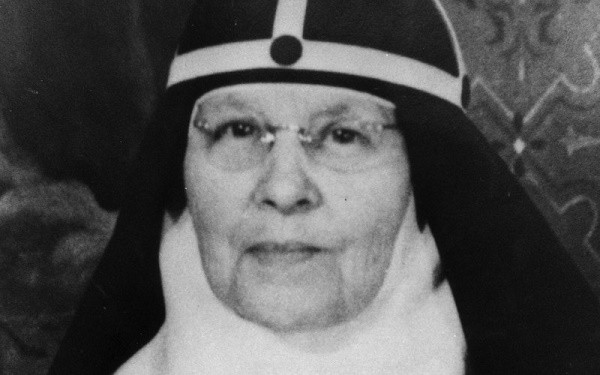
MARIA ELISABETTA HESSELBLAD
(1870-1957)
The Servant of God was born in the little village of Faglavik, in the province of Alvsborg, on the 4 June 1870, the fifth of thirteen children born to Augusto Roberto Hesselblad and Cajsa Pettesdotter Dag. The following month she was baptized and received into the Reformed Church of Sweden in her parish in Hundene. Her childhood was lived out in various places, since economic difficulties forced the family to move on several occasions.
In 1886, in order to make a living and to support her family, she went to work first of all in Karlosborg and then in the United States of America. She went to nursing school at the Roosevelt hospital in New York and dedicated herself to home care of the sick. This meant that she continually had to make many sacrifices, which did not do her health any good, but certainly helped her soul to flourish. The contact she had with so many sick catholics and her thirst for truth helped to keep alive in her heart her search for the true flock of Christ. Through prayer, personal study and a deep daughterly devotion to the Mother of the Redeemer, she was decisively led to the Catholic Church and, on the 15 August 1902, in the Convent of the Visitation in Washington, she received conditional baptism from Fr. Giovani Giorgio Hagen, S.J., who also became her spiritual director. Looking back on that moment of grace, she wrote, "In an instant the love of God was poured over me. I understood that I could respond to that love only through sacrifice and a love prepared to suffer for His glory and for the Church. Without hesitation I offered Him my life, and my will to follow Him on the Way of the Cross." Two days later she was nourished by the Eucharist, and then she left for Europe.
In Rome she received the Sacrament of Confirmation and she clearly perceived that she was to dedicate herself to the unity of Christians. She also visited the church and house of Saint Bridget of Sweden (+ 1373), and came away with a deep and lasting impression: "It is in this place that I want you to serve me." She returned to the United States but, her poor health notwithstanding, she left everything and on 25 March 1904 she settled in Rome at the Casa di Santa Brigida, receiving a wonderful welcome from the Carmelite Nuns who lived there. In silence and in prayer she made great progress in her knowledge and love of Christ, fostered devotion to Saint Bridget and Saint Catherine of Sweden, and nourished a growing concern for her people and the Church.
In 1906 Pope Saint Pius X allowed her to take the habit of the Order of the Most Holy Saviour of Saint Bridget and profess vows as a spiritual daughter of the Swedish saint. In the years that followed she strove to bring back to Rome the Order of the Most Holy Saviour, and to that end she visited the few existing Brigettine monasteries in Europe, an experience that brought joys, disappointments and no concrete help. Her dream of bringing to birth a Brigettine community in Rome that was made up of members coming from monasteries of ancient observance, was not realized. However Divine Providence, in ways that were quite unexpected, enabled a new branch to grow from the ancient Brigettine trunk. In fact, on the 9 November 1911, the Servant of God welcomed three young English postulants and refounded the Order of the Most Holy Saviour of Saint Bridget, whose particular mission was to pray and work, especially for the unity of Scandinavian Christians with the Catholic Church.
In 1931 she experienced the great joy of receiving the Holy SeeÂ’s permission to have permanent use of the church and house of Saint Bridget in Rome. These became the centre of activity for the Order which, driven on by its missionary zeal, also established foundations in India (1937).
During and after the Second World War, the Servant of God performed great works of charity on behalf of the poor and those who suffered because of racial laws; she promoted a movement for peace that involved catholics and non-catholics; she multiplied her ecumenical endeavours and for many people who belonged to other religions or other christian confessions, she was part of their journey towards the Catholic Church.
From the very beginning of her Foundation she was particularly attentive to the formation of her spiritual daughters, for whom she was both a mother and a guide. She implored them to live in close union with God, to have a fervent desire to be conformed to our Divine Saviour, to possess a great love for the Church and the Roman Pontiff, and to pray constantly that there be only one flock and one shepherd, adding, "This is the prime goal of our vocation." She also devoted herself to fostering a unity of spirit within the Order. "The Lord has called us from different nations," she wrote, "but we must be united with one heart and one soul. In the divine Heart of Jesus we will always meet one another and there we seek our strength to face the difficulties of life. May we be strengthened to practice the beautiful virtues of charity, humility and patience. Then our religious life will be the antechamber to Heaven." On other occasions she said, "Our religious houses must be formed after the example of Nazareth: prayer, work, sacrifice. The human heart can aspire to nothing greater."
Throughout her life she remained faithful to what she had written in 1904: "Dear Lord, I do not ask to see the path. In darkness, in anguish and in fear, I will hang on tightly to your hand and I will close my eyes, so that you know how much trust I place in you, Spouse of my soul." Hope in God and in His providence supported her in every moment, especially in times of testing, solitude and the cross. She put the things of Heaven before the things of earth, GodÂ’s will before her own, the good of her neighbour before her own benefit.
Contemplating the infinite love of the Son of God, who sacrificed Himself for our salvation, she fed the flame of love in her heart, as manifested by the goodness of her works. Repeatedly to her daughters she said, "We must nourish a great love for God and our neighbors; a strong love, an ardent love, a love that burns away imperfections, a love that gently bears an act of impatience, or a bitter word, a love that lets an inadvertence or act of neglect pass without comment, a love that lends itself readily to an act of charity." The Servant of God was like a garden in which the sun of charity brought to bloom the flowers of the spiritual and corporal works of mercy. She was filled with care and concern for her Sisters, for the poor, the sick, the persecuted Jewish people, for priests, for the children to whom she taught Christian doctrine, for her family and for the people of Sweden and Rome. She was a humble Sister and most obliging to all who sought her help. She always felt a sense of duty and great joy in sharing with others the gifts she had received from the Lord, and this she did with gentleness, graciousness and simplicity. She was prudent in her work for the Kingdom of God, in her speaking, acting, advising and correcting. She had great respect for the religious freedom of non-christians and non-catholics, whom she received gladly under her roof. She practiced justice towards God and neighbour, temperance, self-control, reserve, detachment from the honours and things of the world, humility, chastity, obedience, fortitude in tribulation, perseverance in her praise and service of God, faithfulness to her religious consecration.
She walked with God, clinging to the cross of Christ, who was her companion from the days of her youth. "For me," she said, "the way of the Cross has been the most beautiful of all because on this path I have met and known my Lord and Saviour." Unremittingly her physical suffering went hand in hand with her moral suffering. The cross became particularly heavy and painful during the final years of her life, when the Holy See prepared the Canonical Visit of her Order as her health got progressively worse. In prayer and peaceful submission to GodÂ’s will she prepared herself for the final meeting with the Divine Spouse, who called her to Himself in the early hours of 24 April 1957.
The reputation for holiness which surrounded her in life increased after her death, and almost immediately the Vicariate of Rome began the cause for Beatification.
vatican.va
8
posted on
06/04/2026 5:39:14 AM PDT
by
annalex
(fear them not)
To: annalex
9
posted on
06/04/2026 5:41:08 AM PDT
by
annalex
(fear them not)
To: annalex
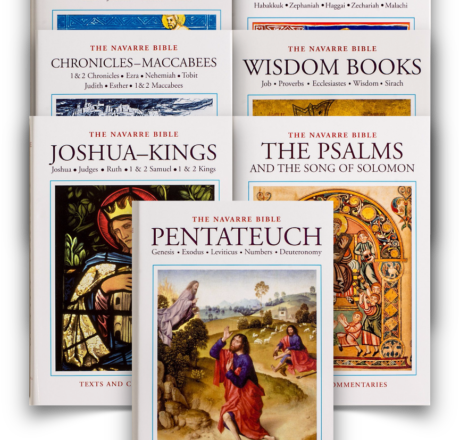
NAVARRE BIBLE COMMENTARY(RSV)
Ad Majorem Dei Gloriam (To the Greater Glory of God)
Today’s First Reading
From: 2 Timothy 2:8-15
Jesus, the Apostle's Model
--------------------------
[8] Remember Jesus Christ, risen from the dead, descended from David, as preached in my gospel, [9] the gospel for which I am suffering and wearing fetters like a criminal. But the word of God is not fettered. [10] Therefore I endure everything for the sake of the elect, that they also may obtain the salvation which in Christ Jesus goes with eternal glory. [11] The saying is sure: If we have died with him, we shall also live with him; [12] if we endure, we shall also reign with him; if we deny him, he also will deny us; [13] if we are faithless, he remains faithful--for he cannot deny himself.
Avoiding Useless Argument
-------------------------
[14] Remind them of this, and charge them before the Lord to avoid disputing about words, which does, no good, but only ruins the hearers. [15] Do your best to present yourself to God as one approved, a workman who has no need to be ashamed, rightly handling the word of truth.
***********************************************************************
Commentary:
8. "Jesus Christ, risen from the dead": the Resurrection is the climax of our faith (cf. 1 Cor 15) and the fixed reference point for Christian living, for we know that "Christ being raised from the dead will never die again; death no longer has dominion over him" (Rom 6:9). Therefore, Christ lives on in a glorified condition: "Christ is alive. He is not someone who has gone, someone who existed for a time and then passed on, leaving us a wonderful example and a great memory. No, Christ is alive. Jesus is Emmanuel: God with us. His resurrection shows us that God does not abandon his own" (St J. Escriva, "Christ Is Passing By", 102).
"As preached in my gospel": literally, "according to my gospel"; Jesus' glorious resurrection and his descent from David were key points in St Paul's preaching.
9-10. The trials which St Paul was experiencing in prison on account of his preaching of the Gospel constitute an entitlement to heaven, for "martyrdom makes the disciple like his master, who willingly accepted death for the salvation of the world, and through it he is conformed to him by the shedding of blood" ("Lumen Gentium", 42). This is a shining example of the Communion of Saints at work, for, when a Christian links his suffering to Christ's passion, that suffering contributes to the Redemption: "Therefore he is carrying out an irreplaceable service. In the Body of Christ, which is ceaselessly born of the Cross of the Redeemer, it is precisely suffering permeated by the spirit of Christ's sacrifice that is the irreplaceable mediator and author of the good things which are indispensable for the world's salvation. It is suffering, more than anything else, which clears the way for the grace which transforms human souls. Suffering, more than anything else, makes present in the history of humanity the powers of the Redemption" (St. John Paul II, "Salvifici Doloris", 27).
Throughout history many pastors of the Church have suffered persecution on account of their fidelity to Christ. St John Chrysostom, shortly before going into exile, expressed his feelings in this way: "For me, this world's evils are something I despise; and its good things are an object of scorn. I am not afraid of poverty nor do I have any desire for riches; I am not afraid of death nor do I have any desire to live unless it be to your advantage" ("Ante Exiltum Hom.", 1).
11-13. "The saying is sure": this is a technical expression used a number of times in the Pastoral Epistles to attract attention to especially important statements (cf. note on 1 Tim 1:15). Here it introduces a poetic section in the form of a hymn of four verses, each consisting of a pair of contrasting phrases (of the type the Semitic mind loves). It is quite possible that this hymn was used in very early baptismal liturgy, given that it has to do with the intimate union of the baptized person with Christ, who died and is now risen; it also encourages Christians to stay faithful in the face of adverse circumstances even if that means martyrdom.
Thus, the first verse deals with the beginning of Christian life. Dying to sin and rising to the life of grace are Pauline expressions (cf. Rom 6:34) which point to the fact that in Baptism the Christian becomes a sharer in the passion, death and burial of the Lord, and also in the glory of his resurrection. Grace is the supernatural life and that life will attain its full form in heaven.
The two following verses deal with the stark choice the Christian has to make in the face of difficulties- endurance, or denial of the faith (cf. Mt 10:33; Lk 12:9); the hymn puts special emphasis on endurance, using as it does terminology proper to athletics (cf. Heb 12:1-3); also, the verb used in the second part of each phrase is in the future tense, as if an unlikely possibility were being discussed: "In the event of our denying him...". And (what is most important) the Christian's faithfulness is orientated towards Christ: "we shall reign with him." "To persevere is to persist in love, 'per Ipsum et cum Ipso et in Ipso...'. Indeed we can also interpret this as: "He himself, with me, for me and in me" (St J. Escriva, "Furrow", 366).
The last verse breaks the pattern because it does not counterpose attitude and result but rather man's infidelity and Christ's fidelity: "If we are faithless, he remains faithful." This paradox of our Lord's love marks the climax of the hymn, which is a kind of poem extolling Christian endurance based on our Lord's eternal faithfulness. "We Christians have the right to proclaim the royalty of Christ. Although injustice abounds, although many do not desire the kingdom of love, the work of salvation is taking place in the same human history as harbors evil" [St J. Escriva, "Christ Is Passing By", 186).
14-16. False teachers were in a position to do harm to the still immature Christian community of the time; apparently they were not teaching things which were directly heretical; but they were involving the believers in controversy to such an extent that there was a danger of turning the truth of faith into rational deductions in a complicated philosophical system. The Apostle advises that the best way to deal with all that dangerous wordiness is to expound revealed truth in a simple, straightforward way.
"Rightly handling": the original means "cutting straight", the way a mason cuts a stone or a farmer ploughs a furrow. Similarly, preaching and teaching the Gospel should be done in direct, simple language accessible to all. The teacher should not simply recommend views, attitudes and feelings: his function is to pass on the certainties which "the word of truth" (that is, revealed teaching) provides. Paul VI taught that one "sign of love will be the effort to transmit to Christians, not doubts and uncertainties born of an erudition poorly assimilated but certainties that are solid because they are anchored in the Word of God. The faithful need these certainties for their Christian life" ("Evangelii Nuntiandi", 79).
10
posted on
06/04/2026 7:26:34 AM PDT
by
fidelis
(June is the Month of Devotion to to the Most Sacred Heart of Jesus. Pass it on!)
Today’s Gospel Reading From: Mark 12:28-34
The Greatest Commandment of All
----------------------------------------------
[28] One of the scribes came up and heard them disputing with one another, and seeing that He (Jesus) answered them well, asked Him, "Which commandment is the first of all?" [29] Jesus answered, "The first is, `Hear, O Israel: The Lord our God, the Lord is one; [30] and you shall love the Lord your God with all your heart, and with all your soul, and with all your mind, and with all your strength.' [31] The second is this, `You shall love your neighbor as yourself.' There is no other commandment greater than these." [32] And the scribe said to Him, "You are right, Teacher; You have truly said that He is one, and there is no other than He; [33] and to love with all the heart, and with all the understanding, and with all the strength, and to love one's neighbor as oneself, is much more than all whole burnt offerings and sacrifices." [34] And when Jesus saw that he answered wisely, He said to him, "You are not far from the Kingdom of God." And after that no one dared to ask Him any question.
***********************************************************************
Commentary:
28-34. The doctor of the law who asks Jesus this question is obviously an upright man who is sincerely seeking the truth. He was impressed by Jesus' earlier reply (verses 18-27) and he wants to learn more from Him. His question is to the point and Jesus devotes time to instructing him, though he will soon castigate the scribes, of whom this man is one (cf. Mark 12:38ff).
Jesus sees in this man not just a scribe but a person who is looking for the truth. And His teaching finds its way into the man's heart. The scribe repeats what Jesus says, savoring it, and our Lord offers him an affectionate word which encourages his definitive conversion: "You are not far from the Kingdom of God." This encounter reminds us of His meeting with Nicodemus (cf. John 3:1ff). On the doctrinal content of these two commandments cf. note on Matthew 22:34-40.
[ Note on Matthew 22:34-40 states: In reply to the question, our Lord points out that the whole law can be condensed into two commandments: the first and more important consists in unconditional love of God; the second is a consequence and result of the first, because when man is loved, St. Thomas says, God is loved, for man is the image of God (cf. "Commentary on St. Matthew", 22:4).
A person who genuinely loves God also loves his fellows because he realizes that they are his brothers and sisters, children of the same Father, redeemed by the same blood of our Lord Jesus Christ: "This commandment we have from Him, that he who loves God should love his brother also" (1 John 4:21). However, if we love man for man's sake without reference to God, this love will become an obstacle in the way of keeping the first commandment, and then it is no longer genuine love of our neighbor. But love of our neighbor for God's sake is clear proof that we love God: "If anyone says, `I love God', and hates his brother, he is a liar" (1 John 4:20).
"You shall love your neighbor as yourself": here our Lord establishes as the guideline for our love of neighbor the love each of us has for himself; both love of others and love of self are based on love of God. Hence, in some cases it can happen that God requires us to put our neighbor's need before our own; in others, not: it depends on what value, in light of God's love, needs to be put on the spiritual and material factors involved.
Obviously spiritual goods take absolute precedence over material ones, even over life itself. Therefore, spiritual goods, be they our own or our neighbor's, must be the first to be safeguarded. If the spiritual good in question is the supreme one for the salvation of the soul, no one is justified in putting his own soul into certain danger of being condemned in order to save another, because given human freedom we can never be absolutely sure what personal choice another person may make: this is the situation in the parable (cf. Matthew 25:1-13), where the wise virgins refuse to give oil to the foolish ones; similarly St. Paul says that he would wish himself to be rejected if that could save his brothers (cf. Romans 9:3)--an unreal theoretical situation. However, what is quite clear is that we have to do all we can to save our brothers, conscious that, if someone helps to bring a sinner back to the way, he will save himself from eternal death and cover a multitude of his own sins (James 5:20). From all this we can deduce that self-love of the right kind, based on God's love for man, necessarily involves forgetting oneself in order to love God and our neighbor for God. ]
30. This commandment of the Old Law, ratified by Jesus, shows, above all, God's great desire to engage in intimate conversation with man: "would it not have sufficed to publish a permission giving us leave to love Him? [...]. He makes a stronger declaration of His passionate love for us, and commands us to love Him with all our power, lest the consideration of His majesty and our misery, which make so great a distance and inequality between us, or some other pretext, divert us from His love. In this He well shows that He did not leave in us for nothing the natural inclination to love Him, for to the end that it may not be idle, He urges us by His general commandment to employ it, and that this commandment may be effected, there is no living man He has not furnished him abundantly with all means requisite thereto" (St. Francis de Sales, "Treatise on the Love of God", Book 2, Chapter 8).
11
posted on
06/04/2026 7:27:13 AM PDT
by
fidelis
(June is the Month of Devotion to to the Most Sacred Heart of Jesus. Pass it on!)
12
posted on
06/04/2026 7:28:32 AM PDT
by
fidelis
(June is the Month of Devotion to to the Most Sacred Heart of Jesus. Pass it on!)
Disclaimer:
Opinions posted on Free Republic are those of the individual
posters and do not necessarily represent the opinion of Free Republic or its
management. All materials posted herein are protected by copyright law and the
exemption for fair use of copyrighted works.
FreeRepublic.com is powered by software copyright 2000-2008 John Robinson