
Posted on 05/19/2026 11:00:18 PM PDT by fidelis
“Lifting up his eyes to heaven, Jesus prayed, saying: “Holy Father, keep them in your name that you have given me, so that they may be one just as we are one.” John 17:11
In the ancient world, a name was not only a means of identification but also an expression of the authority and power that the person possessed. For instance, when a king or ruler issued a decree, it was done “in the name” of the king, meaning with his full authority and power behind it.
In the Bible, the “name” of God is much more than a simple designation or label; it signifies the full revelation of God’s identity, character, and power. The concept of God’s name is deeply tied to His nature and His actions in the world. His name represents who God is and His relationship with His people.
In the Old Testament, God appeared to Moses in the burning bush and instructed him to go to Pharaoh to bring His people, the Israelites, out of Egypt. Moses inquired, “But... if I go to the Israelites and say to them, ‘The God of your ancestors has sent me to you,’ and they ask me, ‘What is His name?’ what do I tell them?” God replied to Moses: “I am who I am.” Then He added: “This is what you will tell the Israelites: I AM has sent me to you” (Exodus 3:13–14).
God’s mysterious name—“I AM WHO I AM” or simply “I AM”—is also His identity. It expresses God’s eternal existence and His self-sufficiency. He is the one who exists by His own nature, without beginning or end, having sovereignty over all creation.
In John’s Gospel, Jesus identifies Himself with the divine name numerous times: “I am he;” “I am the Bread of Life;” “I am the Light of the World;” “Before Abraham was, I AM;” “I am the Gate;” “I am the Good Shepherd;” “I am the Way, the Truth, and the Life;” “I am the True Vine;” and “I told you that I AM.” Therefore, when Jesus prayed to the Father, “Holy Father, keep them in your name that you have given me…,” His prayer was authoritative, by which the Father’s will is implemented, because Jesus is I AM, and in that name, He prays.
Jesus’ prayer was “that they may be one just as we are one.” This prayer should give us great hope... This is why Jesus said three times during the Last Supper that whatever we ask the Father in His name, He will give us.
In 2 Peter 1:4, we read that God’s power has enabled us to escape corruption and evil desire and has bestowed upon us “precious and very great promises, so that through them you may come to share in the divine nature.” This foundational Scripture has led many Church Fathers to speak of our high calling to “divinization.” As Saint Athanasius of Alexandria famously said, “For He was made man that we might be made God; and He manifested Himself by a body that we might receive the idea of the unseen Father...endured the insolence of men that we might inherit immortality” (On the Incarnation, 54:3).
Reflect today on the high calling you have received. You are invited to share in God’s life, to take your identity in Him, to live and act in God’s divine name, exercising His authority and manifesting His sacrificial love. This is only possible when we are united to Christ as He is united to the Father. We become one with God, by His will, with His authority and grace. What high dignity we have received to act in His name and with His authority! Have hope in the ability to be drawn into this high calling, taking on this new identity, so that Jesus’ prayer at the Last Supper becomes a reality in your life.
My divine Lord, the great I AM, You have existed from all eternity as the one and eternal God. You invite me to share in Your life by uniting me with You in Christ through His humanity. I accept this high calling and pray, as You prayed during the Last Supper, that I may be one with You—Father, Son, and Holy Spirit—and live and act in Your Name. Jesus, I trust in You.
Please keep in mind that this is a Catholic Caucus/Devotional thread for the purpose of prayerful reflection on the Sacred Scriptures and is closed to debate of any kind. Per FR policy on Religion Caucus threads, off-topic, argumentative, and abusive comments are not allowed and will be submitted to the Mods for deletion. Thanks, and God bless you.
The Month of May is Dedicated to Devotion to Mary, the Mother of God.

“And when Elizabeth heard the greeting of Mary, the babe leaped in her womb; and Elizabeth was filled with the Holy Spirit and she exclaimed with a loud cry, “Blessed are you among women, and blessed is the fruit of your womb! And why is this granted me, that the Mother of my Lord should come to me?” (Luke 1:41-43)

Pope Leo XIV’s prayer intention for the month of May, 2026:
That everyone might have food
Let us pray that everyone, from large producers to small consumers, be committed to avoid wasting food, and to ensure that everyone has access to quality food.

Today’s First Reading
From: Acts 20:28-38
Speech of Farewell to the Elders of Ephesus (Continuation)
----------------------------------------------------------
(Paul said to the elders of the church,) [28] "Take heed to yourselves and to all the flock, in which the Holy Spirit has made you guardians, to feed the church of the Lord which he obtained with his own blood. [29] I know that after my departure fierce wolves will come in among you, not sparing the flock; [30] and from among your own selves will arise men speaking perverse things, to draw away the disciples after them. [31] Therefore be alert, remembering that for three years I did not cease night or day to admonish every one with tears. [32] And now I commend you to God and to the word of his grace, which is able to build you up and to give you the inheritance among all those who are sanctified. [33] I coveted no one's silver or gold or apparel. [34] You yourselves know that these hands ministered to my necessities, and to those who were with me. [35] In all things I have shown you that by so toiling one must help the weak, remembering the words of the Lord Jesus, how he said, 'It is more blessed to give than to receive.'"
[36] And when he had spoken thus, he knelt down and prayed with them all. [37] And they all wept and embraced Paul and kissed him, [38] sorrowing most of all because of the word he had spoken, that they should see his face no more. And they brought him to the ship.
***********************************************************************
Commentary:
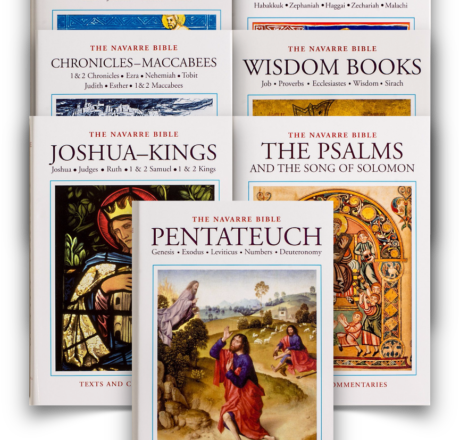
28. Using a metaphor often found in the New Testament to describe the people of God (Ps 100:3; Is 40:11; Jer 13:17), Paul describes the Church as a flock and its guardians or bishops ("episcopos") as shepherds. "The Church is a sheepfold, the sole and necessary gateway to which is Christ (Jn 10:1-10). It is also a flock, of which God foretold that he would himself be the shepherd (cf. Is 40:11; Ex 34:11f), and whose sheep, although watched over by human shepherds, are nevertheless at all times led and brought to pasture by Christ himself, the Good Shepherd and prince of shepherds (cf. Jn 10:11; l Pet 5:4), who gave his life for his sheep (cf. Jn 10:11-16)" (Vatican II, "Lumen Gentium", 6).
In the early days of the Church the terms "priest" and "bishop" had not yet become defined: they both refer to sacred ministers who have received the sacrament of priestly Order.
The last part of the verse refers to Christ's sacrifice: through his redeeming action, the Church has become God's special property. The price of Redemption was the blood of Christ. Paul VI says that Christ, the Lamb of God, took to "himself the sins of the world, and he died for us, nailed to the Cross, saving us by his redeeming blood" ("Creed of the People of God", 12).
The Council of Trent speaks of this when it presents the Redemption as an act of "his beloved Only-begotten, our Lord Jesus Christ, who...merited justification for us by his most holy Passion on the wood of the Cross and made satisfaction for us to God the Father" ("De Iustificatione", 7).
30. Errors derive not only from outsiders: they are also the product of members of the Church who abuse their position as brethren and even as pastors, leading the people astray by taking advantage of their good will. "It is of this that John writes, 'They went out from us, but they were not of us' [1 Jn 2:19]" (St Bede, "Super Act Expositio, ad loc".).
31. "Here he shows that he actually taught them and did not proclaim the teaching once only, just to ease his conscience" (Chrysostom, "Hom. on Acts", 44). Paul did not avoid the pastoral work which fell to him; he set an example of what a bishop should be. "Those who rule the community must perform worthily the tasks of government. [...] There is a danger that some who concern themselves with others and guide them towards eternal life may ruin themselves without realizing it. Those who are in charge must work harder than others, must be humbler than those under them, must in their own lives give an example of service, and must regard their subjects as a deposit which God has given them in trust" (St Gregory of Nyssa, "De Instituto Christiano").
32. "It is not right for Christians to give such importance to human action that they think all the laurels depend on their efforts: their expectation of reward should be subject to the will of God" ("ibid".).
33-35. "The teachings of the Apostle of the Gentiles [...] have key importance for the morality and spirituality of human work. They are an important complement to the great though discreet gospel of work that we find in the life and parables of Christ, in what Jesus 'did and taught' " (John Paul II, "Laborem Exercens", 26).
This saying of our Lord (v. 35) is not recorded in the Gospels.
36. For Christians every situation is suitable for prayer: "The Christian prays everywhere", Clement of Alexandria writes, "and in every situation, whether it be when taking a walk or in the company of friends, or while he is resting, or at the start of some spiritual work. And when he reflects in the interior of his soul and invokes the Father with unspeakable groanings" ("Stromata", VII, 7).
37. They kiss Paul to show their affection for him and how moved they are. This is not the liturgical "kiss of peace". In the East kisses are a common expression of friendship and good manners like handshaking in the West.
From: John 17:11b-19
The Priestly Prayer of Jesus (Continuation)
-------------------------------------------
(Jesus lifted his eyes to heaven and said, ) [11b] "Holy Father, keep them in thy name, which thou has given me, that they may be one, even as we are one. [12] While I was with them, I kept them in thy name, which thou hast given me; I have guarded them, and none of them is lost but the son of perdition, that the scripture might be fulfilled. [13] But now I am coming to thee; and these things I speak in the world, that they may have my joy fulfilled in themselves. [14] I have given them thy word; and the world has hated them because they are not of the world. [15] I do not pray that thou shouldst take them out of the world, but that thou shouldst keep them from the evil one. [16] They are not of the world, even as I am not of the world. [17] Sanctify them in the truth; thy word is truth. [18] As thou didst send me into the world, so I have sent them into the world. [19] And for their sake I consecrate myself, that they also may be consecrated in truth.
***********************************************************************
Commentary:
11-19. Jesus now asks the Father to give his disciples four things--unity, perseverance, joy and holiness. By praying him to keep them in his name (v. 11) he is asking for their perseverance in the teaching he has given them (cf. v. 6) and in communion with him. An immediate consequence of this perseverance is unity: "that they may be one, even as we are one"; this unity which he asks for his disciples is a reflection of the unity of the three divine Persons.
He also prays that none of them should be lost, that the Father should guard and protect them, just as he himself protected them while he was still with them. Thirdly, as a result of their union with God and perseverance they will share in the joy of Christ (v. 13): in this life, the more we know God and the more closely we are joined to him, the happier will we be; in eternal life our joy will be complete, because our knowledge and love of God will have reached its climax.
Finally, he prays for those who, though living in the world, are not of the world, that they may be truly holy and carry out the mission he has entrusted to them, just as he did the work his Father gave him to do.
12. "That the scripture might be fulfilled": this is an allusion to what he said to the Apostles a little earlier (Jn 13:18) by directly quoting Scripture: "He who ate my bread has lifted his heel against me" (Ps 41:10). Jesus makes these references to Judas' treachery in order to strengthen the Apostles' faith by showing that he knew everything in advance and that the Scriptures had already foretold what would happen.
However, Judas went astray through his own fault and not because God arranged things that way; his treachery had been taking shape little by little, through his petty infidelities, and despite our Lord helping him to repent and get back on the right rode (cf. note on Jn 13:21-32); Judas did not respond to this grace and was responsible for his own downfall. God, who sees the future, predicted the treachery of Judas in the Scripture; Christ, being God, knew that Judas would betray him and it is with immense sorrow that he now tells the Apostles.
14-16. In Sacred Scripture "world" has a number of meanings. First, it means the whole of creation (Gen 1:1ff) and, within creation, mankind, which God loves most tenderly (Prov 8:31). This is the meaning intended here when our Lord says, "I do not pray that thou shouldst take them out of the world, but that thou shouldst keep them from the evil one" (v. 15). "I have taught this constantly using words from holy Scripture. The world is not evil, because it has come from God's hands, because it is his creation, because Yahweh looked upon it and saw that it was good (cf. Gen 1:7ff). We ourselves, mankind, make it evil and ugly with our sins and infidelities. Have no doubt: any kind of evasion from the honest realities of daily life is for you, men and women of the world, something opposed to the will of God" (St. J. Escriva, "Conversations", 114).
In the second place, "world" refers to the things of this world, which do not last and which can be at odds with the things of the spirit (cf. Mt 16:26).
Finally, because evil men have been enslaved by sin and by the devil, "the ruler of the world" (Jn 12:31; 16:11), the "world" sometimes means God's enemy, something opposed to Christ and his followers (Jn 1:10). In this sense the "world" is evil, and therefore Jesus is not of the world, nor are his disciples (v. 16). It is also this pejorative meaning which is used by traditional teaching which describes the world, the flesh and the devil as enemies of the soul against which one has to be forever vigilant. "The world, the flesh and the devil are a band of adventurers who take advantage of the weakness of that savage you bear within you, and want you to hand over to them, in exchange for the glittering tinsel of a pleasure--which is worth nothing--the pure gold and the pearls and the diamonds and rubies drenched in the life-blood of your God-Redeemer, which are the price and the treasure of your eternity" (St J. Escriva, "The Way", 708).
17-19. Jesus prays for the holiness of his disciples. God alone is the Holy One; in his holiness people and things share. "Sanctifying" has to do with consecrating and dedicating something to God, excluding it from being used for profane purposes; thus God says to Jeremiah: "Before I formed you in the womb I knew you, and before you were born I consecrated you; I appointed you a prophet to the nations" (Jer 1:5). If something is to be consecrated to God it must be perfect, that is, holy. Hence, a consecrated person needs to have moral sanctity, needs to be practising the moral virtues. Our Lord here asks for both things for his disciples, because they need them if they are to fulfill their supernatural mission in the world.
"For their sake I consecrate myself": these words mean that Jesus Christ, who has been burdened with the sins of men, consecrates himself to the Father through his sacrifice on the Cross. By this are all Christians sanctified: "So Jesus also suffered outside the gate in order to sanctify the people through his own blood" (Heb 13:12). So, after Christ's death, men have been made sons of God by Baptism, sharers in the divine nature and enabled to attain the holiness to which they have been called (cf. Vatican II, "Lumen Gentium", 40).
Disclaimer: Opinions posted on Free Republic are those of the individual posters and do not necessarily represent the opinion of Free Republic or its management. All materials posted herein are protected by copyright law and the exemption for fair use of copyrighted works.


