
Posted on 05/08/2026 7:49:24 PM PDT by CondoleezzaProtege
Named around 71 times in Scripture, Lebanon is both a biblical landscape and a living homeland now marked by war and fragile hope.
Southern Lebanon is not often the first place Christians think of when reading Scripture. Yet both the Bible and long-standing tradition place this region quietly within the story of salvation.
Two cities anchor that connection: Tyre and Sidon.
Both are named multiple times in the Hebrew Bible as centers of trade and power. In the Gospels, they appear again when Jesus travels to the region, encountering the Syrophoenician woman who asks for her daughter’s healing (Mark 7:24–30). This brief episode places southern Lebanon within the lived geography of Christ’s ministry.
Christians in Lebanon
Christians make up about 30% of Lebanon’s population (some estimates suggest even more), the largest share in the Middle East. The Maronite Church is the biggest community, alongside Greek Orthodox and Melkite Catholics.
Southern Lebanon includes historic Christian villages, though many families have been displaced by ongoing conflict.
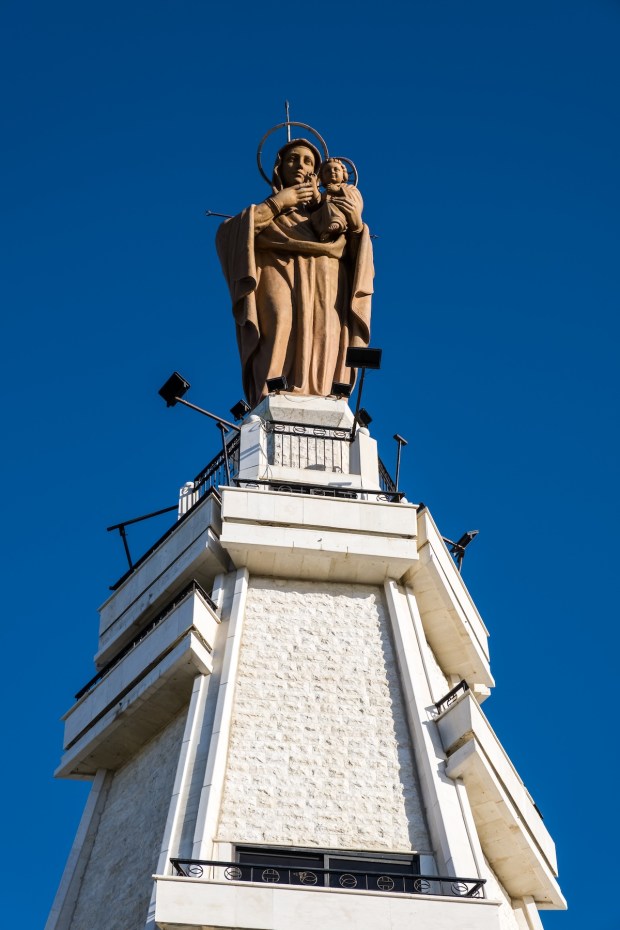
In Maghdouche, local tradition holds that the Virgin Mary waited while Jesus preached in nearby Tyre and Sidon. Today, the shrine of Our Lady of Mantara keeps that memory alive, not as a scriptural claim, but as a testimony to how early Christians understood the movements of Christ and His mother. (Photo above and below show that shrine.)
Further south, the village of Qana is identified by some local traditions as the site of the wedding feast where Jesus turned water into wine. The Gospel of John specifies Cana of Galilee, and scholars continue to debate the precise location. Still, for many believers in Lebanon, Qana remains a place of devotion tied to Christ’s first public sign.
Traditions regarding Biblical locations do not all carry the same historical certainty. But together they reveal something important: southern Lebanon has long been received by Christians not as a distant land, but as part of a sacred landscape — one touched directly or indirectly by the Gospel story.
That sense of belonging makes the present moment more difficult to accept.
A region under strain
A new phase of conflict is reshaping life in southern Lebanon. According to recent reporting, Israel plans to establish a large buffer zone in the region, with troops taking control of areas south of the Litani River.
Bridges across the Litani have been destroyed, and more than one million people have been displaced, according to BBC. Over 1,000 people have been killed, including children and medical workers. Many residents have been told they will not be allowed to return to their homes until security conditions change.
While southern Lebanon is often described as a stronghold of Hezbollah, it is also home to diverse communities, including Christians whose presence stretches back centuries. For them, this is not only a geopolitical crisis. It is a question of continuity — whether families, parishes, and traditions rooted in this land can endure another period of upheaval.
The Bible’s references to Lebanon often speak of strength: cedars that rise high and endure. Christian tradition, too, has treated this land as a place marked by grace and memory. Today, that same land is marked by uncertainty. Yet its history — biblical and lived — suggests that even under pressure, it remains more than a battlefield.

I don’t know how to present this, except to say that one should take it FWIW.
A source close to me, whom I would rather not identify for evident reasons, but who has numerous connections among liturgical Christians and diplomats in the area, told me recently that the plan for disengagement from NATO is to wait until Turkey attempts to enter Lebanon via Syria, in order to confront the IDF along the Syria/Lebanon border. The US will support Israel as its ally, while NATO will support Turkey as a member under Article V. When that happens, the US will disengage from NATO and leave the EU defenseless—whether Putin does, or can, take advantage of the situation is the unanswered question.
Again, I can vouch for the source, but not for the intel.
Ezekiel 7:26
Mischief shall come upon mischief, and rumour shall be upon rumour; then shall they seek a vision of the prophet; but the law shall perish from the priest, and counsel from the ancients
accoring to 1932 census Lebanon was majority Christian- 58.5%.but the PLO set up camp there in late 1960’s when expelled from Jordan. Civil War followed- instability- Hizbollah.
*according
Disclaimer: Opinions posted on Free Republic are those of the individual posters and do not necessarily represent the opinion of Free Republic or its management. All materials posted herein are protected by copyright law and the exemption for fair use of copyrighted works.