Catena Aurea by St. Thomas Aguinas
CHAP. 10
10:1–5
1. Verily, verily, I say unto you, He that entereth not by the door into the sheepfold, but climbeth up some other way, the same is a thief and a robber.
2. But he that entereth in by the door is the shepherd of the sheep.
3. To him the porter openeth; and the sheep hear his voice: and he calleth his own sheep by name, and leadeth them out.
4. And when he putteth forth his own sheep, he goeth before them, and the sheep follow him: for they know his voice.
5. And a stranger will they not follow, but will flee from him: for they know not the voice of strangers.
CHRYSOSTOM. (Hom. lix. 2) Our Lord having reproached the Jews with blindness, they might have said, We are not blind, but we avoid Thee as a deceiver. Our Lord therefore gives the marks which distinguish a robber and deceiver from a true shepherd. First come those of the deceiver and robber: Verily, verily, I say unto you, He that entereth not by the door into the sheepfold, but climbeth up some other way, the same is a thief and a robber. There is an allusion here to Antichrist, and to certain false Christs who had been, and were to be. The Scriptures He calls the door. They admit us to the knowledge of God, they protect the sheep, they shut out the wolves, they bar the entrance to heretics. He that useth not the Scriptures, but climbeth up some other way, i. e. some self-chosen1, some unlawful way, is a thief. Climbeth up, He says, not, enters, as if it were a thief getting over a wall, and running all risks. Some other way, may refer too to the commandments and traditions of men which the Scribes taught, to the neglect of the Law. When our Lord further on calls Himself the Door, we need not be surprised. According to the office which He bears, He is in one place the Shepherd, in another the Sheep. In that He introduces us to the Father, He is the Door; in that He takes care of us, He is the Shepherd.
AUGUSTINE. (Tr. xlv. 2. et sq.) Or thus: Many go under the name of good men according to the standard of the world, and observe in some sort the commandments of the Law, who yet are not Christians. And these generally boast of themselves, as the Pharisees did; Are we blind also? But inasmuch as all that they do they do foolishly, without knowing to what end it tends, our Lord saith of them, Verily, verily, I say unto you, He that entereth not by the door into the sheepfold, hut climbeth up some other way, the name is a thief and a robber. Let the Pagans then, the Jews, the Heretics, say, “We lead a good life;” if they enter not by the door, what availeth it? A good life only profiteth, as leading to life eternal. Indeed those cannot be said to lead a good life, who are either blindly ignorant of, or wilfully despise, the end of good living. No one can hope for eternal life, who knows not Christ, who is the life, and by that door enters into the fold. Whoso wisheth to enter into the sheepfold, let him enter by the door; let him preach Christ; let him seek Christ’s glory, not his own. Christ is a lowly door, and he who enters by this door must be lowly, if he would enter with his head whole. He that doth not humble, but exalt himself, who wishes to climb up over the wall, is exalted that he may fall. Such men generally try to persuade others that they may live well, and not be Christians. Thus they climb up by some other way, that they may rob and kill. They are thieves, because they call that their own, which is not; robbers, because that which they have stolen, they kill.
CHRYSOSTOM. (Hom. lix. 2) You have seen His description of a robber, now see that of the Shepherd: But he that entereth in by the door is the shepherd of the sheep.
AUGUSTINE. (de Verb. Dom. Serm. xlix) He enters by the door, who enters by Christ, who imitates the suffering of Christ, who is acquainted with the humility of Christ, so as to feel and know, that if God became man for us, man should not think himself God, but man. He who being man wishes to appear God, does not imitate Him, who being God, became man. Thou art bid to think less of thyself than thou art, but to know what thou art.
To Him the porter openeth.
CHRYSOSTOM. (Hom. xlix. 2) The porter perhaps is Moses; for to him the oracles of God were committed.
THEOPHYLACT. Or, the Holy Spirit is the porter, by whom the Scriptures are unlocked, and reveal the truth to us.
AUGUSTINE. (Tr. xlvi. 2) Or, the porter is our Lord Himself; for there is much less difference between a door and a porter, than between a door and a shepherd. And He has called Himself both the door and the shepherd. Why then not the door and the porter? He opens Himself, i. e. reveals1 Himself. If thou seek another person for porter, take the Holy Spirit, of whom our Lord below saith, He will guide you into all truth. (c. 16:13) The door is Christ, the Truth; who openeth the door, but He that will guide you into all Truth? Whomsoever thou understand here, beware that thou esteem not the porter greater than the door; for in our houses the porter ranks above the door, not the door above the porter.
CHRYSOSTOM. (Hom. lix. 3. c. 7, 48.) As they had called Him a deceiver, and appealed to their own unbelief as the proof of it; (Which of the rulers believeth on Him?) He shews here that it was because they refused to hear Him, that they were put out of His flock. The sheep hear His voice. The Shepherd enters by the lawful door; and they who follow Him are His sheep; they who do not, voluntarily put themselves out of His flock.
And He calleth His own sheep by name.
AUGUSTINE. (Tr. xlv. 12) He knew the names of the predestinated; as He saith to His disciples, Rejoice that your names are written in heaven. (Luke 19:14)
And leadeth them out.
CHRYSOSTOM. (Hom. lix. 2) He led out the sheep, when He sent them not out of the reach of, but into the midst of, the wolves. There seems to be a secret allusion to the blind man. He called him out of the midst of the Jews; and he heard His voice.
AUGUSTINE. (Tr. xlv. 14) And who is He who leads them out, but the Same who loosens the chain of their sins, that they may follow Him with free unfettered step?
GLOSS. And when He putteth forth His own sheep, He goeth before them, He leadeth them out from the darkness of ignorance into light, while He goeth before in the pillar of cloud, and fire.
CHRYSOSTOM. (Hom. lix. 2) Shepherds always go behind their sheep; but He, on the contrary, goes before, to shew that He would lead all to the truth.
AUGUSTINE. (Tr. xlv. c. 14) And who is this that goeth before the sheep, but He who being raised from the dead, dieth no more; (Rom. 6:9) and who said, Father, I will also that they, whom Thou hast given Me, be with Me where I am? (Infra 17:24)
And the sheep follow Him, for they know His voice. And a stranger will they not follow, but will flee from him; for they know not the voice of strangers.
CHRYSOSTOM. (Hom. xlix. 3) The strangers are Theudas, and Judas, and the false apostles who came after Christ. That He might not appear one of this number, He gives many marks of difference between Him and them. First, Christ brought men to Him by teaching them out of the Scriptures; they drew men from the Scriptures. Secondly, the obedience of the sheep; for men believed on Him, not only during His life, but after death: their followers ceased, as soon as they were gone.
THEOPHYLACT. He alludes to Antichrist, who shall deceive for a time, but lose all his followers when he dies.
AUGUSTINE. (Tr. xlv. 10. ct seq.) But here is a difficulty. Sometimes they who are not sheep hear Christ’s voice; for Judas heard, who was a wolf. And sometimes the sheep hear Him not; for they who crucified Christ heard not; yet some of them were His sheep. You will say, While they did not hear, they were not sheep; the voice, when they heard it, changed them from wolves to sheep. Still I am disturbed by the Lord’s rebuke to the shepherds in Ezekiel, Neither have ye brought again that which strayed. (Ezek. 34:4) He calls it a stray sheep, but yet a sheep all the while; though, if it strayed, it could not have heard the voice of the Shepherd, but the voice of a stranger. What I say then is this; The Lord knoweth them that are His. (2 Tim. 2:19) He knoweth the foreknown, he knoweth the predestinated. They are the sheep: for a time they know not themselves, but the Shepherd knows them; for many sheep are without the fold, many wolves within. He speaks then of the predestinated. And now the difficulty is solved. The sheep do hear the Shepherd’s voice, and they only. When is that? It is when that voice saith, He that endureth to the end shall be saved. (Mat. 10:32) This speech His own hear, the alien hear not.
10:6
6. This parable spake Jesus unto them: but they understood not what things they were which he spake unto them.
AUGUSTINE. (ut sup.) Our Lord feedeth by plain words, exerciseth by obscure. For when two persons, one godly, the other ungodly, hear the words of the Gospel, and they happen to be such that neither can understand them; one says, What He saith is true and good, but we do not understand it: the other says, It is not worth attending to. The former, in faith, knocks, yea, and, if he continue to knock, it shall be opened unto him. The latter shall hear the words in Isaiah, If ye will not believe, surely ye shall not be established1. (Isa. 7:9)
10:7–10
7. Then said Jesus unto them again, Verily, verily, I say unto you, I am the door of the sheep.
8. All that ever came before me are thieves and robbers: but the sheep did not hear them.
9. I am the door: by me if any man enter in, he shall be saved, and shall go in and out, and find pasture.
10. The thief cometh not, but for to steal, and to kill, and to destroy: I am come that they might have life, and that they might have it more abundantly.
CHRYSOSTOM. (Hom. lix. 3) Our Lord, to waken the attention of the Jews, unfolds the meaning of what He has said; Then said Jesus unto them again, Verily, verily, I say unto you, I am the door of the sheep.
AUGUSTINE. (Tr. xlv. 8) Lo, the very door which He had shut up, He openeth; He is the Door: let us enter, and let us enter with joy.
All that ever came before Me are thieves and robbers.
CHRYSOSTOM. (Hom. lix. 3) He saith not this of the Prophets, as the heretics think, but of Theudas, and Judas, and other agitators. So he adds in praise of the sheep, The sheep heard them not; but he no where praises those who disobeyed the prophets, but condemns them severely.
AUGUSTINE. (Tr. xlv. 8) Understand, All that ever came at variance with Me. The Prophets were not at variance2 with Him. They came with Him, who came with the Word of God, who spake the truth. He, the Word, the Truth, sent heralds before Him, but the hearts of those whom He sent were His own. They came with Him, inasmuch as He is always, though He assumed the flesh in time: In the beginning was the Word. His humble advent in the flesh was preceded by just men, who believed on Him as about to come, as we believe on Him come. The times are different, the faith is the same. Our faith knitteth together both those who believed that He was about to come, and those who believe that He has come. All that ever came at variance with Him were thieves and robbers; i. e. they came to steal and to kill; but the sheep did not hear them. They had not Christ’s voice; but were wanderers, dreamers, deceivers. Why He is the Door, He next explains, I am the Door; by Me if any man enter in he shall be saved.
ALCUIN. As if to say, The sheep hear not them, but Me they hear; for I am the Door, and whoever entereth by Me not falsely but in sincerity, shall by perseverance be saved.
THEOPHYLACT. The door admits the sheep into the pasture; And shall go in and out, and find pasture. What is this pasture, but the happiness to come, the rest to which our Lord brings us?
AUGUSTINE. (Tr. xlv. c. 15) What is this, shall go in and out? To enter into the Church by Christ the Door, is a very good thing, but to go out of the Church is not. Going in must refer to inward cogitation; going out to outward action; as in the Psalm, Man goeth forth to his work. (Ps. 103:23)
THEOPHYLACT. Or, to go in is to watch over the inner man; to go out, (Colos. 3) to mortify the outward man, i. e. our members which are upon the earth. He that doth this shall find pasture in the life to come.
CHRYSOSTOM. (Hom. lix. 3) Or, He refers to the Apostles who went in and out boldly; for they became the masters of the world, none could turn them out of their kingdom, and they found pasture.
AUGUSTINE. (Tr. xlv. 15) But He Himself explains it more satisfactorily to me in what follows: The thief cometh not, but for to steal, and for to kill: I am come that they might have life, and that they might have it more abundantly. By going in they have life; i. e. by faith, which worketh by love; by which faith they go into the fold. The just liveth1 by faith. And by going out they will have it more abundantly: (Heb. 10:38) i. e. when true believers die, they have life more abundantly, even a life which never ends. Though in this fold there is not wanting pasture, then they will find pasture, such as will satisfy them. To-day shalt thou be with Me in paradise. (Luke 23:43)
GREGORY. (super Ezek. Hom. xiii.) Shall go in, i. e. to faith: shall go out, i. e. to sight: and find pasture, i. e. in eternal fulness.
ALCUIN. The thief cometh not but for to steal, and to kill. As if He said, And well may the sheep not hear the voice of the thief; for he cometh not but for to steal: he usurpeth another’s office, forming his followers not on Christ’s precepts, but on his own. And therefore it follows, and to kill, i. e. by drawing them from the faith; and to destroy, i. e. by their eternal damnation.
CHRYSOSTOM. (Hom. lix. 1) The thief cometh not but for to steal, and to kill, and to destroy; this was literally fulfilled in the case of those movers of seditiona, whose followers were nearly all destroyed; deprived by the thief even of this present life. But came, He saith, for the salvation of the sheep; That they might have life, and that they might have it more abundantly, in the kingdom of heaven. This is the third mark of difference between Himself, and the false prophets.
THEOPHYLACT. Mystically, the thief is the devil, steals by wicked thoughts, kills by the assent of the mind to them, and destroys by acts.
Catena Aurea John 10
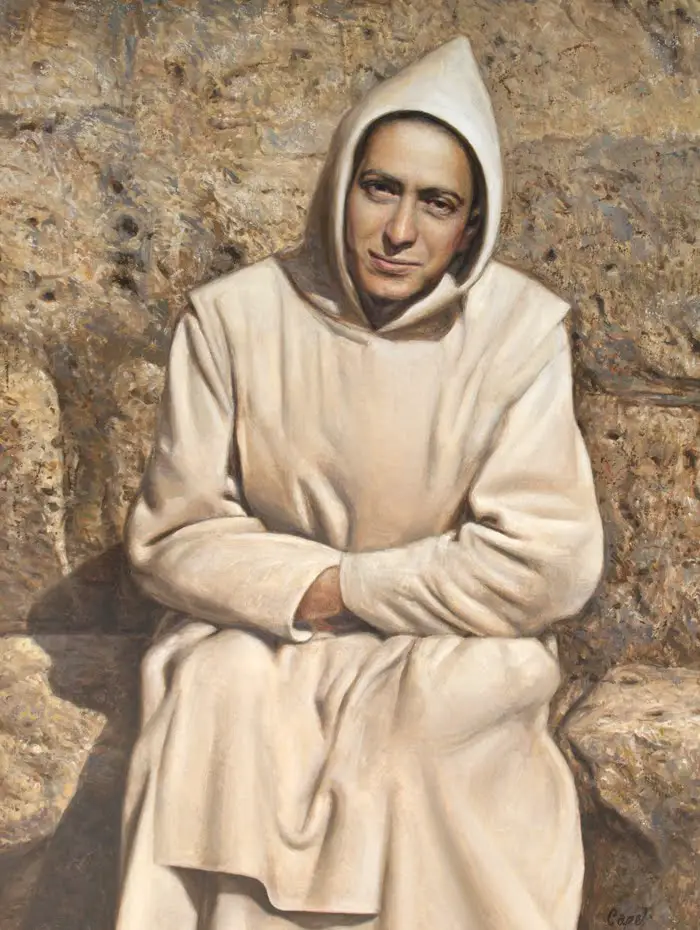
Saint Rafael Arnáiz Barón:
Patron Saint of Diabetics
A Modern Saint for Souls Seeking Silence and God
In an age overflowing with noise and distraction, the radiant witness of Saint Rafael Arnáiz Barón shines as a quiet beacon for every soul longing for God’s presence in stillness and simplicity. Born into wealth in early twentieth-century Spain, Saint Rafael Arnáiz Barón surrendered the world’s restless pursuits for a life veiled in humble silence—embracing the Cross with a love that was wholly Marian and Eucharistic. His journey, marked by suffering and deep spiritual joy, speaks not just to monks behind monastery walls, but to Catholic families, pilgrims, and spiritual seekers everywhere who yearn for deeper intimacy with Jesus and Mary.
At Bob and Penny Lord Store | Journeys of Faith, we have always cherished the luminous path of the saints—those faithful souls who invite us, through word and witness, to discover God’s love anew. Saint Rafael Arnáiz Barón is especially dear to our mission. Through his devotion to the Eucharist, ardent love for the Blessed Mother, and silent offering of his trials, he lived the message at the heart of our apostolate: that holiness is possible, even in the ordinary, when our hearts are consecrated to Christ and Mary.
As you journey with us through the life and message of Saint Rafael Arnáiz Barón, may his testimony encourage you to find God’s voice in silence, to trust Divine Providence, and to bring the treasures of the Faith—straight from the monastery to your home, and from your home back to the heart of the Church.

Early Life in Burgos: A Soul Prepared for God
Born in 1911 in the scenic town of Burgos, Spain, Saint Rafael Arnáiz Barón lived in a world filled with tradition and gentle faith. His family was blessed with material comforts, but what truly distinguished young Rafael was the profound Catholic atmosphere that imbued every moment of his youth. From a tender age, he was surrounded by the practice of daily Mass, family rosaries, and loving conversations about the Blessed Mother and the Holy Eucharist.
As a boy, Rafael displayed a quiet, contemplative nature that stood out even among devout families of Spain’s heartland. Friends and relatives later described him as sensitive, intelligent, and drawn instinctively to silence and presence over noise and distraction. The seeds of his spiritual destiny were planted early—in the sacred rhythms of home prayer, the reverence for sacramentals, and a filial love for the Virgin Mary that would become the guiding star of his interior life.
In these formative years, Rafael’s longing for meaning and depth intensified. He yearned for moments alone in prayer, drawn by an almost magnetic call to be close to Jesus in the Eucharist. This devotion—nourished by countless hours before the tabernacle—became the central axis of his days. The Spanish landscape around him, marked by stone chapels and fields of wheat, whispered of God’s presence and spoke to Rafael’s soul of mysteries beyond the visible world.
Suffering entered his life at an early age with bouts of illness, yet these sorrows only deepened his sense that each hardship could draw him closer to Christ. Family stories tell of the boy quietly offering his discomfort for the intentions of Our Lady, uniting his pain to the sufferings of the Sacred Heart. Even amid youthful dreams and ambitions, one thing was clear: Rafael’s heart had been claimed, set apart for a unique path—a path of surrender, silence, and unparalleled love for the Lord.
Bring the Legacy of Saint Rafael Arnáiz Barón Into Your HomeAre you inspired by the life and devotion of Saint Rafael Arnáiz Barón? You’re not alone. So many Catholic families and pilgrims yearn to draw closer to God through the silence and surrender that marked Saint Rafael’s path to holiness—but sometimes we need help to begin or sustain that journey. At Bob and Penny Lord Store | Journeys of Faith, we invite you to: - Explore resources dedicated to Saint Rafael Arnáiz Barón—books and DVDs that illuminate his gentle, Eucharist-centered love for Christ and Our Lady, preserving the silence that lets God speak.
- Deepen your family’s faith with traditional Catholic guides on devotion to the Eucharist and the Blessed Virgin Mary—perfect for parents, grandparents, or anyone longing to make their home a domestic church.
- Accompany Bob and Penny Lord on their spiritual journeys to shrines and sacred places connected to modern saints like Saint Rafael, through engaging media and heartfelt storytelling rooted in fidelity to Catholic tradition.
- Support a family-owned ministry committed to bringing Catholic heroes and spiritual treasures into Catholic homes worldwide, just as Bob and Penny Lord envisioned.
Let us help you walk in the footsteps of Saint Rafael Arnáiz Barón. Visit our store today, and discover resources and relics that can enrich your journey to Jesus in the Eucharist and Mary, His Mother. |
A Young Man with Everything—Yet Drawn to More
From the outside, Rafael Arnáiz Barón seemed to live a storybook life. Born into a loving, affluent Spanish family in 1911, he was blessed with intelligence, refinement, and every opportunity a young man of his era could desire. He excelled in his studies, his artistry, and his friendships. Those who knew him remember a polite, joyful spirit—the kind of son any Catholic family would be proud to call their own.
Yet, even amid this abundance, Rafael felt a restless stirring in his soul. While many of his peers chased pleasure or worldly success, Rafael’s heart recognized an emptiness that neither accolades nor comfort could fill. From an early age, his deepest joys came not from social gatherings or achievements, but within moments of quiet contemplation—lost in prayer before the Blessed Sacrament, or meditating on the mysteries of the Rosary at his mother’s side.
This hunger for something greater grew steadily, quietly overtaking the attractions of youth. It was not that Rafael scorned the good things of the world—far from it. He cherished his family and friends. But God, ever gentle and patient, was drawing him to something deeper: to the silence of the Carthusian cloister, where he would learn to love Christ in the Eucharist above all else.
Painfully aware of his own frailty, Rafael answered the Lord’s subtle call with humility. He would later write, “To possess God is everything.” His journey—a journey marked by obedience, sacrifice, and a burning Eucharistic love—offers us a powerful witness: even those blessed with every earthly gift are made for something higher, something eternal.

Leaving the World Behind for the Trappist Life
Saint Rafael Arnáiz Barón, so sensitive to the noise and distractions of his age, discerned a radical invitation from Christ—to leave all behind and pursue silence in the heart of the Cistercian Trappist order. In his early twenties, Rafael abandoned promising studies in architecture, the comfort of family wealth, and the dizzying pace of life in Burgos for the spare hiddenness of the Abbey of San Isidro de Dueñas. Here, he entered the novitiate, exchanging worldly ambitions for the white habit of the monks and the rigorous silence of Trappist life.
It was a surrender not only of career and comfort, but of his personal plans—embracing daily labor, the Psalms prayed in choir, nights punctuated by the bell for Matins, and days drawn out in adoration before the Eucharistic Lord. The silence Rafael so hungered for was more than an absence of noise; it was the arena where God’s voice could reach his heart. Saying yes to monastic life, Rafael testified that only in leaving the world behind could he find “the sweetness of lost time recovered with God.”
For Rafael, the cloister was a school of the Cross—a place where human weakness is confronted and transformed by grace. Chronic illness often sent him back outside the monastery walls, yet obedience and humility anchored him through trials. He wrote: “I seek nothing but to love God… whether in bed of pain or at the altar, every moment is an eternal gain if it is spent with Jesus.” His fidelity did not waver in suffering, but seemed only to deepen, especially in his devotion to the Blessed Virgin and his longing for Holy Communion. In the abandonment of the world for the Trappist life, Rafael Arnáiz became a luminous witness of surrender—a saint for restless souls yearning for silence and God.

The Monastery of San Isidro de Dueñas: His Spiritual Home
Tucked away in the Castilian plains, the Monastery of San Isidro de Dueñas became the sacred refuge where Saint Rafael Arnáiz Barón discovered the soul’s true silence—a silence that thrummed with the Real Presence of Christ. The Trappist enclosure, ancient stone cloisters, and echoing Gregorian chant called out to a generation hungry for something beyond the clamor of modernity. Rafael, a young man burning with love for Mary and the Eucharist, found in these quiet walls the peace his heart craved.
Inside the gates, daily life was woven with the Liturgy of the Hours, adoration before the Blessed Sacrament, and humble work. Rafael’s letters brim with the warmth of brotherhood, the simple joys of carving wood, and above all, the grace he found at the altar. “To live hidden with Christ in God, to lose oneself for love of Him,” he wrote—here, every Mass was an encounter with the living Jesus, and every Rosary an embrace of Mary’s maternal care.
Yet the path was not without suffering. Rafael’s illness forced him, again and again, to leave the cloister for long periods of painful recuperation. Each time, he returned to San Isidro not with bitterness, but with deeper trust in Divine Providence. His humility, detachment, and love for the Eucharist became a witness to his fellow monks—and, eventually, to Catholics around the world—reminding all of us that true holiness finds its home where silence, suffering, and sacrament meet.
For those yearning to draw closer to Christ, the story of San Isidro de Dueñas is more than history; it is an invitation. It is a place—and a way—where ordinary life is transfigured by grace. Through Rafael’s example, the monastery’s humble walls echo with a promise: God still calls souls to Himself, in silence, sacrament, and surrender.
Trials of Illness: Suffering with Diabetes in Faith
Saint Rafael Arnáiz Barón’s life bore the unmistakable mark of suffering—a suffering sanctified by his unwavering faith. Diagnosed with severe diabetes at a young age, Rafael’s earthly journey was riddled with exhaustion, physical pain, and the humbling limitations of chronic illness. This was not merely a medical trial, but a spiritual crucible in which God refined one of His hidden gems.
What sets Saint Rafael apart is not just that he suffered, but how he suffered. From within the walls of the Trappist monastery of San Isidro de Dueñas, he embraced his illness in union with Christ Crucified. Every injection, every moment of weakness, every return to his family home because of failing health became an offering—an oblation woven together with countless Rosaries and hours before the Blessed Sacrament.
For Rafael, diabetes was a call to deeper surrender, not despair. His journal, radiant with trust and tinged with the solitude of his struggles, reveals a soul that sought solace in Mary and in humble, hidden prayer. The walls of his cell became a sanctuary where suffering was not wasted, but transformed—a holy school where the Eucharist and the Virgin Mother were his strength and consolation.
In a world distracted by activity and noise, Rafael teaches that illness is not exile from God’s plan, but a privileged invitation to intimacy with the Suffering Lord and his Mother. His witness is a beacon for families and individuals alike who carry hidden crosses: even in weakness, you can become a fiery soul, loving Jesus in the silence and offering everything for the world’s salvation.
Saying “Yes” Again and Again to God’s Will
Saint Rafael Arnáiz Barón’s journey is not a tale of effortless sanctity, but one marked by persistent, humble surrender—one “yes” echoing into the next, every day, in hiddenness and simplicity. Born into a loving Spanish family, Rafael tasted the world’s gifts: talent, good looks, academic promise, and strong friendships. Yet, as he listened in prayerful silence, a gentle but persistent invitation from God grew clearer within his heart: Leave all, come follow Me.
Rafael’s vocation blossomed in the cloistered silence of the Trappist monastery at San Isidro de Dueñas. There, his days unfolded in the rhythm of liturgical prayer, labor, and—perhaps most heroically—acceptance of suffering. He was forced to leave the monastery multiple times because of debilitating diabetes, enduring each departure with the docility of Mary’s fiat: “Let it be done to me according to Thy word.” The world outside beckoned, promising relief or distraction; Rafael responded not with grand gestures, but with daily acts of consent to God’s mysterious plan.
Instead of bitterness, Rafael embraced his limitations as a way to unite more intimately to Jesus in the Eucharist. In his letters and spiritual writings, he returns again and again to the theme of abandonment—trusting that each moment, even the most sorrowful, is willed or allowed by the loving Heart of God. Rafael’s story reminds us that holiness is not about bearing all things in our own strength, but about trusting, as Our Lady did, that God can sanctify every circumstance if we keep saying “yes.” Even in his physical absence from the monastic choir, Rafael offered his sufferings as a hidden sacrificial oblation, united to Christ’s love poured out in every Mass.
For Catholic families, pilgrims, and all souls longing for silence in a noisy world, Rafael Arnáiz Barón stands as a luminous witness: Sainthood is a path of small, persevering fiats—a thousand quiet “yeses”—woven through ordinary days into an extraordinary testimony of faith.
The Spirituality of Silence and Hiddenness
To encounter the life of Saint Rafael Arnáiz Barón is to be invited into the holy paradox of loving what is unseen and cherishing what is unspoken. In a modern world pulsing with distractions and noise, Saint Rafael stands out as a beacon for all souls who thirst for silence—not the emptiness of isolation, but the fullness of a heart devoted to God in secret. His journey, marked by humility and withdrawal from the world’s acclaim, reflects a deeply Marian spirituality: hidden, contemplative, always seeking the quiet where God whispers.
Saint Rafael’s choice to enter the Trappist monastery, to embrace a life removed from the clamor of ordinary ambitions, teaches us that holiness is often found not in doing, but in being—with God, for God, and in God. He understood, with the wisdom of the saints, that the most profound encounters with Christ often happen in the silence of the Eucharist, where all words fail and love alone remains. His devotion was saturated with Eucharistic longing: in hours spent before the Blessed Sacrament, he discovered the secret of surrender, offering every suffering and joy to Jesus truly present.
In the hidden cloisters, away from the gaze of the world, Rafael’s soul blossomed under the gaze of Mary. He entrusted his purity, his difficulties, and his very vocation to Our Lady, confident that she would draw him ever closer to her Son. The rosary was his refuge, a chain binding him to the mysteries of Christ’s life lived quietly at Nazareth and united at the foot of the Cross. His silence was the soil in which his Marian and Eucharistic loves grew strong—unseen by most, but known by God.
For families and seekers drawn to the tradition and beauty of the Catholic faith, Saint Rafael beckons: step back from the clamor, shelter your heart in silence, and discover the hidden presence of God. In following his example, we learn that the path to holiness is often paved with unseen sacrifices, quiet prayers, and the gentle, persistent love that blooms in the silence where Christ dwells.
Loving Jesus in the Eucharist Above All
For Saint Rafael Arnáiz Barón, the heart of his spiritual journey was simple, surpassing every earthly joy or sorrow: to love Jesus in the Eucharist above all else. While the world outside his Trappist monastery was restless and noisy, within its walls, Rafael found an oasis—the Blessed Sacrament enthroned and adored, radiating silent strength to all who would approach with faith. Time after time, Rafael's reflections, preserved with childlike sincerity in his writings, reveal it was at the feet of Jesus in the tabernacle where he found his truest home.
This young saint’s devotion was not an abstract theology, but something lived intimately in daily Adoration and in receiving Holy Communion. He wrote, “What happiness to be near Jesus, to see Him so close, to tell Him everything!” It was this Eucharistic presence that became Rafael’s anchor, especially as his fragile health interrupted his monastic routine, forcing him to spend long periods in the infirmary. Even away from the altar, his heart remained knelt at the foot of the monstrance, longing for union with the Living God veiled beneath the appearance of bread.
Saint Rafael understood what so many saints throughout the ages have proclaimed: the Eucharist is the very center of Christian life. It is the Lord Himself—Body, Blood, Soul, and Divinity—breaking into the solitude of our lives with transforming grace. In an era marked by distractions and endless activity, Rafael’s testimony whispers to every restless soul: “Come, let your heart rest in the gentle silence beside Jesus in the Blessed Sacrament. Everything you seek is here.”
Childlike Trust in the Blessed Virgin Mary
Saint Rafael Arnáiz Barón’s journey to sanctity is intertwined with his unwavering, almost childlike devotion to the Blessed Virgin Mary. For Rafael, Mary was not simply a distant ideal—she was a loving Mother to be trusted with a son’s every worry, joy, and suffering. In his tender letters and journals, he described a relationship with Our Lady marked by boundless confidence, surrender, and simplicity. He turned to Mary in times of struggle, especially during the physical hardships of his illness, invoking her intercession with the pure confidence of a trusting child.
Rafael’s Marian devotion did not spring from grand theology or complex arguments. Rather, it blossomed in quiet moments of prayer: the gentle rhythm of his daily Rosary, the silent presence before her statue in the Trappist monastery, and humble appeals for strength when his body failed him. For him, Mary was the surest path to Jesus. He called her “the avenue to Heaven,” echoing the wisdom of the saints who taught that to come to Mary is to come to Christ.
His example speaks powerfully to Catholic families today. In a world of noise and fleeting distractions, Saint Rafael’s reliance on the maternal heart of Mary is a luminous invitation: “Be little. Be simple. Trust the Mother God has given you.” His legacy calls us back to the Rosary, to Marian consecration, and to the intimate conviction that, as Saint Rafael wrote, “if I abandon myself to her, she will bring me straight to Jesus.”

Finding God in Ordinary and Humble Tasks
Saint Rafael Arnáiz Barón’s sanctity did not arise from grand gestures or the world’s applause, but from his unwavering devotion to God in the smallest corners of daily life. After illness interrupted his monastic aspirations, Rafael returned again and again to the Trappist Abbey of San Isidro de Dueñas, not as a fully professed monk, but as an oblate—one called to serve in the background, often assigned to the most menial work. It was here, in sweeping floors, peeling potatoes, and washing dishes, that Saint Rafael’s soul soared.
Far from resenting these chores or seeking a spotlight, Rafael saw each act as a sacramental encounter, an offering to Jesus truly present in the Eucharist. Each humble duty became a silent hymn of love, his way of reverencing Christ in the ordinary. For Rafael, the monastery kitchen became an altar, and the rhythm of daily labor formed a liturgy as pleasing to God as formal prayer. In his letters, he wrote movingly of finding “the presence of God in each small thing lovingly done,” echoing the Blessed Virgin Mary’s own fiat to the hidden, everyday will of God.
This Eucharistic vision transforms even the most routine tasks. When Rafael polished brass candlesticks for the chapel or mopped chilly hallways, he united his fatigue with Christ’s sacrifice, finding closeness to Mary, who herself lived and sanctified ordinary family life at Nazareth. Rafael teaches families and all who labor in obscurity that holiness is not distant, but accessible through the devotion, patience, and self-offering we pour into every quiet moment. In a world clamoring for attention and noise, Saint Rafael reminds all who seek God that He waits for us in the stillness, in the ordinary, and in the humble tasks of each day.
Conclusion: Embracing Silence with Saint Rafael Arnáiz Barón
Saint Rafael Arnáiz Barón stands as a radiant beacon for our noisy, restless times—a modern saint whose life gently calls Catholic families and pilgrims back to the heart of the Gospel: silence, surrender, and Eucharistic love. In the witness of “Fray Rafael,” we discover anew the invitation to make space for the Lord in the midst of daily life. Here, amid ordinary tasks and hidden sacrifices, he teaches us to let Our Lady lead us, to find renewal before the Blessed Sacrament, and to rest in God’s presence even when the world presses in.
At Bob and Penny Lord Store | Journeys of Faith, we believe the lives of saints like Saint Rafael Arnáiz Barón are not distant relics, but living guides—companions on our own journey of faith. Through his Marian devotion, his love for the Eucharist, and his joyful embracing of suffering, he invites each of us to return to what matters most: Jesus in the Eucharist and the still, small voice of God within. May we follow Saint Rafael’s example, deepening our devotion and finding God’s peace in the silence, trusting that even our hidden prayers and sacrifices echo in eternity.
Frequently Asked Questions About Saint Rafael Arnáiz Barón
Who was Saint Rafael Arnáiz Barón?
Saint Rafael Arnáiz Barón was a Spanish Trappist oblate, known for his profound love of God, deep Eucharistic devotion, and his witness to silence and humility in modern times. Born into a devout Catholic family in 1911, his life stands as a shining testimony of faith and trust in Divine Providence.
What is Saint Rafael Arnáiz Barón known for?
Saint Rafael Arnáiz Barón is recognized for his commitment to silence, contemplation, and prayer as essential pathways to God. His spiritual writings reveal a soul in love with Jesus in the Eucharist and deeply trusting in Mary’s maternal care. His life and legacy offer encouragement to all who seek an intimate relationship with Christ, especially in the midst of the noise of today’s world.
When did Saint Rafael Arnáiz Barón live?
Saint Rafael Arnáiz Barón was born on April 9, 1911, and died on April 26, 1938. Despite his short life, his impact endures through his spiritual diaries and the powerful witness of his joyful surrender to God’s will.
Why is Saint Rafael Arnáiz Barón important for modern Christians?
Saint Rafael’s life addresses the ache of the modern heart for stillness and authentic relationship with God. In an age filled with distractions, his example of silence, adoration, and simplicity gently challenges Catholics—and all Christians—to rediscover the beauty of contemplative prayer and to root their lives more deeply in the Eucharist and Marian devotion.
How did Saint Rafael Arnáiz Barón pursue silence and contemplation?
Saint Rafael embraced the Trappist monastic rhythm, steeped in silence, manual work, and hidden prayer. Even as illness forced him to live much of his monastic life as an oblate rather than a full religious, he offered his sufferings in union with Christ and found God in the quiet, humble daily round of monastic life.
What were the major themes in Saint Rafael’s spiritual writings?
Rafael’s writings center on abandonment to God’s will, the beauty of silence, the centrality of the Eucharist, devotion to Our Lady, and the redeeming value of suffering. Time and again, he returns to the message that authentic Christian joy is born in surrender and simplicity.
What religious order did Saint Rafael Arnáiz Barón join?
Saint Rafael entered the Trappist monastery of San Isidro de Dueñas in Spain, embracing the Cistercian call to contemplative life. Though illness prevented him from taking final vows, he remained a beloved oblate, faithfully living the Trappist spirit until his death.
What role does silence play in Saint Rafael’s teachings?
Silence, for Saint Rafael, is not emptiness but fullness. It is where God speaks to the heart, where distractions fade, and where true communion with Jesus in the Eucharist is fostered. Saint Rafael’s teachings invite families, individuals, and all Catholics to carve out daily moments of prayerful quietude, trusting that in stillness, God’s voice becomes clear
Recommended Stories
Joseph Freyaldenhoven is the digital operations manager at Journeys of Faith, founded by Bob and Penny Lord.
He joined Journeys of Faith after 17 years as a Professional Chemical Engineer.
He has been with Journeys of Faith for over 30 years and traveled for 28 years with Bob and Penny Lord as they researched the Shrines all over the world.
He is responsible for all the book publishing, video production and digital media for Journeys of Faith
He enjoys writing about the Catholic Saints and adds some unique insights that he gathered at their Shrines.
He also adds excerpts from Bob and Penny Lord's extensive library on the Saints to the mix.
email brojoefreyaldenhoven@gmail.com
catholic365.com
NAVARRE BIBLE COMMENTARY(RSV)
Ad Majorem Dei Gloriam (To the Greater Glory of God)
Today’s First Reading
From: Acts 2:14a, 36-41
Peter's Address (Continuation)
------------------------------
[14a] But Peter, standing with the Eleven, lifted up his voice and addressed them,
The Baptism
-----------
[36] "Let all the house of Israel therefore know assuredly that God has made Him both Lord and Christ, this Jesus whom you crucified." [37] Now when they heard this they were cut to the heart, and said to Peter and the rest of the Apostles, "Brethren, what shall we do?" [38] And Peter said to them, "Repent, and be baptized every one of you in the name of Jesus Christ for the forgiveness of your sins; and you shall receive the gift of the Holy Spirit. [39] For the promise is to you and to your children and to all that are far off, every one whom the Lord our God calls to Him." [40] And he testified with many other words and exhorted them, saying, "Save yourselves from this crooked generation." [41] So those who received his word were baptized, and there were added that day about three thousand souls.
***********************************************************************
Commentary:
14-36. Even as the Church takes its first steps St. Peter can be seen to occupy the position of main spokesman. In his address we can distinguish an introduction and two parts: in the first part (verses 16-21) he is explaining that the messianic times foretold by Joel have now arrived; in the second (verses 22-36) he proclaims that Jesus of Nazareth, whom the Jews crucified, is the Messiah promised by God and eagerly awaited by the righteous of the Old Testament; it is He who has effected God's saving plan for mankind.
36. During His life on earth Jesus had often presented Himself as the Messiah and Son of God. His resurrection and ascension into Heaven reveal Him as such to the people at large.
In Peter's address we can see an outline of the content of the apostolic proclamation ("kerygma"), the content of Christian preaching, the object of faith. This proclamation bears witness to Christ's death and resurrection and subsequent exaltation; it recalls the main points of Jesus' mission, announced by John the Baptist, confirmed by miracles and brought to fulfillment by the appearances of the risen Lord and the outpouring of the Holy Spirit; it declares that the messianic time predicted by the prophets have arrived, and calls all men to conversion, in preparation for the Parousia or second coming of Christ in glory.
37. St. Peter's words were the instrument used by God's grace to move the hearts of his listeners: they are so impressed that they ask in all simplicity what they should do. Peter exhorts them to be converted, to repent (cf. note on 3:19). The "St. Pius V Catechism" explains that in order to receive Baptism adults "need to repent the sins they have committed and their evil past life and to be resolved not to commit sin henceforth [...], for nothing is more opposed to grace and power of Baptism than the outlook and disposition of those who never decide to abjure sin" (II, 2, 4).
38. "Be baptized in the name of Jesus Christ": this does not necessarily mean that this was the form of words the Apostles normally used in the liturgy, rather than Trinitarian formula prescribed by Jesus. In the "Didache" (written around the year 100) it is stated that Baptism should be given in the name of the Father and of the Son and of the Holy Spirit, but this does not prevent it, in other passages, from referring to "those baptized in the name of the Lord." The expression "baptized in the name of Christ" means, therefore, becoming a member of Christ, becoming a Christian (cf. "Didache", VII, 1; IX, 5).
"Like the men and women who came up to Peter on Pentecost, we too have been baptized. In baptism, our Father God has taken possession of our lives, has made us share in the life of Christ, and has given us the Holy Spirit" (St J. Escriva, "Christ Is Passing By", 128). From this point onwards, the Trinity begins to act in the soul of the baptized person. "In the same way as transparent bodies, enlightened by the Holy Spirit become spiritual too and lead others to the light of grace. From the Holy Spirit comes knowledge of future events, understanding of mysteries and of hidden truths, an outpouring of gifts, Heavenly citizenship, conversation with angels. From Him comes never-ending joy, perseverance in good, likeness to God and--the most sublime thing imaginable--becoming God" (St. Basil, "On the Holy Spirit", IX, 23).
This divinization which occurs in the baptized person shows how important it is for Christians to cultivate the Holy Spirit who has been infused into their souls, where He dwells as long as He is not driven out by sin. "Love the Third Person of the Blessed Trinity. Listen in the intimacy of your being to the divine motions of encouragement or reproach you receive from Him. Walk through the earth in the light that is poured out in your soul. [...] We can apply to ourselves the question asked by the Apostle: 'Do you not know that you are God's temple and that God's Spirit dwells in you?' (1 Corinthians 3:16). And we can understand it as an invitation to deal with God in a more personal and direct manner. For some, unfortunately, the Paraclete is the Great Stranger. He is merely a name that is mentioned, but not Someone--not one of the three Persons in the one God--with whom we can talk and with whose life we can live. No: we have to deal with Him simply and trustingly, as we are taught by the Church in its liturgy. Then we will come to know our Lord better, and at the same time, we will realize more fully the great favor that was granted us when we became Christians. We will see the greatness and truth of this divinization, which is a sharing in God's own life" (St J. Escriva, "Christ Is Passing By", 133-134).
39. The "promise" of the Holy Spirit applies to both Jews and Gentiles, but in the first instance it concerns the Jews: it is they to whom God entrusted His oracles; theirs was the privilege to receive the Old Testament and to be preached to directly by Jesus Himself. St. Peter makes it clear that this promise is also made "to all that are far off"--a reference to the Gentiles, as St. Paul explains (cf. Ephesians 2:13-17) and in line with Isaiah's announcement, "Peace, peace to the far and to the near" (Isaiah 57:19). Cf. Acts 22:21.
40. "This crooked generation" is not only that part of the Jewish people who rejected Christ and His teaching, but everyone who is estranged from God (cf. Deuteronomy 32:5; Philippians 2:5).
41. St. Luke here concludes his account of the events of the day of Pentecost and prepares to move on to a new topic. Before he does so he adds a note, as it were, to say that "about three thousand souls" became Christians as a result of Peter's address.
St. Luke often makes reference to the numerical growth of the Church (2:47; 4:4; 5:14; 6:1, 7; 9:31; 11:21, 24; 16:5). Interesting in itself, this growth clearly shows the effectiveness of the Gospel message boldly proclaimed by the Apostles. It proves that if the Gospel is preached with constancy and clarity it can take root in any setting and will always find men and women ready to receive it and put it into practice.
"It is not true that everyone today--in general--is closed or indifferent to what our Christian faith teaches about man's being and destiny. It is not true that men in our time are turned only toward the things of this earth and have forgotten to look up to Heaven. There is no lack of narrow ideologies, it is true, or of persons who maintain them. But in our time we find both great desires and base attitudes, heroism and cowardice, zeal and disenchantment--people who dream of a new world, more just and more human, and others who, discouraged perhaps by the failure of their youthful idealism, take refuge in the selfishness of seeking only their own security or remaining immersed in their errors.
"To all those men and women, wherever they may be, in their more exalted moments of in their crises and defeats, we have to bring the solemn and unequivocal message of St. Peter in the days that followed Pentecost: Jesus is the cornerstone, the Redeemer, the hope of our lives. 'For there is no other name under Heaven given among men by which we must be saved' (Acts 4:12)" (St J. Escriva, "Christ Is Passing By", 132).
Today’s Gospel ReadingFrom: John 10:1-10
The Good Shepherd
-----------------
(Jesus said to the Pharisees,) [1] "Truly, truly, I say to you, he who does not enter the sheepfold by the door but climbs in by another way, that man is a thief and a robber; [2] but he who enters by the door is the shepherd of the sheep. [3] To him the gatekeeper opens; the sheep hear his voice, and he calls his own sheep by name and leads them out. [4] When he has brought out all his own, he goes before them, and the sheep follow him, for they know his voice. [5] A stranger they will not follow, but they will flee from him, for they do not know the voice of strangers." [6] This figure Jesus used with them, but they did not understand what He was saying to them.
[7] So Jesus again said to them, "Truly, truly, I say to you, I am the door of the sheep. [8] All who came before Me are thieves and robbers; but the sheep did not heed them. [9] I am the door; if any one enters by Me, he will be saved, and will go in and out and find pasture. [10] The thief comes only to steal and kill and destroy; I came that they may have life, and have it abundantly."
***********************************************************************
Commentary:
1-18. The image of the Good Shepherd recalls a favorite theme of Old Testament prophetic literature: the chosen people is the flock, and Yahweh is their shepherd (cf. Psalm 23). Kings and priests are also described as shepherds or pastors. Jeremiah inveighs against those pastors who had let their sheep go astray and in God's name promises new pastors who will graze their flocks properly so that they will never again be harassed or anxious (cf. 23:1-6; also 2:8; 3:15; 10:21; Isaiah 40:1-11). Ezekiel reproaches pastors for their misdeeds and sloth, their greed and neglect of their responsibility: Yahweh will take the flock away from them and He Himself will look after their sheep: indeed, a unique shepherd will appear, descended from David, who will graze them and protect them (Ezekiel 34). Jesus presents Himself as this shepherd who looks after His sheep, seeks out the strays, cures the crippled and carries the weak on His shoulders (cf. Matthew 18:12-14; Luke 15:4-7), thereby fulfilling the ancient prophecies.
From earliest times, Christian art found its inspiration in this touching image of the Good Shepherd, thereby leaving us a representation of Christ's love for each of us.
In addition to the title of Good Shepherd, Christ applies to Himself the image of the door into the sheepfold of the Church. "The Church," Vatican II teaches, "is a sheepfold, the sole and necessary gateway to which is Christ (cf. John 10:1-10). It is also a flock, of which God foretold that He Himself would be the shepherd (cf. Isaiah 40:11; Ezekiel 34:11ff.), and whose sheep, although watched over by human shepherds, are nevertheless at all times led and brought to pasture by Christ Himself, the Good Shepherd and Prince of shepherds (cf. John 10:11; 1 Peter 5:4), who gave His life for His sheep (cf. John 10:11-15)" ("Lumen Gentium", 6).
1-2. The flock can be harmed in a subtle, hidden way, or in a blatant way through abuse of authority. The history of the Church shows that its enemies have used both methods: sometimes they enter the flock in a secretive way to harm it from within; sometimes they attack it from outside, openly and violently. "Who is the good shepherd? `He who enters by the door' of faithfulness to the Church's doctrine and does not act like the hireling `who sees the wolf coming and leaves the sheep and flees'; whereupon `the wolf snatches them and scatters them'" (St J. Escriva, "Christ Is Passing By", 34).
3-5. In those times it was usual at nightfall to bring a number of flocks together into one sheepfold, where they would be kept for the night with someone acting as look-out. Then at dawn the shepherds would come back and open the sheepfold and each would call his sheep which would gather round and follow him out of the pen (they were used to his voice because he used to call them to prevent them from going astray) and he would then lead them to pasture. Our Lord uses this image--one very familiar to His listeners--to teach them a divine truth: since there are strange voices around, we need to know the voice of Christ--which is continually addressing us through the Magisterium of the Church--and to follow it, if we are to get the nourishment our soul needs. "Christ has given His Church sureness in doctrine and a fountain of grace in the Sacraments. He has arranged things so that there will always be people to guide and lead us, to remind us constantly of our way. There is an infinite treasure of knowledge available to us: the word of God kept safe by the Church, the grace of Christ administered in the Sacraments and also the witness and example of those who live by our side and have known how to build with their good lives a road of faithfulness to God" (St J. Escriva, "Christ Is Passing By", 34).
6. Christ develops and interprets the image of the shepherd and the flock, to ensure that everyone who is well-disposed can understand His meaning. But the Jews fail to understand--as happened also when He promised the Eucharist (John 6:41-43) and spoke of the "living water" (John 7:40-43), or when He raised Lazarus from the dead (John 11:45-46).
7. After describing His future Church through the image of the flock, Christ extends the simile and calls Himself the "door of the sheep". The shepherds and the sheep enter the sheepfold: both must enter through the door, which is Christ. "I", St. Augustine preached, "seeking to enter in among you, that is, into your heart, preach Christ: if I were to preach other than that, I should be trying to enter by some other way. Through Christ I enter in, not to your houses but to your hearts. Through Him I enter and you have willingly heard me speak of Him. Why? Because you are Christ's sheep and you have been purchased with Christ's blood" ("In Ioann. Evang." 47, 2-3).
8. The severe reproach Jesus levels against those who came before Him does not apply to Moses or the prophets (cf. John 5:39, 45; 8:56; 12:41), nor to the Baptist (cf. John 5:33), for they proclaimed the future Messiah and prepared the way for Him. He is referring to the false prophets and deceivers of the people, among them some teachers of the Law--blind men and blind guides (cf. Matthew 23:16-24) who block the people's way to Christ, as happened just a little before when the man born blind was cured (cf. John 9).