Nov. 6, 2025: In a brief email sent to cardinals, the Vatican Secretariat of State said “the Holy Father, Pope Leo XIV, intends to convene an Extraordinary Consistory on 7 and 8 January 2026. In due course, the Dean of the College of Cardinals will send Your Eminence the relevant letter with further details. With sentiments of profound veneration, Office for the Coordination of Dicasteries [Ufficio Coordinamento Dicasteri], Secretariat of State.” The office, which is unknown even to the Sisters who run the Vatican switchboard and not listed in the pontifical yearbook (annuraio pontificio), is part of the Secretariat of State’s Section for General Affairs, and was initially tasked with organizing interdicasterial meetings; it later assumed a permanent role handling matters concerning the various dicasteries. The office is staffed by Romanian Monsignor Claudiù-Catalin Cartes, and a lower-ranking lay official.
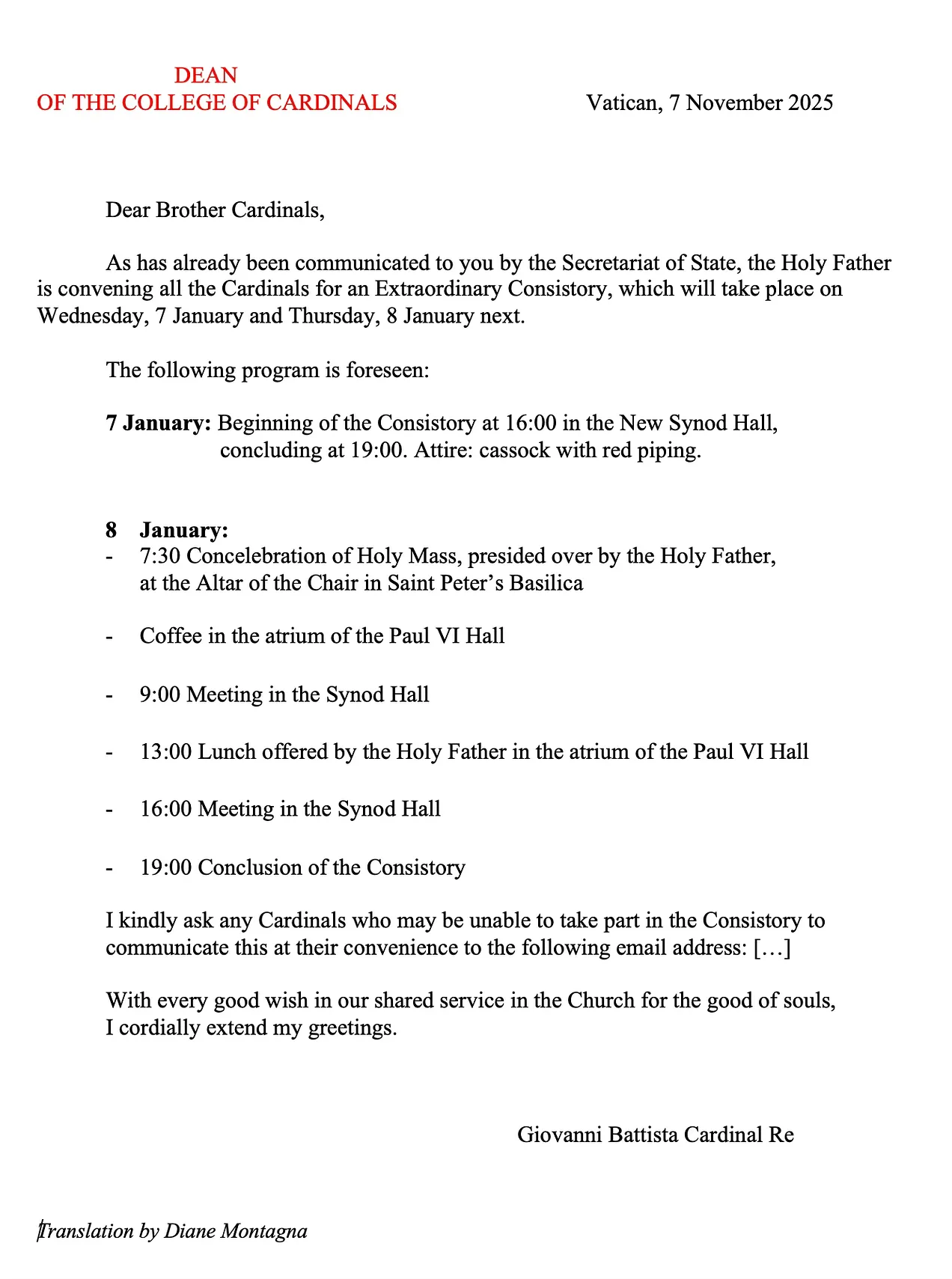
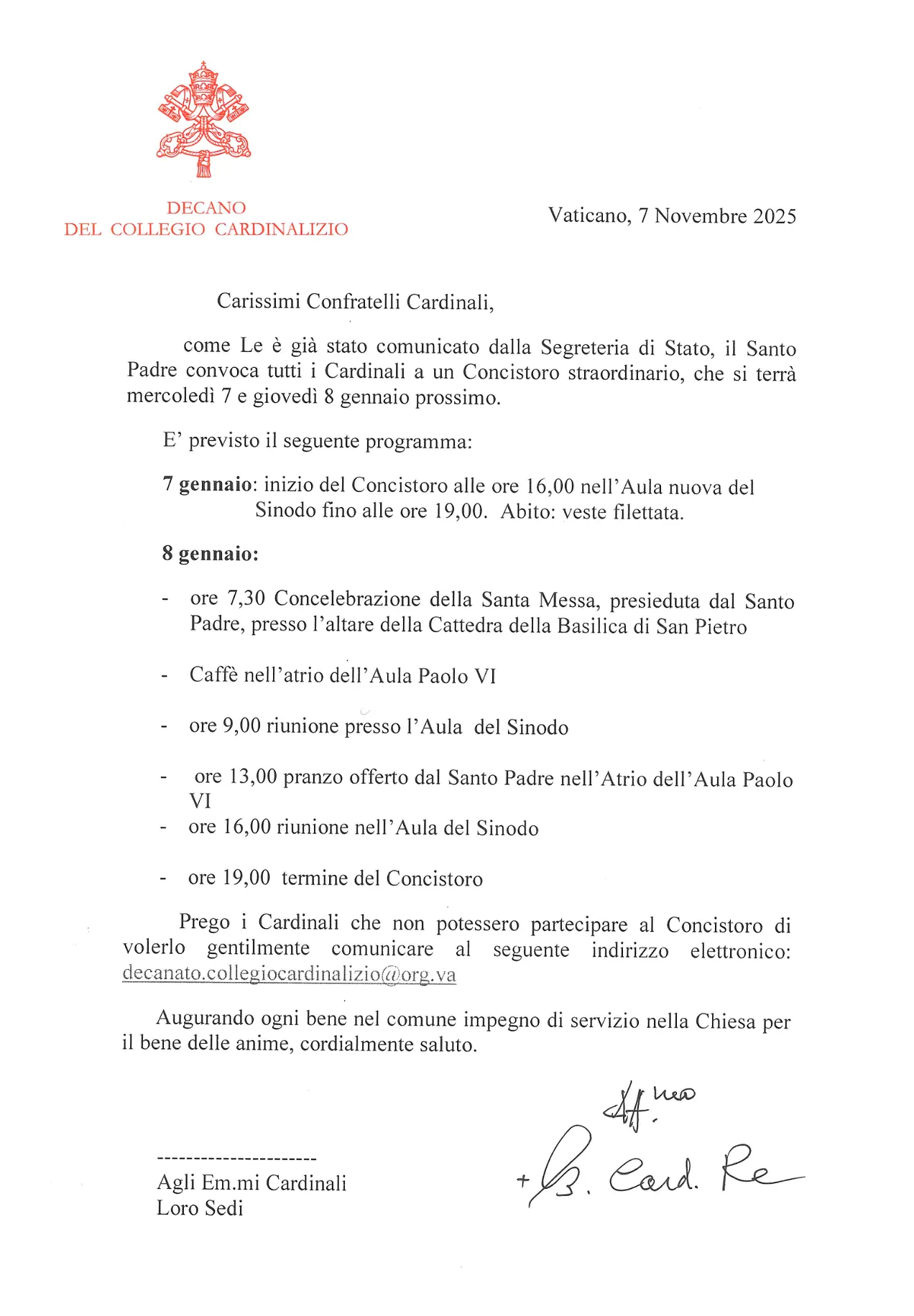
Nov. 7, 2025: Cardinal Giovanni Battista Re, Dean of the College of Cardinals, sent a letter to the cardinals outlining the agenda for the forthcoming consistory.
The letter, which I obtained (view the English translation and original Italian below), was sent from the official email of the Dean of the College of Cardinals, the same channel used to summon cardinals to a conclave, communicate details of the general congregations that precede it, or announce the death of a member of the College.
The agenda would have required prior papal approval.
According to the letter, the extraordinary consistory was to begin at 4:00 p.m. on January 7. Over the course of the day-and-a-half meeting, the cardinals were to meet with Pope Leo in the New Synod Hall for a total of ten hours—an arrangement consistent with the classical format.
Dec. 19, 2025: Pope Leo XIV sent a Christmas letter to the Cardinals, announcing the four topics he wished to discuss at the forthcoming consistory.
In the letter, the Pope wrote: “As already announced last November, from 7 to 8 January 2026, I will be delighted to meet you on the occasion of the first extraordinary Consistory that I have convened. It will be a moment of communion and fraternity, of reflection and sharing, aimed at supporting and advising the Pope in the demanding responsibility of governing the universal Church.”
The letter neither corrected nor modified the program set out on Nov. 7 by Cardinal Re.
The message was transmitted by the Office for the Coordination of Dicasteries, Secretariat of State, with an accompanying note which read: “Most Reverend Eminence, by revered mandate, I am transmitting the letter that the Holy Father, Pope Leo XIV, has wished to send to all the Cardinals on the occasion of Holy Christmas.”
Dec. 20, 2025 — The Holy See Press Office officially confirmed that Pope Leo XIV would hold an extraordinary consistory on January 7–8, largely reiterating the points outlined in his Christmas letter to the Sacred College.
Jan. 5, 2026 (afternoon) — The Cardinals received an email containing a revised agenda, significantly different from that sent by Cardinal Giovanni Battista Re on Nov. 7. It was sent not by the Dean of the College of Cardinals but by the Office for the Coordination of Dicasteries.
The new program indicated substantial changes in times and format, though in terms vague enough that Cardinals would not have known precisely what to expect upon arrival. The Italian original indicated that the program had been updated that same day (view PDF of English translation below). Several cardinals later said they never received the email containing the revised agenda.
What Happened?
The timeline suggests that the shift occurred sometime between December 19 and January 5—over the Christmas holidays. Vatican sources point to the possibility, or even likelihood, that one or more Cardinals met with Pope Leo XIV during that period, proposing a format more in line with the “synodal Church” envisioned by Pope Francis.
Given the distinctly “synodal” style ultimately adopted, some observers have speculated about the involvement of Cardinal Mario Grech, prefect of the Synod Secretariat. Others have raised questions about the role Cardinal Pietro Parolin may have played, given the Secretariat of State’s involvement through its Office for the Coordination of Dicasteries. Others have wondered whether Cardinal Fabio Baggio, who holds several key positions in the Roman Curia, may have had some influence. Multiple sources have also suggested that Michael Czerny, SJ, prefect of the Dicastery for Integral Human Development and known to be on friendly terms with the Pope, may have played a part.
Consistory Press Briefing: No Answers
Once the Consistory was underway, Vatican spokesman Matteo Bruni briefed reporters but offered little insight into who organized the event or how it was arranged.
At the Jan. 7 briefing, I asked Bruni how the president and secretary at each table had been chosen. “They were indicated beforehand among the groups,” he replied, to which I asked: “But how were they chosen?” Bruni said: “They were indicated beforehand, as was the composition of the groups of course.”
Nicole Winfield of the Associated Press then asked more directly: “Who organized this thing? Is this something that the Synod office does? And are they all sitting around round tables? Were there iPads? Are they divided among language groups? Can you give us a sense of how this all happened because it’s kind of just come out of the blue? Who put it together? There’s no College of Cardinals office, is there?”
“There is,” Bruni responded.
Pressed further on who organized the meeting, Bruni said: “I’m not providing that information. I am saying this is how it was organized.”
Asked who had chosen Cardinal Timothy Radcliffe to deliver the opening reflection, the Vatican spokesman added: “I have no information in that regard.”
Meanwhile, requests for a breakdown of the Cardinals, president and secretary present at each table were met with: “I don’t really think it would help in terms of understanding them … I don’t think we’ll be giving that specific breakdowns.”
After the briefing, several journalists continued to question Bruni, one saying: “I feel like I’ve landed on a planet that I haven’t been on. The whole thing seems so weird.” and another asking: “Why can’t we know who organized it?”
Bruni, suggesting he himself might not have full clarity on who organized the event, replied: “I do think that a lot of things were organized, let’s say, rather … well, there were thoughts, and concepts and ideas, and then were given flesh more concretely in recent days.”
“So it was a last-minute rush because of Christmas?” I asked.
“I’m not saying anything else … There were very clear ideas, I mean the themes were out, or at least the idea of the themes we had in November, you had in November. Then we had the [Dec. 20] press release and that synthesized some of the themes as well, then someone published the letter [from the Holy Father]. So obviously there was a very clear idea of what they wanted to discuss.”
Hunting for Answers
Given the silence, I went looking for answers. On March 26, I spoke with the Dean of the College, Cardinal Giovanni Battista Re, asking him to explain the shift from the traditional format described in his letter to the “synodal” format reflected in the revised agenda. In his typically strong voice, His Eminence said he was not feeling well that week and was unable to speak.
The same day, I wrote to the spokesman for the Synod Secretariat. Since the January consistory had taken on a “synodal” form, I said I assumed the Secretariat might have played a coordinating role and asked whether he could confirm this, and, if possible, explain how the presidents and secretaries of each table had been chosen. In a gracious reply, the spokesman said he had the same information as journalists, while emphasizing that “The General Secretariat was not involved in the preparation of that important meeting” (emphasis his).
“At a certain point,” he added, “the Holy Father asked Cardinal Mario Grech to introduce the theme on synodality. That’s all.”
I then called Monsignor Cartes at the Secretariat of State’s Office for the Coordination of Dicasteries. “I understand that your office sent the updated program to the Cardinals on January 5. Given that the consistory was conducted in the style of the Synod on Synodality, who organized it?” I asked.
“Ah, I can’t talk about that,” he said.
Finally, I asked the spokesperson for Cardinal Michael Czerny whether, given his positive view of the format and his reportedly friendly relationship with the Pope, he had suggested using it in advance of the consistory.
“I’m sorry that I’m not able to answer your question,” she replied.
Recollections May Vary
Cardinal Czerny was indeed enthusiastic about the new format. In an interview with The College of Cardinals Report after the consistory, Cardinal Czerny described the meeting as a “wonderful experience,” adding: “I think I speak for everyone in saying that it outstripped our expectations.”
“Certainly, it was more than you can have hoped for from a day-and-a-half meeting. It was encounter, it was dialogue, it us listening to each other and getting to know the Church better, and the Holy Father listening to us. It was a graced, graced time,” he said. “We didn’t express our expectations, but I’m quite sure everyone’s expectations were outstripped.”
His Eminence added: “It seemed so appropriate to fulfill the wish of the Holy Father the very day after he was elected, when he met with us and said, ‘I want us to continue the dialogue that we’d already begun in the Conclave and in the pre-Conclave meetings.’ And this is what turned out to happen. In that sense, it was also consoling, as if he had been inspired to say that then, and now we were actually doing it.”
Asked whether he would like to see any changes to the new small-group format, Cardinal Czerny said: “I think our experience universally — I certainly heard no dissenting voice — was that this format was very fine and very suitable.” While acknowledging that “everyone didn’t speak in public,” he said that “everyone contributed and everyone was heard.” Reflecting on what he called its “mixed format,” he said: “I think it turned out to be a very fine format.”
On whether non-voting cardinals should have been given a more prominent voice, he said that these tables also included voting cardinals from the Roman Curia and that the Holy Father “has other occasions to hear from us, so it’s not a top priority for us to speak, at length in any case.”
It should be noted, however, that several Curial officials— Cardinal Víctor Fernández, Cardinal Mario Grech, Cardinal Arthur Roche, Cardinal Luis Antonio Tagle, Cardinal José Tolentino, Cardinal Angel Fernandez Artime, Cardinal Fabio Baggio, as well as Cardinal Timothy Radcliffe, either formally addressed the assembly or played a key role.
Cardinal Czerny told The College of Cardinals Report: “I don’t know what the format will be like next time, but as far as I heard, everyone was very happy with the format that we had, and I don’t think that the older ones felt unheard. For most of them, it was also a new experience to be at the tables and as far as I know, we were happy to be together for the time we had.”
Yet recollections varied. One Cardinal, in fact, described the meetings to me as “highly controlled,” with reports that, at least on one occasion when a Cardinal tried to intervene after another Cardinal said something he was not in agreement with, he was cut off by the table president, who told him: “No, no, you can’t talk.” Another Cardinal, after experiencing “conversation in the Spirit”, said they were treated like “kindergarteners.”
Meanwhile, German Cardinal Walter Brandmüller was reportedly so frustrated by the format that he left after one of the first sessions and did not return.
Cardinal Raymond Burke adopted a measured tone in his assessment of the January consistory. In a sit-down interview with The College of Cardinals Report, he highlighted the “great benefit” of the cardinals meeting together and expressed gratitude to Pope Leo for his commitment to convene such gatherings regularly in the future.
At the same time, he pointed to ways the format could be improved, noting in particular the drawbacks of the small-group approach compared with the classical structure of an extraordinary consistory.
He explained that the January consistory combined elements of the format used by Pope Francis during the August 2022 “encounter of cardinals” with the style adopted at the Synod on Synodality. On a practical level, he noted that the small-table arrangement in the Paul VI Hall made it “difficult for anyone with a hearing problem,” given the general noise of simultaneous conversations.
He added that the classical format “permits a common hearing and speaking to the issues” among the Pope and Cardinals alike.
Cardinal Burke also observed that, while there were two forty-five-minute sessions for free interventions, each limited to three minutes, “this meant that just fifteen cardinals could speak at one session and another fifteen at the other, but some spoke twice.”
He added: “It was a large group, and not even the whole College. I would think that one has to re-examine the format to make sure that it respects the true nature of an extraordinary consistory.”
His Eminence further argued that the division of the tables into two main groups—voting cardinals and non-voting cardinals with Curial officials — “hinders the communication among the Cardinals.” He also noted that the reports from the latter tables were never discussed.
“There was an email address established where Cardinals can write in at any time,” he said. “Well, that’s effective for communicating a message for the Pope and I trust that all those messages get to him, but on the other hand, it doesn’t contribute to the general discussion among the Cardinals and to the clarification of their own concerns, or of their being alerted to concerns that they simply hadn’t considered that are very important.”
Noting that the report ultimately depends on the secretary’s ability to capture the full discussion, he said: “As you can imagine, these discussions on a topic like evangelization were very broad. But also there were specific points, and I noted in the reporting of it, that some of those specific points got lost in a kind of desire to give a general report.” (Pope Leo’s recent letter to cardinals on the insights that “emerged from the groups” would have been based on these reports.)
Cardinal Burke also highlighted problems with the dissemination of the program. “A number of the cardinals at my table didn’t receive the communication of the topics at all, and so we spent a lot of time just explaining to them what the topics were.”
“There was a problem of organization, that is certain,” he said. “But again, thank God that at least the meeting took place. It was a beginning, and I think now the important thing would be to work on the format.”
Why It Matters
Why the traditional format of Pope Leo’s first consistory was replaced at the last minute—and by whom—remains unclear, but the shift is significant.
The unexplained change from the general discussion format in the New Synod Hall of previous extraordinary consistories to a format of strictly guided table group discussions in the Pope Paul VI Audience Hall, along with very limited opportunities for individual cardinals to address the whole gathering, was a significant shift in the consultative relations between the Pope and the College of Cardinals.
The new arrangement brings in external controls on the freedom of each cardinal to speak and to be heard and creates a new level of bureaucratic management of communication between the cardinals and the Pope. Whatever the goal of this synodal style, it has the effect of significantly reducing the opportunity for open general discussion and limits the number of cardinals who can be heard.
Earlier this week it was reported that Cardinal Re has written to the Cardinals informing them that the next extraordinary consistory will be held on June 26-27, beginning at 9:00 a.m. This is one day earlier than previously anticipated and allows for two full days of sessions without extending into Sunday.
The format has yet to be decided. The Cardinal added that further details would be communicated as they become available.
Given the nature of an extraordinary consistory as articulated in the Code of Canon Law, its format ought to enable the Pope to listen to the Cardinals unfiltered.
Whether that principle will, in fact, be borne out in practice remains to be seen.
Pope Leo XIV’s letter to Cardinals this week, with the insights that “emerged from the groups” regarding Pope Francis’ apostolic exhortation Evangelii Gaudium, would have been based on these reports.