Catena Aurea by St. Thomas Aguinas
6:15–21
15. When Jesus therefore perceived that they would come and take him by force, to make him a king, he departed again into a mountain himself alone.
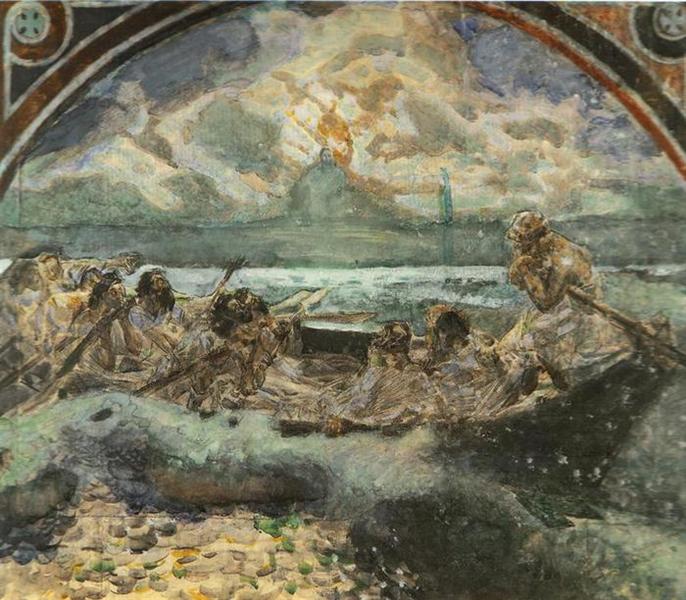
16. And when even was now come, his disciples went down unto the sea,
17. And entered into a ship, and went over the sea toward Capernaum. And it was now dark, and Jesus was not come to them.
18. And the sea arose by reason of a great wind that blew.
19. So when they had rowed about five and twenty or thirty furlongs, they see Jesus walking on the sea, and drawing nigh unto the ship: and they were afraid.
20. But he saith unto them, It is I; be not afraid.
21. Then they willingly received him into the ship: and immediately the ship was at the land whither they went.
BEDE. The multitude concluding, from so great a miracle, that He was merciful and powerful, wished to make Him a king. For men like having a merciful king to rule over them, and a powerful one to protect them. Our Lord knowing this, retired to the mountain: When Jesus therefore perceived that they would come and take Him by force to make Him a king, He departed again into a mountain Himself alone. From this we gather, that our Lord went down from the mountain before, where He was sitting with His disciples, when He saw the multitude coming, and had fed them on the plain below. For how could He go up to the mountain again, unless He had come down from it.
AUGUSTINE. (de Con. Ev. ii. c. xlvii) This is not at all inconsistent with what we read, that He went up into a mountain apart to pray: (Mat. 14:23) the object of escape being quite compatible with that of prayer. Indeed our Lord teaches us here, that whenever escape is necessary, there is great necessity for prayer.
AUGUSTINE. (Tr. xxv. 2) Yet He who feared to be made a king, was a king; not made king by men, (for He ever reigneth with the Father, in that He is the Son of God,) but making men kings: which kingdom of His the Prophets had foretold. Christ by being made man, made the believers in Him Christians, i. e. members of His kingdom, incorporated and purchased by His Word. And this kingdom will be made manifest, after the judgment; when the brightness of His saints shall be revealed. The disciples however, and the multitude who believed on Him, thought that He had come to reign now; and so would have taken Him by force, to make Him a king, wishing to anticipate His time, which He kept secret.
CHRYSOSTOM. (Hom. xlii. 3) See what the belly can do. They care no more for the violation of the Sabbath; all their zeal for God is fled, now that their bellies are filled: Christ has become a Prophet, and they wish to enthrone Him as king. But Christ makes His escape; to teach us to despise the dignities of the world. He dismisses His disciples, and goes up into the mountain.— (Hom. xliii. 1). These, when their Master had left them, went down in the evening to the sea; as we read; And when even was now come, His disciples went down unto the sea. They waited till evening, thinking He would come to them; and then, as He did not come, delayed no longer searching for Him, but in the ardour of love, entered into a ship, and went over the sea toward Capernaum. They went to Capernaum thinking they should find Him there.
AUGUSTINE. (Tr. xxv. s. 5) The Evangelist now returns to explain why they went, and relate what happened to them while they were crossing the lake: And it was dark, he says, and Jesus was not come to them.
CHRYSOSTOM. (Hom. xlii. 1) The mention of the time is not accidental, but meant to shew the strength of their love. They did not mate excuses, and say, It is evening now, and night is coming on, but in the warmth of their love went into the ship. And now many things alarm them: the time, And it was now dark; and the weather, as we read next, And the sea arose by reason of a great wind that blew; their distance from land, So when they had rowed about five and twenty or thirty furlongs.
BEDE. (in v. cap. Joan.) The way of speaking we use, when we are in doubt; about five and twenty, we say, or thirty.
CHRYSOSTOM. (Hom. xliii. 1) And at last He appears quite unexpectedly: They see Jesus walking upon the sea, drawing nigh. He reappears after His retirement, teaching them what it is to be forsaken, and stirring them to greater love; His reappearance manifesting His power. They were disturbed, were afraid, it is said. Our Lord comforts them: But He saith unto them, It is I, be not afraid.
BEDE. (in Matt. c. xiv.) He does not say, I am Jesus, but only I am. He trusts to their easily recognising a voice, which was so familiar to them, or, as is more probable, He shews that He was the same who said to Moses, I am that I am (Exod. 3:14)
CHRYSOSTOM. (Hom. xliii. s. 1) He appeared to them in this way, to shew His power; for He immediately calmed the tempest: Then they wished to receive Him into the ship; and immediately the ship was at the land, whither they went. So great was the calm, He did not even enter the ship, in order to work a greater miracle, and to shew his Divinity more clearlyg.
THEOPHYLACT. Observe the three miracles here; the first, His walking on the sea; the second, His stilling the waves; the third, His putting them immediately on shore, which they were some distance off, when our Lord appeared.
CHRYSOSTOM. (Hom. xliii. 1) Jesus does not shew Himself to the crowd walking on the sea, such a miracle being too much for them to hear. Nor even to the disciples did He shew Himself long, but disappeared immeditately.
AUGUSTINE. Mark’s1 account does not contradict this. He says indeed that our Lord told the disciples first to enter the ship, and go before Him over the sea, while He dismissed the crowds, and that when the crowd was dismissed, He went up alone into the mountain to pray: while John places His going up alone in the mountain first, and then says, And when even was now come, His disciples went down unto the sea. But it is easy to see that John relates that as done afterwards by the disciples, which our Lord had ordered before His departure to the mountain.
CHRYSOSTOM. (Hom. xliii. 1) Or take another explanation. This miracle seems to me to be a different one, from the one given in Matthew: for there they do not receive Him into the ship immediately, whereas here they doh: and there the storm lasts for some time, whereas here as soon as He speaks, there is a calm. He often repeats the same miracle in order to impress it on men’s minds.
AUGUSTINE. (Tr. xxv. s. 3. et seq.) There is a mystical meaning in our Lord’s feeding the multitude, and ascending the mountain: for thus was it prophesied of Him, So shall the congregation of the people come about Thee: for their sake therefore lift up Thyself again: (Ps. 7) i. e. that the congregation of the people may come about Thee, lift up Thyself again. But why is it fled; for they could not have detained Him against His will? This fleeing has a meaning; viz. that His flight is above our comprehension; just as, when you do not understand a thing, you say, It escapes me. He fled alone unto the mountain, because He is ascended from above all heavens. But on His ascension aloft a storm came upon the disciples in the ship, i. e. the Church, and it became dark, the light, i. e. Jesus, having gone. As the end of the world draws nigh, error increases, iniquity abounds. Light again is love, according to John, He that hateth his brother is in darkness. (1 John 2:9) The waves and storms and winds then that agitate the ship, are the clamours of the evil speaking, and love waxing cold. Howbeit the wind, and storm, and waves, and darkness were not able to stop, and sink the vessel; For he that endureth to the end, the same shall be saved. (Matt. 10:22) As the number five has reference to the Law, the books of Moses being five, the number five and twenty, being made up of five pieces, has the same meaning. And this law was imperfect, before the Gospel came. Now the number of perfection is six, so therefore five is multiplied by six, which makes thirty: i. e. the law is fulfilled by the Gospel. To those then who fulfil the law Jesus comes treading on the waves, i. e. trampling under foot all the swellings of the world, all the loftiness of men: and yet such tribulations remain, that even they who believe on Jesus, fear lest they should be lost.
THEOPHYLACT. When either men or devils try to terrify us, let us hear Christ saying, It is I, be not afraid, i. e. I am ever near you, God unchangeable, immoveable; let not any false fears destroy your faith in Me. Observe too our Lord did not come when the danger was beginning, but when it was ending. He suffers us to remain in the midst of dangers and tribulations, that we may be proved thereby, and flee for succour to Him Who is able to give us deliverance when we least expect it. When man’s understanding can no longer help him, then the Divine deliverance comes. If we are willing also to receive Christ into the ship, i. e. to live in our hearts, we shall find ourselves immediately in the place, where we wish to be, i. e. heaven.
BEDE. This ship, however, does not carry an idle crew; they are all stout rowers; i. e. in the Church not the idle and effeminate, but the strenuous and persevering in good works, attain to the harbour of everlasting salvation.
Catena Aurea John 6
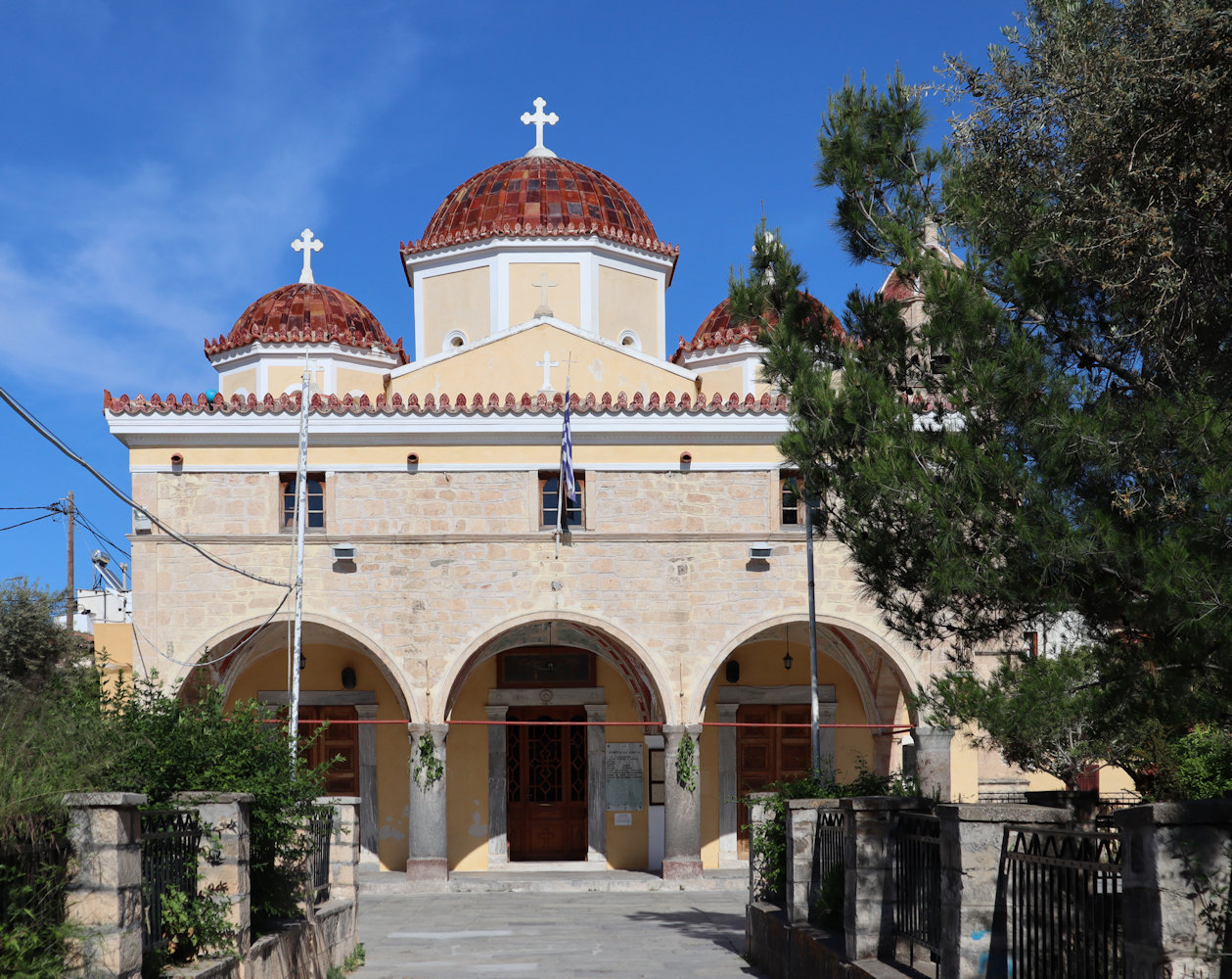
Saint Athanasia of Aegina
April 18, 2025
Feast Day: April 18
Born: c. 790 AD, on the island of Aegina (Greece)
Died: c. 860 AD
Titles: Abbess, Wonderworker, Confessor of the Faith
🌿 Early Life and Virtue
Saint Athanasia was born into a pious Christian family on the island of Aegina, in the Saronic Gulf, during the time of the Iconoclast controversies which troubled the Byzantine Empire. Even as a child, she exhibited deep prayerfulness, modesty, and charity. Her soul longed for solitude and divine union, and she desired to dedicate her life to God in virginity.
However, in obedience to her parents and guided by holy discernment, she accepted marriage to a nobleman. Yet within two weeks of their marriage, her husband was killed in a Saracen raid—a tragic but providential event that allowed her to follow her monastic calling more freely.
🕯️ A Life of Hidden Sanctity
After this, she entered a monastery, living a strict ascetical life of prayer, silence, fasting, and service to the poor. However, her peace was again interrupted when the Emperor Michael II mandated that all young women of ability and standing should marry, in an effort to repopulate and stabilize the empire. Under obedience to this decree, she married again—but this second husband was moved by her holiness and agreed to live with her in chastity as brother and sister.
Together they pursued a life of virtue. Eventually, he entered a monastery himself, and Athanasia returned to the religious life with full dedication, founding a convent in Timia, on Aegina.
🛏️ Abbess and Wonderworker
As abbess, she gathered many women who desired to live for Christ in the monastic life. She established a strict but loving rule of life centered on the Divine Office, continual psalmody, fasting, and charity. Her community served the poor, wove garments for the needy, and offered hospitality to pilgrims.
Saint Athanasia was endowed with the gift of prophecy, and many miracles were attributed to her both during her life and after her death. Her prayers healed the sick, comforted the afflicted, and brought peace to troubled souls.
Desiring greater solitude near the end of her life, she withdrew to a remote hermitage near Constantinople, where she reposed in the Lord around the year 860.
🕊️ Legacy and Veneration
Soon after her death, many miracles were reported at her tomb. Her relics became a source of healing, and her fame as a wonderworking saint spread throughout the Byzantine Empire. She was especially revered for her humility, obedience, and compassion for the suffering.
Her name, Athanasia, meaning “immortality,” reflects her eternal reward in Christ. She is venerated especially in the Orthodox Church, but her life bears deep resonance with traditional Catholic monasticism and the witness of consecrated virgins and widows.
✨ Spiritual Reflection
Saint Athanasia teaches us that:
- Obedience, even when difficult, leads to holiness when united with trust in Divine Providence.
- The path of sanctity may pass through unexpected stages—marriage, widowhood, consecrated life—but God weaves them all into a single beautiful vocation.
- True charity—especially to the poor—is inseparable from the contemplative life.
- Humility and silent service are the foundations of sanctity.
tradcatholica.com