
Posted on 04/17/2026 10:39:28 PM PDT by fidelis
When they had rowed about three or four miles, they saw Jesus walking on the sea and coming near the boat, and they began to be afraid. But he said to them, “It is I. Do not be afraid.” John 6:19–20
One of the most consoling things we can hear is our Lord saying to us, “It is I. Do not be afraid.” Every time we encounter His divine presence in our lives, we should hear those words. Though we do not always perceive Him, He is there, and when we reach out to Him in faith, He responds, dispelling the fear that cripples us, replacing it with confidence in His presence.
What causes you to fear? Though some forms of fear are good—such as fear of falling off a cliff while hiking on a narrow ledge—other forms of fear that we struggle with every day are not good. Fear of what people think about us, fear of failure, or fear of being mistreated are all fears that stem from our own weakness and lack of surrender to God’s grace. In today’s Gospel, Jesus’ miraculous act of walking on the water, coming toward the disciples in their boat at night during the storm, teaches us a lesson about unhealthy fear.
Fear ultimately stems from a lack of humility. It’s the fruit of pride, which is rooted in an excessive reliance on oneself rather than on God. Pride seeks control and resists vulnerability, whereas humility acknowledges one’s dependence on God and His providence. This misplaced trust in one’s own abilities or judgments leads to fear when faced with uncertainties or...exceed personal power. This is beautifully presented in the difficult-to-pray Litany of Humility: “From the fear of being humiliated… despised… suffering rebukes… calumniated… being forgotten… being ridiculed… being wronged… being suspected—deliver me, Jesus!”
In today’s Gospel, after Jesus had performed the miracle of the multiplication of the loaves and fishes, He sent His disciples ahead of Him.
It was evening when they entered their boat and began rowing across the sea. After they “had rowed about three or four miles” and “it had already grown dark,” a fearful situation arose: “the sea was stirred up because a strong wind was blowing.”
Many Church Fathers look at this passage as a literal story that is filled with symbolism, presenting us with deeper spiritual lessons. John frequently uses the images of light and darkness in his Gospel. Darkness symbolizes the absence of Christ, the Light of the World... He is attentive to them from a distance but allows them to endure the storm.
Each of us encounters storms. Though they sometimes lead to confusion, God permits them to help us overcome fear. Humility is the virtue that especially dispels fear because humility enables us to trust in God, rather than in ourselves. By ourselves, we cannot traverse the seas of the world. Not only will we be tossed about, making progress difficult or impossible, we sometimes lose our way and remain in one storm after another.
Reflect today on anything that causes fear or anxiety in your life. What weighs you down and sets you off course toward the freedom and joy God wants to grant you? What is it that is more than you can handle on your own? Whatever it is, humbly admit to yourself and to God that you need Him, because you are incapable of handling it on your own. As you do, listen for His gentle promptings of grace. Hear Him say to you, “It is I. Do not be afraid.” Allow Him to enter your life, calm the waves, and guide you safely to the destination He desires for you. Your humble reliance on our Lord will enable you to traverse any darkness in which you find yourself.
My ever-present Lord, at times I rely on myself more than You. This is especially true when I find myself vulnerable and susceptible to temptation. Please humble me, Lord, so that I will see Your presence in my life as the only answer, the only way to overcome every fear and anxiety I experience as I traverse the waves and darkness of this world. Jesus, I trust in You.
Please keep in mind that this is a Catholic Caucus/Devotional thread for the purpose of prayerful reflection on the Sacred Scriptures and is closed to debate of any kind. Per FR policy on Religion Caucus threads, off-topic, argumentative, and abusive comments are not allowed and will be submitted to the Mods for deletion. Thanks, and God bless you.
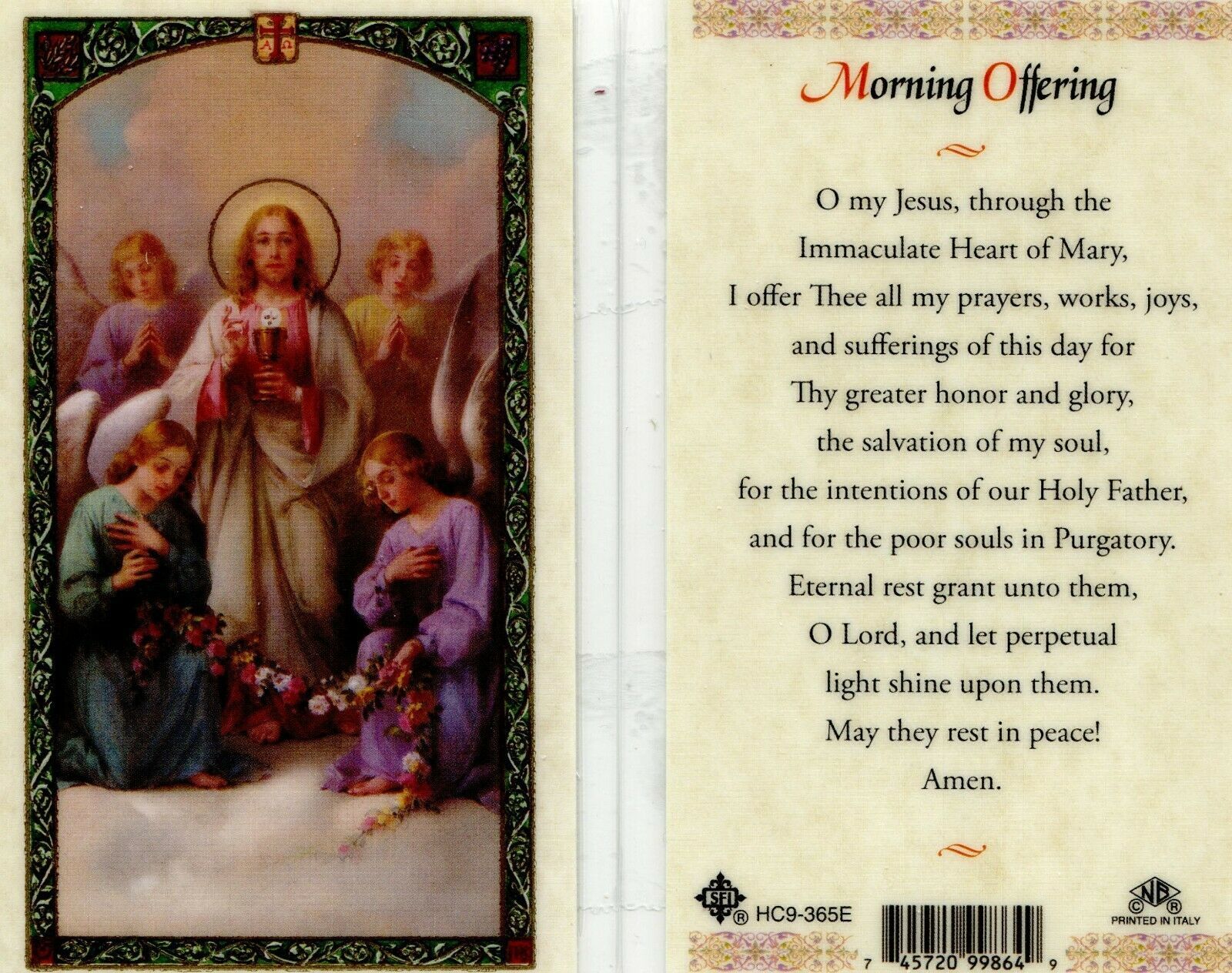
The Month of April is Dedicated to Devotion to the Most Holy Eucharist
“Now as they were eating, Jesus took bread, and blessed, and broke it, and gave it to the disciples and said, “Take, eat; this is my body.” And he took a cup, and when he had given thanks he gave it to them, saying, “Drink of it, all of you; for this is my blood of the covenant, which is poured out for many for the forgiveness of sins.” (Matthew 26:26-28)

Pope Leo XIV’s prayer intention for the month of April, 2026:
For priests in crisis
Let us pray for priests going through moments of crisis in their vocation, that they may find the accompaniment they need and that communities may support them with understanding and prayer.

Today’s First Reading
From: Acts 6:1-7
The Appointment of the Seven Deacons
------------------------------------
[1] Now in these days when the disciples were increasing in numbers, the Hellenists murmured against the Hebrews because their widows were neglected in the daily distribution. [2] And the Twelve summoned the body of the disciples and said, "It is not right that we should give up preaching the Word of God to serve tables. [3] Therefore, brethren, pick out from among you seven men of good repute, full of the Spirit and of wisdom, whom we may appoint to this duty. [4] But we will devote ourselves to prayer and to the ministry of the Word." [5] And what they said pleased the whole multitude, and they chose Stephen, a man full of faith of the Holy Spirit, and Philip, and Prochorus, and Nicanor, and Timon, and Parmenas, and Nicolaus, a proselyte of Antioch. [6] These they set before the Apostles, and they prayed and laid their hands upon them.
[7] And the Word of God increased; and the number of the disciples multiplied greatly in Jerusalem, and a great many of the priests were obedient to the faith.
***********************************************************************
Commentary:
1-6. A new section of the book begins at this point. It is introduced by reference to two groups in the early community, identified by their background prior to their conversion--the Hellenists and the Hebrews. From this chapter onwards, Christians are referred to as "disciples"; in other words this term is no longer applied only to the Apostles and to those who were adherents of Jesus during His life on earth; all the baptized are "disciples". Jesus is the Lord of His Church and the Teacher of all: after His ascension into Heaven He teaches, sanctifies and governs Christians through the ministry of the Apostles, initially, and after the Apostles' death, through the ministry of their successors, the Pope and the bishops, who are aided by priests.
Hellenists were Jews who had been born and lived for a time outside Palestine. They spoke Greek and had synagogues of their own where the Greek translation of Scripture was used. They had a certain amount of Greek culture; the Hebrews would have also had some, but not as much. The Hebrews were Jews born in Palestine; they spoke Aramaic and used the Hebrew Bible in their synagogues. This difference of backgrounds naturally carried over into the Christian community during its early years, but it would be wrong to see it as divisive or to imagine that there were two opposed factions in early Christianity. Before the Church was founded there existed in Jerusalem a well-established Hellenist-Jewish community--an influential and sizeable grouping.
This chapter relates the establishment by the Apostles of "the seven": this is the second, identifiable group of disciples entrusted with a ministry in the Church, the first being "the Twelve".
Although St. Luke does not clearly present this group as constituting a holy "order", it is quite clear that the seven have been given a public role in the community, a role which extends beyond distribution of relief. We shall now see Philip and Stephen preaching and baptizing--sharing in some ways in the ministry of the Apostles, involved in "care of souls".
St. Luke uses the term "diakonia" (service), but he does not call the seven "deacons". Nor do later ancient writers imply that these seven were deacons (in the later technical sense of the word)—constituting with priests and Bishops the hierarchy of the Church. Therefore, we do not know for certain whether the diaconate as we know it derives directly from "the seven". St. John Chrysostom, for example, has doubts about this (cf. "Hom. on Acts", 14). However, it is at least possible that the ministry described here played a part in the instituting of the diaconate proper.
In any event, the diaconate is a form of sacred office of apostolic origin. At ordination deacons take on an obligation to perform—under the direction of the diocesan bishop--certain duties to do with evangelization, catechesis, organization of liturgical ceremonies, Christian initiation of catechumens and neophytes, and Church charitable and social welfare work.
The Second Vatican Council teaches that "at a lower level of the hierarchy are to be found deacons, who receive the imposition of hands `not unto the priesthood, but unto the ministry'. For, strengthened by sacramental grace they are dedicated to the people of God, in conjunction with the bishop and his body of priests, in the service of the liturgy, of the Gospel and of works of charity. It pertains to the office of a deacon, in so far as it may be assigned to him by the competent authority, to administer Baptism solemnly, to be custodian and distributor of the Eucharist, in the name of the Church to assist at and to bless marriages, to bring Viaticum to the dying, to read Sacred Scripture to the faithful, to instruct and exhort the people, to preside over the worship and the prayer of the faithful, to administer sacramentals, and to officiate at funeral and burial services" ("Lumen Gentium", 29).
2-4. The Twelve establish a principle which they consider basic: their apostolic ministry is so absorbing that they have no time to do other things. In this particular case an honorable and useful function--distribution of food--cannot be allowed to get in the way of another even more important task essential to the life of the Church and of each of its members. "They speak of it `not being right' in order to show that the two duties cannot in this case be made compatible"(Chrysostom, "Hom. on Acts", 14).
The main responsibility of the pastors of the Church is the preaching of the Word of God, the administration of the Sacraments and the government of the people of God. Any other commitment they take on should be compatible with their pastoral work and supportive of it, in keeping with the example given by Christ: He cured people's physical ailments in order to reach their souls, and He preached justice and peace as signs of the Kingdom of God.
"A mark of our identity which no doubt ought to encroach upon and no objection eclipse is this: as pastors, we have been chosen by the mercy of the Supreme Pastor (cf. 1 Peter 5:4), in spite of our inadequacy, to proclaim with authority the Word of God, to assemble the scattered people of God, to nourish this people on the road to salvation, to maintain it in that unity of which we are, at different levels, active and living instruments, and increasingly to keep this community gathered around Christ faithful to its deepest vocation" (Pope Paul VI, "Evangelii Nuntiandi", 68).
A priest should be avid for the Word of God, [Pope] John Paul II emphasizes; he should embrace it in its entirety, meditate on it, study it assiduously and spread it through his example and preaching (cf. e.g., "Addresses" in Ireland and the United States, 1 October and 3 October 1979 respectively). His whole life should be a generous proclamation of Christ. Therefore, he should avoid the temptation to "temporal leadership: that can easily be a source of division whereas he should be a sign and promoter of unity and fraternity" ("To the Priests of Mexico", 27 January 1979).
This passage allows us to see the difference between election and appointment to a ministry in the Church. A person can be elected or designated by the faithful; but power to carry out that ministry (which implies a calling from God) is something he must receive through ordination, which the Apostles confer. "The Apostles leave it to the body of the disciples to select the [seven], in order that it should not seem that they favor some in preference to others" (Chrysostom, "Hom. on Acts", 14). However, those designated for ordination are not representatives or delegates of the Christian community; they are ministers of God. They have received a calling and, by the imposition of hands, God--not men--gives them a spiritual power which equips them to govern the Christian community, make and administer the Sacraments and preach the Word.
Christian pastoral office, that is, the priesthood of the New Testament in its various degrees, does not derive from family relationship, as was the case of the Levitical priesthood in the Old Testament; nor is it a type of commissioning by the community. The initiative lies with the grace of God, who calls whom He chooses.
5. All the people chosen have Greek names. One of them is a "proselyte", that is, a pagan who became a Jew through circumcision and observance of the Law of Moses.
6. The Apostles establish the seven in their office or ministry through prayer and the laying on of hands. This latter gesture is found sometimes in the Old Testament, principally as a rite of ordination of Levites (cf. Numbers 8:10) and as a way of conferring power and wisdom on Joshua, Moses' successor as leader of Israel (Numbers 27:20; Deuteronomy 13:9).
Christians have retained this rite, as can be seen quite often in Acts. Sometimes it symbolizes curing (9:12, 17; 28:8), in line with the example given by our Lord in Luke 4:40. It is also a rite of blessing, as when Paul and Barnabas are sent out on their first apostolic journey (13:3); and it is used as a post-baptismal rite for bringing down the Holy Spirit (8:17; 19:5).
In this case it is a rite for the ordination of ministers of the Church--the first instance of sacred ordination reported by Acts (cf. 1 Timothy 4:14; 5:22; 2 Timothy 5:22). "St. Luke is brief. He does not say how they were ordained, but simply that it was done with prayer, because it was an ordination. The hand of a man is laid [upon a person], but the whole work is of God and it is His hand which touches the head of the one ordained" (Chrysostom, "Hom. on Acts", 14).
The essential part of the rite of ordination of deacons is the laying on of hands; this is done in silence, on the candidate's head, and then a prayer is said to God asking Him to send the Holy Spirit to the person being ordained.
7. As in earlier chapters, St. Luke here refers to the spread of the Church--this time reporting the conversion of "a great many of the priests". Many scholars think that these would have come from the lower ranks of the priesthood (like Zechariah: cf. Luke 1:5) and not from the greatly priestly families, which were Sadducees and enemies of the new-born church (cf. 4:1; 5:17). Some have suggested that these priests may have included members of the Qumran sect. However, the only evidence we have to go on is what St. Luke says here.
From: John 6:16-21
Jesus Walks on the Water
------------------------
[16] When evening came, His (Jesus') disciples went down to the sea, [17] got into the boat, and started across the sea to Capernaum. It was now dark, and Jesus had not yet come to them. [18] The sea rose because a strong wind was blowing. [19] When they had rowed about three or four miles, they saw Jesus walking on the sea and drawing near to the boat. They were frightened, [20] but He said to them, "It is I; do not be afraid." [21] Then they were glad to take Him into the boat, and immediately the boat was at the land to which they were going.
***********************************************************************
Commentary:
16-21. It seems the disciples were disconcerted because darkness had fallen, the sea was getting rough and Jesus had still not appeared. But our Lord does not abandon them; when they had been rowing for some five kilometers (three miles), He arrives unexpectedly, walking on the water--to strengthen their faith, which was still weak.
In meditating on this episode Christian tradition has seen the boat as symbolizing the Church, which will have to cope with many difficulties and which our Lord has promised to help all through the centuries (cf. Matthew 28:20); the Church, therefore, will always remain firm. St. Thomas Aquinas comments: "The wind symbolizes the temptations and persecution the Church will suffer due to lack of love. For, as St. Augustine says, when love grows cold, the sea becomes rougher and the boat begins to founder. Yet the wind, the storm, the waves and the darkness will fail to put it off course and wreck it" ("Commentary on St. John, in loc.").
Disclaimer: Opinions posted on Free Republic are those of the individual posters and do not necessarily represent the opinion of Free Republic or its management. All materials posted herein are protected by copyright law and the exemption for fair use of copyrighted works.

