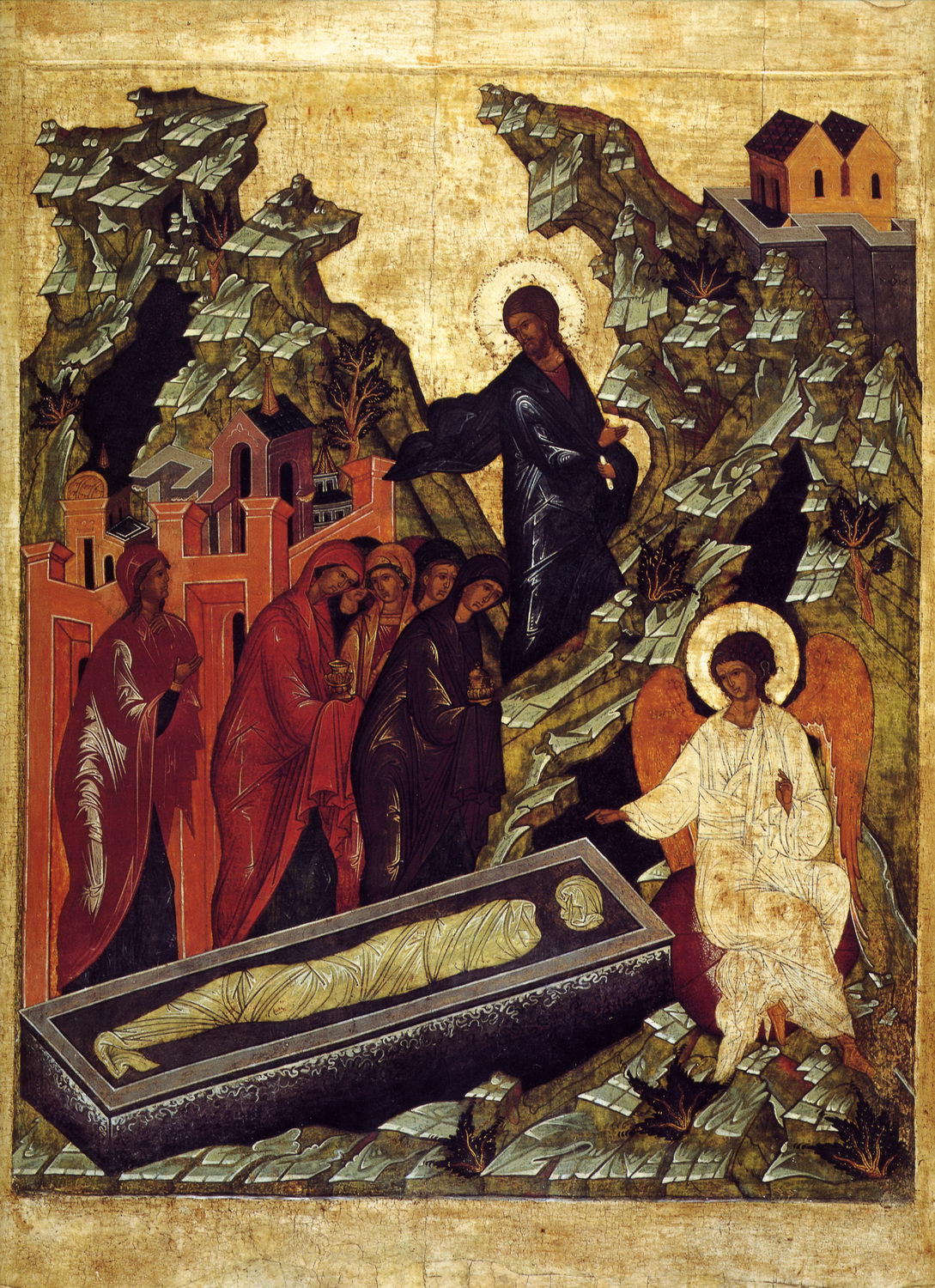
Catena Aurea by St. Thomas Aguinas
Catena Aurea by St. Thomas Aguinas
CHAP. 28
28:1–7
1. In the end of the sabbath, as it began to dawn toward the first day of the week, came Mary Magdalene and the other Mary to see the sepulchre.
2. And, behold, there was a great earthquake: for the angel of the Lord descended from heaven, and came and rolled back the stone from the door, and sat upon it.
3. His countenance was like lightning, and his raiment white as snow:
4. And for fear of him the keepers did shake, and became as dead men.
5. And the angel answered and said unto the women, Fear not ye: for I know that ye seek Jesus, which was crucified.
6. He is not here: for he is risen, as he said. Come, see the place where the Lord lay.
7. And go quickly and tell his disciples that he is risen from the dead; and, behold, he goeth before you into Galilee; there shall ye see him: lo, I have told you.
PSEUDO-CHRYSOSTOM. (Hom. de Resur. iii.) After the mockings and scourgings, after the mingled draughts of vinegar and gall, the pains of the cross, and the wounds, and finally after death itself and Hades, there rose again from the grave a renewed flesh, there returned from obstruction a hidden life, health chained up in death broke forth, with fresh beauty from its ruin.
AUGUSTINE. (de Cons. Ev. iii. 24.) Concerning the hour when the women came to the sepulchre there arises a question not to be overlooked. Matthew here says, On the evening of the Sabbath. What then means that of Mark, Very early in the morning, the first day of the week? (Mark 16:2.) Truly Matthew, by naming the first part of the night, to wit, the evening, denotes the whole night in the end of which they come to the sepulchre. But seeing the Sabbath hindered them from doing this before, he designates the whole night by the earliest portion of it in which it became lawful for them to do whatever, during some period of the night, they designed to do. Thus, On the evening of the sabbath, is just the same as if he had said, On the night of the sabbath, i. e. the night which follows the day of the sabbath, which is sufficiently proved by the words which follow, As it began to dawn towards the first day of the week. This could not be if we understood only the first portion of the night, its beginning, to be conveyed by the word, evening. For the evening or beginning of the night does not begin to dawn towards the first day of the week, but only the night which is concluded by the dawn. And this is the usual mode of speaking in Holy Scripture, to express the whole by a part. By evening therefore he implied the night, in the end of which they came to the sepulchre.
BEDE. (in loc.) Otherwise; It may be understood that they began to come in the evening, but that it was the dawn of the first day of the week when they reached the sepulchre; that is, that they prepared the spices for anointing the Lord’s body in the evening, but that they took them to the sepulchre in the morning. This has been so shortly described by Matthew, that it is not quite clear in his account, but the other Evangelists give the order more distinctly. The Lord was buried on the sixth day of the week, and the women returning from the sepulchre prepared spices and ointments as long as it was lawful to work; on the sabbath they rested, according to the commandment, as Luke plainly declares; and when the Sabbath was past and the evening was come, and the season of labour returned, with zealous devotion they proceeded to purchase such spices as they yet lacked, (this is implied in Mark’s words, when the sabbath was past, that they might go and anoint Jesus, for which purpose they come early in the morning to the sepulchre.
JEROME. Or, otherwise; This apparent discrepancy in the Evangelists as to the times of their visits is no mark of falsehood, as wicked men urge, but shews the sedulous duty and attention of the women, often going and coming, and not enduring to be long absent from the sepulchre of their Lord.
REMIGIUS. It is to be known that Matthew designs to hint to us a mystical meaning, of how great worthiness this most holy night drew from the noble conquest of death, and the Resurrection of Our Lord. With this purpose he says, On the evening of the Sabbath. For whereas according to the wonted succession of the hours of the day, evening does not dawn towards day, but on the contrary darkens towards night, these words shew that the Lord shed, by the light of His resurrection joy and brilliance over the whole of this night.
BEDE. (Hom. Æst. i.) For from the beginning of the creation of the world until now, the course of time has followed this arrangement, that the day should go before the night, because man, fallen by sin from the light of paradise, has sunk into the darkness and misery of this world. But now most fitly night goes before day, when, through faith in the resurrection, we are brought back from the darkness of sin and the shadow of death to the light of life, by the bounty of Christ.
CHRYSOLOGUS. (Serm. 75.)g. Because the sabbath is illuminated, not taken away, by Christ, Who said, I am not come to destroy the Law, but to fulfil it. (Matt. 5:17.) It is illuminated that it may lighten into the Lord’s day, and shine forth in the Church, when it had hitherto burnt dim, and been obscured by the Jews in the Synagogue.
It follows, Came Mary Magdalen, and the other Mary, &c. Late runs woman for pardon, who had run early to sin; in paradise she had taken up unbelief, from the sepulchre she hastes to take up faith; she now hastens to snatch life from death, who had before snatched death from life. And it is not, They come, but came, (in the singular,) for in mystery and not by accident, the two came under one name. She came, but altered; a woman, changed in life, not in name; in virtue, not in sex. The women go before the Apostles, bearing to the Lord’s sepulchre a type of the Churches; the two Marys, to wit. For Mary is the name of Christ’s mother; and one name is twice repeated for two women, because herein is figured the Church coming out of the two nations, the Gentiles and the Jews, and being yet one. Mary came to the sepulchre, as to the womb of the resurrection, that Christ might be the second time born out of the sepulchre of faith, who after the flesh had been born of her womb; and that as a virgin had borne Him into this life present, so a sealed sepulchre might bring Him forth into life eternal. It is proof of Deity to have left a womb virgin after birth, and no less to have come forth in the body from a closed sepulchre.
JEROME. And, behold, there was a great earthquake. Our Lord, Son at once of God and man, according to His twofold nature of Godhead and of flesh, gives a sign one while of His greatness, another while of His lowliness. Thus, though now it was man who was crucified, and man who was buried, yet the things that were done around shew the Son of God.
HILARY. The earthquake is the might of the resurrection, when the sting of death being blunted, and its darkness illuminated, there is stirred up a quaking of the powers beneath, as the Lord of the heavenly powers rises again.
CHRYSOSTOM. Or the earthquake was to rouse and waken the women, who had come to anoint the body; and as all these things were done in the night-time, it was probable that some of them had fallen asleep.
BEDE. (ubi sup.) The earthquake at the Resurrection, as also at the Crucifixion, signifies that worldly hearts must be first moved to penitence by a health-giving fear through belief in His Passion and Resurrection.
CHRYSOLOGUS. (Serm. 77 et 74.) If the earth thus quaked when the Lord rose again to the pardon of the Saints, how will it quake when He shall rise again to the punishment of the wicked? As the Prophet speaks, The earth trembled when the Lord rose again to judgment. (Ps. 76:8.) And how will it endure the Lord’s presence, when it was unable to endure the presence of His Angel? And the Angel of the Lord descended from heaven. For when Christ arose, death was destroyed, commerce with heaven is restored to things on the earth; and woman, who had of old held communication to death with the Devil, now holds communication to life with the Angel.
HILARY. This is an instance of the mercy of God the Father, to supply the ministry of heavenly power to the Son on His resurrection from the grave; and he is therefore the proclaimer of this first resurrection, that it may be heralded by some attendant token of the Father’s good pleasure.
BEDE. (ubi sup.) Forasmuch as Christ is both God and man, therefore there lack not amidst the acts of His humanity the ministrations of Angels, due to Him as God. And came and rolled back the stone; not to open the door for the Lord to come forth, but to give evidence to men that He was already come forth. For He who as mortal had power to enter the world through the closed womb of a Virgin, He when become immortal, was able to depart out of the world by rising from a sealed sepulchre.
REMIGIUS. The rolling back of the stone signifies the opening of Christ’s sacraments, which were covered by the letter of the Law. For the Law having been writen on stones, is here denoted by the stone.
CHRYSOLOGUS. (Serm. 74.) He said not ‘rolled,’ but rolled back; because the rolling to of the stone was a proof of death; the rolling it back asserted the resurrection. The order of things is changed; The Tomb devours death, and not the dead; the house of death becomes the mansion of life; a new law is imposed upon it, it receives a dead, and renders up a living, man. It follows, And sat thereon. He sat down, who was incapable of weariness; but sat as a teacher of the faith, a master of the Resurrection; upon the stone, that the firmness of his seat might assure the sted fastness of the believers; the Angel rested the foundations of the Faith upon that rock, on which Christ was to found His Church. Or, by the stone of the sepulchre may be denoted death, under which we all lay; and by the Angel sitting thereon, is shewn that Christ hath by His might subdued death.
BEDE. (ubi sup.) And rightly did the Angel appear standing, who proclaimed the Lord’s coming into the world, to shew that the Lord should come to vanquish the prince of this world. But the Herald of the Resurrection is related to have been seated, to shew that now He had overcome him that had the power of death, He had mounted the throne of the everlasting kingdom. He sate upon the stone, now rolled back, wherewith the mouth of the sepulchre had been closed, to teach that He by His might had burst the bonds of the tomb.
AUGUSTINE. (de Cons. Ev. iii. 24.) It may disquiet some, how it is that according to Matthew the Angel sate upon the stone after it had been rolled back from the sepulchre, whereas Mark says that the women having gone into the sepulchre, saw a young man sitting on the right hand. Either we may suppose that they saw two, and that Matthew has not mentioned him whom they saw within, nor Mark him whom they saw without the sepulchre; but that they heard from each severally what the Angels said concerning Jesus. Or the words, entering into the sepulchre, (Mark 16:5.) may mean entering into some enclosed place, which probably there might be in front of the rock out of which the sepulchre was hewn; and thus it might be the same Angel whom they saw sitting on the right hand, whom Matthew describes as sitting on the stone which he had rolled back.
CHRYSOLOGUS. (Serm. 75.) The splendour of his countenance is distinct from the shining of his raiment; his countenance is compared to lightning, his raiment to snow; for the lightning is in heaven, snow on the earth; as the Prophet saith, Praise the Lord from the earth; fire and hail, snow and vapours. (Ps. 148:7.) Thus in the Angel’s countenance is preserved the splendour of his heavenly nature; in his raiment is shewn the grace of human communion. For the appearance of the Angel that talked with them is so ordered, that eyes of flesh might endure the still splendour of his robes, and by reason of his shining countenance they might tremble before the messenger of their Maker.
CHRYSOLOGUS. (Serm. 77.) But what means this raiment where there is no need of a covering? The Angel figures our dress, our shape, our likeness in the Resurrection, when man is sufficiently clothed by the splendour of his own body.
JEROME. The Angel in white raiment signifies the glory of His triumph.
GREGORY. (Hom. in Ev. xxi. 4.) Or otherwise; Lightning inspires terror; snow is an emblem of equity; and as the Almighty God is terrible to sinners and mild to the righteous, so this Angel is rightly a witness of His resurrection, and is exhibited with a countenance as lightning, and with raiment as snow, that by His presence He might terrify the wicked, and comfort the good; and so it follows, And for fear of him the keepers did shake.
RABANUS. These who had not the faith of love were shaken with a panic fear; and they who would not believe the truth of the resurrection become themselves as dead men.
CHRYSOLOGUS. (Serm. 75.) For they kept watch over Him with a purpose of cruelty, not with the solicitude of affection. And no man can stand who is forsaken by his own conscience, or troubled with a sense of guilt. Hence the Angel confounds the wicked, and comforts the good.
JEROME. The guards lay like dead men in a trance of terror, but the Angel speaks comfort not to them, but to the women, saying, Fear not ye; as much as to say, Let them fear with whom unbelief abides; but do ye who seek the crucified Jesus hear that He has risen again, and has accomplished what He promised.
CHRYSOLOGUS. (Serm. 77.) For their faith had been bowed by the cruel storm of His Passion, so that they sought Him yet as crucified and dead; I know that ye seek Jesus which was crucified; the weight of the trial had bent them to look for the Lord of heaven in the tomb, but, He is not here.
RABANUS. His fleshly presence, that is; for His spiritual presence is absent from no place. He is risen, as he said.
CHRYSOSTOM. As much as to say, If ye believe me not, remember His own words. And then follows further proof, when he adds, Come, see the place where the Lord lay.
JEROME. That if my words fail to convince you, the empty tomb may.
CHRYSOLOGUS. (Serm. 76.) Thus the Angel first announces His name, declares His Cross, and confesses His Passion; but straightway proclaims Him risen and their Lord. An Angel after such sufferings, after the grave acknowledges Him Lord; how then shall man judge that the Godhead was diminished by the flesh, or that His Might failed in His Passion. He says, Which was crucified, and points out the place where the Lord was laid, that they should not think that it was another, and not the same, who had risen from the dead. And if the Lord reappears in the same flesh, and gives evidence of His resurrection, why should man suppose that he himself shall reappear in other flesh? Or why should a slave disdain his own flesh, seeing the Lord did not change ours?
RABANUS. And this glad tiding is given not to you alone for the secret comfort of your own hearts, but ye must extend it to all who love Him; Go quickly, and tell his disciples.
CHRYSOLOGUS. (Serm. 77.) As much as to say, Woman, now thou art healed, return to the man, and persuade him! to faith, whom thou didst once persuade to treachery. Carry to man the proof of the Resurrection, to whom thou didst once carry counsel of destruction.
CHRYSOSTOM. And, behold, he shall go before you, that is, to save you from danger, lest fear should prevail over faith.
JEROME. Mystically; He shall go before you into Galilee, that is, into the wallowing stye1 of the Gentiles, where before was wandering and stumbling, and the foot had no firm and steady resting-place.
BEDE. (Hom. ubi sup.) The Lord is rightly seen by His disciples in Galilee, forasmuch as He had already passed from death to life, from corruption to incorruption; for such is the interpretation of Galilee, ‘Transmigration.’ Happy women! who merited to announce to the world the triumph of the Resurrection! More happy souls, who in the day of judgment, when the reprobate are smitten with terror, shall have merited to enter the joy of the blessed resurrection!
28:8–10
8. And they departed quickly from the sepulchre with fear and great joy; and did run to bring his disciples word.
9. And as they went to tell his disciples, behold, Jesus met them, saying, All hail. And they came and held him by the feet, and worshipped him.
10. Then said Jesus unto them, Be not afraid: go tell my brethren that they go into Galilee, and there shall they see me.
HILARY. The women having been comforted by the Angel, are straightway met by the Lord, that when they should proclaim His resurrection to the disciples, they should speak rather from Christ’s own mouth than from an Angel’s.
AUGUSTINE. (de Cons. Ev. iii. 23.) They departed forth of the tomb, that is, from that spot of the garden which was before the tomb hewn in the rock.
JEROME. A twofold feeling possessed the minds of the women, fear and joy; fear, at the greatness of the miracle; joy, in their desire of Him that was risen; but both added speed to their women’s steps, as it follows, And did run to bring his disciples word. They went to the Apostles, that through them might be spread abroad the seed of the faith. They who thus desired, and who thus ran, merited to have their rising Lord come to meet them; whence it follows, And, behold, Jesus met them, saying, All hail.
RABANUS. Hereby He shewed that He will meet with His help all those who begin the ways of virtue, and enable them to attain to everlasting salvation.
JEROME. The women ought first to hear this Hail, that the curse of the woman Eve may be removed in these women.
CHRYSOLOGUS. (Serm. 76.) That in these women is contained a full figure of the Church is shewn hereby, that Christ convinces His disciples when in doubt concerning the Resurrection, and confirms them when in fear; and when He meets them He does not terrify them by His power, but prevents them with the ardour of love. And Christ in His Church salutes Himself, for He has taken it into His own Body.
AUGUSTINE. (ubi sup.) We conclude that they had speech of Angels twice at the sepulchre; when they saw one Angel, of whom Matthew and Mark speak; and again when they saw two Angels, as Luke and John relate. And twice in like manner of the Lord; once at that time when Mary supposed Him to be the gardener, (John 20:15.) and now again when He met them in the way to confirm them by repetition, and to restore them from their faintness.
CHRYSOLOGUS. (ubi sup.) Then Mary was not suffered to touch Him; now she has permission not only to touch, but to hold Him altogether; they came and held him by the feet, and worshipped him.
RABANUS. It was told above how He rose when the sepulchre was closed, to shew that that body which had been shut up therein dead, was now become immortal. He now offers His feet to be held by the women, to shew that He had real flesh, which can be touched by mortal creatures.
CHRYSOLOGUS. (ubi sup.) They hold Christ’s feet, who in the Church present the type of Evangelic preaching, and merit this privilege by their running to Him; and by faith so detain their Saviour’s footsteps, that they may come to the honour of His perfect Godhead. She is deservedly bid to touch me not, who mourns her Lord upon earth, and so seeks Him dead in the tomb, as not to know that He reigns in heaven with the Father. This, that the same Mary, one while exalted to the summit of faith, touches Christ, and holds Him with entire and holy affection; and again, cast down in weakness of flesh, and womanly infirmity, doubts, undeserving to touch her Lord, causes us no difficulty. For that is of mystery, this of her sex; that is of divine grace, this of human nature. And so also we, when we have knowledge of divine things, live unto God; when we are wise in human things, we are blinded by our own selves.
CHRYSOLOGUS. (Serm. 80.) They held His feet to shew that the head of Christ is the man, but that the woman is in Christ’s feet, and that it was given to them through Christ, not to go before, but to follow the man. Christ also repeats what the Angel had said, that what an Angel had made sure, Christ might make yet more sure. It follows, Then saith Jesus unto them, Fear not.
JEROME. This may be always observed, both in the Old and New Testament, that when there is an appearance of any majestic person, the first thing done is to banish fear, that the mind being tranquillized may receive the things that are said.
HILARY. The same order as of old now followed in the reversal of our woe, that whereas death began from the female sex, the same should now first see the glory of the Resurrection, and be made the messenger thereof. Whence the Lord adds, Go tell my brethren that they go into Galilee, there shall they see me.
CHRYSOLOGUS. (ubi sup.) He calls them brethren whom He has made akin to His own body; brethren whom the generous Heir has made His co-heirs; brethren, whom He has adopted to be sons of His own Father.
AUGUSTINE. (de Cons. Ev. iii. ult.) That the Lord, both by His own mouth, and by the Angel, directs them to seek for Him, not in that place in which He was to shew Himself first, but in Galilee, makes every believer anxious to understand in what mystery it is spoken. Galilee is interpreted ‘transmigration,’ or ‘revelationa’. And according to the first interpretation what meaning offers itself, save this, that the grace of Christ was to pass from the people of Israel to the Gentiles, who would not believe when the Apostles should preach the Gospel to them, unless the Lord Himself should first make ready their way in the hearts of men. This is the signification of that, He shall go before you into Galilee. There shall ye see him, means, there shall ye find His members, there shall ye perceive His living Body in such as shall receive you. According to the other interpretation, ‘revelation,’ it is to be understood, ye shall see him no longer in the form of a servant, but in that in which He is equal with the Father. That revelation will be the true Galilee, when we shall be like him, and shall see him as he is. (1 John 3:2.) That will be the blessed passing from this world to that eternity.
Catena Aurea Matthew 28
NAVARRE BIBLE COMMENTARY(RSV)
Ad Majorem Dei Gloriam (To the Greater Glory of God)
First Reading: Genesis 1:1—2:2-2
***********************************************************************
Commentary:
1:1-2:4a. Creation is the beginning of salvation history and the foundation on which are built God's salvific plans, which reach their climax in Jesus Christ. The biblical accounts of creation focus on the action of God; it is he who sets the scene and he is the creator, too, of those who will act out the drama and with whom he will enter into dialogue.
The sacred text incorporates ancient traditions about the origin of the world; scholars identify two separate accounts in the early chapters of Genesis. The first of these emphasizes God's transcendence over all created things, and is written in a very schematic style; this account (1:1-2:4a) is attributed to the "Priestly" tradition. The second, which also covers the fall and the expulsion from paradise, speaks of God in an anthropomorphic way; this more vivid, more popular account (2:4b-4:26) is considered to belong to the "Yahwistic" tradition. Here we have two different ways in which the Word of God (not intending to provide a scientific explanation of the origin of the world and of man) expounds the basic facts and truths on the subject in a way people can readily understand, inviting us to see me greatness and love of God manifested first in creation and then in the history of mankind. "Our faith teaches us," St. Josemaria Escriva writes, "that all creation, the movement of the earth and the other heavenly bodies, the good actions of creatures and all the good that has been achieved in history, in short everything, comes from God and directed toward him" ("Christ Is Passing By", 130).
In the first account the Bible offers profound teaching about God, about man and about the world. About God, who is the only God, creator of all things and man in particular; he transcends the created world and is its supreme master. About man, who is the image and likeness of God, above all other created beings and placed in the world to rule all creation. About the world, which is something good and is at the service of man.
1.1. "Three things are affirmed in these first words of Scripture: the eternal God gave a beginning to all that exists outside of himself; he alone is Creator (the verb 'create'--Hebrew "bara"--always has God for its subject). The totality of what exists (expressed by the formula 'the heavens and the earth') depends on the One who gives it being" ("Catechism of the Catholic Church", 290).
"In the beginning" means that creation marks the start of time and the course of history. Time and history have a beginning and they are headed towards a final goal, which the Bible will tell us more about, especially in its last book, Revelation. At the end, we are told: 'Then I saw a new heaven and a new earth; for the first heaven and the first earth had passed away, and the sea was no more" (Rev 21:1).
God the Creator is the same God as will manifest himself to the patriarchs, to Moses and to the prophets and make himself known to as through Jesus Christ. In the light of the New Testament we know that God created all things through his eternal Word, his beloved Son (cf. Jn 1:1; Col 1:16-17). God the Creator is Father and Son and (the relationship of love between them) the Holy Spirit. Creation is the work of the Blessed Trinity, and all of creation (particularly man, created in the image and likeness of God) in some way bears their seal. Some Fathers of the Church (Augustine, Ambrose and Basil, for example), in the light of the New Testament, saw the words "in the beginning" as having a deeper meaning--namely, "in the Son".
The "action of creating" belongs exclusively to God; man cannot create; he can only "change" or "develop" something that already exists. In the creation accounts of other Near East religions the world and gods developed out of preexistent matter. The Bible, however, records gradual revelation of the mystery of creation interpreted in the light of God's choice of Israel and his covenant with mankind; it roundly asserts that everything was made by God. Later on it will draw the conclusion that everything was created out of' nothing: "I beseech you, my child, to look at the heavens and the earth and see everything that is in them, and to recognize that God did not make them out of things that existed" (2 Mac 7:28). This creative power of God is also able to give sinful man a pure heart (cf. Ps 51:12), to restore the dead to life and to give the light of faith to those who do not know him (cf. 2 Cor 4:6).
It was God's love and wisdom that moved him to create the world, thereby communicating his goodness and making his glory manifest. The world, therefore, "is not the product of any necessity whatever, nor of blind, fate or chance. We believe that it proceeds from God's free will; he wanted to make his creatures share in his being, wisdom and goodness" ("Catechism of the Catholic Church", 295).
The expression "the heavens and the earth" means everything that exists. The earth is the world of men; the sky (or the heavens) can mean the firmament or the divine world, God's own "place", his glory and all spiritual (non-material) creatures--the angels.
1:2. The Bible teaches not just that God created all things, but also that the separation and ordering of the elements of nature is something established by God once and for all. The presence of the loving power of God, symbolized by a gentle breeze or a breath (the text refers to it as a spirit; "ruah" in Hebrew) which hovers and keeps watch over the world when it is still in chaos, shows that, as the text will go on to say, the Word of God and his Breath are present in the origin of being and in the origin of every creature's life. That is why many Fathers of the Church (Jerome and Athanasaus, for example) saw this passage as reflecting the presence of the Holy Spirit as a divine Person who, along with the Father and the Son, is at work in the creation of the world, "This biblical concept of creation", John Paul II explains, "includes not only the call to existence of the very being of the cosmos, that is to say, "the giving of existence", but also the presence of the Spirit of God in creation, that is to say, the beginning of "first of all concerning man", who has been created in the image and likeness of God" ("Dominum Et Vivificantem", 12).
1:3-5. At this point strictly speaking begins the description of the creation, which, according to the literary plan of this account, is going to take place over six days. These six days are meant to indicate the orderliness with which God went about his work, and to show a rhythm of work and rest: the Jewish Law laid down Saturday, the Sabbath, as a day of rest and a day dedicated to the Lord. In the Christian Church this day was shifted to Sunday, because Sunday was the day on which our Lord rose from the dead, thereby inaugurating the new Creation: Sunday, the "dies dominica" (Latin), the Lord's day.
On the first day God creates light and separates light from darkness (the latter, being something negative--the absence of light--cannot be created). Light is seen here as being a thing in its own right (without reference to the fact that daylight comes from the sun, which will not be created until the fourth day). The fact that God puts names on things (or in this case on situations caused by some elements being separated from others) indicates that he wields absolute power over them. God is in authority, whether it be day or night.
Here we meet for the first time a phrase which is going to be used seven times over the course of the narrative: "And God saw that it was good." This means that everything that God creates is good because in some way it bears his seal and shares in his own goodness, for it has come from divine goodness. The goodness of the world proclaimed here by Holy Scripture has important consequences for the Christian: "We must love the world and work and all human things. For the world is good. Adam's sin destroyed the divine balance of creation; but God the Father sent his only Son to re-establish peace, so that we, his children by adoption, might free creation from disorder and reconcile all things to God" (St Escriva, "Christ Is Passing By", 112).
1:6-8. In line with the culture of their time, the early Hebrews thought that rain came from huge containers of water in the vault of heaven; when trapdoors were opened, the rain poured down. When it says here that God separated the water which were above the firmament from those below, what is really being taught is that God imposed order on the natural world and is responsible for the phenomenon of rain. It is also making it clear from the outset that the firmament must not be thought to involve any divinity (as was believed in the nations roundabout Israel); the firmament is part of the created world.
1:11. As the inspired author depicts here, a distinction is made between God's action in separating and ordering the elements (creating the vast spaces of sky, sea and land) and his action of filling or adorning these spaces with different kinds of creatures. These creatures introduced in an increasing order of dignity (in line with the thinking of the time)—first the vegetable kingdom, then the stellar kingdom, and, lastly, the animal kingdom. Everything is perfectly arranged; the world of Creation invites to contemplate the Creator.
1:14-17. Against the neighboring religions, which regarded the heavenly bodies as divinities exerting influence over human life, the biblical author, enlightened by inspiration, teaches that the sun, moon and stars are simply created things; their purpose is to serve man by giving him light by day and night, and to be a way of measuring time. Put in their proper, natural place heavenly bodies (like all the rest of creation) lead man to appreciate the greatness of God, and to praise him for his awesome works: "The heavens are telling the glory of God; and the firmament proclaims his handiwork..." (Ps 19:1; cf. Ps 104). It follows that all forms of divination are to be rejected--consulting horoscopes, astrology, clairvoyance etc. (cf. "Catechism of the Catholic Church", 2116).
1:26. The sacred text emphasizes the special significance of this moment: God seems to stop to reflect and plan every detail of his next creation--man. Ancient Jewish interpretation (followed also by some Christian writers) saw the use of the plural "Let us make..." as meaning that God deliberated with his heavenly court, that is, with the angels (implying that God had created them at the very start, when he "created the heavens and the earth"). But the use of the plural should rather be taken as reflecting the greatness and power of God. A considerable part of Christian tradition has seen the "Let us make" as reflecting the Holy Trinity, for New Testament revelation has made the Christian reader more aware of the unfathomable greatness of the divine mystery.
"Man" here has a collective meaning: every human being, by his or her very nature, is in the image and likeness of God. The human being is intelligible not by reference to other created beings in the universe but by reference to God. The likeness between God and man is not a physical one, for God has no body; it is a spiritual likeness, lying in the human being's capacity for interiority. The Second Vatican Council teaches that man is not deceived when he regards himself as superior to bodily things and as more than just a speck of nature or a nameless unit in the city of man. For by his power to know himself in the depths of his being he rises above the whole universe of mere objects. When he is drawn to think about his real self, he turns to those deep recesses of his being where God who probes the heart (1 Kings 1.6:7; Jer 17:10) awaits him, and where he himself decides his own destiny in the sight of God. So when he recognizes in himself a spiritual and immortal soul, he is not being led astray by false imaginings that are due to merely physical or social causes. On the contrary, he grasps what is profoundly true in this matter" ("Gaudium Et Spes", 14).
The fact that God creates man in own image and likeness "means not only rationality and freedom as constitutive properties of human nature, but also from the very beginning, the capacity of having a "personal relationship" with God as 'I' and 'you' and therefore the capacity "of having a covenant", which will take place in God's salvific communication with man" (John Paul 11, "Dominun Et Vivificantem", 34). In the light of this communication, brought about in all its fullness by Jesus Christ, the Fathers the Church read the words "image and likeness" as meaning, on the one hand man's spiritual condition, and, on the other, his sharing in the divine nature through sanctifying grace. Even after the fall, man is still in the "image" of God; through sin, however, he lost his "likeness" but this was restored through Christ's redemption.
It is part of God's design that human beings should have dominion over other created things (represented here by the animals). This dominion makes man God's representative (everything really belongs to God) in the created world. Therefore, although man is going to be the lord of creation, he needs to recognize that God alone is the Creator; man has to respect and look after creation; he is responsible for it.
These words of Scripture show that "man is the only creature that God has loved for itself alone, because all others were created to be at the service of man. Here we can see, too, the basic equality of all human beings. For the Church, this equality, which has its roots in man's very being, takes on the very special dimension of brotherhood through the Incarnation of the Son of God. [...] Therefore, discrimination of any type [...] is absolutely unacceptable" (John Paul II, Address, 7 July 1984).
1:27. The creation of man marks the completion of God's plan, In presenting this final act of creation, the sacred writer offers us a summary of the things that go to make up the human being. As, well as repeating that God created man in his image and likeness, he tells us that God created them man and woman, that is to say, corporeal beings, endowed with sexuality, and designed to live in society. "Being in the image of God, the human individual possesses the dignity of a person, who is not just something, but someone. He is capable of self-knowledge, of self-possession and of freely giving himself and entering into communion with other persons. And he is called by grace to a covenant with his Creator to offer him a response of faith and love that no other creature can give in his stead" ("Catechism of the Catholic Church", 357).
"The fact that man 'created as man and woman' is the image of God means not only that each of them individually is like God, as a rational and free being. It also means that man and woman, created as a 'unity of the two' in their common humanity, are called to live in a communion of love, and in this way to mirror in the world the communion of love that is in God, through which the Three Persons love each other in the intimate mystery of the one divine life. This 'unity of the two', which is a sign of interpersonal communion, "shows that the creation of man" is also marked by a certain likeness to the divine communion ("communio") This likeness is a quality of the personal being of both man and woman, and is also a call and a task" (John Paul II, "Mulieris Dignitatem", 7).
The fact that the Bible and everyday language speak of God as masculine is a result of cultural influences and the great care taken in the Bible to avoid any hint of polytheism (which could arise if the godhead were described as feminine, opening the way to generations of gods, as in other religions). God transcends the body and sexuality; therefore, both man (masc.) and woman (fem.) equally reflect his image and likeness. In these words of Genesis, for the very first time in history, the fundamental equality in dignity of man and woman is proclaimed--in marked contrast with the low esteem in which women were held in the ancient world.
According to the traditional Jewish and Christian interpretation, this verse is alluding to marriage, as if God had already created the first man and the first woman as a married couple--forming that human community which is the basis of every society. In the second Genesis account of the creation of man and woman (cf. 2:18-24), this will emerge even more clearly.
1:28. God has already created animals, endowing them with fruitfulness (v. 22). He now addresses these two human beings personally: "he said to them..."; this indicates that the reproductive power of human beings (and therefore their sexuality) are values for which they must assume responsibility before God, as a way of co-operating in God's plans. Thus, God, "wishing to associate them in a special way with his own creative work, blessed man and woman with the words: 'Be fruitful and multiply' (Gen 1:28). Without intending to underestimate the other ends of marriage, it must be said that true married love and the whole structure of family life which results from it is directed to disposing the spouses to cooperate valiantly with the love of the Creator and Savior, who through them will increase and enrich his family from day to day" (Vatican II, "Gaudium Et Spes", 50).
God also commands man to make the earth serve him. Here divine Revelation is teaching us that human work is regarded as a way by which main operates in the plan God had when he created the world: "By the work of his hands and with the aid of technical means man tills the earth to bring fruit and to make it a dwelling place for all mankind; he, also consciously plays his part in the life of social groups; in so doing he is realizing the design, which God revealed at the beginning of time, to subdue the earth and perfect the work of creation, and at the same time he is improving his own person" (Vatican II, "Gaudium Et Spes", 57).
From this divine disposition we see the importance a person's work has in his or her personal life: "Your human vocation is a part--and an important part--of your divine vocation. That reason why you must strive for holiness, giving a particular character to your human personality, a style to your life; contributing at the same time to the sanctification of others, your fellow men; sanctifying your work and your environment: the profession or job that fills day, your home and family and the country where you were born and which you love [...]. Work, all work, bears witness to the dignity of man, to his dominion over creation. It is an opportunity to develop one's personality. It is a bond of union with others, the way to support one's family, a means of aiding the improvement of the society in which we live and in the progress of all mankind" ("Christ Is Passing By", 46-47).
Man is charged by God with mastery over the earth; but he may not do whatever he likes with it or act despotically: he should respect the universe as being the work of the Creator. In this regard, Wisdom 9:3 says: "0 God, [...] who hast formed man, to have dominion over the creatures thou hast made, and rule the world in holiness and righteousness, and pronounce judgment in uprightness of soul." "This holds good also for out daily work. When men and women provide for themselves and their families in such a way as to be of service to the community as well, they can rightly look upon their work as a prolongation of the work of the creator, a service to their fellow men, and their personal contribution to the fulfillment in history of the divine plan" (Vatican II, "Gaudium Et Spes", 34).
1:31. These words bring to an end this first description of the work of Creation. It is as if God, after making man, stood back to see what he had done and was very pleased with the result. Whereas the wording previously used was "And God saw that it was good," now we are told that it was "very good". In this way, the goodness of the created world is being stressed, indicating that "this natural goodness of theirs receives an added dignity from their relation with the human person, for whose use they have been created" (Vatican II, "Apostolicam Actuositatem", 7). From this it follows that the human person and his/her dignity must be valued above all other created things, and all human endeavor should be geared to foster and defend these values.
2:1-3. From this point onwards, God will almost never intervene in creation directly. Now it is up to man to act in the created world through the work he does.
God's "resting" sets an example for man. By resting, we are acknowledging that creation in the last analysis depends on and belongs to God, and that God is watching over it. Here rest is an example set by the Creator; we shall later find it as one of the Ten Commandments (cf. Ex 20:8-18; Deut 5:42-14). "The institution of the Lord's Day helps everyone enjoy adequate rest and leisure to cultivate their familial, cultural, social and religious lives" ("Catechism of the Catholic Church", 2184; cf. also John Paul II, Apostolic Letter, "Dies Domini", 31 May 1998).
Apropos of the sabbath, unlike the other days there is no mention of there being evening and morning. It is as if that rhythm of time were being broken by the sabbath--prefiguring the situation in which man, once he has accomplished his mission of mastering the earth, will enjoy an unending rest, at an eternal feast in God's presence (cf. Heb 4:1-10). In the language of the Bible "feast" or "festival" means three things--a) obligatory rest from everyday work; b) recognition of God as Lord of creation, and joyful contemplation of the created world; c) a foretaste of the enduring rest and joy that will be man's after he leaves this world.
-------------------------------------------------------
Second Reading: Genesis 22:1-18
***********************************************************************
Commentary:
22:1-19. God has been true to his promise: he has given Abraham a son by Sarah. Now it is Abraham who should show his fidelity to God by being ready to sacrifice his son in recognition that the boy belongs to God. The divine command seems to be senseless: Abraham has already lost Ishmael, when he and Hagar were sent away; now he is being asked to sacrifice his remaining son. Disposing of his son, meant detaching himself even from the fulfillment of the promise which Isaac represented. In spite of all this, Abraham obeys.
'"As a final stage in the purification of his faith, Abraham 'who had received the promises' (Heb 11:17) is asked to sacrifice the son God had given him. Abraham's faith does hot weaken ('God himself will provide the lamb for a burnt offering'), for he 'considered that God was able to raise men even from the dead' (Heb 11:19). And so the father of believers is conformed to the likeness of the Father who will not spare his own son but will deliver him up for us all (cf. Rom 8:32). Prayer restores man to God's likeness and enables him to share in the power of God's love that saves the multitude (cf. Rom 4:16-21)" ("Catechism of the Catholic Church", 2572).
By undergoing the test which God set, Abraham attains perfection (cf. Jas 2:2 1) and he is now in a position for God to reaffirm in a solemn way the promise he made previously (cf. Gen 12:3).
The sacrifice of Isaac has features which make it a figure of the redemptive sacrifice of Christ. Thus, there is father giving up his son; the son who renders himself to his father's will; the tools of sacrifice such as the wood, the knife and the altar. The account reaches its climax by showing through Abraham's obedience and Isaac's non-resistance, God's blessing will reach all the nations of the earth (cf. v. 18). So, it is not surprising that Jewish tradition should attribute a certain redemptive value to Isaac's submissiveness, and that the Fathers should see this episode prefiguring the passion of Christ, only Son of the Father.
22:2. "The land of Moriah": according to the Syrian version of Genesis this is "land of the Ammorites". We do not in fact know where this place was, although in 2 Chronicles 3:1 it is identified the mountain on which the temple Jerusalem was built, to stress the holiness of that site.
22:12. God is satisfied just by Abraham's sincere intention to do what he asked of him. It is as good as if he had actually done the deed. "The patriarch turned sacrificer of his son for the love of God; he stained his right hand with blood in intention and offered sacrifice. But owing to God's loving kindness beyond telling he received his son back safe and sound and went off with him; the patriarch was commended for his intention and bedecked with a bright crown; he had engaged in the ultimate struggle and at every stage given evidence of his godly attitude" ("Homiliae in Genesim", 48, 1).
Making an implicit comparison between Isaac and Jesus, St Paul sees in the death of Christ the culmination of God's love; he writes: "He who did not spare his own Son but gave him up for us all, will he not also give us all things with him?" (Rom 8:32).
If staying Abraham's hand was really a sign of God's love, an even greater one was really a sign of God's love, an even greater one was the fact that he allowed Jesus to die as an expiatory sacrifice on behalf of all mankind. In that later sacrifice, because "God is love" (1 Jn 4:8), "the abyss of malice which sin opens wide has been bridged by his infinite charity. God did not abandon men. His plans foresaw that the sacrifices of the old law would be insufficient to repair our faults and reestablish the unity which had been lost. A man who was God would have to offer himself up" (St. J. Escriva "Christ is Passing By", 95).
22: 13-14. Some Fathers see this ram as a prefigurement of Jesus Christ, insofar as, like Christ, the ram. was immolated in order to save man. In this sense, St Ambrose wrote: "Whom does the ram represent, if not him of whom it is written, 'He has raised up a horn for his people' (Ps 148:14)? [...] Christ: It is He whom Abraham saw in that sacrifice; it was his passion he saw. Thus, our Lord himself says of Abraham: 'Your father Abraham rejoiced that he was to see my day; he saw it and was glad' (Jn 8:56). Therefore Scripture says: 'Abraham called the name of that place 'The Lord will provide,' so that today one can say: the Lord appeared on the mount, that is, he appeared to Abraham revealing his future passion in his body, whereby he redeemed the world; and sharing, at the same time, the nature of his passion when he caused him to see the ram suspended by his horns. The thicket stands for the scaffold of the cross" ("De Abraham", 1, 8, 77-7.8).
-------------------------------------------------------
Third Reading: Exodus 14:15—15:1
***********************************************************************
Commentary:
14:10-14. The Egyptians get so close that the Israelites are terrified; this produces their first crisis of faith: the liberty they seek means giving up a quiet life in Egypt. Moses begins to reveal himself not just as a charismatic leader but as a mediator between the people and God. The words of v. 13 underlie the theological virtue of hope: God is the one who acts, man has to stand firm in faith; he has no reason to fear. As the Letter to the Hebrews teaches, Jesus is the model of faithfulness and hope: "Therefore [...] let us run with perseverance the race that is set before us, looking to Jesus the pioneer and perfecter of our faith, who for the joy that was set before him endured the cross, despising the shame, and is seated at the right hand of the throne of God" (Heb 12:12)
14:17-18. The military language and the depiction of God as a warrior should cause no surprise: it is a daring anthropomorphism which shows that God is almighty and therefore can deliver the elect from any danger that threatens: "You, too, if you distance yourself from the Egyptians and flee far from the power of demons," Origen comments, "will see what great helps will be provided to you each day and what great protection is available to you. All that is asked of you is that you stand firm in the faith and do not let yourself be terrified by either the Egyptian cavalry or the noise of their chariots" ("Homiliae in Exodum", 5, 4).
14:19-22. At the wonderful moment of the crossing of the sea, God, man and the forces of nature play the leading role. In the person of the angel of the Lord, God the person of the angel of the Lord, becomes more visible; he directs operations; he plays a direct part. Moses' part consists in doing as the Lord commands; he is his vicar. The sons of Israel have no active part; they benefit from what happens. Even the forces of nature come into play: the pillar of cloud which marked the route by day now blocks the Egyptians' way; night, the symbol of evil become, as in the Passover, the time God's visitation; the warm west wind, always feared for its harmful effects, now proves a great help; and the waters of the sea, so often the symbol of the abyss and of evil, allow the victorious passage of the sons of Israel.
The prophets see this event as an instance of the creative power of God (cf. Is 43:1-3), and Christian writers comment along the same lines. Thus, Origen will say: "See the goodness of God the Creator: if you submit to his will and follow his Law, he will see to it that created things cooperate with you, against their own nature if necessary" ("Homiliae In Exodum", 5,5).
The book of Wisdom turns the account of the crossing of the sea into a hymn of praise to the Lord who delivered Israel (cf. Wis 19:6-9), and St Paul sees the waters as a figure of baptismal water: "All were baptized into Moses in the cloud and in the sea" (1 Cor 10:2).
14:31. The main effect the miraculous crossing of the sea had on the Israelites was the faith it gave them in the power of God and in the authority of Moses. This section of the account of the escape from Egypt ends as it began--that is, showing that the people's faith (4:31) is now strengthened. So, too, Christian faith is strengthened when we do what God desires.: "Following Jesus on his way. You have understood what our Lord was asking from you and you have decided to accompany him on his way. You trying to walk in his footsteps, to clothe yourself in Christ's clothing, to be Christ himself: well, your faith, your faith in the light our Lord is giving you, must both operative and full of sacrifice" ([St] J. Escriva, "Friends of God", 198).
15:1-21. This victory anthem, along with that of Deborah (Judg 5), is one the oldest hymns of Israel. It probably goes as far back as the 13th century BC, long before the redactor of this be decided to include it as a colophon to Exodus account. It is called the "Song of Miriam" (v. 21) because, as we know from Ugarit poems of the period (13th-9th centuries BC) it was the practice to put at the end (not the start) the reason why the poem was written, the author's name and the poem's title (vv. 18-21). It is very likely that this canticle was recited in the liturgy and that the entire people said the response (vv, 1, 21) after each stanza was said or sung by the choir.
It is a hymn of praise and thanksgiving which the three stages of the deliverance of Israel are remembered--the prodigies of the Red Sea (vv. 4-10), the triumphal pilgrimage in the desert (vv. 4-16) and the taking possession of the land of Canaan (vv. 17-18).
In this poetic re-creation of these events the divine attributes are extolled one by one (might, military power, redemption, etc); they reflect the theological implications of exodus, wilderness and land: it is God who has done all these wondrous things; he has done them because he has chosen the people to be his very own; he himself requires that they respond by acknowledging him to be God, Lord of all, the only deliverer.
15:1-3. Victory over the Egyptians has revealed the glory arid might of God. Strength, power, salvation can be taken as meaning the same thing, for the sacred author does not regard the divine attributes as abstract qualities but as particular actions: only God could truly save the people.
"The Lord is a man of war": this daring description indicates that this is a very ancient poem. Some translations, possibly because they thought it might be misunderstood, toned it down a little: the Samaritan Pentateuch has "powerful in combat" and the Septuagint "he who breaks through battles". We in our Spanish version coincide with the RSV and the New Vulgate, retaining the blunt military imagery, which is very descriptive of the almighty power of God: "He is the Lord of the Universe [...]. He is master of history, governing hearts and events in keeping with his will" ("Catechism of the Catholic Church", 269).
"The Lord is his name": literally, "his name is Yah", using an abbreviation of Yahweh which may have been customary in more ancient times. It may well be that there is an echo of this name in the "Alleluia" of the Psalms.
-------------------------------------------------------
Fourth Reading: Isaiah 54:5-14
***********************************************************************
Commentary:
54:1-17. After the Song of the Servant, the sacred writer turns his attention again to Zion in a beautiful hymn celebrating the glory and restoration of Jerusalem. By inserting it immediately after the fourth song, he seems to indicate that this will be the first outcome of the servant's work. This hymn is an oracle of consolation and hope after the humiliations of exile. The content of the fourth song was quite new not so this hymn it uses traditional Old Testament imagery—the barren wife who becomes fruitful again (v. 1; cf. 1 Sam 2:5; Ps 113:9), the unfaithful and repudiated wife who is taken back (v.4; cf. Hos 1:16-22). Zion will have far more offspring than she had before the exile (v. 3). The Lord of hosts will be her Maker and her Husband (vv. 5-6). He forsook her for a short while (vv. 7-9) but now he will make a new Covenant with her, sealed with love (v. 10). He will rebuild Zion’s walls with precious stones, and peace will prevail (vv. 11-15). But the figure of Zion now accomodates not just the city’s inhabitants: it comes to stand for the homeland of all the Lord’s servants.
As the poem develops, so does God’s tenderness towards his city and his people: the first stanza (vv. 1-3) sees the city as a woman who was once barren and now has many children: she is the new Sarah (Gen 16:1), the new Rachel (Gen 29:3 1), the new Hannah (1 Sam 1:2). This will be so, for so “says the Lord” (v. 1). The second stanza (vv. 4-6) stresses the titles of her husband-- Maker, Lord of hosts, Redeemer, the Holy One of Israel, etc; and it confirms this by a slight change in wording: “says your God” (v. 6). The third stanza (vv. 7-10) describes the husband’s tender affection: he forsook Israel “for a brief moment”, but his love is everlasting: as in the days of Noah she was disgraced for a while, but he has sworn to be angry no longer, and not to rebuke her. The oracular formula is now: “says the Lord, your Redeemer" (v. 8b) and “says the Lord who has compassion on you”(v. 10b), which is etymologically the equivalent of “who loves you tenderly”.
The second part of the poem consists of two oracles of restoration: the first (vv. 11-15) shows the city constructed with precious stones ("abanim" in Hebrew; v. 11) and full of sons ("banim", in Hebrew) who will be docile to the Lord; the second part (vv. 16-17) confirms that God himself, mighty and just, guarantees the splendor and permanence of Zion.
A Christian reading sees the poem as explaining that the Church is the continuation and culmination of the ancient people of God, especially in its eschatological stage when tribulation will be a thing of the past: “The cry in scripture, 'Sing, O barren one', refers to us, because our Church was barren until children were born to it. 'Break forth into singing and cry aloud, you who have not been in travail': our singing is the prayers we should offer to God, without ceasing, without fail; those who live apart from God will fail. And Scripture adds 'the children of the desolate one will be more than the children of her that is married', so that we will see how, though we seemed to have been abandoned by the Lord in the beginning, we are now more fruitful than ever, and more numerous even than the people who believed that God was their God alone” (Pseudo-Clement, "Epistula II Ad Corinthios", 2).
Verses 11-12 will inspire the vision of the heavenly Jerusalem in Revelation 21:18-21. Verse 13 is applied to Jesus’ disciples in John 6:45 to indicate that God himself guarantees’ faith of believers in Jesus Christ.
The Church reads part of this passage (vv. 5-14) during the Easter Vigil, because the death and resurrection of Jesus is, for the new people of God, the fulfillment of this promise made by God, that he would enter into a new and definitive Covenant in which Christ unites himself permanently to his Church, the beloved Spouse for whom he sacrifices himself.
54:5-14, are read in the liturgy of the Easter Vigil, which celebrates Christ’s victory over sin and which invites the faithful to partake of the banquet of the Covenant sealed by his death and resurrection: “On the feasts of the Lord, when the faithful receive the Body of the Son, they proclaim to one another the Good News that the first fruits of life have been given, as when the angel said to Mary Magdalene, "Christ is risen!" Now too are life and resurrection conferred on whoever receives Christ.” (Fanqith, Syriac Office of Antioch, Vol. I, Commun., 237a-b)
-------------------------------------------------------
Fifth Reading: Isaiah 55:1-11
*****************************************************
Commentary:
55:1-13. The invitation to the Covenant banquet acts as the epilogue to the second part of the book of Isaiah, and picks up on themes in chapter 40, which is its prologue. The two chapters help to give literary and thematic unity to this part of the book. The oracle in chapter 55 sums up in a way the teachings contained in the preceding chapters -- the invitation to the Covenant banquet (vv. 1-3), reminiscent of that celebrated by Moses at Mount Sinai (Ex 24:5, 11); the renewal of the Covenant with David on Zion (vv. 4-5); the transcendence of God, who is unaffected by the sins of men (vv. 8-9); the power of the word of God (vv. 10-11); and, as a final synthesis, the promise of a new exodus, a sign of God’s everlasting salvation.
These oracles are a call for conversion, a call to take advantage of the salvific gifts so generously offered: “Come to the waters” (v. 1), “Come to me” (v. 3), “Seek the Lord” (v. 6), “Let the wicked forsake his way” (v. 7). Originally, it was a call to those exiled in Babylon to return to Jerusalem; but it is a call that is made at all times, to everyone. The reference to an everlasting Covenant, in keeping with promises made to David (cf. v. 3), can be read by Christians as an invitation to share in the new and eternal Covenant sealed with the Blood of our Lord Jesus Christ, a pledge of salvation for all mankind. In the Eucharist, the banquet of the New Testament, the words of the prophet come true in the complete sense in the words spoken by our Lord when he instituted that sacrament: “Take and eat” (cf. v. 1) the true bread of life, the very finest food, which money cannot buy (vv. 1-3). Therefore, the invitation extended by the prophet is a call to Christians to partake of the Blessed Eucharist. Paul VI, urging the faithful to take part in the Sunday celebration of the Eucharist, wrote: “How could we fail to take part in this encounter, to partake of the banquet that Christ has lovingly prepared for us? Our participation should be dignified and filled with joy. Christ, crucified and glorified, comes among his disciples to draw them all into the power of his resurrection. It is the pinnacle, here on earth, of the Covenant of love between God and his people: the sign and source of Christian joy, the preparation for the eternal banquet in heaven” (Gaudete in Domino, 322). Verses1-11, like 54:5-14, are read in the liturgy of the Easter Vigil, which celebrates Christ’s victory over sin and which invites the faithful to partake of the banquet of the Covenant sealed by his death and resurrection: “On the feasts of the Lord, when the faithful receive the Body of the Son, they proclaim to one another the Good News that the first fruits of life have been given, as when the angel said to Mary Magdalene, ‘Christ is risen!’ Now too are life and resurrection conferred on whoever receives Christ” (Fanqith, Brevarium iuxta ritum Ecclesiae Antiochenae Syrorum, in Catechism of the Catholic Church, 1391).
55:6-9. The Israelites are called to conversion. In order to return to their homeland, they must return to God, must “seek” him (vv. 6-7). And the Lord, who allows himself to be found and who does not judge in the way that men do, is willing and able to grant forgiveness (vv. 8-9). In other words, the call to repentance is grounded on the goodness of God who “will abundantly pardon” (v. 7). Man, for his part, should grasp this opportunity that God offers him. So, the words in this passage are a constant encouragement to begin and begin again in the pursuit of virtue: “To be converted means to ask for forgiveness and to seek out the strength of God in the Sacrament of reconciliation, and thus begin again, advancing step by step every day, learning to overcome ourselves, to win the spiritual battles that we face, and to give of ourselves joyfully, ‘for God loves a cheerful giver’ (2 Cor 9:7)” (John Paul II, Novo incipiente, 8 April 1979). And St Augustine, apropos of conversion, wrote: “Do not say: ‘Tomorrow, I will he converted; tomorrow, I will give thanks to God; and all my sins, today’s and yesterday’s, will be forgiven’. It is true that God promises forgiveness for your conversion; but He does not promise tomorrow for your delays” (Enarrationes in Psalmos, 144, 11).
The words of v. 8 are echoed by St Paul in Romans 11:33, and are a reminder to us of just how narrow-minded we can be and how we can fail even to imagine the great things that God has in store for us.
55:10-11. The prophet uses comparisons that are particularly meaningful to those who live in the arid countries of the East, to describe how very powerful the word of God is: it actually delivers the salvation that it promises. The personified word of God (cf. Wis 8:4; 9:9-10; 18:14-15) is a figure of the incarnation of Jesus Christ, the eternal Word of the Father, who comes down to save mankind. "The Word of God, he says, will not return to him empty and barren; rather, it will flourish in all things, nourished by the good deeds of those who obey and fulfill his teachings. The word is fulfilled when it is put into practice; if it is not put into practice, it remains barren and withered and starved. Listen carefully, then, when he tells of the food that nourishes him: 'My food is to do the will of him who sent me' (Jn 4:34)" (St Bernard, "In Cantica Canticorum", 71, 12-13).
------------------------------
Sixth Reading: Baruch 3:9-15, 32—4:4
********************************************
Commentary:
3:9—4:4. This section is a consideration and eulogy of the divine attribute of true Wisdom; at the same time, it is an exhortation addressed to Israel (“Listen, Israel”: 3:9). This passage from Baruch is similar in style to many of the Wisdom writings of the Old Testament. True Wisdom was given to Israel, who forsook it (3:9-14). The pagan nations look for Wisdom where there is none, Wisdom in solely human terms: they believe it is to be found in worldly power and wealth, and in control over natural resources and animals (3:15-31); they fail to seek the Wisdom that comes from God (3:32-36; cf. Job 28:12-28; Sir 1:1-10; Wis 7:7-14). The Lord revealed his Wisdom to Israel in the Law; they should consider themselves blessed for having been chosen to receive the commandments of the Lord (3:37—4:4). This is the part of the book that has been most frequently commented on by the Fathers (cf. 3:37-38). St Irenaeus, for example, sees a prophetic foreshadowing of the redemption of mankind through the Incarnation of the Word in 3:29—4:1; “Whenever and wherever people believe in him and carry out his will and call on his name, Jesus draws near and stands by their side and responds to the petitions they make from the bottom of their heart. When we have been redeemed, we will give thanks to God every day, for in his great, unimaginable, Wisdom, he saved us and proclaimed our salvation from the highest heavens: the proclamation was made in the visible coming of the Lord, that is, when he was made man. We have received the salvation that, left to ourselves, we could never have earned. But what is impossible to man is possible to God” (“Demonstratio praedicationis apostolicae”,97).
3:9-14. Why was Israel deported to a foreign country? Because it forsook “the way of God” (v. 13). God is called the “Fountain of Wisdom” (v. 12), thereby anticipating the reply to the question in 3:15. Wisdom is described (v. 14) by synonyms that show how multi-faceted it is: it is “strength”, it is “understanding”, it gives “length of days and life” and “light for the eyes and peace” Commenting on the gifts of understanding and prudence, St Bonaventure refers to v. 14: “Of all the things that guide man’s understanding in everything that he does and strives to avoid doing, he should consider most of all the purpose of his life. By his nature, he must hope for something, some gain, from what he does. But if you satisfy yourselves with earthly consolations, you will reap a terrible reward. The greatest good of all is eternal happiness. Therefore, listen to what is said in Baruch: Learn where there is wisdom…(3:14)” (“De septem donis Spiriti Sancti”, 8, 10).
3:33-36. To avoid any danger of polytheism and pantheism that might result from the notion of that Wisdom is something divine, the sacred writer reasserts his belief in the one God, and his notion of creation. The Creator must not be confused with his works—light and stars (cf. Job 9:9; 38-35).
3:37—4:4. The Lord revealed his Wisdom in the Law and gave it to Israel. As the book of Sirach (Ecclesiasticus) in particular makes clear (Sir 19:20-28; 24:1-47; etc.), Wisdom is not just an endowment from God to the people; it is in fact the Law of Moses; that is where man most clearly sees God.
3:36-37. Two things here are worth stressing: 1) as in the sapiential books, Wisdom is mentioned as a gift from God to the patriarchs and the people of Israel (v. 36; cf. Sir 24:8-12) however, it belongs not only to Israel but “lives among men” (v. 36); so here is another instance of the Old Testament universalist outlook.
St Gregory of Nyssa read v. 37 as proof that God in his providence looks after mankind: “He found the whole way to knowledge, and gave her to Jacob his servant…Thus man discovered fire and the tasks that need fire and need no fire, and the work that involves water, and a thousand more discoveries and a thousand ways of working, so that he would lack nothing that helps to sustain his life.” (“De beneficentia”, 1).
As with other similar passages where Wisdom is personified (cf, Prov 8:1-36; Wis 6:12-15; 9:10; Sir 15:2-6, etc.), some Fathers and commentators saw in v. 37 (cf. Wis 9:10; Prov 8:31) a glimpse of the incarnation of the Son of God (cf. John 1:14). St Irenaeus offered his interpretation first in his Demonstratio (cf. the note on 3:9—4:4), He gives the same interpretation in his most famous and profound work, Against Heresies: “This is his Word, our Lord Jesus Christ, who in his last days became a man among men, to unite the beginning and the end, that is, man and God. Thus the prophets, who received the gift of prophecy from God, foretold his coming in the flesh; and his coming has intensified the communion and union of God and man, in accordance with the will of the Father. The word of God said long ago that he would appear[ed] upon earth and live[ed] among men (Bar 3:37), that he would speak with them, and talk to them about the work he would do to save them and gather them to himself” (“Adversus haereses”, 4, 20, 5). We can see v. 37 also in the following passage where St John Damascene, explaining that God is at work everywhere, quotes Baruch loosely” “The earth is his footstool (cf, Is 66:1), whereby being made flesh he came to live among men.” (“Expositio fidei”, 1, 13).
Echoing the Fathers, the Second Vatican Council refers to this passage of Baruch: “Through this revelation, therefore, the invisible God (cf. Col 1:15; 1 Tim 1:17) out of the abundance of his love speaks to man as friends (cf. Ex 33:11; John 15:14-15) and lives among them (cf. Baruch 3:38), so that he may invite them and take them into fellowship with himself.” (Dei Verbum, 2). In v. 37, where it says “she lived among men”, the Greek uses the verb “synanestraphe”, which the Latin translates as “conversatus est”, implying a relationship of familiarity between God and man; that familiar or familial relationship finds its fullest expression in the incarnation of the Son of God.
-------------------------------------------------------
Seventh Reading: Ezekiel 36:16-17a, 18-28
**********************************************************************************
Commentary:
36:16-39:29. In this second last section of the book, the prophet uses a series of metaphors to paint the scene of a restored Israel. The oracles have an eschatological dimension to them, particularly the latter ones (38:1-39:29).
Overall, what we are given here is a song celebrating hope; nothing is impossible to the Lord: he is able to renew Israel (36:16-38), by giving her a new heart and a new spirit (v. 25); he can make the people come back to life (37:1-14); and the unity between this new people and their Lord will he almost like the way things were in Eden (37:15-28) -- so wonderful that it will astonish the nations (37:28). The final oracles (38:1-39:29) are a dramatic climax that convey an idea of the vicissitudes of the chosen people up to when their fortunes will be permanently restored. The empires seem to be those determining the course of events, but that is not the case: the Lord is always in control and, when the end comes, his victory will be so amazing that not only Israel but all other nations, too, will know that he truly is the Lord.
36:16-38. In these oracles, which continue the proclamation of Israel’s restoration-purification, we can see the core of Ezekiel’s teaching, namely, that the Lord, who is above all things, is the one who determines the election, punishment and restoration of his people. People have an obligation to accept the gifts that God offers; they must acknowledge that the Lord is sovereign and free, and render him due worship. This teaching can be seen in the announcement about restoration and a return to the promised land (vv. 16—24) and in the Lord’s promise of inner renewal (vv. 25-38).
“They defiled it by their ways” (v. 17): the people’s straying, their sins, defiled the promised land, the most precious of all the gifts God had given them. As Ezekiel explains it, their exile was a necessary punishment (v. 19), but it is also a condition for restoring to the land its lost honour.
“The holiness of my great name, which has been profaned among the nations” (v. 22): when the pagan nations saw the Israelites being deported, they thought that the God of Israel had been defeated or, at least, that he had failed to protect his people. In this sense the exile caused the name of the Lord to he profaned among the nations. The return of the people to the promised land was a necessary part of their deliverance (v. 24). but it was also needed to vindicate the name of the Lord (v. 22). This “theology” of the Name of God carries over into the New Testament, where we find it as a petition in the Our Father (cf. Mt 6:9; Lk 11:2, and from there it becomes part of the whole Christian tradition. The Catechism of the Council of Trent has this to say about these verses of Ezekiel: “Many people judge the truth of religion and of its Author by the deeds and lives of Christians. Those who truly profess their faith and put it into practice in their lives carry out the most valuable apostolate, provoking in others the desire to glorify the name of the heavenly Father” (Roman Catechism, 4, 10, 9).
“You shall be clean[sed]” (v. 25): Ezekiel views the renewal of Israel from the perspective of divine worship -- sprinkling with water and other purification rites being a sign of inner change. This passage can be read as an announcement of the effects of Baptism: “Baptism, by the power of God, remits and pardons all sin -- the original sin that we inherited from our first parents, and all our peronal sins, no matter how grave and terrible they may seem to us, no matter how grave and terrible they were. This truth was foretold long ago by the prophet Ezekiel, through whom the Lord God spoke: I will sprinkle clean water upon you, and you shall be clean from all your uncleannesses (Ezek 36:25)” (ibid., 2, 2, 42).
“A new heart” and “a new spirit” (v. 26): renewal affects a person’s disposition (heart) and motivation (spirit). The Israelites will have a completely new life-force: as a result, their conduct will be perfect (v. 27), the Covenant will never again be broken (v. 28), and the land, also cleansed of defilement, will he abundant in the fruit it yields (v. 30).
God’s patent initiative in repatriating and renewing Israel is a proof of his disinterested love for his people. Jesus makes this very clear, for example, in his discourse on the bread of life: “No one can come to me unless the Father who sent me draws him” (Jn 6:44). “Our salvation flows from God’s initiative of love for us, because ‘he loved us and sent his Son to be the expiation for our sins’ (Jn 4:10)’’ (Catechism of the Catholic Church, 620).
-------------------------------------------------------
Epistle: Romans 6:3-11
*******************************************************************
Commentary:
1-11. The universal dominion of sin, which began with the sin of Adam, is not the only event to be reckoned with. When sin reached its full extent, the grace brought by Jesus Christ came in superabundance. Through Baptism this grace reaches each of us and frees us from the control of sin. When we receive this Sacrament we die: that is to say, our blameworthiness is destroyed, we renounce sin once and for all, and are born again into a new life.
"The Lord", St. Ambrose tells the newly baptized, "who wanted His benefactions to endure, the serpent's plans to be turned to naught, and the harm done to be put right, delivered a sentence to mankind: 'You are dust, and to dust you shall return' (Genesis 3:19), and made man subject to death [...]. The remedy was given him: man would die and rise again [...]. You ask me how? [...] Pay attention. So that in this world too the devil's snare would be broken, a rite was instituted whereby man would die, being alive, and rise again, being alive [...]. Through immersion in water the sentence is blotted out: 'You are dust, and to dust you shall return'" ("De Sacramentis", II, 6).
This passage of the epistle, which reveals the key truths concerning Baptism, also reminds us of the profound meaning of this rite which Christ established, its spiritual effects in Christians and its far-reaching effects with respect to the Christian life. Thus, we can apply to Baptism what St. Thomas Aquinas says about all the sacraments: "Three aspects of sanctification may be considered--its very cause, which is Christ's Passion; its form, which is grace and the virtues; and its ultimate end, which is eternal life. And all these are signified by the sacraments. Consequently, a sacrament is a sign which is both a reminder of the past, that is, of the Passion of Christ, and an indication of what is effected in us by Christ's Passion, and a foretelling and pledge of future glory" ("Summa Theologiae", III, q. 60, a. 3).
In the specific case of Baptism, the various things which the Sacrament implies carry a special nuance--a new birth which presupposes a symbolic death. It reproduces in us not only the Passion, Death and burial of Christ, symbolized by immersion in water (verses 3-4, 6), but also new life, the life of grace which pours into the soul, enabling the person to share in the Resurrection of Christ (verses 4-5). This sharing in Christ's Resurrection to immortal life is a kind of seed which will ultimately produce the glorious resurrection of our bodies.
The baptized person is, therefore, someone newly created, someone born into a new life, someone who has moved out of darkness into light. The white garment used at Baptism symbolizes innocence and grace; the burning candle, the light of Christ--two symbols the Church uses in the baptismal liturgy to signify what is happening.
Thus, in Baptism, God "removes every trace of sin, whether original or personal" ("The Rite of Baptism", Introduction, 5) and also remits the penalties that these sins incur. On being baptized in the name of the Three Divine Persons, the Christian is shown God the Father's love for him (a love he has not merited), is given a share in the Paschal Mystery of the Son, and to him is communicated new life in the Spirit (cf. "Instruction on Infant Baptism", 20 October 1980, 9). Baptism, which is also described as "the door of the spiritual life", unites a person to Christ and to the Church by means of grace, which makes us children of God and heirs to Heaven. Finally, in addition to the infused virtues and supernatural gifts, the person is given "the graces necessary to live in a Christian way, and on his soul is impressed the sacramental character which makes him a Christian for evermore" ("St. Pius X Catechism", 250).
Baptism, which confers a "character", that is, a kind of seal confirming our Christian calling, gives us a share in Christ's priesthood and makes us capable of receiving the other sacraments.
4. It is easier to grasp the symbolism of burial and resurrection if one remembers that in earlier times, and particularly in the apostolic period, Baptism was usually administered by immersion in water--in some cases by total immersion, up to three times, with one Person of the Blessed Trinity being invoked each time. "They asked you, 'Do you believe in God the Father almighty?' You said, 'I believe', and you were immersed, that is, you were buried. Again they asked you, 'Do you believe in our Lord Jesus Christ and in His Cross?' You said, 'I believe', and you were again immersed. This time you have been buried with Christ, and he who is buried with Christ rises with Christ. For a third time you were asked, 'Do you believe in the Holy Spirit?' You said, 'I believe', and for a third time you were immersed, so that by this three-fold confession you might be loosed of your many attachments to your past life" (St. Ambrose, "De Sacramentis", II, 7).
Today Baptism is normally administered by pouring water over the head-- a method also used in apostolic times and which gradually came into general use because it was found more convenient.
5. Just as the ingraft and the plant form a single thing and make a single principle of life, Christians by being grafted onto or incorporated into Christ through Baptism form one single thing with Him and begin to draw on His divine life. We are also "united with Him in a death like His": Christ suffered physical death; we, in Baptism, die spiritually to the life of sin. St. John Chrysostom explains this as follows: "Baptism is for us what the Cross and burial were for Christ; but with this difference: the Savior died physically, He was physically buried, whereas we ought to die spiritually. That is why the Apostle does not say we are 'united with Him with His death', but 'in a death like his" ("Hom. on Rom.", 10).
9-10. Jesus Christ chose to bear all the consequences of sin, even though He was sinless. His voluntary death on the Cross and His glorious Resurrection broke the bonds of death, for Himself and for all His own. Death no longer shall have dominion: "[Christ died] that through death He might destroy him who has the power of death, that is, the devil, and deliver all those who through fear of death were subject to lifelong bondage" (Hebrews 2:14-15). And as a consequence He won, for His own human nature and for us, a new life.
In all those who have been baptized these same events in Christ's life are in some way reproduced. "Our past sins have been wiped out by the action of grace. Now, so as to stay dead to sin after Baptism, personal effort is called for, although God's grace continues to be with us, providing us with great help" (Chrysostom, "Hom. on Rom.", 11). This personal effort might be encapsulated in a resolution: "May we never die through sin; may our spiritual resurrection be eternal" (St. J. Escriva, "Holy Rosary", 1st Glorious Mystery).
-------------------------------------------------------
Gospel Reading: Matthew 28:1-10
***********************************************************************
Commentary:
1-15. The resurrection of Jesus, which happened in the early hours of the Sunday morning, is a fact which all the evangelist state clearly and unequivocally. Some holy women discover to their surprise that the tomb is open. On entering the hall (cf. Mark 16:5-6), they see an angel who says to them, "He is not here; for He has risen, as He said." The guards who were on duty when the angel rolled back the stone go to the city and report what has happened to the chief priests. These, because of the urgency of the matter, decide to bribe the guards; they give them a considerable sum of money on condition that they spread the word that His disciples came at night and stole the body of Jesus when they were asleep. "Wretched craftiness," says St. Augustine, "do you give us witnesses who were asleep? It is you who are really asleep if this is the only kind of explanation you have to offer!" ("Ennarationes in Psalmos", 63, 15). The Apostles, who a couple of days before fled in fear, will, now that they have seen Him and have eaten and drunk with Him, become tireless preachers of this great event: "This Jesus, they will say, "God raised up, and of that we are all witnesses" (Acts 2:32).
Just as He foretold He would go up to Jerusalem and be delivered to the leaders of the Jews and put to death, He also prophesied that He would rise from the dead (Matthew 20:17-19; Mark 10:32-34; Luke 18:31-34). By His resurrection He completes the sign He promised to give unbelievers to show His divinity (Matthew 12:40).
The resurrection of Christ is one of the basic dogmas of the Catholic faith. In fact, St. Paul says, "If Christ has not been raised, then our preaching is in vain and your faith is in vain" (1 Corinthians 15:14); and, to prove his assertion that Christ rose, he tells us "that He appeared to Cephas, then to the Twelve. Then He appeared to more than five hundred brethren at one time, most of whom are still alive, though some have fallen asleep. Then He appeared to James, then to all the apostles. Last of all, as to one untimely born, He appeared also to me" (1 Corinthians 15:5-8). The creed states that Jesus rose from the dead on the third day ("Nicene Creed"), by His own power (Ninth Council of Toledo, "De Redemptione Creed"), by a true resurrection of the flesh ("Creed" of St. Leo IX), reuniting His soul with His body (Innocent III, "Eius Exemplo"), and that this fact of the resurrection is historically proven and provable ("Lamentabili", 36).
"By the word `resurrection' we are not merely to understand that Christ was raised from the dead...but that He rose by His own power and virtue, a singular prerogative peculiar to Him alone. Our Lord confirmed this by the divine testimony of His own mouth when He said: `I lay down My life, that I may take it again....I have power to lay it down: and I have power to take it up again' (John 10:17-18). To the Jews He also said, in corroboration of His doctrine" `Destroy this temple, and in three days I will raise it up' (John 2:19-20) [...]. We sometimes, it is true, read in Scripture that He was raised by the Father (cf. Acts 2:24; Romans 8:11); but this refers to Him as man, just as those passages on the other hand, which say that He rose by His own power, related to Him as God" ("St. Pius V Catechism", I, 6, 8).
Christ's resurrection was not a return to His previous earthly existence; it was a "glorious" resurrection, that is to say, attaining the full development of human life--immortal, freed from all limitations of space and time. As a result of the resurrection, Christ's body now shares in the glory which His soul had from the beginning. Here lies the unique nature of the historical fact of the resurrection. He could not be seen by anyone but only by those to whom He granted that grace, to enable them to be witnesses of this resurrection, and to enable others to believe in Him by accepting the testimony of the seers.
Christ's resurrection was something necessary for the completion of the work of our Redemption. For, Jesus Christ through His death freed us from sins; but by His resurrection He restored us all that we had lost through sin and, moreover, opened for us the gates of eternal life (cf. Romans 4:25). Also, the fact that He rose from the dead by His own power is a definitive proof that He is the Son of God, and therefore His resurrection fully confirms our faith in His divinity.
The resurrection of Christ, as has been pointed out, is the most sublime truth of our faith. That is why St. Augustine exclaims: "It is no great thing to believe that Christ died; for this is something that is also believed by pagans and Jews and by all the wicked: everyone believes that He died. The Christians' faith is in Christ's resurrection; that is what we hold to be a great thing--to believe that He rose" ("Enarrationes in Psalmos", 120).
The mystery of the Redemption wrought by Christ, which embraces His death and resurrection, is applied to every man and woman through Baptism and the other sacraments, by means of which the believer is as it were immersed in Christ and in His death, that is to say, in a mystical way he becomes part of Christ, he dies and rises with Christ: "We were buried therefore with Him by baptism unto death, so that as Christ was raised from the dead by the glory of the Father, we too might walk in newness of life" (Romans 6:4).
An ardent desire to seek the things of God and an interior taste for the things that are above (cf. Colossians 3:1-3) are signs of our resurrection with Christ.