Free Republic
Browse · Search
Religion
Topics · Post Article

Skip to comments.

Catholic Caucus: Daily Mass Readings 12-February-2026
Universalis/Jerusalem Bible ^

Posted on 02/12/2026 5:25:13 AM PST by annalex

12 February 2026

Thursday of week 5 in Ordinary Time


St. Eulalia Parish, Coudersport, PA

Readings at Mass

Liturgical Colour: Green. Year: A(II).


First reading1 Kings 11:4-13

For the sake of my servant David, I will leave you one tribe

When Solomon grew old his wives swayed his heart to other gods; and his heart was not wholly with the Lord his God as his father David’s had been. Solomon became a follower of Astarte, the goddess of the Sidonians, and of Milcom, the Ammonite abomination. He did what was displeasing to the Lord, and was not a wholehearted follower of the Lord, as his father David had been. Then it was that Solomon built a high place for Chemosh the god of Moab on the mountain to the east of Jerusalem, and to Milcom the god of the Ammonites. He did the same for all his foreign wives, who offered incense and sacrifice to their gods.
  The Lord was angry with Solomon because his heart had turned from the Lord the God of Israel who had twice appeared to him and who had then forbidden him to follow other gods; but he did not carry out the Lord’s order. The Lord therefore said to Solomon, ‘Since you behave like this and do not keep my covenant or the laws I laid down for you, I will most surely tear the kingdom away from you and give it to one of your servants. For your father David’s sake, however, I will not do this during your lifetime, but will tear it out of your son’s hands. Even so, I will not tear the whole kingdom from him. For the sake of my servant David, and for the sake of Jerusalem which I have chosen, I will leave your son one tribe.’


Responsorial Psalm
Psalm 105(106):3-4,35-37,40
O Lord, remember me out of the love you have for your people.
They are happy who do what is right,
  who at all times do what is just.
O Lord, remember me
  out of the love you have for your people.
O Lord, remember me out of the love you have for your people.
But instead they mingled with the nations
  and learned to act as they did.
They worshipped the idols of the nations
  and these became a snare to entrap them.
O Lord, remember me out of the love you have for your people.
They even offered their own sons
  and their daughters in sacrifice to demons,
till his anger blazed against his people;
  he was filled with horror at his chosen ones.
O Lord, remember me out of the love you have for your people.

Gospel AcclamationPs144:13
Alleluia, alleluia!
The Lord is faithful in all his words
and loving in all his deeds.
Alleluia!
Or:Jm1:21
Alleluia, alleluia!
Accept and submit to the word
which has been planted in you
and can save your souls.
Alleluia!

GospelMark 7:24-30

The astuteness of the Syro-Phoenician woman

Jesus left Gennesaret and set out for the territory of Tyre. There he went into a house and did not want anyone to know he was there, but he could not pass unrecognised. A woman whose little daughter had an unclean spirit heard about him straightaway and came and fell at his feet. Now the woman was a pagan, by birth a Syrophoenician, and she begged him to cast the devil out of her daughter. And he said to her, ‘The children should be fed first, because it is not fair to take the children’s food and throw it to the house-dogs.’ But she spoke up: ‘Ah yes, sir,’ she replied ‘but the house-dogs under the table can eat the children’s scraps.’ And he said to her, ‘For saying this, you may go home happy: the devil has gone out of your daughter.’ So she went off to her home and found the child lying on the bed and the devil gone.

Christian Art

Illustration

Each day, The Christian Art website gives a picture and reflection on the Gospel of the day.

The readings on this page are from the Jerusalem Bible, which is used at Mass in most of the English-speaking world. The New American Bible readings, which are used at Mass in the United States, are available in the Universalis apps, programs and downloads.

You can also view this page with the Gospel in Greek and English.


TOPICS: Catholic; General Discusssion; Prayer; Worship
KEYWORDS: catholic; mk7; ordinarytime; prayer

Click here: to donate by Credit Card

Or here: to donate by PayPal

Or by mail to: Free Republic, LLC - PO Box 9771 - Fresno, CA 93794

Thank you very much and God bless you.

For your reading, reflection, faith-sharing, comments, questions, discussion.

1 posted on 02/12/2026 5:25:13 AM PST by annalex
[ Post Reply | Private Reply | View Replies]

To: All

KEYWORDS: catholic; mk7; ordinarytime; prayer


2 posted on 02/12/2026 5:25:41 AM PST by annalex (fear them not)
[ Post Reply | Private Reply | To 1 | View Replies]

To: nickcarraway; NYer; ELS; Pyro7480; livius; ArrogantBustard; Catholicguy; RobbyS; marshmallow; ...


Alleluia Ping

Please FReepmail me to get on/off the Alleluia Ping List.


3 posted on 02/12/2026 5:26:38 AM PST by annalex (fear them not)
[ Post Reply | Private Reply | To 2 | View Replies]

To: annalex
Chris Robinson: My Dad [our Jim Robinson] Passed Away Peacefully Monday Night (October 27th) In Our Home.
Jim still needs our prayers. Thread 2
Prayer thread for Salvation's recovery
Pray for Ukraine
Prayer thread for Fidelis' recovery
Update on Jim Robinson's health issues
4 posted on 02/12/2026 5:27:06 AM PST by annalex (fear them not)
[ Post Reply | Private Reply | To 3 | View Replies]

To: annalex
Mark
 English: Douay-RheimsLatin: Vulgata ClementinaGreek NT: Byzantine/Majority Text (2000)
 Mark 7
24And rising from thence he went into the coasts of Tyre and Sidon: and entering into a house, he would that no man should know it, and he could not be hid. Et inde surgens abiit in fines Tyri et Sidonis : et ingressus domum, neminem voluit scire, et non potuit latere.και εκειθεν αναστας απηλθεν εις τα μεθορια τυρου και σιδωνος και εισελθων εις οικιαν ουδενα ηθελεν γνωναι και ουκ ηδυνηθη λαθειν
25For a woman as soon as she heard of him, whose daughter had an unclean spirit, came in and fell down at his feet. Mulier enim statim ut audivit de eo, cujus filia habebat spiritum immundum, intravit, et procidit ad pedes ejus.ακουσασα γαρ γυνη περι αυτου ης ειχεν το θυγατριον αυτης πνευμα ακαθαρτον ελθουσα προσεπεσεν προς τους ποδας αυτου
26For the woman was a Gentile, a Syrophenician born. And she besought him that he would cast forth the devil out of her daughter. Erat enim mulier gentilis, Syrophœnissa genere. Et rogabat eum ut dæmonium ejiceret de filia ejus.ην δε η γυνη ελληνις συραφοινικισσα τω γενει και ηρωτα αυτον ινα το δαιμονιον εκβαλη εκ της θυγατρος αυτης
27Who said to her: Suffer first the children to be filled: for it is not good to take the bread of the children, and cast it to the dogs. Qui dixit illi : Sine prius saturari filios : non est enim bonum sumere panem filiorum, et mittere canibus.ο δε ιησους ειπεν αυτη αφες πρωτον χορτασθηναι τα τεκνα ου γαρ καλον εστιν λαβειν τον αρτον των τεκνων και βαλειν τοις κυναριοις
28But she answered and said to him: Yea, Lord; for the whelps also eat under the table of the crumbs of the children. At illa respondit, et dixit illi : Utique Domine, nam et catelli comedunt sub mensa de micis puerorum.η δε απεκριθη και λεγει αυτω ναι κυριε και γαρ τα κυναρια υποκατω της τραπεζης εσθιει απο των ψιχιων των παιδιων
29And he said to her: For this saying go thy way, the devil is gone out of thy daughter. Et ait illi : Propter hunc sermonem vade : exiit dæmonium a filia tua.και ειπεν αυτη δια τουτον τον λογον υπαγε εξεληλυθεν το δαιμονιον εκ της θυγατρος σου
30And when she was come into her house, she found the girl lying upon the bed, and that the devil was gone out. Et cum abiisset domum suam, invenit puellam jacentem supra lectum, et dæmonium exiisse.και απελθουσα εις τον οικον αυτης ευρεν το δαιμονιον εξεληλυθος και την θυγατερα βεβλημενην επι της κλινης

5 posted on 02/12/2026 5:30:47 AM PST by annalex (fear them not)
[ Post Reply | Private Reply | To 4 | View Replies]

To: annalex

Catena Aurea by St. Thomas Aguinas

7:24–30

24. And from thence he arose, and went into the borders of Tyre and Sidon, and entered in to an house, and would have no man know it: but he could not be hid.

25. For a certain woman, whose young daughter had an unclean spirit, heard of him, and came and fell at his feet:

26. The woman was a Greek, a Syrophenician by nation; and she besought him that he would cast forth the devil out of her daughter.

27. But Jesus said unto her, Let the children first be filled: for it is not meet to take the children’s bread, and to cast it unto the dogs.

28. And she answered and said unto him, Yes, Lord: yet the dogs under the table eat of the children’s crumbs.

29. And he said unto her, For this saying go thy way; the devil is gone out of thy daughter.

30. And when she was come to her house, she found the devil gone out, and her daughter laid upon the bed.

THEOPHYLACT. After that the Lord had finished His teaching concerning food, seeing that the Jews were incredulous, He enters into the country of the Gentiles, for the Jews being unfaithful, salvation turns itself to the Gentiles; wherefore it is said, And from thence he arose, and went into the borders of Tyre and Sidon.

PSEUDO-CHRYSOSTOM. (Vict. Ant. e Cat. in Marc.) Tyre and Sidon were places of the Canaanites, therefore the Lord comes to them, not as to His own, but as to men, who had nothing in common with the fathers to whom the promise was made. And therefore He comes in such a way, that His coming should not be known to the Tyrians and Sidonians. Wherefore it continues: And entered in to a house, and would have no man know it. For the time had not come for His dwelling with the Gentiles and bringing them to the faith, for this was not to be, till after His cross and resurrection.

THEOPHYLACT. (Pseudo-Aug. Quæst. e Vet. et Nov. Test. 77) Or else His reason for coming in secret was that the Jews should not find occasion of blame against Him, as if He had passed over to the unclean Gentiles. It goes on, But he could not be hid.

PSEUDO-AUGUSTINE. But if He wished to do so and could not, it appears as if His will was impotent; it is not possible however that our Saviour’s will should not be fulfilled, nor can He will a thing, which He knows ought not be. Therefore when a thing has taken place, it may be asserted that He has willed it. But we should observe that this happened amongst the Gentiles, to whom it was not time to preach; nevertheless not to receive them, when they came to the faith of their own accord, would have been to grudge them the faith. So then it came to pass that the Lord was not made known by His disciples; others, however, who had seen Him entering the house, recognised Him, and it began to be known that He was there. His will therefore was that He should not be proclaimed by His own disciples, but that others should come to seek Him, and so it took place.

BEDE. (in Marc. 2, 30) Having entered also into the house, He commanded His disciples not to betray who He was to any one in this unknown region, that they, on whom He had bestowed the grace of healing, might learn by His example, as far as they could, to shrink from the glory of human praise in the shewing forth of their miracles; yet they were not to cease from the pious work of virtue, when either the faith of the good justly deserved that miracles should be done, or the unfaithfulness of the wicked might necessarily compel them. For He Himself made known His entry into that place to the Gentile woman, and to whomsoever He would.

PSEUDO-AUGUSTINE. (ubi sup.) Lastly, the Canaanitish woman came in to Him, on hearing of Him; if she had not first submitted herself to the God of the Jews, she would not have obtained their benefit. Concerning her it continues: For a woman, whose daughter had an unclean spirit, as soon as she had heard of him, came in and fell at his feet.

PSEUDO-CHRYSOSTOM. (Vict. Ant. e Cat. in Marc.) Now by this the Lord wished to shew His disciples that He opened the door of faith even to the Gentiles, wherefore also the nation of the woman is described when it is added, The woman was a Gentile, a Syrophenician by nation, that is, from Syria of Phænice. It goes on: And she besought him that he would cast forth the devil out of her daughter.

AUGUSTINE. (de Con. Evan. 2, 49) It appears however that some question about a discrepancy may be raised, because it is said that the Lord was in the house when the woman came to her, asking about her daughter. When, however, Matthew says that His disciples had suggested to Him, Send her away, for she crieth after us, (Matt. 15:23) he appears to imply nothing less than that the woman uttered supplicating cries after the Lord, as He walked. How then do we infer that she was in the house, except by gathering it from Mark, who says that she came in to Jesus, after having before said that He was in the house? But Matthew in that he says, He answered her not a word, gave us to understand that He went out, during that silence, from the house; thus too the other events are connected together, so that they now in no way disagree. It continues; But he said unto her, Let the children be first filled.

BEDE. (ubi sup.) The time will come when even you who are Gentiles will obtain salvation; but it is right that first the Jews who deservedly are wont to be called by the name of children of God’s ancient election, should be refreshed with heavenly bread, and that so at length, the food of life should be ministered to the Gentiles. There follows: For it is not meet to take the children’s bread, and to cast it to the dogs.

PSEUDO-CHRYSOSTOM. (Vict. Ant. e Cat. in Marc.) These words He uttered not that there is in Him a deficiency of virtue, to prevent His ministering to all, but because His benefit, if ministered to both Jews and Gentiles who had no communication with each other, might be a cause of jealousy.

THEOPHYLACT. He calls the Gentiles dogs, as being thought wicked by the Jews; and He means by bread, the benefit which the Lord promised to the children, that is, to the Jews. The sense therefore is, that it is not right for the Gentiles first to be partakers of the benefit, promised principally to the Jews. The reason, therefore, why the Lord does not immediately hear, but delays His grace, is, that He may also shew that the faith of the woman was firm, and that we may learn not at once to grow weary in prayer, but to continue earnest till we obtain.

PSEUDO-CHRYSOSTOM. (Vict. Ant. e Cat. in Marc.) In like manner also to shew the Jews that He did not confer healing on foreigners in the same degree as to them, and that by the discovery of the woman’s faith, the unfaithfulness of the Jews might be the more laid bare. For the woman did not take it ill, but with much reverence assented to what the Lord had said. Wherefore it goes on, And she answered and said unto him, Truth, Lord, but the dogs under the table eat of the children’s crumbs.

THEOPHYLACT. As if she had said, The Jews have the whole of that bread which comes down from heaven, and Thy benefits also; I ask for the crumbs, that is, a small portion of the benefit.

PSEUDO-CHRYSOSTOM. (Vict. Ant. e Cat. in Marc.) Her placing herself therefore in the rank of dogs is a mark of her reverence; as if she said, I hold it as a favour to be even in the position of a dog, and to eat not from another table, but from that of the Master himself.

THEOPHYLACT. Because therefore the woman answered with much wisdom, she obtained what she wanted; wherefore there follows, And he said unto her, &c. He said not, My virtue hath made thee whole, but for this saying, that is, for thy faith, which is shewn by this saying, go thy way, the devil is gone out of thy daughter. It goes on, And when she was come into her house, she found her daughter laid upon the bed, and the devil gone out.

BEDE. (ubi sup.) On account then of the humble and faithful saying of her mother, the devil left the daughter; here is given a precedent for catechising and baptizing infants, seeing that by the faith and the confession of the parents, infants are freed in baptism from the devil, though they can neither have knowledge in themselves, or do either good or evil.

PSEUDO-JEROME. Mystically however the Gentile woman, who prays for her daughter, is our mother the Church of Rome. Her daughter afflicted with a devil, is the barbarian western race, which by faith hath been turned from a dog into a sheep. She desires to take the crumbs of spiritual understanding, not the unbroken bread of the letter.

THEOPHYLACT. The soul of each of us also, when he falls into sin, becomes a woman; and this soul has a daughter who is sick, that is, evil actions; this daughter again has a devil, for evil actions arise from devils. Again, sinners are called dogs, being filled with uncleanness. For which reason we are not worthy to receive the bread of God, or to be made partakers of the immaculate mysteries of God; if however in humility, knowing ourselves to be dogs, we confess our sins, then the daughter, that is, our evil life, shall be healed.

Catena Aurea Mark 7


6 posted on 02/12/2026 5:31:31 AM PST by annalex (fear them not)
[ Post Reply | Private Reply | To 5 | View Replies]

To: annalex


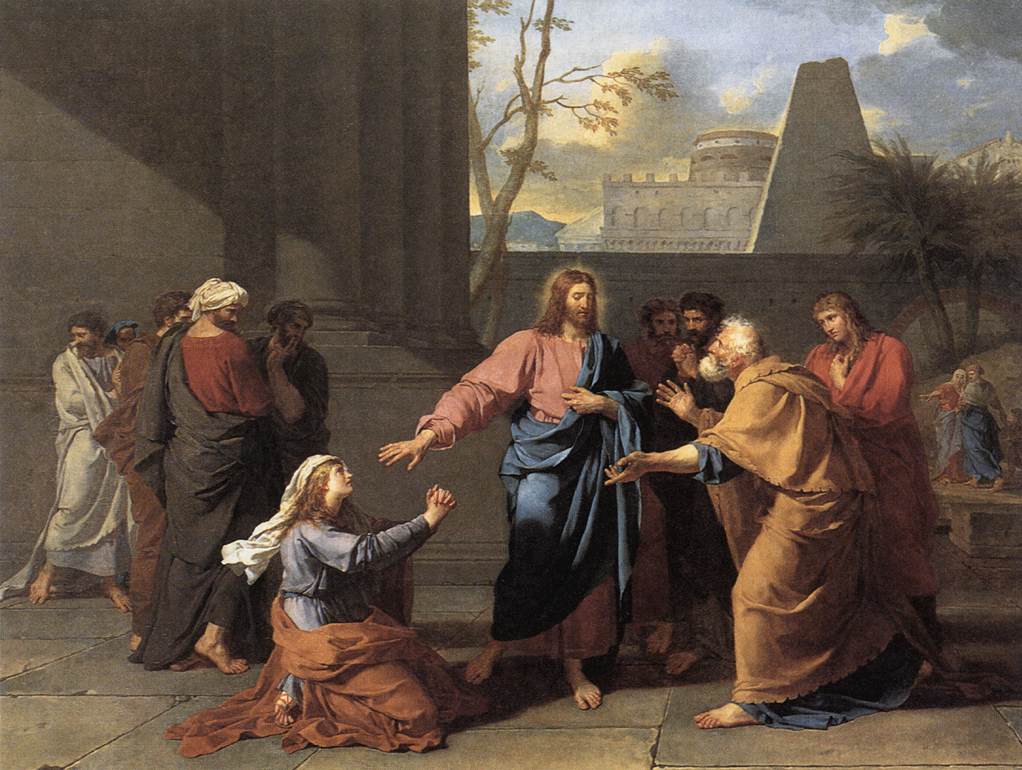
Christ and the Canaanite Woman

Germain-Jean Drouais

1784
Louvre, Paris

7 posted on 02/12/2026 5:33:13 AM PST by annalex (fear them not)
[ Post Reply | Private Reply | To 6 | View Replies]

To: annalex

Who Was St. Eulalia of Barcelona, and Why Is Her Legacy Significant in the Catholic Church?

CATHOLIC ARTICLE / Mary and the Saints / By / 16 minutes of reading

Brief Overview

Detailed Response

Historical Context of St. Eulalia’s Life

St. Eulalia of Barcelona lived during a tumultuous period for Christians in the Roman Empire, specifically under the reign of Emperor Diocletian (284–305 AD). This era, marked by the Great Persecution, saw widespread efforts to suppress Christianity through imperial edicts demanding sacrifices to pagan gods. Eulalia, born around 290 AD near Barcino (modern Barcelona), came from a noble Christian family, according to the Orthodox Church in America. Her parents raised her in the Christian faith, fostering a deep piety that shaped her life from an early age. At just 13 or 14, she lived a life of prayer and devotion, often in seclusion with others her age, engaging in spiritual practices and handicrafts. The arrival of the Roman governor Dacian in Barcino intensified local persecutions, as he enforced Diocletian’s decrees with rigor. Eulalia’s story begins with her bold decision to leave her home and confront Dacian publicly, an act of extraordinary bravery for a young girl. Her defiance in denouncing the persecution of Christians set the stage for her martyrdom. This historical backdrop underscores the challenges faced by early Christians and the courage required to uphold their faith. Eulalia’s life, though brief, reflects the intense spiritual conviction that characterized many early martyrs.

The Martyrdom of St. Eulalia

Eulalia’s martyrdom is a central element of her legacy, marked by her refusal to renounce her faith despite severe consequences. According to tradition, she endured thirteen tortures, one for each year of her life, ordered by Governor Dacian. These tortures included being locked in a flea-infested dungeon, flagellation, and having her flesh torn with iron hooks. Some accounts describe her being rolled down a hill in a barrel filled with knives or broken glass, a particularly gruesome punishment associated with the street now called Baixada de Santa Eulalia in Barcelona. Other sources suggest she was subjected to boiling oil and calcium deposits, with her wounds rubbed with pumice stones. Tradition holds that her tortures culminated in crucifixion on an X-shaped cross, known as a saltire, though some scholars propose she was tortured on an X-frame and left on display, leading to later depictions of crucifixion. A miraculous event at her death—described as a white dove emerging from her mouth and ascending to heaven—symbolized her soul’s ascent and divine approval. This detail, paralleled in the story of Eulalia of Mérida, has fueled debate about their identities but is a cherished element of her hagiography. After her death, a sudden snowstorm reportedly covered her body, seen as a divine act of modesty. Her parents and fellow Christians later buried her, with one Christian, Felix, proclaiming her the first among them to receive the martyr’s crown.

Distinction from St. Eulalia of Mérida

A significant scholarly debate surrounds whether St. Eulalia of Barcelona is distinct from St. Eulalia of Mérida, a martyr with a similar story. Both were young Christian virgins martyred around 304 AD under Diocletian’s persecution, and both share details like the white dove at their deaths. However, historical evidence, including the 7th-century hymn by Bishop Quiricus of Barcelona, supports the existence of two separate saints. The hymn, preserved in the Mozarabic Liturgy, aligns with accounts of Eulalia of Barcelona, while Prudentius’ Peristephanon documents Eulalia of Mérida’s martyrdom. Additionally, the presence of a church and monastery in Cordova named after the Barcelona martyr strengthens her distinct identity. Mozarabic calendars, examined by scholar Dom Ferotin, further corroborate this separation. While Eulalia of Mérida’s veneration spread widely across Spain, particularly during the Reconquista, Eulalia of Barcelona’s cult remained more localized. Critics, such as those noted in 2004 when Eulalia of Barcelona was removed from the Roman Martyrology, argue she may be a localized version of Mérida’s saint, but traditional sources and archaeological evidence, like Bishop Frodoino’s 9th-century discovery of her relics, affirm her unique status. This distinction is crucial for understanding her specific role in Catalan spirituality. The Catholic Church continues to recognize her as a distinct martyr, particularly in Barcelona.

Relics and Their Significance

The relics of St. Eulalia are a cornerstone of her veneration in Barcelona. Initially interred in the church of Santa Maria de les Arenes (now Santa Maria del Mar), her body was hidden in 713 AD during the Moorish invasion to protect it from desecration. In 878, Bishop Frodoino rediscovered her relics in the cemetery of Santa Maria del Mar, along with a marble inscription commemorating her. This rediscovery was a significant event, reinforcing her status as a local patroness. In 1339, her relics were transferred to a polychromed alabaster sarcophagus in the crypt of the newly constructed Cathedral of the Holy Cross and St. Eulalia, crafted by a Pisan sculptor, possibly Luppo di Francesco. The sarcophagus features reliefs depicting her trial, tortures, and burial, serving as both a devotional and artistic testament to her martyrdom. The transfer, witnessed by the king and bishops, underscored her importance to the Christian community. Her relics continue to be venerated, with occasional Orthodox liturgies held at the crypt by agreement with Catholic clergy. The preservation and relocation of her relics reflect the enduring devotion to her in Catalonia. They also symbolize the resilience of Christian faith through centuries of political and religious upheaval.

The Cathedral of the Holy Cross and St. Eulalia

The Cathedral of the Holy Cross and St. Eulalia, Barcelona’s main Catholic church, is a lasting tribute to the martyr. Construction began in 1298 on the foundations of earlier Visigothic and Romanesque churches, with the principal work completed in the 14th century. Dedicated to both the Holy Cross and St. Eulalia, it reflects her status as co-patroness of the city. The cathedral’s Gothic architecture, with its vaulted aisles and radiating chapels, creates a solemn space for veneration. The crypt, housing Eulalia’s sarcophagus, is a focal point for pilgrims and visitors. A unique feature is the cloister’s Well of the Geese, where 13 white geese are kept, symbolizing Eulalia’s age at martyrdom. This tradition, rooted in the miraculous dove associated with her death, adds a distinctive element to the cathedral’s identity. The cathedral’s construction and embellishments, including the neo-Gothic façade completed in 1913, reflect centuries of devotion to Eulalia. It serves as a spiritual and cultural hub, particularly during her feast day celebrations. The cathedral’s prominence underscores Eulalia’s enduring role in Barcelona’s religious life.

Feast Day and Festival in Barcelona

St. Eulalia’s feast day on February 12 is celebrated with a week-long festival in Barcelona, a tradition that highlights her role as co-patroness. The festival includes religious services, cultural events, and processions, drawing locals and visitors to honor her memory. Unlike the larger festival for La Mercè, Barcelona’s other patroness, Eulalia’s celebration is more subdued but deeply rooted in local tradition. Activities often center around the cathedral, where Masses and prayers commemorate her martyrdom. The festival also features cultural performances, such as traditional Catalan dances and music, reflecting the region’s heritage. Statues and street names throughout Barcelona, like the Baixada de Santa Eulalia, serve as reminders of her legacy during these celebrations. The event fosters community unity and reinforces Catholic identity in Catalonia. Historically, Eulalia’s festival was overshadowed by La Mercè’s after the latter was credited with ending a locust plague in the 17th century. Despite this, her feast remains a significant moment for Barcelonians to reflect on her sacrifice. The festival’s continuity demonstrates the lasting impact of her story in Catalan culture.

Patronage and Intercessory Role

St. Eulalia is recognized as the co-patroness of Barcelona, alongside La Mercè, and is also a patron of sailors, pregnant women, and those seeking protection against drought and dysentery. Her patronage of sailors likely stems from Barcelona’s maritime history, with the schooner named after her anchored in the old port. Her intercessory role for pregnant women reflects her purity and youth, qualities often associated with divine protection in Catholic tradition. The attribution of drought protection may be linked to local folklore, such as the belief that sunshine on her feast day benefits apples and cider. These roles highlight her significance in addressing both spiritual and practical needs of the faithful. In Catholic teaching, patron saints serve as intercessors, guiding prayers to God, as outlined in the Catechism of the Catholic Church (CCC 956). Eulalia’s intercessory power is seen in her ability to inspire courage and faith, particularly in times of persecution. Her patronage extends to the Barcelona Cathedral, where her presence is felt in its dedication and relics. Devotees often pray for her intercession during personal trials, drawing on her example of steadfastness. Her multifaceted patronage underscores her importance in both religious and civic life.

Artistic Representations of St. Eulalia

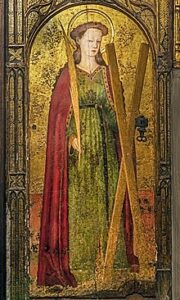
Artistic depictions of St. Eulalia emphasize her martyrdom and sanctity, often portraying her with the X-shaped cross or saltire, her primary iconographic symbol. Statues throughout Barcelona, such as the one at Plaça de Pedró, depict her with this cross, symbolizing her sacrifice. The cathedral’s sarcophagus reliefs, crafted in the 14th century, vividly illustrate her trial, tortures, and burial, blending Gothic and Romanesque styles. Paintings, like John William Waterhouse’s 1885 work, present a more idealized image, focusing on her purity and the miraculous dove rather than the gruesome details of her martyrdom. These artistic choices reflect the Catholic emphasis on glorifying the triumph of faith over suffering, as seen in Lumen Gentium (50). The dove, a recurring motif, symbolizes her soul’s ascent and the Holy Spirit’s presence. Sculptures at sites like l’Hospital de Sant Pau further cement her visual presence in Barcelona. These artworks serve both devotional and educational purposes, teaching the faithful about her courage. The artistic legacy also connects to the broader tradition of martyr iconography in the Church. Such representations ensure that Eulalia’s story remains vivid in Catholic imagination.

Theological Significance of Martyrdom

In Catholic theology, martyrdom is the ultimate witness to faith, as martyrs imitate Christ’s sacrifice on the cross (CCC 2473). St. Eulalia’s martyrdom exemplifies this, as she chose death over apostasy, demonstrating heroic virtue. Her youth enhances the theological weight of her sacrifice, showing that even the young can embody profound faith. The Catechism teaches that martyrs are immediately united with Christ in heaven, their souls purified by their witness (CCC 1258). Eulalia’s reported prayer for God to take her to heaven, followed by the dove’s appearance, aligns with this belief. Her story also reflects the early Church’s emphasis on confessio, or public profession of faith, as a path to sanctity. The Church venerates martyrs as models of holiness, encouraging the faithful to emulate their courage (CCC 828). Eulalia’s defiance of Roman authorities parallels the acts of other early martyrs, reinforcing the Church’s teaching on the primacy of conscience. Her martyrdom also serves as a reminder of the cost of discipleship, as described in Matthew 16:24-25. Her legacy invites Catholics to reflect on their own commitment to faith in the face of adversity.

St. Eulalia in Catalan Identity

St. Eulalia’s story is deeply woven into Catalan cultural and religious identity. As Barcelona’s original patroness, she held a central role until La Mercè’s prominence grew in the 17th century. Her festival, though smaller, remains a key expression of Catalan pride, particularly in the Gothic Quarter. The preservation of her relics through the Moorish invasion and Reconquista reflects Catalonia’s resilience as a Christian region. Street names, statues, and the cathedral’s dedication keep her memory alive in daily life. Her story also resonates with Catalan values of standing firm in one’s beliefs, as seen in her confrontation with Dacian. The 13 geese in the cathedral cloister, a unique local tradition, symbolize her enduring presence. Her veneration fosters a sense of historical continuity, linking modern Catalans to their early Christian ancestors. Even during the Spanish Civil War, when her statue was removed by anarchists, its restoration under Franco’s regime highlighted her symbolic importance. Eulalia’s legacy thus serves as both a spiritual and cultural anchor for Catalonia.

Comparison with Other Child Martyrs

St. Eulalia’s youth places her among other notable child martyrs in the Catholic Church, such as St. Agnes and St. Tarcisius. Like Eulalia, St. Agnes, martyred at 12 or 13 in Rome, refused to renounce her faith, enduring torture and death. St. Tarcisius, a young boy, died protecting the Eucharist, symbolizing devotion to the sacraments. These young martyrs highlight the Church’s belief that holiness transcends age, as noted in CCC 958. Eulalia’s public confrontation with authority sets her apart, emphasizing her boldness compared to Agnes’ more passive resistance. Her tortures, though similar to those of other martyrs, are uniquely numerous, reflecting the intensity of her witness. The dove motif, shared with Eulalia of Mérida, is less common in other martyr stories, adding a distinctive element. These comparisons show that child martyrs, despite their youth, played significant roles in early Christianity. Their stories inspire the faithful to see holiness as attainable at any age. Eulalia’s place among them underscores her importance in the martyrology.

Challenges in Historical Verification

Verifying the historical details of St. Eulalia’s life poses challenges due to the oral nature of early Christian traditions. Her story was first recorded centuries after her death, primarily through Bishop Quiricus’ 7th-century hymn. The similarity with Eulalia of Mérida’s account has led some scholars to question whether they are the same person, a debate noted in the 2004 Roman Martyrology revision. The discovery of her relics by Bishop Frodoino in 878, while significant, has been criticized as potentially fabricated to bolster local devotion. However, the existence of a Cordova church named after her supports her distinct identity. The Acts of her martyrdom, copied in the 12th century by Renallus Grammaticus, provide a concise but late source. Archaeological evidence, such as the marble inscription found with her relics, adds credibility but lacks definitive proof. The Catholic Church accepts her historicity based on tradition and these sources, as per CCC 123. Modern scholars, however, call for caution, emphasizing the need for critical analysis of hagiographic texts. Despite these challenges, her veneration remains robust in Barcelona.

Veneration in the Orthodox Tradition

St. Eulalia is also venerated in the Orthodox Church, particularly in the Orthodox Church in America, which commemorates her on February 12 or sometimes December 10. Orthodox accounts emphasize her solitary life of prayer and her bold denunciation of pagan worship. The snowstorm covering her body and the dove’s appearance are central to Orthodox hagiography, symbolizing divine protection. Since 2004, Russian Orthodox priests have occasionally held liturgies at her crypt in Barcelona’s cathedral, reflecting ecumenical cooperation. Her veneration in Orthodoxy highlights the shared heritage of pre-schism saints, as both Catholic and Orthodox Churches honor martyrs from the undivided Church (CCC 817). Her story resonates with Orthodox teachings on martyrdom as a path to theosis, or union with God. The Orthodox perspective emphasizes her spiritual preparation, noting her engagement with Scripture and handicrafts. This cross-traditional veneration underscores her universal appeal as a martyr. The Orthodox commemoration, though less prominent than in Catholicism, enriches her legacy. Her story bridges the two traditions, fostering dialogue and shared reverence.

Miracles Attributed to St. Eulalia

Catholic tradition attributes several miracles to St. Eulalia, most notably the white dove and snowstorm at her death. These events, recorded in hagiographic accounts, signify divine intervention and her sanctity. The dove, a symbol of the Holy Spirit, is seen as confirmation of her immediate entry into heaven (CCC 1258). The snowstorm, covering her body, is interpreted as God’s act to preserve her dignity. Some sources suggest her intercession protected Barcelona from destruction during modern terrorist attacks, though these claims lack definitive evidence. Her failure to stop a locust plague in the 17th century led to La Mercè’s rise as a patroness, but this does not diminish her spiritual significance. Local folklore credits her with influencing weather, particularly for agriculture, as seen in sayings about her feast day. These miracles, while rooted in tradition, align with the Church’s cautious approach to verifying supernatural events (CCC 67). They inspire devotion by illustrating God’s power through her intercession. Her miraculous legacy continues to draw pilgrims to her crypt.

St. Eulalia’s Role in the Reconquista

During the Reconquista, the centuries-long Christian effort to reclaim Spain from Muslim rule, St. Eulalia’s name was invoked as a symbol of resistance. Her relics, hidden during the 713 Moorish invasion, were rediscovered in 878, a time when Christian communities sought to reaffirm their faith. Her story of defiance against pagan authorities resonated with Christians fighting for their homeland. While St. James (Santiago) later became the primary warrior saint, Eulalia’s earlier role as a protector of Christian troops is noted in historical accounts. Her veneration during this period strengthened Barcelona’s Christian identity. The transfer of her relics to the cathedral in 1339, during the Reconquista’s progress, symbolized the triumph of Christianity in Catalonia. Her example inspired martyrs like St. Eulogius of Cordova, who cited her courage in defending spontaneous confessions of faith. The Catechism highlights martyrs as witnesses to the truth of the Gospel, a role Eulalia fulfilled (CCC 2474). Her legacy in the Reconquista underscores her as a spiritual warrior. This historical role enhances her significance in Spanish Catholic history.

Modern Relevance of St. Eulalia

In contemporary times, St. Eulalia’s story remains relevant for Catholics seeking models of courage and faith. Her youth and determination inspire young people to stand firm in their beliefs, even in the face of societal pressures. The Catechism emphasizes the call to witness Christ in all circumstances (CCC 1816), a call Eulalia answered heroically. Her festival encourages community engagement and reflection on Christian values in a secularizing world. The cathedral’s geese and her statues serve as tangible reminders of her presence in Barcelona. Her intercessory role continues to draw devotees, particularly sailors and pregnant women, seeking her aid. The ecumenical liturgies at her crypt reflect her ability to unite different Christian traditions. Her story also prompts reflection on the persecution of Christians, a reality still faced in some regions today (CCC 2112). By honoring her, Catholics are reminded of the enduring power of faith. Her legacy challenges the faithful to live authentically in their spiritual commitments.

Lessons from St. Eulalia’s Life

St. Eulalia’s life offers several lessons for Catholics today. Her courage in confronting injustice reflects the Christian duty to speak truth, as taught in Ephesians 4:15. Her youth shows that holiness is not limited by age, encouraging young Catholics to pursue sanctity. Her refusal to compromise her faith mirrors the Church’s call to fidelity (CCC 1816). The miraculous signs at her death affirm the belief in God’s presence in suffering. Her story also teaches resilience, as her relics’ preservation through invasions symbolizes the Church’s endurance. Her intercessory role encourages reliance on the communion of saints (CCC 957). Her festival fosters community, reminding Catholics of the importance of shared worship. Her legacy also highlights the value of local traditions in strengthening faith. By reflecting on her life, Catholics are inspired to live with conviction and trust in God’s grace.

Conclusion

St. Eulalia of Barcelona’s legacy as a 3rd-century child martyr remains a powerful testament to faith and courage within the Catholic Church. Her story, rooted in historical tradition and supported by archaeological evidence, distinguishes her as a unique figure despite debates with Eulalia of Mérida. Her relics, cathedral, and festival keep her memory alive in Catalonia, where she is a symbol of spiritual and cultural identity. Her martyrdom, marked by extraordinary bravery and divine signs, aligns with the Church’s teachings on the sanctity of martyrs (CCC 2473). Her veneration in both Catholic and Orthodox traditions underscores her universal appeal. As co-patroness of Barcelona, she continues to inspire devotion, particularly among sailors and those seeking strength in trials. Her artistic representations and the cathedral’s geese add distinctive elements to her legacy. Though less known globally, her story challenges Catholics to emulate her unwavering commitment to Christ. Her life invites reflection on the cost of discipleship and the power of faith to transform lives. St. Eulalia’s enduring significance lies in her witness to the Gospel, a legacy that continues to resonate in Barcelona and beyond.

Disclaimer: This article presents Catholic teaching for educational purposes. For official Church teaching, consult the Catechism and magisterial documents. For personal spiritual guidance, consult your parish priest or spiritual director. Questions? Contact editor@catholicshare.com


catholicshare.com
8 posted on 02/12/2026 5:40:23 AM PST by annalex (fear them not)
[ Post Reply | Private Reply | To 7 | View Replies]

To: annalex

9 posted on 02/12/2026 5:43:30 AM PST by annalex (fear them not)
[ Post Reply | Private Reply | To 8 | View Replies]

To: annalex

NAVARRE BIBLE COMMENTARY(RSV)

Ad Majorem Dei Gloriam (To the Greater Glory of God)

Today’s First Reading

From: 1 Kings 11:4-13

The King’s Sins (Continuation)
------------------------------
[4] For when Solomon was old his wives turned away his heart after other gods, and his heart was not wholly true to the LORD his God, as was the heart of David his father. [5] For Solomon went after Ashtoreth the goddess of the Sidonians, and after Milcom the abomination of the Ammonites. [6] So Solomon did what was evil in the sight of the LORD, and did not wholly follow the LORD, as David his father had done. [7] Then Solomon built a high place for Chemosh the abomination of Moab, and for Molech the abomination of the Ammonites, on the mountain east of Jerusalem. [8] And so he did for all his foreign wives, who burned incense and sacrificed to their gods.

[9] And the LORD was angry with Solomon, because his heart had turned away from the LORD, the God of Israel, who had appeared to him twice, [10] and had commanded him concerning this thing, that he should not go after other gods; but he did not keep what the LORD commanded.

The Division of the Kingdom Foretold
------------------------------------
[11] Therefore the LORD said to Solomon, “Since this has been your mind and you have not kept my covenant and my statutes which I have commanded you, I will surely tear the kingdom from you and will give it to your servant. [12] Yet for the sake of David your father I will not do it in your days, but I will tear it out of the hand of your son. [13] However I will not tear away all the kingdom; but I will give one tribe to your son, for the sake of David my servant and for the sake of Jerusalem which I have chosen.”

***********************************************************************
Commentary:

11:1-43 The sacred Writer deals briefly with some negative aspects of Solomon, and in them we can see the cause of the split in the kingdom that occurred after his death. Applying the teaching of the book of Deuteronomy he allows us to see that when Solomon was true to the Lord, peace and prosperity reigned; but when he moved away from God (vv. 1-10) he was visited with divine punishment (vv. 11-13) in the form of Israel’s external enemies (vv. 14-25) and internal division (vv. 26-40). Yet the split will not happen in Solomon’s lifetime: by the mercy of God he will see out his reign in peace (vv. 41-43).

11:1-10. Conscious of the effects of Solomon’s marriages with foreign women, the writer retrospectively applies a law (v. 2) which was not in fact made until later (Deut 7:3-4; 17:17).

The real cause of Solomon’s sin was that “his wives turned away his heart” (v. 3), not just by getting his permission to worship idols but by involving him in that practice. This meant that Solomon ceased to worship the God of Israel with all his heart. “Idolatry refers not only to false pagan worship. It remains a constant temptation to faith. Idolatry consists in divinizing what is not God. Man commits idolatry whenever he honors and reveres a creature in place of God, whether this be gods or demons (for example, satanism), power, pleasure, race, ancestors, the state, money, etc. Jesus says, ‘You cannot serve God and mammon (Mt 6:24). Many martyrs died for not adoring ‘The Beast’ (cf. Rev 13-14) refusing even to simulate such worship. Idolatry rejects the unique Lordship of God; it is therefore incompatible with communion with God (cf.Gal 5:20; Eph 5:5)” ("Catechism of the Catholic Church", 2113).

11:11-13. These words of the Lord to Solomon provide the key to understanding what is going to happen after the king dies. Although Solomon’s sin would have justified the kingdom’s being taken away from the house of David, God is faithful to his promises to David (cf. 2 Sam 7:12-15) and to Solomon himself (cf 1 Kings 9:3): he leaves the tribe of Judah with the city of Jerusalem under a king of Solomon’s and, therefore, of David’s line. This shows that if Judah and its capital survive it is only because of God's fidelity to his promise.

10 posted on 02/12/2026 7:27:06 AM PST by fidelis (Ecce Crucem Domini! Fugite partes adversae! Vicit Leo de tribu Juda, Radix David! Alleluia!)
[ Post Reply | Private Reply | To 9 | View Replies]

Today’s Gospel Reading

From: Mark 7:24-30

The Curing of the Syrophoenician Woman
--------------------------------------
[24] And from there he (Jesus) arose and went away to the region of Tyre and Sidon. And he entered a house, and would not have any one know it; yet he could not be hid. [25] But immediately a woman, whose little daughter was possessed by an unclean spirit, heard of him, and came and fell down at his feet. [26] Now the woman was a Greek, a Syrophoenician by birth. And she begged him to cast the demon out of her daughter. [27] And he said to her, "Let the children first be fed, for it is not right to take the children's bread and throw it to the dogs." [28] But she answered him, "Yes, Lord; yet even the dogs under the table eat the children's crumbs." [29] And he said to her, "For this saying you may go your way; the demon has left your daughter." [30] And she went home, and found the child lying in bed, and the demon gone.

***********************************************************************
Commentary:

24. The region of Tyre and Sidon is nowadays the southern part of Lebanon--Phoenicia in ancient times. The distance from the lake of Gennesaret to the frontier of Tyre and Sidon is not more than 50 kms (30 miles). Jesus withdrew from Palestine to avoid persecution by the Jewish authorities and to give the Apostles more intensive training.

27. Our Lord actually uses the diminutive--"little dogs" to refer to the Gentiles--thereby softening a scornful expression which Jews used. On the episode of the Canaanite woman cf. notes on parallel passages, Mt 15:21-28.

[The notes on Mt 15:21-28 states: 21-22. Tyre and Sidon were Phoenician cities on the Mediterranean coast, in present-day Lebanon. They were never part of Galilee but they were near its northeastern border. In Jesus' time they were outside the territory of Herod Antipas. Jesus withdrew to this area to escape persecution from Herod and from the Jewish authorities and to concentrate on training His Apostles.

Most of the inhabitants of the district of Tyre and Sidon were pagans. St. Matthew calls this woman a "Canaanite"; according to Genesis (10:15), this district was one of the first to be settled by the Canaanites; St. Mark describes the woman as a "Syrophoenician" (Mark 7:26). Both Gospels point out that she is a pagan, which means that her faith in our Lord is more remarkable; the same applies in the case of the centurion (Matthew 8:5-13).

The Canaanite woman's prayer is quite perfect: she recognizes Jesus as the Messiah (the Son of David)--which contrasts with the unbelief of the Jews; she expresses her need in clear, simple words; she persists, undismayed by obstacles; and she expresses her request in all humility: "Have mercy on me." Our prayer should have the same qualities of faith, trust, perseverance and humility.

24. What Jesus says here does not take from the universal reference of His teaching (cf. Matthew 28:19-20; Mark 16:15-16). Our Lord came to bring His Gospel to the whole world, but He Himself addressed only the Jews; later on He will charge His Apostles to preach the Gospel to pagans. St. Paul, in his missionary journeys, also adopted the policy of preaching in the first instance to the Jews (Acts 13:46).

25-28. This dialogue between Jesus and the woman is especially beautiful. By appearing to be harsh He so strengthens the woman's faith that she deserves exceptional praise: "Great is your faith!" Our own conversation with Christ should be like that: "Persevere in prayer. Persevere, even when your efforts seem barren. Prayer is always fruitful" (St J. Escriva, "The Way", 101). ]

11 posted on 02/12/2026 7:28:17 AM PST by fidelis (Ecce Crucem Domini! Fugite partes adversae! Vicit Leo de tribu Juda, Radix David! Alleluia!)
[ Post Reply | Private Reply | To 10 | View Replies]

Click here to go to the My Catholic Life! Devotional thread for a meditation on today’s Gospel Reading.

12 posted on 02/12/2026 7:29:01 AM PST by fidelis (Ecce Crucem Domini! Fugite partes adversae! Vicit Leo de tribu Juda, Radix David! Alleluia!)
[ Post Reply | Private Reply | To 11 | View Replies]

Disclaimer: Opinions posted on Free Republic are those of the individual posters and do not necessarily represent the opinion of Free Republic or its management. All materials posted herein are protected by copyright law and the exemption for fair use of copyrighted works.

Free Republic
Browse · Search
Religion
Topics · Post Article

FreeRepublic, LLC, PO BOX 9771, FRESNO, CA 93794
FreeRepublic.com is powered by software copyright 2000-2008 John Robinson