Free Republic
Browse · Search
Religion
Topics · Post Article

Skip to comments.

Catholic Caucus: Daily Mass Readings 7-February-2026
Universalis/Jerusalem Bible ^

Posted on 02/07/2026 10:07:28 AM PST by annalex

7 February 2026

Saturday of week 4 in Ordinary Time


Altarpiece and shrine of Saint Richard the Pilgrim, in San Frediano, at Lucca, Italy

Readings at Mass

Liturgical Colour: Green. Year: A(II).


First reading1 Kings 3:4-13

Solomon chooses the gift of wisdom

King Solomon went to Gibeon to sacrifice there, since that was the greatest of the high places – Solomon offered a thousand holocausts on that altar. At Gibeon the Lord appeared in a dream to Solomon during the night. God said, ‘Ask what you would like me to give you.’ Solomon replied, ‘You showed great kindness to your servant David, my father, when he lived his life before you in faithfulness and justice and integrity of heart; you have continued this great kindness to him by allowing a son of his to sit on his throne today. Now, O Lord my God, you have made your servant king in succession to David my father. But I am a very young man, unskilled in leadership. Your servant finds himself in the midst of this people of yours that you have chosen, a people so many its number cannot be counted or reckoned. Give your servant a heart to understand how to discern between good and evil, for who could govern this people of yours that is so great?’ It pleased the Lord that Solomon should have asked for this. ‘Since you have asked for this’ the Lord said ‘and not asked for long life for yourself or riches or the lives of your enemies, but have asked for a discerning judgement for yourself, here and now I do what you ask. I give you a heart wise and shrewd as none before you has had and none will have after you. What you have not asked I shall give you too: such riches and glory as no other king ever had.’


Responsorial Psalm
Psalm 118(119):9-14
Lord, teach me your statutes.
How shall the young remain sinless?
  By obeying your word.
I have sought you with all my heart;
  let me not stray from your commands.
Lord, teach me your statutes.
I treasure your promise in my heart
  lest I sin against you.
Blessed are you, O Lord;
  teach me your statutes.
Lord, teach me your statutes.
With my tongue I have recounted
  the decrees of your lips.
I rejoiced to do your will
  as though all riches were mine.
Lord, teach me your statutes.

Gospel AcclamationJn10:27
Alleluia, alleluia!
The sheep that belong to me listen to my voice,
says the Lord,
I know them and they follow me.
Alleluia!

GospelMark 6:30-34

They were like sheep without a shepherd

The apostles rejoined Jesus and told him all they had done and taught. Then he said to them, ‘You must come away to some lonely place all by yourselves and rest for a while’; for there were so many coming and going that the apostles had no time even to eat. So they went off in a boat to a lonely place where they could be by themselves. But people saw them going, and many could guess where; and from every town they all hurried to the place on foot and reached it before them. So as he stepped ashore he saw a large crowd; and he took pity on them because they were like sheep without a shepherd, and he set himself to teach them at some length.

You can also view this page with the New Testament in Greek and English.

Universalis podcast: The week ahead – from 8 to 14 February 2025

Saint Scholastica; the Shipwreck of St Paul; Our Lady of Lourdes; Saints Cyril and Methodius, and the Basilica of San Clemente. (22 minutes)
Episode notes.Play

The readings on this page are from the Jerusalem Bible, which is used at Mass in most of the English-speaking world. The New American Bible readings, which are used at Mass in the United States, are available in the Universalis apps, programs and downloads.

You can also view this page with the Gospel in Greek and English.


TOPICS: Catholic; General Discusssion; Prayer; Worship
KEYWORDS: catholic; mk6; ordinarytime; prayer

Click here: to donate by Credit Card

Or here: to donate by PayPal

Or by mail to: Free Republic, LLC - PO Box 9771 - Fresno, CA 93794

Thank you very much and God bless you.

For your reading, reflection, faith-sharing, comments, questions, discussion.

1 posted on 02/07/2026 10:07:28 AM PST by annalex
[ Post Reply | Private Reply | View Replies]

To: All

KEYWORDS: catholic; mk6; ordinarytime; prayer


2 posted on 02/07/2026 10:08:00 AM PST by annalex (fear them not)
[ Post Reply | Private Reply | To 1 | View Replies]

To: nickcarraway; NYer; ELS; Pyro7480; livius; ArrogantBustard; Catholicguy; RobbyS; marshmallow; ...


Alleluia Ping

Please FReepmail me to get on/off the Alleluia Ping List.


"Christian Art" section is not working at source.
3 posted on 02/07/2026 10:09:05 AM PST by annalex (fear them not)
[ Post Reply | Private Reply | To 2 | View Replies]

To: annalex
Chris Robinson: My Dad [our Jim Robinson] Passed Away Peacefully Monday Night (October 27th) In Our Home.
Jim still needs our prayers. Thread 2
Prayer thread for Salvation's recovery
Pray for Ukraine
Prayer thread for Fidelis' recovery
Update on Jim Robinson's health issues
4 posted on 02/07/2026 10:09:30 AM PST by annalex (fear them not)
[ Post Reply | Private Reply | To 3 | View Replies]

To: annalex
Mark
 English: Douay-RheimsLatin: Vulgata ClementinaGreek NT: Byzantine/Majority Text (2000)
 Mark 6
30And the apostles coming together unto Jesus, related to him all things that they had done and taught. Et convenientes Apostoli ad Jesum, renuntiaverunt ei omnia quæ egerant, et docuerant.και συναγονται οι αποστολοι προς τον ιησουν και απηγγειλαν αυτω παντα και οσα εποιησαν και οσα εδιδαξαν
31And he said to them: Come apart into a desert place, and rest a little. For there were many coming and going: and they had not so much as time to eat. Et ait illis : Venite seorsum in desertum locum, et requiescite pusillum. Erant enim qui veniebant et redibant multi : et nec spatium manducandi habebant.και ειπεν αυτοις δευτε υμεις αυτοι κατ ιδιαν εις ερημον τοπον και αναπαυεσθε ολιγον ησαν γαρ οι ερχομενοι και οι υπαγοντες πολλοι και ουδε φαγειν ευκαιρουν
32And going up into a ship, they went into a desert place apart. Et ascendentes in navim, abierunt in desertum locum seorsum.και απηλθον εις ερημον τοπον τω πλοιω κατ ιδιαν
33And they saw them going away, and many knew: and they ran flocking thither on foot from all the cities, and were there before them. Et viderunt eos abeuntes, et cognoverunt multi : et pedestres de omnibus civitatibus concurrerunt illuc, et prævenerunt eos.και ειδον αυτους υπαγοντας και επεγνωσαν αυτον πολλοι και πεζη απο πασων των πολεων συνεδραμον εκει και προηλθον αυτους και συνηλθον προς αυτον
34And Jesus going out saw a great multitude: and he had compassion on them, because they were as sheep not having a shepherd, and he began to teach them many things. Et exiens vidit turbam multam Jesus : et misertus est super eos, quia erant sicut oves non habentes pastorem, et cœpit docere multa.και εξελθων ειδεν ο ιησους πολυν οχλον και εσπλαγχνισθη επ αυτοις οτι ησαν ως προβατα μη εχοντα ποιμενα και ηρξατο διδασκειν αυτους πολλα

5 posted on 02/07/2026 10:11:57 AM PST by annalex (fear them not)
[ Post Reply | Private Reply | To 4 | View Replies]

To: annalex

Catena Aurea by St. Thomas Aguinas

6:30–34

30. And the apostles gathered themselves together unto Jesus, and told him all things, both what they had done, and what they had taught.

31. And he said unto them, Come ye yourselves apart into a desert place, and rest a while: for there were many coming and going, and they had no leisure so much as to eat.

32. And they departed into a desert place by ship privately.

33. And the people saw them departing, and many knew him, and ran afoot thither out of all cities, and outwent them, and came together unto him.

34. And Jesus, when he came out, saw much people, and was moved with compassion toward them, because they were as sheep not having a shepherd: and he began to teach them many things.

GLOSS. (non occ.) The Evangelist, after relating the death of John, gives an account of those things which Christ did with His disciples after the death of John, saying, And the Apostles gathered themselves together unto Jesus, and told him all things, both what they had done, and what they had taught.

PSEUDO-JEROME. For they return to the fountain-head whence the streams flow; those who are sent by God, always offer up thanks for those things which they have received.

THEOPHYLACT. Let us also learn, when we are sent on any mission, not to go far away, and not to overstep the bounds of the office committed, but to go often to him, who sends us, and report all that we have done and taught; for we must not only teach but act.

BEDE. (ubi sup.) Not only do the Apostles tell the Lord what they themselves had done and taught, but also his own and John’s disciples together tell Him what John had suffered, during the time that they were occupied in teaching, as Matthew relates. It goes on: And he said to them, Come ye yourselves apart, &c.

AUGUSTINE. (de Con. Evan. 2. 45) This is said to have taken place, after the passion of John, therefore what is first related took place last, for it was by these events that Herod was moved to say, This is John the Baptist, whom I beheaded.

THEOPHYLACT. Again, He goes into a desert place from His humility. But Christ makes His disciples rest, that men who are set over others may learn, that they who labour in any work or in the word deserve rest, and ought not to labour continually.

BEDE. (ubi sup.) How arose the necessity for giving rest to His disciples, He shews, when He adds, For there were many coming and going, and they had no leisure so much as to eat; we may then see how great was the happiness of that time, both from the toil of the teachers, and from the diligence of the learners. It goes on, And embarking in a ship, they departed into a desert place privately. The disciples did not enter into the ship alone, but taking up the Lord with them, they went to a desert place, as Matthew shews. (Matt. 14) Here He tries the faith of the multitude, and by seeking a desert place He would see whether they care to follow Him. And they follow Him, and that not on horseback, nor in carriages, but laboriously coming on foot, they shew how great is their anxiety for their salvation. There follows, And the people saw them departing, and many knew him, and ran afoot thither out of all cities, and outwent them. In saying that they outwent them on foot, it is proved that the disciples with the Lord did not reach the other bank of the sea, or of the Jordan, but they went to the nearest places of the same country, where the people of those parts could come to them on foot.

THEOPHYLACT. So do thou not wait for Christ till He Himself call you, but outrun Him, and come before Him. There follows, And Jesus when he came out saw much people, and was moved with compassion towards them, because they were as sheep having no shepherd. The Pharisees being ravening wolves did not feed the sheep, but devoured them; for which reason they gather themselves to Christ, the true Shepherd, who gave them spiritual food, that is, the word of God. Wherefore it goes on, And he began to teach them many things. For seeing that those who followed Him on account of His miracles were tired from the length of the way, He pitied them, and wished to satisfy their wish by teaching them.

BEDE. (in Marc. 2, 26) Matthew says that He healed their sick, for the real way of pitying the poor is to open to them the way of truth by teaching them, and to take away their bodily pains.

PSEUDO-JEROME. Mystically, however, the Lord took apart those whom He chose, that though living amongst evil men, they might not apply their minds to evil things, as Lot in Sodom, Job in the land of Uz, and Obadiah in the house of Ahab.

BEDE. (in Marc. 2, 25) Leaving also Judæa, the holy preachers, in the desert of the Church, overwhelmed by the burden of their tribulations amongst the Jews, obtained rest by the imparting of the grace of faith to the Gentiles.

PSEUDO-JEROME. Little indeed is the rest of the saints here on earth, long is their labour, but afterwards, they are bidden to rest from their labours. But as in the ark of Noah, the animals that were within were sent forth, and they that were without rushed in, so is it in the Church, Judas went, the thief came to Christ. But as long as men go back from the faith, the Church can have no refuge from grief; for Rachel weeping for her children would not be comforted. Moreover, this world is not the banquet, in which the new wine is drank, when the new song will be sung by men made anew, when this mortal shall have put on immortality.

BEDE. (in Marc. 2, 26) But when Christ goes to the deserts of the Gentiles, many bauds of the faithful leaving the walls of their cities, that is their old manner of living, follow Him.

Catena Aurea Mark 6


6 posted on 02/07/2026 10:13:18 AM PST by annalex (fear them not)
[ Post Reply | Private Reply | To 5 | View Replies]

To: annalex


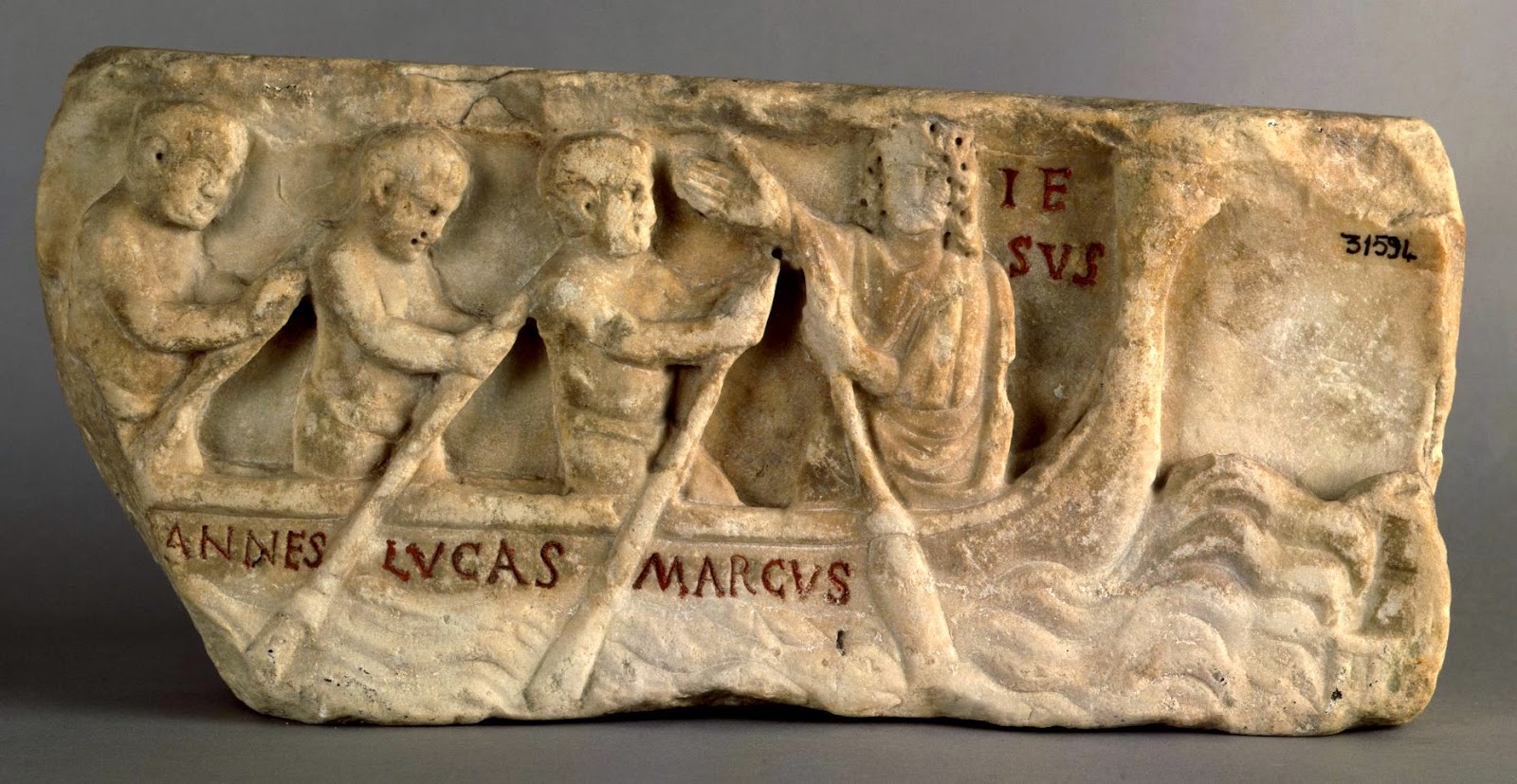
Jesus in a boat with John, Luke and Mark

Marble, from the wall of Spoleto
c AD 300
20 x 46 x 7.5 cm
Pius Christian Museum, Vatican Museums, Vatican City

7 posted on 02/07/2026 10:13:57 AM PST by annalex (fear them not)
[ Post Reply | Private Reply | To 6 | View Replies]

To: annalex

Who is St. Richard the Pilgrim?

1,000 miles from home, this holy king blesses a city in Italy.

Anglo-Saxon

The king was dead.

He was 1,000 miles from home, on pilgrimage in a foreign land. But instead of landing in an unmarked grave, far from anyone who would remember him, this king was venerated by the strangers around him.

They buried him with reverence in their own basilica. They prayed at the tomb of the foreign king, confident that he heard them from paradise. And he did. Miracles started to happen. Graces and answers to prayer flowed from the spot.

The people of Lucca knew that Richard was a powerful saint sent to them by God.

But…how did he get there in the first place?

Richard was from England. He ruled the old Anglo-Saxon kingdom of Wessex. Tradition holds that he’s the father of three early British saints—Willibald, Winnibald, and Walpurga.

In 720 A.D., towards the end of his life, Richard decided to travel to Rome. Renouncing his throne, he set off on the journey—accompanied by his two sons—and got as far as Lucca, Italy. There he fell sick. His ensuing illness and holy death inspired in those around him the devotion that prevails today.

Traveling is much easier now than it was in St. Richard’s time—not least because of the existence of travel mugs! Whether your trip is local or global, take along our Catholic Coffee Travel Mug. Perfectly insulated, stylishly practical, unabashedly Catholic, this mug has your coffee’s back. Pick it up today at The Catholic Company!


catholiccompany.com

8 posted on 02/07/2026 10:18:33 AM PST by annalex (fear them not)
[ Post Reply | Private Reply | To 7 | View Replies]

To: annalex

9 posted on 02/07/2026 10:20:34 AM PST by annalex (fear them not)
[ Post Reply | Private Reply | To 8 | View Replies]

To: annalex

NAVARRE BIBLE COMMENTARY(RSV)

Ad Majorem Dei Gloriam (To the Greater Glory of God)

Today’s First Reading

From: 1 Kings 3:4-13

Solomon’s Request of God (Continuation)
--------------------------------------
[4] And the king (Solomon) went to Gibeon to sacrifice there, for that was the great high place; Solomon used to offer a thousand burnt offerings upon that altar. [5] At Gibeon the LORD appeared to Solomon in a dream by night; and God said, “Ask what I shall give you.” [6] And Solomon said, “Thou hast shown great and steadfast love to thy servant David my father, because he walked before thee in faithfulness, in righteousness, and in uprightness of heart toward thee; and thou hast kept for him this great and steadfast love, and hast given him a son to sit on his throne this day. [7] And now, O LORD my God, thou hast made thy servant king in place of David my father, although I am but a little child; I do not know how to go out or come in. [8] And thy servant is in the midst of thy people whom thou hast chosen, a great people, that cannot be numbered or counted for multitude. [9] Give thy servant therefore an understanding mind to govern thy people, that I may discern between good and evil; for who is able to govern this thy great people?”

[10] lt pleased the Lord that Solomon had asked this. [11] And God said to him, “Because you have asked this, and have not asked for yourself long life or riches or the life of your enemies, but have asked for yourself understanding to discern what is right, [12] behold, I now do according to your word. Behold, I give you a wise and discerning mind, so that none like you has been before you and none like you shall arise after you. [13] I give you also what you have not asked, both riches and honor, so that no other king shall compare with you, all your days."

***********************************************************************
Commentary:

3:1-11:1:43. The reign of Solomon became idealized in the memory of Israel. The sacred writer of 1 and 2 Kings gives him much more space than any other king. First we are shown his wisdom (3:1-5:14), which would become proverbial and would cause wisdom books such as Proverbs, Ecclesiastes and the Book of Wisdom to be attributed to him, and also poetical books such as the Song of Songs and a collection of Psalms. He then goes on to deal with the king’s public works programme (5:15-9:9), especially the building of the temple and its dedication, for that temple would become the center of the religious life of the people. On these two scores Solomon became famous inside and outside Israel, as explained in 9:10-10:29. Finally, with a realism rare among historians of the time, the writer exposes the king’s sins and failings towards the end of his reign (11:1-40).

The reign of Solomon is depicted in these chapters in all its splendor--and all its weakness. The splendor derives from the wisdom with which God endows the king (3:1-5:14) and is to be found in Solomon’s great buildings (especially the temple: 5:15-7:51), in his prayer at the dedication of the temple (8:1-9:9) and in the booming commerce which gives Solomon great prestige and untold wealth (9:10-10:29). The king’s weakness lies in his unfaithfulness to God, for, to please his foreign wives, he introduces the worship of other gods into the country. There are political weaknesses, too: cracks are appearing in the (north-south) union, and enemies exist inside and outside the state (11:1-40).

3:1-5:14. The most important trait of Solomon is his wisdom, to which our Lord refers in the Gospel (cf. Mt 12:45). The sacred writer shows here the source and evidence of that wisdom: it is a gift from God, his answer to the king’s prayer (3:12-14), and it can be seen in the way Solomon administers justice (3:16-28) and in the way that court and kingdom are organized, that is, in the typical functions of a king (4:1-24). The more he acts with wisdom, the wiser he becomes (4:29-34).

3:2-14. The “high places” (v. 2) were altars built in open country, on the top of some hill, and under a shady tree, where Canaanites and Israelites of this period offered sacrifices to the divinity. From the time of King Josiah’s reform in 622 this type of worship was expressly forbidden in case the worship of God should become associated with worship of local gods, baals (cf. 2 Kings 23:4-20).

Gibeon, about 10 km. (6 miles) northwest of Jerusalem, belonged to the tribe of Benjamin (cf. Josh 18:25) and was one of the cities given over to the Levites (cf. Josh 21:17) in which according to Chronicles, the desert tent or tabernacle was kept for a time (cf. 1 Chron 21:29). The fact that the Lord should speak to Solomon here also means that he is confirming him as king of Israel.

Solomon’s request pleases the Lord because it is made with humility (cf. v. 7) and because he asks not for material things but for “an understanding mind” so as to be able to govern well (vv. 9-14). Solomon’s request is an anticipation of the proper order which, according to Christ’s teaching, should be present in prayer of petition: “The one Master and Lord teaches us how and in what order we ought to pray to God for the things we want; since we indicate and express our desires and petitions in, prayer, then we pray properly and well when the order of our petitions matches the right order of desires. True charity teaches us that we ought to dedicate ourselves and all our desires to God; God, the supreme Good, deserves the highest form of love. And God cannot be loved from the heart, exclusively, if his honor and glory are not valued above all other things and creatures; all good things, those we have and those we do not possess, all things that are called good, must be subordinated to the supreme Good from whom they derive their goodness” ("Roman Catechism", 4, 10, 1).

10 posted on 02/07/2026 10:21:04 AM PST by fidelis (Ecce Crucem Domini! Fugite partes adversae! Vicit Leo de tribu Juda, Radix David! Alleluia!)
[ Post Reply | Private Reply | To 8 | View Replies]

Today’s Gospel Reading

From: Mark 6:30-34

The Apostles Return
-------------------
[30] The Apostles returned to Jesus, and told Him all that they had done and taught. [31] And He said to them, "Come away by yourselves to a lonely place, and rest a while." For many were coming and going, and they had no leisure even to eat. [32] And they went away in the boat to a lonely place by themselves.

First Miracles of the Loaves
----------------------------
[33] Now many saw them going, and knew them, and they ran there on foot from the towns, and got there ahead of them. [34] As He landed He saw a great throng, and He had compassion on them, because they were like sheep without a shepherd; and He began to teach them many things.

***********************************************************************
Commentary:

30-31. We can see here the intensity of Jesus' public ministry. Such was His dedication to souls that St. Mark twice mentions that the disciples did not even have time to eat (cf. Mark 3:20). A Christian should be ready to sacrifice his time and even his rest in the service of the Gospel. This attitude of availability will lead us to change our plans whenever the good of souls so requires.

But Jesus also teaches us here to have common sense and not to go to such extremes that we physically cannot cope: "The Lord makes His disciples rest, to show those in charge that people who work or preach cannot do so without breaks" (St. Bede, "In Marci Evangelium Expositio, in loc."). "He who pledges himself to work for Christ should never have a free moment, because to rest is not to do nothing: it is to relax in activities which demand less effort" (St J. Escriva, "The Way", 357).

34. Our Lord had planned a period of rest, for Himself and His disciples, from the pressures of the apostolate (Mark 6:31-32). And He has to change His plans because so many people come, eager to hear Him speak. Not only is He not annoyed with them: He feels compassion on seeing their spiritual need. "My people are destroyed for lack of knowledge" (Hosea 4:6). They need instruction and our Lord wants to meet this need by preaching to them. "Jesus is moved by hunger and sorrow, but what moves Him most is ignorance" (St J. Escriva, "Christ Is Passing By", 109).

11 posted on 02/07/2026 10:21:25 AM PST by fidelis (Ecce Crucem Domini! Fugite partes adversae! Vicit Leo de tribu Juda, Radix David! Alleluia!)
[ Post Reply | Private Reply | To 10 | View Replies]

Click here to go to the My Catholic Life! Devotional thread for a meditation on today’s Gospel Reading.

12 posted on 02/07/2026 10:22:33 AM PST by fidelis (Ecce Crucem Domini! Fugite partes adversae! Vicit Leo de tribu Juda, Radix David! Alleluia!)
[ Post Reply | Private Reply | To 11 | View Replies]

Disclaimer: Opinions posted on Free Republic are those of the individual posters and do not necessarily represent the opinion of Free Republic or its management. All materials posted herein are protected by copyright law and the exemption for fair use of copyrighted works.

Free Republic
Browse · Search
Religion
Topics · Post Article

FreeRepublic, LLC, PO BOX 9771, FRESNO, CA 93794
FreeRepublic.com is powered by software copyright 2000-2008 John Robinson