Posted on 02/05/2026 5:19:12 AM PST by annalex
Saint Agatha, Virgin, Martyr on Thursday of week 4 in Ordinary Time ![]() Saint Agatha Church, Saint Louis, Missouri Readings at MassLiturgical Colour: Red. Year: A(II). These are the readings for the feria
David's dying exhortation to SolomonAs David’s life drew to its close he laid this charge on his son Solomon, ‘I am going the way of all the earth. Be strong and show yourself a man. Observe the injunctions of the Lord your God, following his ways and keeping his laws, his commandments, his customs and his decrees, as it stands written in the Law of Moses, that so you may be successful in all you do and undertake, so that the Lord may fulfil the promise he made me, “If your sons are careful how they behave, and walk loyally before me with all their heart and soul, you shall never lack for a man on the throne of Israel.”’ So David slept with his ancestors and was buried in the Citadel of David. David’s reign over Israel lasted forty years: he reigned in Hebron for seven years, and in Jerusalem for thirty-three. Solomon was seated upon the throne of David, and his sovereignty was securely established.
You, Lord, are the ruler of all. May you be blessed, O Lord, the God of Israel, our father, for ever, for ages unending! You, Lord, are the ruler of all. Yours, Lord, are greatness and power, and splendour, triumph, and glory. All is yours, in heaven and on earth. You, Lord, are the ruler of all. Yours, Lord, is the kingdom; you are supreme above all. Both honour and riches come from you. You, Lord, are the ruler of all. You are the ruler of all, from your hand come strength and power; from your hand come greatness and might. You, Lord, are the ruler of all.
Alleluia, alleluia! I call you friends, says the Lord, because I have made known to you everything I have learnt from my Father. Alleluia!
Alleluia, alleluia! The kingdom of God is close at hand: repent and believe the Good News. Alleluia!
'Take nothing with you'Jesus made a tour round the villages, teaching. Then he summoned the Twelve and began to send them out in pairs giving them authority over the unclean spirits. And he instructed them to take nothing for the journey except a staff – no bread, no haversack, no coppers for their purses. They were to wear sandals but, he added, ‘Do not take a spare tunic.’ And he said to them, ‘If you enter a house anywhere, stay there until you leave the district. And if any place does not welcome you and people refuse to listen to you, as you walk away shake off the dust from under your feet as a sign to them.’ So they set off to preach repentance; and they cast out many devils, and anointed many sick people with oil and cured them. These are the readings for the memorial
God chose what is foolish by human reckoning, to shame the wiseTake yourselves for instance, brothers, at the time when you were called: how many of you were wise in the ordinary sense of the word, how many were influential people, or came from noble families? No, it was to shame the wise that God chose what is foolish by human reckoning, and to shame what is strong that he chose what is weak by human reckoning; those whom the world thinks common and contemptible are the ones that God has chosen – those who are nothing at all to show up those who are everything. The human race has nothing to boast about to God, but you, God has made members of Christ Jesus and by God’s doing he has become our wisdom, and our virtue, and our holiness, and our freedom. As scripture says: if anyone wants to boast, let him boast about the Lord.
Into your hands, O Lord, I commend my spirit. Be a rock of refuge for me, a mighty stronghold to save me, for you are my rock, my stronghold. For your name’s sake, lead me and guide me. Into your hands, O Lord, I commend my spirit. Into your hands I commend my spirit. It is you who will redeem me, Lord. As for me, I trust in the Lord: let me be glad and rejoice in your love. Into your hands, O Lord, I commend my spirit. My life is in your hands, deliver me from the hands of those who hate me. Let your face shine on your servant. Save me in your love. Into your hands, O Lord, I commend my spirit.
Alleluia, alleluia! It is a blessing for you when they insult you for bearing the name of Christ, for the Spirit of God rests on you. Alleluia!
The Son of Man is destined to suffer grievouslyJesus said: ‘If anyone wants to be a follower of mine, let him renounce himself and take up his cross every day and follow me. For anyone who wants to save his life will lose it; but anyone who loses his life for my sake, that man will save it. What gain, then, is it for a man to have won the whole world and to have lost or ruined his very self? For if anyone is ashamed of me and of my words, of him the Son of Man will be ashamed when he comes in his own glory and in the glory of the Father and the holy angels.’ The readings on this page are from the Jerusalem Bible, which is used at Mass in most of the English-speaking world. The New American Bible readings, which are used at Mass in the United States, are available in the Universalis apps, programs and downloads. |
Dear FRiends,
We need your continuing support to keep FR funded. Your donations are our sole source of funding. No sugar daddies, no advertisers, no paid memberships, no commercial sales, no gimmicks, no tax subsidies. No spam, no pop-ups, no ad trackers.
If you enjoy using FR and agree it's a worthwhile endeavor, please consider making a contribution today:
Click here: to donate by Credit Card
Or here: to donate by PayPal
Or by mail to: Free Republic, LLC - PO Box 9771 - Fresno, CA 93794
Thank you very much and God bless you,
Jim
KEYWORDS: catholic; lk9; mk6; ordinarytime; prayer;

Please FReepmail me to get on/off the Alleluia Ping List.
| Mark | |||
| English: Douay-Rheims | Latin: Vulgata Clementina | Greek NT: Byzantine/Majority Text (2000) | |
| Mark 6 | |||
| 7. | And he called the twelve; and began to send them two and two, and gave them power over unclean spirits. | Et vocavit duodecim : et cœpit eos mittere binos, et dabat illis potestatem spirituum immundorum. | και προσκαλειται τους δωδεκα και ηρξατο αυτους αποστελλειν δυο δυο και εδιδου αυτοις εξουσιαν των πνευματων των ακαθαρτων |
| 8. | And he commanded them that they should take nothing for the way, but a staff only: no scrip, no bread, nor money in their purse, | Et præcepit eis ne quid tollerent in via, nisi virgam tantum : non peram, non panem, neque in zona æs, | και παρηγγειλεν αυτοις ινα μηδεν αιρωσιν εις οδον ει μη ραβδον μονον μη πηραν μη αρτον μη εις την ζωνην χαλκον |
| 9. | But to be shod with sandals, and that they should not put on two coats. | sed calceatos sandaliis, et ne induerentur duabus tunicis. | αλλ υποδεδεμενους σανδαλια και μη ενδυσησθε δυο χιτωνας |
| 10. | And he said to them: Wheresoever you shall enter into an house, there abide till you depart from that place. | Et dicebat eis : Quocumque introieritis in domum, illic manete donec exeatis inde : | και ελεγεν αυτοις οπου εαν εισελθητε εις οικιαν εκει μενετε εως αν εξελθητε εκειθεν |
| 11. | And whosoever shall not receive you, nor hear you; going forth from thence, shake off the dust from your feet for a testimony to them. | et quicumque non receperint vos, nec audierint vos, exeuntes inde, excutite pulverem de pedibus vestris in testimonium illis. | και οσοι αν μη δεξωνται υμας μηδε ακουσωσιν υμων εκπορευομενοι εκειθεν εκτιναξατε τον χουν τον υποκατω των ποδων υμων εις μαρτυριον αυτοις αμην λεγω υμιν ανεκτοτερον εσται σοδομοις η γομορροις εν ημερα κρισεως η τη πολει εκεινη |
| 12. | And going forth they preached that men should do penance: | Et exeuntes prædicabant ut pœnitentiam agerent : | και εξελθοντες εκηρυσσον ινα μετανοησωσιν |
| 13. | And they cast out many devils, and anointed with oil many that were sick, and healed them. | et dæmonia multa ejiciebant, et ungebant oleo multos ægros, et sanabant. | και δαιμονια πολλα εξεβαλλον και ηλειφον ελαιω πολλους αρρωστους και εθεραπευον |
(*) In v.11: αμην λεγω υμιν ανεκτοτερον εσται σοδομοις η γομορροις εν ημερα κρισεως η τη πολει εκεινη -- "Verily I say unto you, It shall be more tolerable for Sodom and Gomorrha in the day of judgment, than for that city" is not in the translations

6:6–13
6. —And he went round about the villages, teaching.
7. And he called unto him the twelve, and began to send them forth by two and two; and gave them power over unclean spirits;
8. And commanded them that they should take nothing for their journey, save a staff only; no scrip, no bread, no money in their purse:
9. But be shod with sandals; and not put on two coats.
10. And he said unto them, In what place soever ye enter into an house, there abide till ye depart from that place.
11. And whosoever shall not receive you, nor hear you, when ye depart thence, shake off the dust under your feet for a testimony against them. Verily I say unto you, It shall be more tolerable for Sodom and Gomorrha in the day of judgment, than for that city.
12. And they went out, and preached that men should repent.
13. And they cast out many devils, and anointed with oil many that were sick, and healed them.
THEOPHYLACT. The Lord not only preached in the cities, but also in villages, that we may learn not to despise little things, nor always to seek for great cities, but to sow the word of the Lord, in abandoned and lowly villages. Wherefore it is said, And he went round about the villages, teaching.
BEDE. (in Marc. 2, 24) Now our kind and merciful Lord and Master did not grudge His servants and their disciples His own virtues, and as He Him self had healed every sickness and every infirmity, so also He gave the same power to His disciples. Wherefore it goes on: And he called unto him the twelve, and began to send them forth by two and two; and gave them power over unclean spirits. Great is the difference between giving and receiving. Whatsoever He does, is done in His own power, as Lord; if they do any thing, they confess their own weakness and the power of the Lord, saying in the name of Jesus, Arise, and walk.
THEOPHYLACT. Again He sends the Apostles two and two that they, might become more active; for, as says the Preacher, Two are better than one. (Eccl. 4:9) But if He had sent more than two, there would not have been a sufficient number to allow of their being sent to many villages.
GREGORY. (Hom. in Evan. 17) Further, the Lord sent the disciples to preach, two and two, because there are two precepts of charity, namely, the love of God, and of our neighbour; and charity cannot be between less than two; by this therefore He implies to us, that he who has not charity towards his neighbour, ought in no way to take upon himself the office of preaching. There follows, And he commanded them, that they should take nothing for their journey, save a staff only; no scrip, no bread, no money in their purse: but be shod with sandals; and not put on two coats.
BEDE. (ubi sup.) For such should be the preacher’s trust in God, that, though he takes no thought for supplying his own wants in this present world, yet he should feel most certain that these will not be left unsatisfied, lest whilst his mind is taken up with temporal things, he should provide less of eternal things to others.
PSEUDO-CHRYSOSTOM. (Vict. Ant. e Cat. in Marc.) The Lord also gives them this command, that they might shew by their mode of life, how far removed they were from the desire of riches.
THEOPHYLACT. Instructing them also by this means not to be fond of receiving gifts, in order too that those, who saw them proclaim poverty, might be reconciled to it, when they saw that the Apostles themselves possessed nothing.
AUGUSTINE. (de Con. Evan. 2, 30.) Or else; according to Matthew (Matt. 10:19), the Lord immediately subjoined, The workman is worthy of his meat, which sufficiently proves why He forbade their carrying or possessing such things; not because they were not necessary, but because He sent them in such a way as to shew, that they were due to them from the faithful, to whom they preached the Gospel. From this it is evident, that the Lord did not mean by this precept that the Evangelists ought to live only on the gifts of those to whom they preach the Gospel, else the Apostle transgressed this precept, when he procured his livelihood, by the labour of his own hands, but He meant that He had given them a power, in virtue of which, they might be assured, these things were due to them. It is also often asked, how it comes that Matthew and Luke have related that the Lord commanded His disciples not to carry even a staff, whilst Mark says, And he commanded them that they should take nothing for their journey, save a staff only. Which question is solved, by supposing that the word ‘staff’ has a meaning in Mark, who says that it ought to be carried, different from that which it bears in Matthew and Luke, who affirm the contrary. For in a concise way one might say, Take none of the necessaries of life with you, nay, not a staff, save a staff only; so that the saying, nay not a staff, may mean, nay not the smallest thing; but that which is added, save a staff only, may mean that, through the power received by them from the Lord, of which a rod is the ensign, nothing, even of those things which they do not carry, will be wanting to them. The Lord therefore said both, but because one Evangelist has not given both, men suppose, that he who has said that the staff, in one sense, should be taken, is contrary to him who again has declared, that, in another sense, it should be left behind: now however that a reason has been given, let no one think so. So also when Matthew declares that shoes are not to be worn on the journey, he forbids anxiety about them, for the reason why men are anxious about carrying them, is that they may not be without them. This is also to be understood of the two coats, that no man should be troubled about having only that with which he is clad, from anxiety lest he should need another, when he could always obtain one from the power given by the Lord. In like manner Mark, by saying that they are to be shod with sandals or soles, warns us that this mode of protecting the feet has a mystical signification, that the foot should neither be covered above nor be naked on the ground, that is, that the Gospel should neither be hid, nor rest upon earthly comforts; and in that He forbids their possessing or taking with them, or more expressly their wearing, two coats, He bids them walk simply, not with duplicity. But whosoever thinks that the Lord could not in the same discourse say some things figuratively, others in a literal sense, let him look into His other discourses, and he shall see, how rash and ignorant is his judgment.
BEDE. (ubi sup.) Again, by the two tunics He seems to me to mean two sets of clothes; not that in places like Scythia, covered with the ice and snow, a man should be content with only one garment, but by coat, I think a suit of clothing is implied, that being clad with one, we should not keep another through anxiety as to what may happen.
PSEUDO-CHRYSOSTOM. (Vict. Ant. e Cat. in Marc.) Or else, Matthew and Luke neither allow shoes nor staff, which is meant to point out the highest perfection. But Mark bids them take a staff and be shod with sandals, which (1 Cor. 7:6) is spoken by permission.
BEDE. (ubi sup.) Again, allegorically; under the figure of a scrip is pointed out the burdens of this world, by bread is meant temporal delights, by money in the purse, the hiding of wisdom; because he who receives the office of a doctor, should neither be weighed down by the burden of worldly affairs, nor be made soft by carnal desires, nor hide the talent of the word committed to him under the ease of an inactive body. It goes on, And he said unto them, In what place soever ye enter into an house, there abide till ye depart from that place. Where He gives a general precept of constancy, that they should look to what is due to the tie of hospitality, adding, that it is inconsistent with the preaching of the kingdom of heaven to run about from house to house.
THEOPHYLACT. That is, lest they should be accused of gluttony in passing from one to another. It goes on, And whoever shall not receive you, &c. This the Lord commanded them, that they might shew that they had walked a long way for their sakes, and to no purpose. Or, because they received nothing from them, not even dust, which they shake off, that it might be a testimony against them, that is, by way of convicting themv.
PSEUDO-CHRYSOSTOM. (Vict. Ant. e Cat. in Marc.) Or else, that it might be a witness of the toil of the way, which they sustained for them; or as if the dust of the sins of the preachers was turned against themselves. It goes on, And they went and preached that men should repent. And they cast out many devils, and anointed with oil many that were sick, and healed them. Mark alone mentions their anointing with oil. James however, in his canonical Epistle, says a thing similar. For oil both refreshes our labours, and gives us light and joy; but again, oil signifies the mercy of the unction of God, the healing of infirmity, and the enlightening of the heart, the whole of which is worked by prayer.
THEOPHYLACT. It also means, the grace of the Holy Ghost, by which we are eased from our labours, and receive light and spiritual joy.
BEDE. (ubi sup.) Wherefore it is evident from the Apostles themselves, that it is an ancient custom of the holy Church that persons possessed or afflicted with any disease whatever, should be anointed with oil consecrated by priestly blessing.
Catena Aurea Mark 6

| Luke | |||
| English: Douay-Rheims | Latin: Vulgata Clementina | Greek NT: Byzantine/Majority Text (2000) | |
| Luke 9 | |||
| 23. | And he said to all: If any man will come after me, let him deny himself, and take up his cross daily, and follow me. | Dicebat autem ad omnes : Si quis vult post me venire, abneget semetipsum, et tollat crucem suam quotidie, et sequatur me. | ελεγεν δε προς παντας ει τις θελει οπισω μου ελθειν απαρνησασθω εαυτον και αρατω τον σταυρον αυτου και ακολουθειτω μοι |
| 24. | For whosoever will save his life, shall lose it; for he that shall lose his life for my sake, shall save it. | Qui enim voluerit animam suam salvam facere, perdet illam : nam qui perdiderit animam suam propter me, salvam faciet illam. | ος γαρ εαν θελη την ψυχην αυτου σωσαι απολεσει αυτην ος δ αν απολεση την ψυχην αυτου ενεκεν εμου ουτος σωσει αυτην |
| 25. | For what is a man advantaged, if he gain the whole world, and lose himself, and cast away himself? | Quid enim proficit homo, si lucretur universum mundum, se autem ipsum perdat, et detrimentum sui faciat ? | τι γαρ ωφελειται ανθρωπος κερδησας τον κοσμον ολον εαυτον δε απολεσας η ζημιωθεις |
| 26. | For he that shall be ashamed of me and of my words, of him the Son of man shall be ashamed, when he shall come in his majesty, and that of his Father, and of the holy angels. | Nam qui me erubuerit, et meos sermones: hunc Filius hominis erubescet cum venerit in majestate sua, et Patris, et sanctorum angelorum. | ὃς γὰρ ἂν ἐπαισχυνθῇ με καὶ τοὺς ἐμοὺς λόγους, τοῦτον ὁ υἱὸς τοῦ ἀνθρώπου ἐπαισχυνθήσεται, ὅταν ἔλθῃ ἐν τῇ δόξῃ αὐτοῦ καὶ τοῦ πατρὸς καὶ τῶν ἁγίων ἀγγέλων. |

9:23–27
23. And he said to them all, If any man will come after me, let him deny himself, and take up his cross daily, and follow me.
24. For whosoever will save his life shall lose it: but whosoever will lose his life for my sake, the same shall save it.
25. For what is a man advantaged, if he gain the whole world, and lose himself, or be cast away?
26. For whosoever shall be ashamed of me and of my words, of him shall the Son of man be ashamed, when he shall come in his own glory, and in his Father’s, and of the holy angels.
27. But I tell you of a truth, there be some standing here, which shall not taste of death, till they see the kingdom of God.
CYRIL OF ALEXANDRIA. (non occ.) Great and noble leaders provoke the mighty in arms to deeds of valour, not only by promising them the honours of victory, but by declaring that suffering is in itself glorious. Such we see is the teaching of the Lord Jesus Christ. For He had foretold to His disciples, that He must needs suffer the accusations of the Jews, be slain, and rise again on the third day. Lest then they should think that Christ indeed was to suffer persecution for the life of the world, but that they might lead a soft life, He shews them that they must needs pass through similar struggles, if they desired to obtain His glory. Hence it is said, And he said unto all.
BEDE. He rightly addressed Himself to all, since He treats of the higher things (which relate to the belief in His birth and passion) apart with His disciples.
CHRYSOSTOM. (Hom. 55. in Matt.) Now the Saviour of His great mercy and lovingkindness will have no one serve Him unwillingly and from constraint, but those only who come of their own accord, and are grateful for being allowed to serve Him. And so not by compelling men and putting a yoke upon them, but by persuasion and kindness, He draws unto Him every where those who are willing, saying, If any man will, &c.
BASIL. (in Cons. Mon. cap. 4.) But He has left His own life for an example of blameless conversation to those who are willing to obey Him; as He says, Come after me, meaning thereby not a following of His body, for that would be impossible to all, since our Lord is in heaven, but a due imitation of His life according to their capacities.
BEDE. Now unless a man renounces himself, he comes not near to Him, who is above him; it is said therefore, Let him deny himself.
BASIL. (in reg. fus. int. 6.) A denial of one’s self is indeed a total forgetfulness of things past, and a forsaking of his own will and affection.
ORIGEN. (in Matt. tom. 12.) A man also denies himself when by a sufficient alteration of manners or a good conversation he changes a life of habitual wickedness. He who has long lived in lasciviousness, abandons his lustful self when he becomes chaste, and in like manner a forsaking of any crimes is a denial of one’s self.
BASIL. (ubi sup.) Now a desire of suffering death for Christ and a mortification of one’s members which are upon the earth, and a manful resolution to undergo any danger for Christ, and an indifference towards the present life, this it is to take up one’s cross. Hence it is added, And let him take up his cross daily.
THEOPHYLACT. By the cross, He speaks of an ignominious death, meaning, that if any one will follow Christ, he must not for his own sake flee from even an ignominious death.
GREGORY. (Hom. 32. in Ev) In two ways also is the cross taken up, either when the body is afflicted through abstinence, or the mind; touched by sympathy.
GREEK EXPOSITOR. (Isaac. Monac.) He rightly joins these two, Let him deny himself, and let him take up his cross, for as he who is prepared to ascend the cross conceives in his mind the intention of death, and so goes on thinking to have no more part in this life, so he who is willing to follow our Lord, ought first to deny himself, and so take up his cross, that his will may be ready to endure every calamity.
BASIL. (ubi sup. lnt. 8.) Herein then stands a man’s perfection, that he should have his affections hardened, even towards life itself, and have ever about him the answer (ἀποκρίμα.) of death a, that he should by no means trust in himself. (2 Cor. 1:9.) But perfection takes its beginning from the relinquishment of things foreign to it; suppose these to be possessions or vain-glory, or affection for things that profit not.
BEDE. We are bid then to take up the cross of which we have above spoken, and having taken it, to follow our Lord who bore His own cross. Hence it follows, And let him follow me.
ORIGEN. (ut sup.) He assigns the cause of this when He adds, For whosoever will save his life shall lose it; that is, whosoever will according to the present life keep his own soul fixed on things of sense, the same shall lose it, never reaching to the bounds of happiness. But on the other hand He adds, but whosoever shall lose his life for my sake, shall save it. That is, whosoever forsakes the things of sense looking upon truth, and exposes himself to death, as it were losing his life for Christ, shall the rather save it. If then it is a blessed thing to save our life, (with regard to that safety which is in God,) there must be also a certain good surrender of life which is made by looking upon Christ. It seems also to me from resemblance to that denying of one’s self which has been before spoken of, that it becomes us to lose a certain sinful life of ours, to take up that which is saved by virtue.
CYRIL OF ALEXANDRIA. (non occ.) But that incomparable exercise of the passion of Christ, which surpasses the delights and precious things of the world, is alluded to when he adds, What is a man advantaged, if he gain the whole world and lose himself, or be a cast away? As if he says, When a man, through his looking after the present delights, gains pleasure, and refuses indeed to suffer, but chooses to live splendidly in his riches, what advantage will he get then, when he has lost his soul? For the fashion of this world passeth away, and pleasant things depart as a shadow. (1 Cor. 7:31. Sap. 5:9.) For the treasures of ungodliness shall not profit, but righteousness snatches a man from death. (Prov. 10:2.)
GREGORY. (Hom. 32. in Ev.) Since then the holy Church has one time of persecution, another time of peace, our Lord has noticed both times in His command to us. For at the time of persecution we must lay down our soul, that is our life, which He signified, saying, Whosoever shall lose his life. But in time of peace, those things which have the greatest power to subdue us, our earthly desires, must be vanquished; which He signified, saying, What does it profit a man, &c. Now we commonly despise all fleeting things, but still we are so checked by that feeling of shame so common to man, that we are yet unable to express in words the uprightness which we preserve in our hearts. But to this wound the Lord indeed subjoins a suitable application, saying, For whoever shall be ashamed of me and my words, of him shall the Son of man be ashamed.
THEOPHYLACT. He is ashamed of Christ who says, Am I to believe on Him that is crucified? He also is ashamed of His words who despises the simplicity of the Gospel. But of him shall the Lord be ashamed in His kingdom, in the same manner as if a master of a household should have a bad servant, and be ashamed to have him.
CYRIL OF ALEXANDRIA. Now he strikes fear into their hearts, when He says that He will descend from heaven, not in His former humility and condition proportioned to our capacities for receiving Him, but in the glory of the Father, with the Angels ministering unto Him. For it follows, When he shall come in his own glory, and his Father’s, and of the holy angels. Awful then and fatal will it be, to be branded as an enemy, and slothful in business, when so great a Judge shall descend with the armies of Angels standing round Him. But from this you may perceive, that though He has taken to Himself our flesh and blood, the Son is no less God, seeing that He promises to come in the glory of God the Father, and that Angels shall minister to Him as the Judge of all, Who was made man like unto us.
AMBROSE. Now our Lord while He ever raises us to look to the future reward of virtue, and teaches us how good it is to despise worldly things, so also He supports the weakness of the human mind by a present recompense. For it is a hard thing to take up the cross, and expose your life to danger and your body to death; to give up what you are, when you wish to be what you are not; and even the loftiest virtue seldom exchanges things present for future. The good Master then, lest any man should be broken down by despair or weariness, straightway promises that He will be seen by the faithful, in these words, But I say unto you, There are some standing here who shall not taste of death till they see the kingdom of God.
THEOPHYLACT. That is, the glory in which the righteous shall be. Now He said this of His transfiguration, which was the type of the glory to come; as if He said, There are some standing here, Peter, James, and John, who shall not reach death before they have seen at the time of My transfiguration what will be the glory of those who confess Me.
GREGORY. (Hom. 32. in Ev.) Or, by the kingdom of God in this place, is meant the present Church; and some of His disciples were to live in the body up to that time, when they should behold the Church of God built and raised up against the glory of the world.
AMBROSE. If then we also wish not to fear death, let us stand where Christ is. For they only cannot taste death who are able to stand with Christ, wherein we may consider from the nature of the very word, that they will not experience even the slightest perception of death, who are thought worthy to obtain union with Christ. At least let us suppose that the death of the body is tasted by touch, the life of the soul preserved by possession; for here not the death of the body, but of the soul, is denied.
Catena Aurea Luke 9

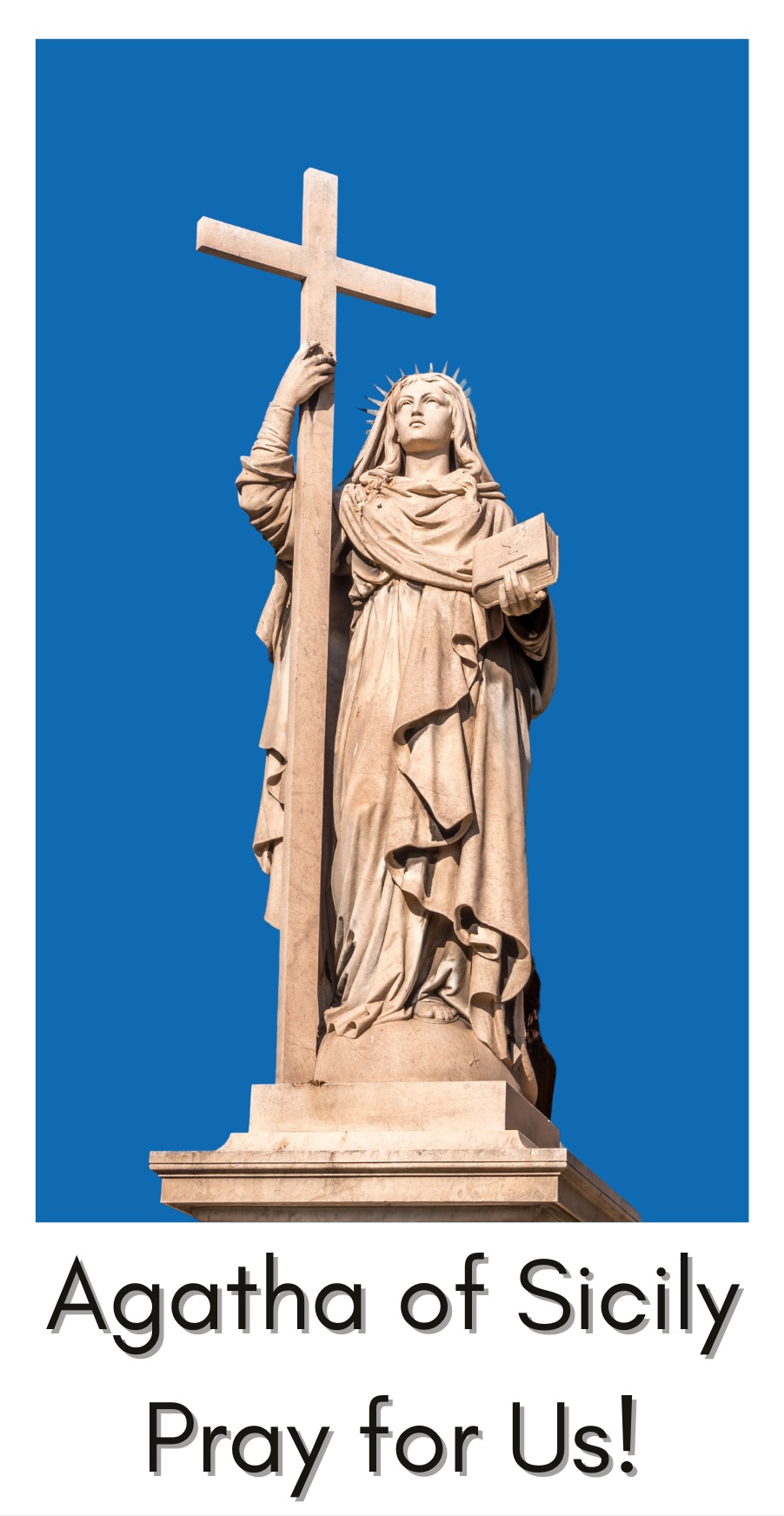
As in the case of Saint Agnes, another virgin-martyr of the early Church, almost nothing is historically certain about this saint except that she was martyred in Sicily during the persecution of Emperor Decius in 251.
Legend has it that Agatha, like Agnes, was arrested as a Christian, tortured, and sent to a house of prostitution to be mistreated. She was preserved from being violated, and was later put to death.
Saint Agatha is claimed as the patroness of both Palermo and Catania. The year after her death, the stilling of an eruption of Mt. Etna was attributed to her intercession. As a result, apparently, people continued to ask her prayers for protection against fire.
The scientific modern mind winces at the thought of a volcano’s might being contained by God because of the prayers of a Sicilian girl. Still less welcome, probably, is the notion of that saint being the patroness of such varied professions as those of foundry workers, nurses, miners and Alpine guides. Yet, in our historical precision, have we lost an essential human quality of wonder and poetry, and even our belief that we come to God by helping each other, both in action and prayer?
Healing from Diseases of the Breast
Nurses

The Second Commandment forbids religious idols — statues and pictures. Notice how the church of rome has deleted it from its list:
Here are the Catholic Ten Commandments:
I am the LORD your God. You shall worship the Lord your God and Him only shall you serve.
You shall not take the name of the Lord your God in vain.
Remember to keep holy the Sabbath day.
Honor your father and your mother.
You shall not kill.
You shall not commit adultery.
You shall not steal.
You shall not bear false witness against your neighbor.
You shall not covet your neighbor’s wife.
You shall not covet your neighbor’s goods.
THE FIRST COMMANDMENT
I am the LORD your God, who brought you out of the land of Egypt, out of the house of bondage. You shall have no other gods before me. You shall not make for yourself a graven image, or any likeness of anything that is in heaven above, or that is in the earth beneath, or that is in the water under the earth; you shall not bow down to them or serve them.
It is written: "You shall worship the Lord your God and him only shall you serve."

This is also how it appears in Catholic Bibles.
The Ten Commandments. Then God spoke all these words:
I am the Lord your God, who brought you out of the land of Egypt, out of the house of slavery. You shall not have other gods beside me. You shall not make for yourself an idol or a likeness of anything in the heavens above or on the earth below or in the waters beneath the earth; you shall not bow down before them or serve them. For I, the Lord, your God, am a jealous God, inflicting punishment for their ancestors’ wickedness on the children of those who hate me, down to the third and fourth generation; but showing love down to the thousandth generation of those who love me and keep my commandments. (Exodus 20:1-6; New American Bible)
If the Catholic Church was trying to "hide" the 10 Commandments from it's people, they are doing a poor job of it.
Also, please keep in mind that this is a Catholic Caucus/Devotional thread for the purpose of prayerful reflection on the Sacred Scriptures and is closed to debate of any kind. Per FR policy on Religion Caucus threads, off-topic, argumentative, and abusive comments are not allowed and will be submitted to the Mods for deletion. Thanks, and God bless you.

Today’s First Reading
From: 1 Kings 2:1-4, 10-12
David's last instructions
----------------------------------
[1] When David's time to die drew near, he charged Solomon his son, saying, [2] "I am about to go the way of all the earth. Be strong, and show yourself a man, [3] and keep the charge of the LORD your God, walking in his ways and keeping his statutes, his commandments, his ordinances, and his testimonies, as it is written in the law of Moses, that you may prosper in all that you do and wherever you turn; [4] that the LORD may establish his word which he spoke concerning me, saying, 'If your sons take heed to their way, to walk before me in faithfulness with all their heart and with all their soul, there shall not fail you a man on the throne of Israel.'
Death of David
---------------------
[10] Then David slept with his fathers, and was buried in the city of David. [11] And the time that David reigned over Israel was forty years; he reigned seven years in Hebron, and thirty-three years in Jerusalem. [12] So Solomon sat upon the throne of David his father; and his kingdom was firmly established.
************************************************
Commentary:
2:1-4. David realizes that he is going to die soon and, like other outstanding biblical figures (such as Jacob, Moses and Jesus himself), he leaves a last will before he dies. David's consists of two parts -- one religious and theological (vv. 2-4), the other to do with political matters (vv. 5-9).
The first, although addressed to Solomon in the first instance, applies to all the kings in the future; in fact it is valid for all men. It begins by stressing the same thing Moses did to Joshua -- be strong and act manfully (cf. Deut 31:23; Josh 1:6; etc.) -- and it goes on to adopt the Mosaic teaching of the book of Deuteronomy: fidelity to God's commandments leads man to happiness and success; and, with reference to the people of God, fidelity is the condition for continuing to dwell in the promised land. It is the people's part of the covenant.
In general, David's successors will not keep to their commitment, and for that reason the nation will be split in two and eventually sent into exile. This is the explanation the books of Kings and Deuteronomic history provide for the tragic events of the monarchy period. But in the light of the New Testament God will be seen to fulfill his promise: Jesus Christ, Son of David, through his perfect obedience (cf. Phil 2) will be made king for ever (cf. Rev 1:15; 17:14; etc.).
The Bible's notion of a king being under divine law can be applied to the exercise of any type of authority for, as the Second Vatican Council teaches, "it is clear that the political community and public authority are based on human nature, and therefore that they must belong to an order established by God; nevertheless, the choice of the political regime and the appointment of rulers are left to the free decision of the citizens. It follows that political authority, either within the political community as such or through organizations representing the state, must be exercised within the limits of the moral order and directed toward the common good (understood in the dynamic sense of the term) according to the juridical order legitimately established or due to be established. Citizens, then, are bound in conscience to obey. Accordingly, the responsibility, the dignity, and the importance of state rulers is clear" (Gaudium et spes, 74).
2:10. "To sleep with one's fathers" is a Hebrew way of saying "to die"; it indirectly has to do with belief in life after death: this is a meaning which will emerge later.
Given that David had won the city of Jerusalem from the Jebusites, it was considered to be his property and, in line with ancient custom (cf. Gen 25: 7-10), when someone died he was buried on his property. The site of David's tomb was known to all, according to Jewish tradition (cf. Acts 2:29), and it was very richly decorated, as Flavius Joseph reported ("Antiquitates Iudaicae", 7, 394-395). A summary is provided in Sirach 47:3-12 of David's valour, glory, piety and of the forgiveness God extended to him.
From: Mark 6:7-13
The Mission of the Twelve
-------------------------
[7] And he (Jesus) called to him the Twelve, and began to send them out two by two, and gave them authority over the unclean spirits. [8] He charged them to take nothing for their journey except a staff; no bread, no bag, no money in their belts; [9] but to wear sandals and not put on two tunics. [10] And he said to them, "Where you enter a house, stay there until you leave the place. [11] And if any place will not receive you and they refuse to hear you, when you leave, shake off the dust that is on your feet for a testimony against them." [12] So they went out and preached that men should repent. [13] And they cast out many demons, and anointed with oil many that were sick and healed them.
***********************************************************************
Commentary:
7. Cf. note on Mk 1:27; 3:14-19.
[The note on Mk 1:17 states: 27. The same authority that Jesus showed in His teaching (1:22) is now to be seen in His actions. His will is His command: He has no need of long prayers or incantations. Jesus' words and actions already have a divine power which provokes wonder and fear in those who hear and see Him.
Jesus continues to impress people in this way (Mark 2:12; 5:20-42; 7:37; 15:39; Luke 19:48; John 7:46). Jesus of Nazareth is the long-awaited Savior. He knows this Himself and He lets it be known by His actions and by His words; according to the gospel accounts (Mark 1:38-39; 2:10-11; 4:39) there is complete continuity and consistency between what He says and He does. As Vatican II teaches ("Dei Verbum", 2) Revelation is realized by deeds and words intimately connected with each other: the words proclaim the deeds and clarify the mystery contained in them; the deeds confirm the teaching. In this way Jesus progressively reveals the mystery of His Person: first the people sense His exceptional authority; later on, the Apostles, enlightened by God's grace, recognize the deepest source of this authority: "You are the Christ, the Son of the living God" (Matthew 16:16). ]
[The note on Mk 3:14-19 states: 14-19. The Twelve chosen by Jesus (cf. 3:14) receive a specific vocation to be "people sent out", which is what the word "apostles" means. Jesus chooses them for a mission which He will give them later (6:6-13) and to enable them to perform this mission He gives them part of His power. The fact that He chooses "twelve" is very significant. This is the same number as the twelve Patriarchs of Israel, and the Apostles represent the new people of God, the Church founded by Christ. Jesus sought in this way to emphasize the continuity that exists between the Old and New Testaments. The Twelve are the pillars on which Christ builds His Church (cf. Gal 2:9); their mission to make disciples of the Lord (to teach) all nations, sanctifying and governing the believers (Mt 28:16-20; Mk 16:15; Lk 24:45-48; Jn 20:21-23).]
8-9. Jesus requires them to be free of any form of attachment if they are to preach the Gospel. A disciple, who has the mission of bringing the Kingdom of God to souls through preaching, should not rely on human resources but on God's Providence. Whatever he does not in order to live with dignity as a herald of the Gospel, he must obtain from those who benefit from his preaching, for the laborer deserves his maintenance (cf. Mt 10:10).
"The preacher should so trust in God that he is convinced that he will have everything he needs to support life, even if he cannot himself obtain it; for he should not neglect eternal things worrying about temporal things" (St Bede, "In Marci Evangelium Expositio, in loc."). "By these instructions the Lord did not mean that the evangelists should not seek to live in any other way than by depending on what was offered to them by those to whom they preached the Gospel; otherwise this very Apostle (St Paul) would have acted contrary to this precept when he earned his living by the labors of his own hands" (St Augustine, "De Consensu Evangelistarum", II, 30).
13. St Mark is the only evangelist who speaks of anointing the sick with oil. Oil was often used for treating wounds (cf. Is 1:6; Lk 10:34), and the Apostles also use it for the miraculous cure of physical illnesses by virtue of the power given them by Jesus. Hence the use of oil as the matter of the sacrament of the Anointing of the Sick, which cures wounds of the soul and even, if appropriate, bodily diseases. As the Council of Trent teaches--"Doctrina De Sacramento Extremae Unctionis", chap. 1--in this verse of St Mark there can be seen a "hint" of the sacrament of the Anointing of the Sick, which our Lord will institute and which later on "is recommended and promulgated to the faithful by St James the Apostle" (cf. Jas 5:14ff).
Disclaimer: Opinions posted on Free Republic are those of the individual posters and do not necessarily represent the opinion of Free Republic or its management. All materials posted herein are protected by copyright law and the exemption for fair use of copyrighted works.