Posted on 01/31/2026 8:13:29 AM PST by fidelis
Memorial of Saint John Bosco, Priest
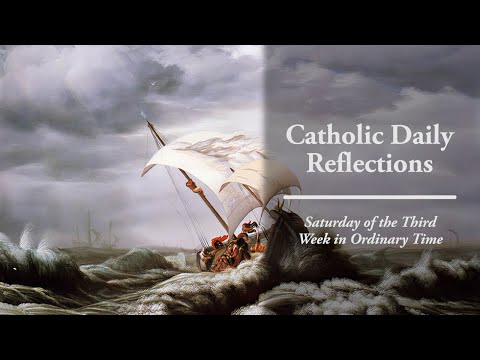
“Let us cross to the other side.” Leaving the crowd, they took Jesus with them in the boat just as he was. And other boats were with him. A violent squall came up and waves were breaking over the boat, so that it was already filling up. Jesus was in the stern, asleep on a cushion. Mark 4:35–38
Our Lord’s words were prophetic, but so were His actions. Today’s Gospel begins after a long day of Jesus teaching parables to the people by the Sea of Galilee. One might think that, after a long day, Jesus and His disciples would have remained in Capernaum for the night, getting a good night’s sleep. Instead, Jesus invites His disciples to join Him for a long night on a boat, crossing to the other side of the sea to the territory of the Gerasenes.
The Gerasenes were a predominantly Gentile population living in a region that formed part of the Decapolis—a group of ten cities heavily influenced by Greco-Roman culture and pagan practices... Jesus’ invitation to cross the sea was not only an invitation to a long night, but also an invitation to spend the next day within a culturally distinct and perhaps an uneasy setting different from their Jewish hometown.
This dual invitation should be seen as a prophetic action by which Jesus invited His disciples—and us—to leave our comfort zone and travel into the challenging and unfamiliar... Fear must never deter us from answering the call, even when we are tired and prefer to rest. When God calls, we must respond.
The journey across the Sea of Galilee is also packed with prophetic lessons. The journey by boat from Capernaum to the territory of the Gerasenes was about five to six miles. Under calm conditions, the journey might have taken one to two hours. However, the storm likely extended this time, possibly making the trip several hours long, especially if the disciples had to work against the wind and waves.
One important aspect of the journey is that Jesus is asleep during the storm. Because it would have been difficult for anyone to sleep while “waves were breaking over the boat, so that it was already filling up,” we should see our Lord’s sleep as intentional, to reveal a spiritual lesson. Though God might seem distant at times, or asleep during our time of need, He is there, waiting for us to turn to Him, wake Him, and call on Him.
Though these were experienced fishermen and boatmen, they were terrified. Jesus permitted them to experience this terror to reveal their need for faith and trust in Him... His rebuke of the wind and waves, “Quiet! Be still!” not only restored peace to the sea but also revealed His divine authority, revealing Himself as God: “LORD, God of hosts, who is like you? Mighty LORD, your faithfulness surrounds you. You rule the raging sea; you still its swelling waves” (Psalm 89:9–10).
Reflect today on Jesus’ invitation to the disciples to make the journey across the sea after a tiring day. Similarly, God sometimes calls us to enter the chaos of this world to bring His grace where it is not found. Though rest is important, sometimes we must deny ourselves and enter into the sea toward the unfamiliar—reaching out to neighbors or others with whom we feel hesitant, volunteering in ministries, or embracing new challenges that call us out of our comfort zone. As you ponder this scene, let the words of Christ echo in your heart, bringing peace to your soul: “Quiet! Be still!” Do not fear. Have faith. Trust that His command will calm every storm, and hold on to the knowledge that He is always with you, guiding you safely...
All-powerful God, in Your human nature, You faced every difficulty and conquered them so that You could provide me the grace to do the same. When You call me out of my comfort zone into the unfamiliar, give me courage to respond generously, knowing that You are always nearby, waiting to be awakened through a prayer and act of faith. Jesus, I trust in You.
Please keep in mind that this is a Catholic Caucus/Devotional thread for the purpose of prayerful reflection on the Sacred Scriptures and is closed to debate of any kind. Per FR policy on Religion Caucus threads, off-topic, argumentative, and abusive comments are not allowed and will be submitted to the Mods for deletion. Thanks, and God bless you.
The Month of January is Dedicated to the Holy Name of Jesus

“At the name of Jesus every knee should bow, of those in heaven, and of those on earth, and of those under the earth, and that every tongue should confess that Jesus Christ is Lord, to the glory of God the Father.” (Philippians 2:10-11)

Pope Leo XIV’s monthly prayer intention for the month of January, 2026:
For prayer with the Word of God
Let us pray that praying with the Word of God be nourishment for our lives and a source of hope in our communities, helping us to build a more fraternal and missionary Church.

Today’s First Reading
From: 2 Samuel 12:1-7a-10-17
David’s Repentance
------------------
[1] And the LORD sent Nathan to David. He came to him, and said to him, “There were two men in a certain city, the one rich and the other poor. [2] The rich man had very many flocks and herds; [3] but the poor man had nothing but one little ewe lamb, which he had bought. And he brought it up, and it grew up with him and with his children; it used to eat of his morsel, and drink from his cup, and lie in his bosom, and it was like a daughter to him. [4] Now there came a traveller to the rich man, and he was unwilling to take one of his own flock or herd to prepare for the wayfarer who had come to him, but he took the poor man’s lamb, and prepared it for the man who had come to him.” [5] Then David’s anger was greatly kindled against the man; and he said to Nathan, “As the LORD lives, the man who has done this deserves to die; [6] and he shall restore the lamb fourfold, because he did this thing, and because he had no pity.” [7a] Nathan said to David, “You are the man.
[10] 'Now therefore the sword shall never depart from your house, because you have despised me, and have taken the wife of Uriah the Hittite to be your wife.' Thus says the LORD, ‘Behold, I will raise up evil against you out of your own house; and I will take your wives before your eyes, and give them to your neighbor, and he shall lie with your wives in the sight of this sun. [12] For you did it secretly; but I will do this thing before all Israel, and before the sun.'" [13] David said to Nathan, “I have sinned against the LORD.” And Nathan said to David, “The LORD also has put away your sin; you shall not die. [14] Nevertheless, because by this deed you have utterly scorned the LORD, the child that is born to you shall die.” [15] Then Nathan went to his house.
And the LORD struck the child that Uriah’s wife bore to David, and it became sick. [16] David therefore besought God for the child; and David fasted, and went in and lay all night upon the ground, [17] And the elders of his house stood beside him, to raise him from the ground; but he would not, nor did he eat food with them.
***********************************************************************
Commentary:
12:1-25. Nathan’s intervention (vv. 1-15), David’s repentance (vv. 16-19), and the birth of Solomon (vv. 20-25) are the main subjects in this chapter. Nathan makes an appeal to David with one of the most beautiful parables in the Old Testament and gets the king to condemn his own conduct: “the man who has done this deserves to die” (v. 5). In reply, Nathan tells him the penalty the Lord has decreed, which in line with the law of vengeance or retaliation has three parts to it, corresponding to David's triple crime--murder, adultery and the fact that the victim was a blameless man. On account of the murder, the sword will not depart from David’s house (V. 10): this punishment will affect his eldest sons, Amnon, Absalom and Adonijah, who will die violent deaths. For the adultery, his wives will be violated in public (v. 11), which will happen when Absalom takes his father’s harem (cf. 16:20-23). And for the killing of an innocent man, his own recently born son will not survive (v. 14).
David’s repentance is exemplary (vv. 16-19): he weeps for his sin, and fasts and pleads for his little son: so, in spite of his weaknesses and sins, he still trusts in the Lord and shows himself to he “a man after (the Lord’s) own heart” (1 Sam 13:14). David is a model of penance because, by acknowledging his sin, he obtained divine forgiveness. His repentance finds expression in Psalm 51, which so beautifully and piously records the sinful king’s supplication to the Lord: “Have mercy on me, 0 God, according to your steadfast love; according to your abundant mercy blot out my transgressions. Wash me thoroughly from my iniquity, and cleanse me from my sin!” (Ps 51:1-2).
The birth of a new son (vv. 20-25) brings this account to an end and makes it clear that Solomon was born within marriage; his birth causes David great joy and he is given a second name in a message from Nathan--"Jedidiah" (v. 25); beloved of the Lord. This means that, from birth, Solomon is the one chosen by God to advance his plan of salvation for Israel.
Great was David’s sin, and heartfelt his contrition. But God’s forgiveness is greatest of all. “In the course of its history, Israel was able to discover that God had only one reason to reveal himself to theirs, a single motive for choosing them from among all peoples as his special possession--his sheer gratuitous love. And thanks to the prophets Israel understood that it was again out of love that God never stopped saving them and pardoning their unfaithfulness and sins” ("Catechism of the Catholic Church", 218).
From: Mark 4:35-41
The Calming of the Storm
------------------------
[35] On that day, when evening had come, He (Jesus) said to them, "Let us go across to the other side." [36] And leaving the crowd, they took Him with them just as He was, in the boat. And other boats were with Him. [37] And a great storm of wind arose, and the waves beat into the boat so that the boat was already filling. [38] But He was in the stern, asleep on the cushion; and they woke Him and said to Him, "Teacher, do You not care if we perish?" [39] And He awoke and rebuked the wind, and said to the sea, "Peace! Be still!" And the wind ceased, and there was a great calm. [40] He said to them, "Why are you afraid? Have you no faith?" [41] And they were filled with awe, and said to one another, "Who then is this, that even wind and sea obey Him?"
***********************************************************************
Commentary:
35-41. The episode of the calming of the storm, the memory of which must have often helped the Apostles regain their serenity in the midst of struggles and difficulties, also helps us never lose the supernatural way of looking at things: a Christian's life is like a ship: "As a vessel on the sea is exposed to a thousand dangers--pirates, quicksands, hidden rocks, tempests--so man in this life, is encompassed with perils, arising from the temptations of Hell, from the occasions of sin, from the scandals or bad counsels of men, from human respect, and, above all from the passions of corrupt nature [...]. This should not cause him to lose confidence. Rather [...] when you find yourself assaulted by a violent passion [...] take whatever steps you can to avoid the occasions [of sin] and place your reliance on God [...]: when the tempest is violent, the pilot never takes his eyes from the light which guides him to port. In like manner, we should keep our eyes always turned to God, who alone can deliver us from the many dangers to which we are exposed" (St. Augustine, "Sermon 51; for the Fourth Sunday After Epiphany).
Disclaimer: Opinions posted on Free Republic are those of the individual posters and do not necessarily represent the opinion of Free Republic or its management. All materials posted herein are protected by copyright law and the exemption for fair use of copyrighted works.

