Posted on 01/30/2026 5:24:23 AM PST by annalex
Friday of week 3 in Ordinary Time ![]() church of St. Hyacintha in Viterbo, Italy Readings at MassLiturgical Colour: Green. Year: A(II).
David and BathshebaAt the turn of the year, the time when kings go campaigning, David sent Joab and with him his own guards and the whole of Israel. They massacred the Ammonites and laid siege to Rabbah. David, however, remained in Jerusalem. It happened towards evening when David had risen from his couch and was strolling on the palace roof, that he saw from the roof a woman bathing; the woman was very beautiful. David made inquiries about this woman and was told, ‘Why, that is Bathsheba, Eliam’s daughter, the wife of Uriah the Hittite.’ Then David sent messengers and had her brought. She came to him, and he slept with her. She then went home again. The woman conceived and sent word to David, ‘I am with child.’ Then David sent Joab a message, ‘Send me Uriah the Hittite’, whereupon Joab sent Uriah to David. When Uriah came into his presence, David asked after Joab and the army and how the war was going. David then said to Uriah, ‘Go down to your house and enjoy yourself.’ Uriah left the palace, and was followed by a present from the king’s table. Uriah however slept by the palace door with his master’s bodyguard and did not go down to his house. This was reported to David; ‘Uriah’ they said ‘did not go down to his house.’ The next day David invited him to eat and drink in his presence and made him drunk. In the evening Uriah went out and lay on his couch with his master’s bodyguard, but he did not go down to his house. Next morning David wrote a letter to Joab and sent it by Uriah. In the letter he wrote, ‘Station Uriah in the thick of the fight and then fall back behind him so that he may be struck down and die.’ Joab, then besieging the town, posted Uriah in a place where he knew there were fierce fighters. The men of the town sallied out and engaged Joab; the army suffered casualties, including some of David’s bodyguard; and Uriah the Hittite was killed too.
Have mercy on us, Lord, for we have sinned. Have mercy on me, God, in your kindness. In your compassion blot out my offence. O wash me more and more from my guilt and cleanse me from my sin. Have mercy on us, Lord, for we have sinned. My offences truly I know them; my sin is always before me Against you, you alone, have I sinned; what is evil in your sight I have done. Have mercy on us, Lord, for we have sinned. That you may be justified when you give sentence and be without reproach when you judge, O see, in guilt I was born, a sinner was I conceived. Have mercy on us, Lord, for we have sinned. Make me hear rejoicing and gladness, that the bones you have crushed may thrill. From my sins turn away your face and blot out all my guilt. Have mercy on us, Lord, for we have sinned.
Alleluia, alleluia! Make me grasp the way of your precepts, and I will muse on your wonders. Alleluia!
Alleluia, alleluia! Blessed are you, Father, Lord of heaven and earth, for revealing the mysteries of the kingdom to mere children. Alleluia!
The kingdom of God is a mustard seed growing into the biggest shrub of allJesus said to the crowds: ‘This is what the kingdom of God is like. A man throws seed on the land. Night and day, while he sleeps, when he is awake, the seed is sprouting and growing; how, he does not know. Of its own accord the land produces first the shoot, then the ear, then the full grain in the ear. And when the crop is ready, he loses no time: he starts to reap because the harvest has come.’ He also said, ‘What can we say the kingdom of God is like? What parable can we find for it? It is like a mustard seed which at the time of its sowing in the soil is the smallest of all the seeds on earth; yet once it is sown it grows into the biggest shrub of them all and puts out big branches so that the birds of the air can shelter in its shade.’ Using many parables like these, he spoke the word to them, so far as they were capable of understanding it. He would not speak to them except in parables, but he explained everything to his disciples when they were alone. .Universalis podcast: The week ahead – from 1 to 7 FebruaryCandlemas, the feast of the Purification of Mary and the Presentation of the Lord. Purification. The celebration and sanctification of transitions. The hundredth episode!! (21 minutes)Play Christian Art![]() The readings on this page are from the Jerusalem Bible, which is used at Mass in most of the English-speaking world. The New American Bible readings, which are used at Mass in the United States, are available in the Universalis apps, programs and downloads. |
|
Click here: to donate by Credit Card Or here: to donate by PayPal Or by mail to: Free Republic, LLC - PO Box 9771 - Fresno, CA 93794 Thank you very much and God bless you. |
KEYWORDS: catholic; mk4; ordinarytime; prayer; Click to Add Keyword

Please FReepmail me to get on/off the Alleluia Ping List.
| Mark | |||
| English: Douay-Rheims | Latin: Vulgata Clementina | Greek NT: Byzantine/Majority Text (2000) | |
| Mark 4 | |||
| 26. | And he said: So is the kingdom of God, as if a man should cast seed into the earth, | Et dicebat : Sic est regnum Dei, quemadmodum si homo jaciat sementem in terram, | και ελεγεν ουτως εστιν η βασιλεια του θεου ως εαν ανθρωπος βαλη τον σπορον επι της γης |
| 27. | And should sleep, and rise, night and day, and the seed should spring, and grow up whilst he knoweth not. | et dormiat, et exsurgat nocte et die, et semen germinet, et increscat dum nescit ille. | και καθευδη και εγειρηται νυκτα και ημεραν και ο σπορος βλαστανη και μηκυνηται ως ουκ οιδεν αυτος |
| 28. | For the earth of itself bringeth forth fruit, first the blade, then the ear, afterwards the full corn in the ear. | Ultro enim terra fructificat, primum herbam, deinde spicam, deinde plenum frumentum in spica. | αυτοματη γαρ η γη καρποφορει πρωτον χορτον ειτα σταχυν ειτα πληρη σιτον εν τω σταχυι |
| 29. | And when the fruit is brought forth, immediately he putteth in the sickle, because the harvest is come. | Et cum producerit fructus, statim mittit falcem, quoniam adsit messis. | οταν δε παραδω ο καρπος ευθεως αποστελλει το δρεπανον οτι παρεστηκεν ο θερισμος |
| 30. | And he said: To what shall we liken the kingdom of God? or to what parable shall we compare it? | Et dicebat : Cui assimilabimus regnum Dei ? aut cui parabolæ comparabimus illud ? | και ελεγεν τινι ομοιωσωμεν την βασιλειαν του θεου η εν ποια παραβολη παραβαλωμεν αυτην |
| 31. | It is as a grain of mustard seed: which when it is sown in the earth, is less than all the seeds that are in the earth: | Sicut granum sinapis, quod cum seminatum fuerit in terra, minus est omnibus seminibus, quæ sunt in terra : | ως κοκκον σιναπεως ος οταν σπαρη επι της γης μικροτερος παντων των σπερματων εστιν των επι της γης |
| 32. | And when it is sown, it groweth up, and becometh greater than all herbs, and shooteth out great branches, so that the birds of the air may dwell under the shadow thereof. | et cum seminatum fuerit, ascendit, et fit majus omnibus oleribus, et facit ramos magnos, ita ut possint sub umbra ejus aves cæli habitare. | και οταν σπαρη αναβαινει και γινεται παντων των λαχανων μειζων και ποιει κλαδους μεγαλους ωστε δυνασθαι υπο την σκιαν αυτου τα πετεινα του ουρανου κατασκηνουν |
| 33. | And with many such parables, he spoke to them the word, according as they were able to hear. | Et talibus multis parabolis loquebatur eis verbum, prout poterant audire : | και τοιαυταις παραβολαις πολλαις ελαλει αυτοις τον λογον καθως εδυναντο ακουειν |
| 34. | And without parable he did not speak unto them; but apart, he explained all things to his disciples. | sine parabola autem non loquebatur eis : seorsum autem discipulis suis disserebat omnia. | χωρις δε παραβολης ουκ ελαλει αυτοις κατ ιδιαν δε τοις μαθηταις αυτου επελυεν παντα |

4:26–29
26. And he said, So is the kingdom of God, as if a man should cast seed into the ground;
27. And should sleep, and rise night and day, and the seed should spring and grow up, he knoweth not how.
28. For the earth bringeth forth fruit of herself; first the blade, then the ear, after that the full corn in the ear.
29. But when the fruit is brought forth, immediately he putteth in the sickle, because the harvest is come.
PSEUDO-CHRYSOSTOM. (Vict. Ant. e Cat. in Marc.) A parable occurred, a little above, about the three seeds which perished in various ways, and the one which was saved; in which last He also shews three differences, according to the proportion of faith and practice. Here, however, He puts forth a parable concerning those only who are saved. Wherefore it is said, And he said, So is the kingdom of God, as if a man should cast seed into the ground, &c.
PSEUDO-JEROME. The kingdom of God is the Church, which is ruled by God, and herself rules over men, and treads down the powers which are contrary to her, and all wickedness.
PSEUDO-CHRYSOSTOM. (Vict. Ant. e Cat. in Marc.) Or else He calls by the name of kingdom of God, faith in Him, and in the economy of His Incarnation; which kingdom indeed is as if a man should throw seed. For He Himself being God and the Son of God, having without change been made man, has cast seed upon the earth, that is, He has enlightened the whole world by the word of divine knowledge.
PSEUDO-JEROME. For the seed is the word of life, the ground is the human heart, and the sleep of the man means the death of the Saviour. The seed springs up night and day, because after the sleep of Christ, the number of Christians, through calamity and prosperity, continued to flourish more and more in faith, and to wax greater in deed.
PSEUDO-CHRYSOSTOM. (Vict. Ant. e Cat. in Marc.) Or Christ Himself is the man who rises, for He sat waiting with patience, that they who received seed should bear fruit. He rises, that is, by the word of His love, He makes us grow to the bringing forth fruit, by the armour of righteousness on the right hand, by which is meant the day, and on the left, by which is meant the night of persecution; for by these the seed springs up, and does not wither. (2 Cor. 6:7)
THEOPHYLACT. Or else Christ sleeps, that is, ascends into heaven, where, though He seem to sleep, yet He rises by night, when through temptations He raises us up to the knowledge of Himself; and in the day time, when on account of our prayers, He sets in order our salvation.
PSEUDO-JEROME. But when He says, He knoweth not how, He is speaking in a figure; that is, He does not make known to us, who amongst us will produce fruit unto the end.
PSEUDO-CHRYSOSTOM. (Vict. Ant. e Cat. in Marc.) Or else He says, He knoweth not, that He may shew the free-will of those who receive the word, for He commits a work to our will, and does not work the whole Himself alone, lest the good should seem involuntary. For the earth brings forth fruits of its own accord, that is, she is brought to bear fruit without being compelled by a necessity contrary to her will. First the blade.
PSEUDO-JEROME. That is, fear. For the fear of God is the beginning of wisdom. Then the full corn in the ear; (Ps. 111:10. Rom. 13:8) that is, charity, for charity is the fulfilling of the Law.
PSEUDO-CHRYSOSTOM. (Vict. Ant. e Cat. in Marc.) Or, first it produces the blade, in the law of nature, by degrees growing up to advancement; afterwards it brings forth the ears, which are to be collected into a bundle, and to be offered on an altar to the Lord, that is, in the law of Moses; afterwards the full-fruit, in the Gospel. Or because we must not only put forth leaves by obedience, but also learn prudence, and, like the stalk of corn, remain upright without minding the winds which blow us about. We must also take heed to our soul by a diligent recollection, that, like the ears, we may bear fruit, that is, shew forth the perfect operation of virtue.
THEOPHYLACT. For we put forth the blade, when we shew a principle of good; then the ear, when we can resist temptations; then comes the fruit, when a man works something perfect. It goes on: and when it has brought forth the fruit, immediately he sendeth the sickle, because the harvest is come.
PSEUDO-JEROME. The sickle is death or the judgment, which cuts down all things; the harvest is the end of the world.
GREGORY. (in Ezech. 2. Hom. 3) Or else; Man casts seed into the ground, when he places a good intention in his heart; and he sleeps, when he already rests in the hope which attends on a good work. But he rises night and day, because he advances amidst prosperity and adversity, though he knows it not, for he is as yet unable to measure his increase, and yet virtue, once conceived, goes on increasing. When therefore we conceive good desires, we put seed into the ground; when we begin to work rightly, we are the blade. When we increase to the perfection of good works, we arrive at the ear; when we are firmly fixed in the perfection of the same working, we already put forth the full corn in the ear.
30. And he said, Whereto shall we liken the kingdom of God? or with what comparison shall we compare it?
31. It is like a grain of mustard seed, which, when it is sown in the earth, is less than all the seeds that be in the earth:
32. But when it is sown, it grows up, and becomes greater than all herbs, and shoots out great branches; so that the fowls of the air may lodge under the shadow of it.
33. And with many such parables spoke he the word to them, as they were able to hear it.
34. But without a parable spoke he not to them: and when they were alone, he expounded all things to his disciples.
GLOSS. After having narrated the parable concerning the coming forth of the fruit from the seed of the Gospel, he here subjoins another parable, to show the excellence of the doctrine of the Gospel before all other doctrines. Wherefore it is said, And he said, Whereto shall life liken the kingdom of God?
THEOPHYL. Most brief indeed is the word of faith; Believe in God, and you shall he saved. But the preaching of it has been spread far and wide over the earth, and increased so, that time birds of heaven, that is, contemplative men, sublime in understanding and knowledge, dwell under it. For how many wise men among the Gentiles, quitting their wisdom, have found rest in the preaching of the Gospel! Its preaching then is greater than all.
CHRYS. And also because the wisdom spoken amongst the perfect expands, to a extent greater than all other sayings, that which was told to men in short discourses, for there is nothing greater than this truth.
THEOPHYL. Again, it put forth great boughs, for the Apostles were divided off as the boughs of a tree, some to Rome, some to India, some to other parts of the world
PSEUDO-JEROME; Or else, that seed is very, small in fear, but great when it has grown into charity, which is greater than all herbs; for God is love, whilst all flesh is grass. But the boughs which it puts forth are those of mercy and compassion, since under its shade the poor of Christ, who are meant by the living creatures of the heavens, delight to dwell.
BEDE; Again, the man who sows is by many taken to mean the Savior Himself, by others, man himself sowing in his own heart.
CHRYS. Then after this, Mark, who delights in brevity, to show the nature of the parables, subjoins, And with many such parables spoke he the word to them as they could hear him.
THEOPHYL. For since the multitude was unlearned, he instructs them from objects of food and familiar names, and for this reason he adds, But without a parable spoke he not to them, that is, in order that they might be induced to approach and to ask Him. It goes on And when they were alone, he expounded all things to his disciples, that is, all things about which they were ignorant and asked Him, not simply all, whether obscure or not.
PSEUDO-JEROME; For they were worthy to hear mysteries apart, in the most secret haunt of wisdom, for they were men, who, removed from the crowds of evil thoughts, remained in the solitude of virtue; and wisdom is received in a time of quiet.
Catena Aurea Mark 4
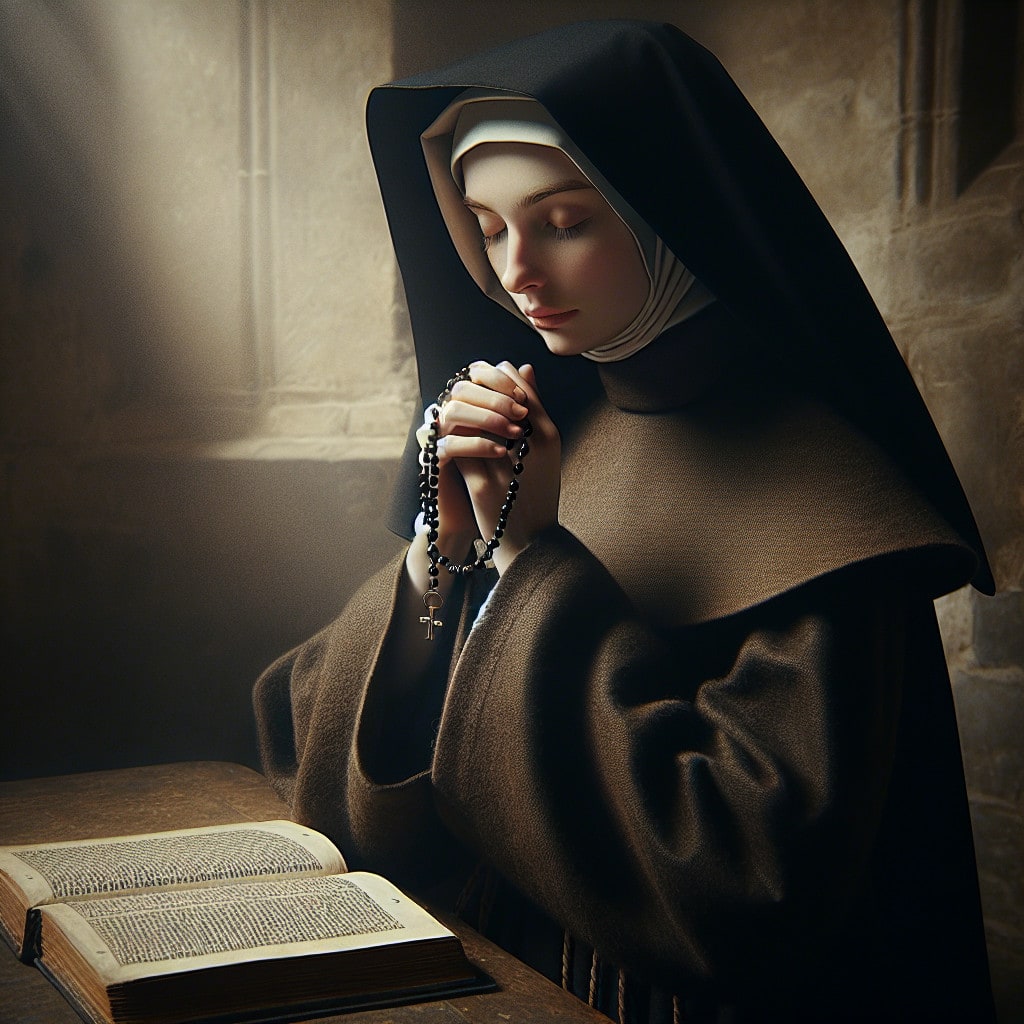
St Hyacintha de Mariscotti
Feast Day – January 30
St Hyacintha, born in 1585, belonged to a wealthy and prominent family. Her father was Count Antonio of Mariscotti, her mother descended from the princely Roman family of the Orsini.
After her younger sister had been given in marriage, the disappointed Clarice, as Hyacintha was then called, entered the convent of the Tertiaries at Viterbo, but apparently only as a secular Tertiary. She permitted herself to be supplied with all sorts of things by way of eatables and articles of dress which enabled her to enjoy quite an agreeable and comfortable existence. Her rooms were furnished with much worldly apparatus.
The spirit of mortification and of penance with which every Tertiary ought to be equipped was in no wise discernible to St Hyacintha de Mariscotti at this point in her life.
Then it happened that she was afflicted with a strange illness, and her confessor was obliged to go to her rooms to administer the sacraments to her. When he saw the worldly and frivolous objects in her cell, he sharply reproved the sick sister.
Following her confessor's advice, she afterwards went to the common refectory and there, with a rope around her neck, begged forgiveness of her fellow sisters for the scandal she had given them.
However, it was only after she had invoked the aid of St. Catherine of Siena that she dispossessed herself of all frivolous and unnecessary objects, and thereupon resolutely entered upon a life of heroic virtue.
She began to lead a very penitential life, in which she persevered unto the end. She went barefoot, wore an old habit that had been discarded by another sister, and performed the lowliest and most trying tasks. She ate only inferior food with which she mixed bitter herbs. Her bed consisted of a few bare boards, on which there was but a single blanket; a stone served as her pillow. She fostered a special devotion to the sufferings of Christ; and in memory of them, she subjected herself to special austerities on Fridays and in Holy Week. She also entertained a filial love for Mary, the Mother of Mercy, who sometimes appeared to her and comforted her.
Enriched by every virtue and held in great repute by her fellow sisters, St Hyacintha de Mariscotti died in the 55th year of her age, in the year of our Lord 1640. Many miracles occurred at her grave for which reason Pope Benedict XIII placed her in the ranks of the blessed.
In the year 1807 she was canonized by Pope Pius VII.
*from: The Franciscan Book of Saints, ed. by Marion Habig, ofm.


Today’s First Reading
From: 2 Samuel 11:1-4a, 5-10a, 13-17
David’s Sin
-----------
[1] In the spring of the year, the time when kings go forth to battle, David sent Joab, and his servants with him, and all Israel; and they ravaged the Ammonites, and besieged Rabbah. But David remained at Jerusalem.
[2] It happened, late one afternoon, when David arose from his couch and was walking upon the roof of the king’s house, that he saw from the roof a woman bathing; and the woman was very beautiful. [3] And David sent and inquired about the woman. And one said, “Is not this Bathsheba, the daughter of Eliam, the wife of Uriah the Hittite?” [4a] So David sent messengers, and took her; and she came to him, and he lay with her. Then she returned to her house. [5] And the woman conceived; and she sent and told David, “I am with child.”
[6] So David sent word to Joab, “Send me Uriah the Hittite.” And Joab sent Uriah to David. [7] When Uriah came to him, David asked how Joab was doing, and how the people fared, and how the war prospered. [8] Then David said to Uriah, “Go down to your house, and wash your feet.” And Uriah went out of the king’s house, and there followed him a present from the king. [9] But Uriah slept at the door of the king’s house with all the servants of his lord, and did not go down to his house. [10a] (When) they told David, “Uriah did not go down to his house.” [13] And David invited him, and he ate in his presence and drank, so that he made him drunk; and in the evening he went out to lie on his couch with the servants of his lord, but he did not go down to his house.
[14] In the morning David wrote a letter to Joab, and sent it by the hand of Uriah. [15] In the letter he wrote, “Set Uriah in the forefront of the hardest fighting, and then draw back from him, that he may be struck down, and die.” [16] And as Joab was besieging the city, he assigned Uriah to the place where he knew there were valiant men. [17] And the men of the city came out and fought with Joab; and some of the servants of David among the people fell. Uriah the Hittite was slain also.
***********************************************************************
Commentary:
11-12:25. The birth of Solomon, chosen by God to be the first and greatest of David’s successors (12:20-25), is preceded by the drama that results from the gravest sins committed by David. The book of Chronicles, perhaps in a desire not to tarnish the image of David, makes no mention of David’s adultery. But the book of Samuel reports it in detail; by so doing it shows that salvation history is not the result of the merits and virtues of its protagonists, but of the mercy of God who forgives sins and always keeps his project of salvation on track. Here we see David, like Adam, and despite all God has given him, yielding to temptation and committing the two most grievous sins, the only sins punishable by death both in Israel and among its neighbors--murder and adultery. And yet as also happened in the case of Adam, the mercy of God prevails and David finds his way again. Once he has repented and been pardoned he will have another son by Bathsheba, “by the wife of Uriah” (Mt 1:6), but this time within marriage, thereby fulfilling the prophecy of Nathan. This son, Solomon called by Nathan "Jedidiah" that is, “beloved of the Lord” (12:25), will be the first link in the “sons of David” and will mark the start of hope in a future Messiah.
11:1-27. David’s grave sin involves three actions--adultery (vv. 1-5), the scheme to cover up evidence of that sin and avoid the penalty attaching to it (vv. 6-13), and his decision to get rid of Uriah (vv. 14-24).
The adultery is reported very plainly, just enough to identify David as the father of the child. The text also shows in a veiled way (by referring to Bathsheba’s imprudence in bathing within sight of the king) that she herself is not an innocent party. Thus there is a marked analogy between this sin and that of Adam and Eve. The woman who will play an important part in the life of Solomon also had an active role from the very start of her relationship with David. The image of the idle king, exposed to the onslaught of passion, is used in Christian tradition as a warning about the need to keep one’s senses under control in order to avoid falling into other sins. “The appetites are inflamed by the sensuality of the gaze, and our eyes, used to looking lustfully at our neighbor because we are so idle, spark impure desires” (Clement of Alexandria, "Paedagogus", 3, 77, 1). And St J. Escrivá writes: “The eyes! Through them many iniquities enter the soul. So many experiences like David’s !--If you guard your sight you will have assured the guard of your heart” ("The Way", 183).
The account goes into more detail when describing the malice of the king as he makes every effort to ensure that his good name is not sullied: he twice tries to get Uriah to go down to his house (“wash your feet”: v. 8 is a euphemism for marital relations) and, when he sees that he cannot make Uriah responsible for Bathsheba’s pregnancy, he decides to arrange for him to die in battle. It is the worst sort of cynicism a king could be guilty of. The death of Uriah (vv. 16-17), one of the best and most loyal soldiers in the army, marks the climax of David’s sin: the murderer has planned a perfect crime which hides his own part in that crime and will also cover up his earlier adultery. His accomplice in this sordid business is Joab, his cold and unscrupulous lieutenant who is interested only in his personal advantage (vv. 19-21) and who has nothing to lose.
Everything seemed to go smoothly once Bathsheba was installed in the palace as the king’s wife and gave birth to her son. But David, as Adam was in the first days, is unmasked by the Lord: just when the cover-up seems to have worked, a severe divine sentence is pronounced: “the thing that David had done displeased the Lord” (v. 27).
From: Mark 4:26-34
Parables of the Seed and of the Mustard Seed
--------------------------------------------
[26] And He (Jesus) said, "The Kingdom of God is as if a man should scatter seed upon the ground, [27] and should sleep and rise night and day, and the seed should sprout and grow, he knows not how. [28] The earth produces of itself, first the blade, then the ear, then the full grain in the ear. [29] But when the grain is ripe, at once he puts in the sickle, because the harvest is come."
[30] And He said, "With what can we compare the Kingdom of God, or what parable shall we use for it? [31] It is like a grain of mustard seed, which, when sown upon the ground, is the smallest of all the seeds on earth; [32] yet when it is sown it grows up and becomes the greatest of all shrubs, and puts forth large branches, so that the birds of the air can make nests in its shade."
The End of the Parables Discourse
---------------------------------
[33] With many such parables He spoke the word to them, as they were able to hear it; [34] He did not speak to them without a parable, but privately to His own disciples He explained everything.
***********************************************************************
Commentary:
26-29. Farmers spare no effort to prepare the ground for the sowing; but once the grain is sown there is nothing more they can do until the harvest; the grain develops by itself. Our Lord uses this comparison to describe the inner strength that causes the Kingdom of God on earth to grow up to the day of harvest (cf. Joel 3:13 and Revelation 14:15), that is, the day of the Last Judgment.
Jesus is telling His disciples about the Church: the preaching of the Gospel, the generously sown seed, will unfailingly yield its fruit, independently of who sows or who reaps: it is God who gives the growth (cf. 1 Corinthians 3:5-9). It will all happen "he knows not how", without men being fully aware of it.
The Kingdom of God also refers to the action of grace in each soul: God silently works a transformation in us, whether we sleep or watch, causing resolutions to take shape in our soul--resolutions to be faithful, to surrender ourselves, to respond to grace--until we reach "mature manhood" (cf. Ephesians 4:13). Even though it is necessary for man to make this effort, the real initiative lies with God, "because it is the Holy Spirit who, with His inspirations, gives a supernatural tone to our thoughts, desires and actions. It is He who leads us to receive Christ's teaching and to assimilate it in a profound way. It is He who gives us the light by which we perceive our personal calling and the strength to carry out all that God expects of us. If we are docile to the Holy Spirit, the image of Christ will be found more and more fully in us, and we will be brought closer every day to God the Father. `For whoever are led by the Spirit of God, they are the children of God' (Romans 8:14)" (St J. Escriva, "Christ Is Passing By", 135).
30-32. The main meaning of this parable has to do with the contrast between the great and the small. The seed of the Kingdom of God on earth is something very tiny to begin with (Luke 12:32; Acts 1:15); but it will grow to be a big tree. Thus we see how the small initial group of disciples grows in the early years of the Church (cf Acts 2:47; 6:7; 12:24), and spreads down the centuries and becomes a great multitude "which no man could number" (Revelation 7:9). This mysterious growth which our Lord refers to also occurs in each soul: "the Kingdom of God is in the midst of you" (Luke 17:21); we can see a prediction of this in the words of Psalm 92:12: "The righteous grow like a cedar in Lebanon." To allow the mercy of God to exalt us, to make us grow, we must make ourselves small, humble (Ezekiel 17:22-24; Luke 18:9-14).
Disclaimer: Opinions posted on Free Republic are those of the individual posters and do not necessarily represent the opinion of Free Republic or its management. All materials posted herein are protected by copyright law and the exemption for fair use of copyrighted works.