Free Republic
Browse · Search
Religion
Topics · Post Article

Skip to comments.

Catholic Caucus: Daily Mass Readings 29-January-2026
Universalis/Jerusalem Bible ^

Posted on 01/29/2026 4:47:47 PM PST by annalex

29 January 2026

Thursday of week 3 in Ordinary Time


Interior of Santa Maria in Aracoeli, Rome

Readings at Mass

Liturgical Colour: Green. Year: A(II).


First reading
2 Samuel 7:18-19,24-29

'The house of your servant will be blessed for ever'

After Nathan had spoken to him, King David went in and, seated before the Lord, said: ‘Who am I, O Lord, and what is my House, that you have led me as far as this? Yet in your sight, O Lord, this is still not far enough, and you make your promises extend to the House of your servant for a far-distant future. You have constituted your people Israel to be your own people for ever; and you, Lord, have become their God.
  ‘Now, O Lord, always keep the promise you have made your servant and his House, and do as you have said. Your name will be exalted for ever and men will say, “The Lord of Hosts is God over Israel.” The House of your servant David will be made secure in your presence, since you yourself, Lord of Hosts, God of Israel, have made this revelation to your servant, “I will build you a House”; hence your servant has ventured to offer this prayer to you. Yes, Lord, you are God indeed, your words are true and you have made this fair promise to your servant. Be pleased, then, to bless the House of your servant, that it may continue for ever in your presence; for you, Lord, have spoken; and with your blessing the House of your servant will be for ever blessed.’


Responsorial Psalm
Psalm 131(132):1-5,11-14
The Lord God will give him the throne of his father David.
O Lord, remember David
  and all the many hardships he endured,
the oath he swore to the Lord,
  his vow to the Strong One of Jacob.
The Lord God will give him the throne of his father David.
‘I will not enter the house where I live
  nor go to the bed where I rest.
I will give no sleep to my eyes,
  to my eyelids I will give no slumber
till I find a place for the Lord,
  a dwelling for the Strong One of Jacob.’
The Lord God will give him the throne of his father David.
The Lord swore an oath to David;
  he will not go back on this word:
‘A son, the fruit of your body,
  will I set upon your throne.
The Lord God will give him the throne of his father David.
‘If they keep my covenant in truth
  and my laws that I have taught them,
their sons also shall rule
  on your throne from age to age.’
The Lord God will give him the throne of his father David.
For the Lord has chosen Zion;
  he has desired it for his dwelling:
‘This is my resting-place for ever;
  here have I chosen to live.
The Lord God will give him the throne of his father David.

Gospel AcclamationPh2:15-16
Alleluia, alleluia!
You will shine in the world like bright stars
because you are offering it the word of life.
Alleluia!
Or:Ps118:105
Alleluia, alleluia!
Your word is a lamp for my steps
and a light for my path.
Alleluia!

GospelMark 4:21-25

A lamp is to be put on a lampstand. The amount you measure out is the amount you will be given

Jesus said to the crowd, ‘Would you bring in a lamp to put it under a tub or under the bed? Surely you will put it on the lamp-stand? For there is nothing hidden but it must be disclosed, nothing kept secret except to be brought to light. If anyone has ears to hear, let him listen to this.’
  He also said to them, ‘Take notice of what you are hearing. The amount you measure out is the amount you will be given – and more besides; for the man who has will be given more; from the man who has not, even what he has will be taken away.’

The readings on this page are from the Jerusalem Bible, which is used at Mass in most of the English-speaking world. The New American Bible readings, which are used at Mass in the United States, are available in the Universalis apps, programs and downloads.

You can also view this page with the Gospel in Greek and English.


TOPICS: Catholic; General Discusssion; Prayer; Worship
KEYWORDS: catholic; mk4; ordinarytime; prayer

Click here: to donate by Credit Card

Or here: to donate by PayPal

Or by mail to: Free Republic, LLC - PO Box 9771 - Fresno, CA 93794

Thank you very much and God bless you.

For your reading, reflection, faith-sharing, comments, questions, discussion.

1 posted on 01/29/2026 4:47:47 PM PST by annalex
[ Post Reply | Private Reply | View Replies]

To: All

KEYWORDS: catholic; mk4; ordinarytime; prayer


2 posted on 01/29/2026 4:48:11 PM PST by annalex (fear them not)
[ Post Reply | Private Reply | To 1 | View Replies]

To: nickcarraway; NYer; ELS; Pyro7480; livius; ArrogantBustard; Catholicguy; RobbyS; marshmallow; ...


Alleluia Ping

Please FReepmail me to get on/off the Alleluia Ping List.


3 posted on 01/29/2026 4:48:50 PM PST by annalex (fear them not)
[ Post Reply | Private Reply | To 2 | View Replies]

To: annalex
Chris Robinson: My Dad [our Jim Robinson] Passed Away Peacefully Monday Night (October 27th) In Our Home.
Jim still needs our prayers. Thread 2
Prayer thread for Salvation's recovery
Pray for Ukraine
Prayer thread for Fidelis' recovery
Update on Jim Robinson's health issues
4 posted on 01/29/2026 4:49:17 PM PST by annalex (fear them not)
[ Post Reply | Private Reply | To 3 | View Replies]

To: annalex
Mark
 English: Douay-RheimsLatin: Vulgata ClementinaGreek NT: Byzantine/Majority Text (2000)
 Mark 4
21And he said to them: Doth a candle come in to be put under a bushel, or under a bed? and not to be set on a candlestick? Et dicebat illis : Numquid venit lucerna ut sub modo ponatur, aut sub lecto ? nonne ut super candelabrum ponatur ?και ελεγεν αυτοις μητι ο λυχνος ερχεται ινα υπο τον μοδιον τεθη η υπο την κλινην ουχ ινα επι την λυχνιαν επιτεθη
22For there is nothing hid, which shall not be made manifest: neither was it made secret, but that it may come abroad. Non est enim aliquid absconditum, quod non manifestetur : nec factum est occultum, sed ut in palam veniat.ου γαρ εστιν τι κρυπτον ο εαν μη φανερωθη ουδε εγενετο αποκρυφον αλλ ινα εις φανερον ελθη
23If any man have ears to hear, let him hear. Si quis habet aures audiendi, audiat.ει τις εχει ωτα ακουειν ακουετω
24And he said to them: Take heed what you hear. In what measure you shall mete, it shall be measured to you again, and more shall be given to you. Et dicebat illis : Videte quid audiatis. In qua mensura mensi fueritis, remetietur vobis, et adjicietur vobis.και ελεγεν αυτοις βλεπετε τι ακουετε εν ω μετρω μετρειτε μετρηθησεται υμιν και προστεθησεται υμιν τοις ακουουσιν
25For he that hath, to him shall be given: and he that hath not, that also which he hath shall be taken away from him. Qui enim habet, dabitur illi : et qui non habet, etiam quod habet auferetur ab eo.ος γαρ αν εχη δοθησεται αυτω και ος ουκ εχει και ο εχει αρθησεται απ αυτου

5 posted on 01/29/2026 4:51:21 PM PST by annalex (fear them not)
[ Post Reply | Private Reply | To 4 | View Replies]

To: annalex

Catena Aurea by St. Thomas Aguinas

4:21–25

21. And he said unto them, Is a candle brought to be put under a bushel, or under a bed? and not to be set on a candlestick?

22. For there is nothing hid, which shall not be manifested; neither was any thing kept secret, but that it should come abroad.

23. If any man have ears to hear, let him hear.

24. And he saith unto them, Take heed what ye hear: with what measure ye mete, it shall be measured to you: and unto you that hear shall more be given.

25. For he that hath, to him shall be given: and he that hath not, from him shall be taken even that which he hath.

CHRYSOSTOM. (non occ.) After the question of the disciples concerning the parable, and its explanation, He well subjoins, And he said unto them, Is a candle brought, &c. As if he said, A parable is given, not that it should remain obscure, and hidden as if under a bed or a bushel, but that it should be manifested to those who are worthy. The candle within us is that of our intellectual nature, and it shines either clearly or obscurely according to the proportion of our illumination. For if meditations which feed the light, and the recollection with which such a light is kindled, are neglected, it is presently extinguished.

PSEUDO-JEROME. Or else the candle is the discourse concerning the three sorts of seed. The bushel or the bed is the hearing of the disobedient. The Apostles are the candlestick, whom the word of the Lord hath enlightened; wherefore it goes on, For there is nothing hidden, &c. The hidden and secret thing is the parable of the seed, which comes forth to light, when it is spoken of by the Lord.

THEOPHYLACT. Or else the Lord warns His disciples to be as light, in their life and conversation; as if He said, As a candle is put so as to give light, so all will look to your life. Therefore be diligent to lead a good life; sit not in corners, but be ye a candle. For a candle gives light, not when placed under a bed, but on a candlestick; this light indeed must be placed on a candlestick, that is, on the eminence of a godly life, that it may be able to give light to others. Not under a bushel, that is, in things pertaining to the palate, nor under a bed, that is, in idleness. For no one who seeks after the delights of his palate and loves rest can be a light shining over all.

BEDE. (in Marc. i. 20) Or, because the time of our life is contained under a certain measurement of Divine Providence, it is rightly compared to a bushel. But the bed of the soul is the body, in which it dwells and reposes for a time. He therefore who hides the word of God under the love of this transitory life, and of carnal allurements, covers his candle with a bushel or a bed. But he puts his light on a candlestick, who employs his body in the ministry of the word of God; therefore under these words He typically teaches them a figure of preaching. Wherefore it goes on, For there is nothing hidden, which shall not be revealed, nor is there any thing made secret, which shall not come abroad. As if He said, Be not ashamed of the Gospel, but amidst the darkness of persecution raise the light of the word of God upon the candlestick of your body, keeping fixedly in your mind that day, when the Lord will throw light upon the hidden places of darkness, for then everlasting praise awaits you, and everlasting punishment your adversaries.

CHRYSOSTOM. (in Matt. Hom. 15) Or else, There is nothing hid; as if He said, If ye conduct your life with care, accusation will not be able to obscure your light.

THEOPHYLACT. For each of us, whether he have done good or evil, is brought to light in this life, much more in that which is to come. For what can be more hidden than God, nevertheless He Himself is manifested in the flesh. It continues, If any man have ears to ear, let him hear.

BEDE. (ubi sup.) That is, if any man have a sense for understanding the word of God, let him not withdraw himself, let him not turn his ear to fables, but let him lend his ear to search those things which truth hath spoken, his hands for fulfilling them, his tongue for preaching them. There follows, And he said unto them, Take heed what ye hear.

THEOPHYLACT. That is, that none of those things which are said to you by me should escape you. With what measure ye mete, it shall be measured to you, that is, whatsoever degree of application ye bring, in that degree ye will receive profit.

BEDE. (ubi sup.) Or else, If ye diligently endeavour to do all the good which ye can, and to teach it to your neighbours, the mercy of God will come in, to give you both in the present life a sense to take in higher things, and a will to do better things, and will add for the future an everlasting reward. And therefore it is subjoined, And to you shall more be given.

PSEUDO-JEROME. According to the measure of his faith the understanding of mysteries is divided to every man, and the virtues of knowledge will also be added to them. It goes on: For he that hath, to him shall be given; that is, he who hath faith shall have virtue, and he who hath obedience to the word, shall also have the understanding of the mystery. Again, he who, on the other hand, has not faith, fails in virtue; and he who has not obedience to the word, shall not have the understanding of it; and if he does not understand, he might as well not have heard.

PSEUDO-CHRYSOSTOM. (Vict. Ant. e Cat. in Marc.) Or else, He who has the desire and wish to hear and to seek, to him shall be given. But he who has not the desire of hearing divine things, even what he happens to have of the written law is taken from him.

BEDE. (ubi sup.) For sometimes a clever reader by neglecting his mind, deprives himself of wisdom, of which he tastes the sweetness, who, though slow in intellect, works more diligently.

CHRYSOSTOM. (non occ.) Again it may be said, that he hath not, who has not truth. But our Lord says that he hath, because he has a lie, for every one whose understanding believes a lie, thinks that he has something.

Catena Aurea Mark 4

6 posted on 01/29/2026 4:52:27 PM PST by annalex (fear them not)
[ Post Reply | Private Reply | To 5 | View Replies]

To: annalex


The Last Judgment

Master of the Bambino Vispo

1422
Alte Pinakothek, Munich, Germany

7 posted on 01/29/2026 4:52:46 PM PST by annalex (fear them not)
[ Post Reply | Private Reply | To 6 | View Replies]

To: annalex
deeper-truth-wordmark_edited.png
Use tab to navigate through the menu items.

The Catholic Defender: Servant of God Brother Juniper

Deepertruth with special permission and aid with Franiciscan Media, a great team for the Lord


Saint Juniper (San Ginepro, d.1258), called "the renowned jester of the Lord," was one of the original followers of Saint Francis of Assisi, admitted to the order in 1210 by St. Francis. Juniper established Franciscan missions in various locations, and when St. Clare of Assisi was dying, he was at her side. Juniper is buried at Ara Coeli Church in Rome. His feast day is 29 January. Junípero Serra (1713–1784, Miquel Josep Serra i Ferrer) took the name in honor of Saint Juniper.


Brother Juniper was a close friend and one of the first followers of St. Francis of Assisi. He had such compassion for the poor that he continually gave away whatever he had including his coat and shirt.

Brother Juniper joined the Franciscan Order in 1210 and he helped establish monasteries in Viterbo and Gualdo Tadino, Italy. He is depicted in the "Little Flowers of St. Francis" written by an unknown author. Brother Juniper was with St. Clare of Assisi during her final days. He died in 1258 and is buried at Aracoeli Church in Rome.

Brother Juniper's feast day is Jan. 29.


The Servant of God, Juniper, O.F.M., best known as Brother Juniper (Italian: Fra Ginepro) (died 1258), called "the renowned jester of the Lord," was one of the original followers of St.Francis of Assisi. Not much is known about Juniper before he joined the friars.


The devils could not endure the purity of Brother Juniper's innocence and his profound humility, as appears in the following example: A certain demoniac one day fled in an unaccustomed manner, and through devious paths, seven miles from his home. When his parents, who had followed him in great distress of mind, at last overtook him, they asked him why he had fled in this strange way. The demoniac answered: "Because that fool Juniper was coming this way. I could not endure his presence, and therefore, rather than wait his coming, I fled away through these woods." And on inquiring into the truth of these words, they found that Brother Juniper had indeed arrived at the time the devil had said. Therefore when demoniacs were brought to St Francis to be healed, if the evil spirit did not immediately depart at his command, he was wont to say: "Unless thou dost instantly leave this creature, I will bring Brother Juniper to thee." Then the devil, fearing the presence of Brother Juniper, and being unable to endure the virtue and humility of St Francis, would forthwith depart.


“Would to God, my brothers, I had a whole forest of such Junipers,” said Francis of this holy friar.


Once upon a time the devil, desiring to terrify Brother Juniper, and to raise up scandal and tribulation against him, betook himself to a most cruel tyrant, named Nicholas, who was then at war with the city of Viterbo, and said to him: "My lord, take heed to watch your castle well, for a vile traitor will come here shortly from Viterbo to kill you and set fire to your castle. And by this sign you shall know him: he will come in the guise of a poor beggar, with his clothes all tattered and patched, and a torn hood falling on his shoulders, and he will carry with him an awl, wherewith to kill you, and a flint and steel wherewith to set fire to the castle; and if you find not my words to be true, punish me as you will."


At these words Nicholas was seized with great terror, believing the speaker to be a person worthy of credit; and he commanded a strict watch to be kept, and that if such a person would present himself he should be brought before him forthwith. Presently Brother Juniper arrived alone; for, because of his great perfection, he was allowed to travel without a companion as he pleased.


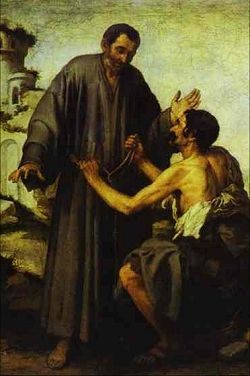
Brother Juniper was so full of pity and compassion for the poor, that when he saw anyone poor or naked he immediately took off his tunic, or the hood of his clock, and gave it to him. The guardian therefore laid an obedience upon him not to give away his tunic or any part of his habit.


A few days afterwards, a poor half-naked man asked an alms of Brother Juniper for the love of God, who answered him with great compassion: "I have nothing which I could give thee but my tunic, and my superior has laid me under obedience not to give it, nor any part of my habit, to anyone. But if thou take it off my back I will not resist thee." He did not speak to a deaf man; for the begger forthwith stripped him of his tunic, and went off with it. When Brother Juniper returned home, and was asked what had become of his tunic, he replied: "A good man took it off my back, and went away with it." And as the virtue of compassion increased in him, he was not contented with giving his tunic, but would give books, or clocks, or whatever he could lay his hands on, to the poor. For this reason the brethren took care to leave nothing in the common rooms of the convent, because Brother Juniper gave away everything for the love of God and to the glory of his name.


Francis sent him to establish “places” for the friars in Gualdo Tadino and Viterbo. When Saint Clare was dying, Juniper consoled her. He was devoted to the passion of Jesus and was known for his simplicity.


We don’t know much about Juniper before he joined the friars in 1210. Francis sent him to establish “places” for the friars in Gualdo Tadino and Viterbo. When Saint Clare was dying, Juniper consoled her. He was devoted to the passion of Jesus and was known for his simplicity.


As Brother Juniper was one day hearing Mass with great devotion, he fell into an ecstasy, and so continued for a long space of time. And when he came to himself, he said with great fervour of spirit to the other friars: "Oh, my brethren, who is there in this world so noble that he would disdain to carry a basket of mud all the world over, in the hope of obtaining a house full of gold?" Then he added: "Alas, why will we not endure a little shame to obtain life eternal?"


Several stories about Juniper in the Little Flowers of St. Francis illustrate his exasperating generosity. Once Juniper was taking care of a sick man who had a craving to eat pig’s feet. This helpful friar went to a nearby field, captured a pig and cut off one foot, and then served this meal to the sick man. The owner of the pig was furious and immediately went to Juniper’s superior. When Juniper saw his mistake, he apologized profusely. He also ended up talking this angry man into donating the rest of the pig to the friars!


Another time Juniper had been commanded to quit giving part of his clothing to the half-naked people he met on the road. Desiring to obey his superior, Juniper once told a man in need that he couldn’t give the man his tunic, but he wouldn’t prevent the man from taking it either. In time, the friars learned not to leave anything lying around, for Juniper would probably give it away.


He died in 1258 and is buried at Ara Coeli Church in Rome. He was never formally Beatified.


8 posted on 01/29/2026 5:01:34 PM PST by annalex (fear them not)
[ Post Reply | Private Reply | To 7 | View Replies]

To: annalex

NAVARRE BIBLE COMMENTARY(RSV)

Ad Majorem Dei Gloriam (To the Greater Glory of God)

Today’s First Reading

From: 2 Samuel 7:18-19, 24-29

David’s prayer
---------------------
[18] Then King David went in and sat before the Lord, and said, “Who am I, O Lord God, and what is my house, that thou hast brought me thus far? [19] And yet this was a small thing in thy eyes, O Lord God; thou hast spoken also of thy servant’s house for a great while to come, and hast shown me future generations, O Lord God!

[24] And thou didst establish for thyself thy people Israel to be thy people for ever; and thou, O Lord, didst become their God. [25] And now, O Lord God, confirm for ever the word which thou hast spoken concerning thy servant and concerning his house, and do as thou hast spoken; [26] and thy name will be magnified for ever, saying, ‘The Lord of hosts is God over Israel,’ and the house of thy servant David will be established before thee. [27] For thou, O Lord of hosts, the God of Israel, hast made this revelation to thy servant, saying, “I will build you a house’; therefore thy servant has found courage to pray this prayer to thee. [28] And now, O Lord God, thou art God, and thy words are true, and thou hast promised this good thing to thy servant; [29] now therefore may it please thee to bless the house of thy servant, that it may continue for ever before thee; for thou, O Lord God, hast spoken, and with thy blessing shall the house of thy servant be blessed for ever.”

**************************************************
Commentary:

7:18-29. David’s prayer in response to the prophecy is a song of praise that follows the three main points of the prophecy: the divine election of David himself (vv. 18-21), the election of the people as people of God (vv. 22-24), and the consolidation of the Davidic dynasty (vv. 25-29). In this prayer David identifies himself with his line, and therefore the blessings which have come on him extend to the whole house of David (vv. 28-29). “David is par excellence the king ‘after God’s own heart’, the shepherd who prays for his people and prays in their name. His submission to the will of God, his praise and his repentance, will be a model for the prayer of the people. His prayer, the prayer of God’s Anointed, is a faithful adherence to the divine promise (2 Sam 7:18-29) and expresses a loving and joyful trust in God, the only King and Lord.” (Catechism of the Catholic Church, 2579).

--------------------------

Today’s Gospel Reading

From: Mark 4:21-25

Parables of the Lamp and the Measure
------------------------------------
[21] And He (Jesus) said to them, "Is a lamp brought in to be put under a bushel, or under a bed, and not on a stand? [22] For there is nothing hid, except to be made manifest; nor is anything secret, except to come to light. [23] If any man has ears to hear, let him hear." [24] And He said to them, "Take heed what you hear; the measure you give will be the measure you get, and still more will be given you. [25] For to him who has will more be given; and from him who has not, even what he has will be taken away."

***********************************************************************
Commentary:

21. A "bushel" was a container used for measuring cereals and vegetables. It held a little over eight liters (two gallons).

22. This parable contains a double teaching. Firstly, it says that Christ's doctrine should not be kept hidden; rather, it must be preached throughout the whole world. We find the same idea elsewhere in the Gospels: "what you hear whispered, proclaim it upon the house-tops" (Matthew 10:27); "Go into all the world and preach the Gospel to the whole of creation..." (Mark 16:15). The other teaching is that the Kingdom which Christ proclaims has such ability to penetrate all hearts that, at the end of time, when Jesus comes again, not a single human action, in favor or against Christ, will not become public and manifest.

24-25. Our Lord never gets tired of asking the Apostles, the seed which will produce the Church, to listen carefully to the teaching He is giving: they are receiving a treasure for which they will be held to account. "To him who has will more be given...": he who responds to grace will be given more grace and will yield more and more fruit; but he who does not will become more and more impoverished (cf. Matthew 25:14-30). Therefore, there is no limit to the development of the theological virtues: "If you say `Enough,' you are already dead" (St. Augustine, "Sermon 51"). A soul who wants to make progress in the interior life will pray along these lines: "Lord, may I have due measure in everything, except in Love" (St J. Escriva, "The Way", 247).

9 posted on 01/29/2026 5:01:43 PM PST by fidelis (Ecce Crucem Domini! Fugite partes adversae! Vicit Leo de tribu Juda, Radix David! Alleluia!)
[ Post Reply | Private Reply | To 7 | View Replies]

Click here to go to the My Catholic Life! Devotional thread for a meditation on today’s Gospel Reading.

10 posted on 01/29/2026 5:02:29 PM PST by fidelis (Ecce Crucem Domini! Fugite partes adversae! Vicit Leo de tribu Juda, Radix David! Alleluia!)
[ Post Reply | Private Reply | To 9 | View Replies]

To: annalex

11 posted on 01/29/2026 5:03:28 PM PST by annalex (fear them not)
[ Post Reply | Private Reply | To 8 | View Replies]

To: annalex
deepertruthcatholics.com
12 posted on 01/29/2026 5:05:07 PM PST by annalex (fear them not)
[ Post Reply | Private Reply | To 8 | View Replies]

Disclaimer: Opinions posted on Free Republic are those of the individual posters and do not necessarily represent the opinion of Free Republic or its management. All materials posted herein are protected by copyright law and the exemption for fair use of copyrighted works.

Free Republic
Browse · Search
Religion
Topics · Post Article

FreeRepublic, LLC, PO BOX 9771, FRESNO, CA 93794
FreeRepublic.com is powered by software copyright 2000-2008 John Robinson