Posted on 01/21/2026 4:46:30 PM PST by annalex
Saint Agnes, Virgin, Martyr on Wednesday of week 2 in Ordinary Time Church of Sant'Agnese in Rome Readings at MassLiturgical Colour: Red. Year: A(II). These are the readings for the feria
David and GoliathDavid said to Saul, ‘Let no-one lose heart on his account; your servant will go and fight the Philistine.’ But Saul answered David, ‘You cannot go and fight the Philistine; you are only a boy and he has been a warrior from his youth.’ ‘The Lord who rescued me from the claws of lion and bear’ David said ‘will rescue me from the power of this Philistine.’ Then Saul said to David, ‘Go, and the Lord be with you!’ He took his staff in his hand, picked five smooth stones from the river bed, put them in his shepherd’s bag, in his pouch, and with his sling in his hand he went to meet the Philistine. The Philistine, his shield-bearer in front of him, came nearer and nearer to David; and the Philistine looked at David, and what he saw filled him with scorn, because David was only a youth, a boy of fresh complexion and pleasant bearing. The Philistine said to him, ‘Am I a dog for you to come against me with sticks?’ And the Philistine cursed David by his gods. The Philistine said to David, ‘Come over here and I will give your flesh to the birds of the air and the beasts of the field.’ But David answered the Philistine, ‘You come against me with sword and spear and javelin, but I come against you in the name of the Lord of Hosts, the God of the armies of Israel that you have dared to insult. Today the Lord will deliver you into my hand and I shall kill you; I will cut off your head, and this very day I will give your dead body and the bodies of the Philistine army to the birds of the air and the wild beasts of the earth, so that all the earth may know that there is a God in Israel, and that all this assembly may know that it is not by sword or by spear that the Lord gives the victory, for the Lord is lord of the battle and he will deliver you into our power.’ No sooner had the Philistine started forward to confront David than David left the line of battle and ran to meet the Philistine. Putting his hand in his bag, he took out a stone and slung it and struck the Philistine on the forehead; the stone penetrated his forehead and he fell on his face to the ground. Thus David triumphed over the Philistine with a sling and a stone and struck the Philistine down and killed him. David had no sword in his hand. Then David ran and, standing over the Philistine, seized his sword and drew it from the scabbard, and with this he killed him, cutting off his head. The Philistines saw that their champion was dead, and took to flight.
Blessed be the Lord, my rock. Blessed be the Lord, my rock, who trains my arms for battle, who prepares my hands for war. Blessed be the Lord, my rock. He is my love, my fortress; he is my stronghold, my saviour my shield, my place of refuge. He brings peoples under my rule. Blessed be the Lord, my rock. To you, O God, will I sing a new song; I will play on the ten-stringed lute to you who give kings their victory, who set David your servant free. Blessed be the Lord, my rock.
Alleluia, alleluia! The word of God is something alive and active: it can judge secret emotions and thoughts. Alleluia!
Alleluia, alleluia! Jesus proclaimed the Good News of the kingdom and cured all kinds of sickness among the people. Alleluia!
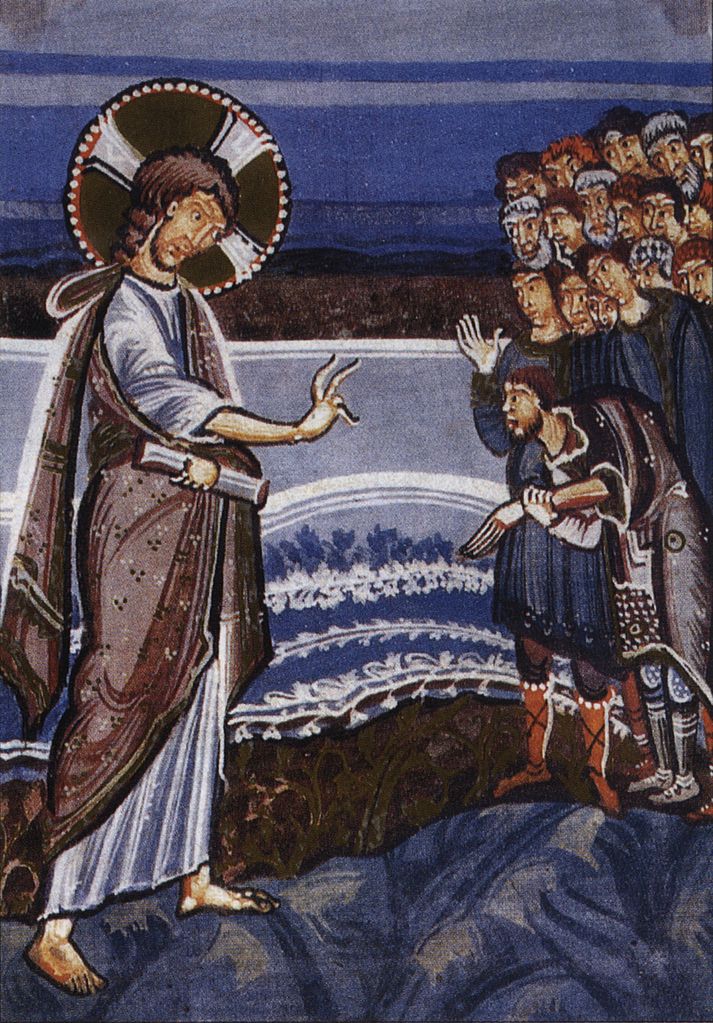
Is it against the law on the sabbath day to save life?Jesus went into a synagogue, and there was a man there who had a withered hand. And they were watching him to see if he would cure him on the sabbath day, hoping for something to use against him. He said to the man with the withered hand, ‘Stand up out in the middle!’ Then he said to them, ‘Is it against the law on the sabbath day to do good, or to do evil; to save life, or to kill?’ But they said nothing. Then, grieved to find them so obstinate, he looked angrily round at them, and said to the man, ‘Stretch out your hand.’ He stretched it out and his hand was better. The Pharisees went out and at once began to plot with the Herodians against him, discussing how to destroy him. These are the readings for the memorial
God chose what is foolish by human reckoning, to shame the wiseTake yourselves for instance, brothers, at the time when you were called: how many of you were wise in the ordinary sense of the word, how many were influential people, or came from noble families? No, it was to shame the wise that God chose what is foolish by human reckoning, and to shame what is strong that he chose what is weak by human reckoning; those whom the world thinks common and contemptible are the ones that God has chosen – those who are nothing at all to show up those who are everything. The human race has nothing to boast about to God, but you, God has made members of Christ Jesus and by God’s doing he has become our wisdom, and our virtue, and our holiness, and our freedom. As scripture says: if anyone wants to boast, let him boast about the Lord.
The Lord is my shepherd: there is nothing I shall want. The Lord is my shepherd; there is nothing I shall want. Fresh and green are the pastures where he gives me repose. Near restful waters he leads me, to revive my drooping spirit. The Lord is my shepherd: there is nothing I shall want. He guides me along the right path; he is true to his name. If I should walk in the valley of darkness no evil would I fear. You are there with your crook and your staff; with these you give me comfort. The Lord is my shepherd: there is nothing I shall want. You have prepared a banquet for me in the sight of my foes. My head you have anointed with oil; my cup is overflowing. The Lord is my shepherd: there is nothing I shall want. Surely goodness and kindness shall follow me all the days of my life. In the Lord’s own house shall I dwell for ever and ever. The Lord is my shepherd: there is nothing I shall want.
Alleluia, alleluia! Remain in my love, says the Lord; whoever remains in me, with me in him, bears fruit in plenty. Alleluia!
He sells everything he owns and buys the fieldJesus said to the crowds: ‘The kingdom of heaven is like treasure hidden in a field which someone has found; he hides it again, goes off happy, sells everything he owns and buys the field. ‘Again, the kingdom of heaven is like a merchant looking for fine pearls; when he finds one of great value he goes and sells everything he owns and buys it.’ The readings on this page are from the Jerusalem Bible, which is used at Mass in most of the English-speaking world. The New American Bible readings, which are used at Mass in the United States, are available in the Universalis apps, programs and downloads. |
Dear FRiends,
We need your continuing support to keep FR funded. Your donations are our sole source of funding. No sugar daddies, no advertisers, no paid memberships, no commercial sales, no gimmicks, no tax subsidies. No spam, no pop-ups, no ad trackers.
If you enjoy using FR and agree it's a worthwhile endeavor, please consider making a contribution today:
Click here: to donate by Credit Card
Or here: to donate by PayPal
Or by mail to: Free Republic, LLC - PO Box 9771 - Fresno, CA 93794
Thank you very much and God bless you,
Jim
KEYWORDS: catholic; mk3; mt13; ordinarytime; prayer

Please FReepmail me to get on/off the Alleluia Ping List.
| Mark | |||
| English: Douay-Rheims | Latin: Vulgata Clementina | Greek NT: Byzantine/Majority Text (2000) | |
| Mark 3 | |||
| 1. | AND he entered again into the synagogue, and there was a man there who had a withered hand. | Et introivit iterum in synagogam : et erat ibi homo habens manum aridam. | και εισηλθεν παλιν εις την συναγωγην και ην εκει ανθρωπος εξηραμμενην εχων την χειρα |
| 2. | And they watched him whether he would heal on the sabbath days; that they might accuse him. | Et observabant eum, si sabbatis curaret, ut accusarent illum. | και παρετηρουν αυτον ει τοις σαββασιν θεραπευσει αυτον ινα κατηγορησωσιν αυτου |
| 3. | And he said to the man who had the withered hand: Stand up in the midst. | Et ait homini habenti manum aridam : Surge in medium. | και λεγει τω ανθρωπω τω εξηραμμενην εχοντι την χειρα εγειραι εις το μεσον |
| 4. | And he saith to them: Is it lawful to do good on the sabbath days, or to do evil? to save life, or to destroy? But they held their peace. | Et dicit eis : Licet sabbatis benefacere, an male ? animam salvam facere, an perdere ? At illi tacebant. | και λεγει αυτοις εξεστιν τοις σαββασιν αγαθοποιησαι η κακοποιησαι ψυχην σωσαι η αποκτειναι οι δε εσιωπων |
| 5. | And looking round about on them with anger, being grieved for the blindness of their hearts, he saith to the man: Stretch forth thy hand. And he stretched it forth: and his hand was restored unto him. | Et circumspiciens eos cum ira, contristatus super cæcitate cordis eorum, dicit homini : Extende manum tuam. Et extendit, et restituta est manus illi. | και περιβλεψαμενος αυτους μετ οργης συλλυπουμενος επι τη πωρωσει της καρδιας αυτων λεγει τω ανθρωπω εκτεινον την χειρα σου και εξετεινεν και αποκατεσταθη η χειρ αυτου υγιης ως η αλλη |
| 6. | And the Pharisees going out, immediately made a consultation with the Herodians against him, how they might destroy him. | Exeuntes autem pharisæi, statim cum Herodianis consilium faciebant adversus eum quomodo eum perderent. | και εξελθοντες οι φαρισαιοι ευθεως μετα των ηρωδιανων συμβουλιον εποιουν κατ αυτου οπως αυτον απολεσωσιν |

3:1–5
1. And he entered again into the synagogue; and there was a man there which had a withered hand.
2. And they watched him, whether he would heal him on the sabbath day; that they might accuse him.
3. And he saith unto the man which had the withered hand, Stand forth.
4. And he saith unto them, Is it lawful to do good on the sabbath days, or to do evil? to save life, or to kill? But they held their peace.
5. And when he had looked round about on them with anger, being grieved for the hardness of their hearts, he saith unto the man, Stretch forth thine hand. And he stretched it out: and his hand was restored whole as the other.
THEOPHYLACT. After confounding the Jews, who had blamed His disciples, for pulling the ears of corn on the sabbath day, by the example of David, the Lord now further bringing them to the truth, works a miracle on the sabbath; shewing that, if it is a pious deed to work miracles on the sabbath for the health of men, it is not wrong to do on the sabbath things necessary for the body: he says therefore, And he entered again into the synagogue; and there was a man there which had a withered hand. And they watched him, whether he would heal him on the sabbath-day; that they might accuse him.
BEDE. (in Marc. i. 14) For, since He had defended the breaking of the sabbath, which they objected to His disciples, by an approved example, now they wish, by watching Him, to calumniate Himself, that they might accuse Him of a transgression, if He cured on the sabbath, of cruelty or of folly, if He refused. It goes on: And he saith unto the man which had the withered hand, Stand in the midst.
PSEUDO-CHRYSOSTOM. (Vict. Ant. e Cat. in Marc. v. Chrys. Hom. in Matt. 40) He placed him in the midst, that they might be frightened at the sight, and on seeing him compassionate him, and lay aside their malice.
BEDE. (ubi sup.) And anticipating the calumny of the Jews, which they had prepared for Him, He accused them of violating the precepts of the law, by a wrong interpretation. Wherefore there follows: And he saith unto them, Is it lawful to do good on the sabbath-day, or to do evil? And this He asks, because they thought that on the sabbath they were to rest even from good works, whilst the law commands to abstain from bad, saying, Ye shall do no servile work therein; (Levit. 23:7) that is, sin: for Whosoever committeth sin is the servant of sin. (John 8:34) What He first says, to do good on the sabbath-day or to do evil, is the same as what He afterwards adds, to save a life or to lose it; that is, to cure a man or not. Not that God, Who is in the highest degree good, can be the author of perdition to us, but that His not saving is in the language of Scripture to destroy. But if it be asked, wherefore the Lord, being about to cure the body, asked about the saving of the soul, let him understand either that in the common way of Scripture the soul is put for the man; as it is said, All the souls that came out of the loins of Jacob; (Exodus 1:5) or because he did those miracles for the saving of a soul, or because the healing itself of the hand signified the saving of the soul.
AUGUSTINE. (de Con. Evan. ii. 35) But some one may wonder how Matthew could have said, that they themselves asked the Lord, if it was lawful to heal on the sabbath-day; when Mark rather relates that they were asked by our Lord, Is it lawful to do good on the sabbath-day, or to do evil? Therefore we must understand that they first asked the Lord, if it was lawful to heal on the sabbath-day, then that understanding their thoughts, and that they were seeking an opportunity to accuse Him, He placed in the middle him whom He was about to cure, and put those questions, which Mark and Luke relate. We must then suppose, that when they were silent, He propounded the parable of the sheep, and concluded, that it was lawful to do good on the sabbath-day. It goes on: But they were silent.
PSEUDO-CHRYSOSTOM. (Vict. Ant. e Cat, in Marc.) For they knew that He would certainly cure him. It goes on: And looking round about upon them with anger. His looking round upon them in anger, and being saddened at the blindness of their hearts, is fitting for His humanity, which He deigned to take upon Himself for us. He connects the working of the miracle with a word, which proves that the man is cured by His voice alone. It follows therefore, And he stretched it out, and his hand was restored. Answering by all these things for His disciples, and at the same time shewing that His life is above the law.
BEDE. (ubi sup.) But mystically, the man with a withered hand shews the human race, dried up as to its fruitfulness in good works, but now cured by the mercy of the Lord; the hand of man, which in our first parent had been dried up when he plucked the fruit of the forbidden tree, through the grace of the Redeemer, Who stretched His guiltless hands on the tree of the cross, has been restored to health by the juices of good works. Well too was it in the synagogue that the hand was withered; for where the gift of knowledge is greater, there also the danger of inexcusable guilt is greater.
PSEUDO-JEROME. Or else it means the avaricious, who, being able to give had rather receive, and love robbery rather than making gifts. And they are commanded to stretch forth their hands, that is, let him that stole steal no more, but rather let him labour, working with his hand the thing which is good, that he may have to give to him that needeth. (Eph. 4:28)
THEOPHYLACT. Or, he has his right hand withered, who does not the works which belong to the right side; for from the time that our hand is employed in forbidden deeds, from that time it is withered to the working of good. But it will be restored whenever it stands firm in virtue; wherefore Christ saith, Arise, that is, from sin, and stand in the midst; that thus it may stretch itself forth neither too little or too much.
3:6–12
6. And the Pharisees went forth, and straightway took counsel with the Herodians against him, how they might destroy him.
7. But Jesus withdrew himself with his disciples to the sea: and a great multitude from Galilee followed him, and from Judæa,
8. And from Jerusalem, and from Idumæa, and from beyond Jordan; and they about Tyre and Sidon, agr eat multitude, when they had heard what great things he did, came unto him.
9. And he spake to his disciples, that a small ship should wait on him, because of the multitude, lest they should throng him.
10. For he had healed many; insomuch that they pressed upon him for to touch him, as many as had plagues.
11. And unclean spirits, when they saw him, fell down before him, and cried, saying, Thou art the Son of God.
12. And he straitly charged them that they should not make him known.
BEDE. (in Marc. i. 15) The Pharisees, thinking it a crime that at the word of the Lord the hand which was diseased was restored to a sound state, agreed to make a pretext of the words spoken by our Saviour; wherefore it is said, And the Pharisees went forth, and straightway took counsel with the Herodians against him, how they might destroy him. As if every one amongst them did not greater things on the sabbath day, carrying food, reaching forth a cup, and whatever else is necessary for meals. Neither could He, Who said and it was done, be convicted of toiling on the sabbath day.
THEOPHYLACT. But the soldiers of Herod the king are called Herodians, because a certain new heresy had sprung up, which asserted that Herod was the Christ. For the prophecy of Jacob intimated, that when the princes of Judah failed, then Christ should come; because therefore in the time of Herod none of the Jewish princes remained, and he, an alien, was the sole ruler, some thought that he was the Christ, and set on foot this heresy. These, therefore, were with the Pharisees trying to kill Christ.
BEDE. (ubi sup.) Or else he calls Herodians the servants of Herod the Tetrarch, who on account of the hatred which their lord had for John, pursued with treachery and hate the Saviour also, Whom John preached. It goes on, But Jesus withdrew himself with his disciples to the sea; He fled from their treachery, because the hour of His passion had not yet come, and no place away from Jerusalem was proper for His Passion. By which also He gave an example to His disciples, when they suffer persecution in one city, to flee to another.
THEOPHYLACT. At the same time again, He goes away, that by quitting the ungrateful He might do good to more, for many followed him, and he healed them. For there follows, And a great multitude from Galilee, &c. Syrians and Sidonians, being foreigners, receive benefit from Christ; but His kindred the Jews persecute Him: thus there is no profit in relationship, if there be not a similarity in goodness.
BEDE. (ubi sup.) For the strangers followed Him, because they saw the works of His powers, and in order to hear the words or His teaching. But the Jews, induced solely by their opinion of His powers, in a vast multitude come to hear Him, and to beg for His aiding health; wherefore there follows, And he spake to his disciples, that they should wait, &c.
THEOPHYLACT. Consider then how He hid His glory, for He begs for a little ship, lest the crowd should hurt Him, so that entering into it, He might remain unharmed. It follows, As many as had scourges, &c. But he means by scourges, diseases, for God scourges us, as a father does His children.
BEDE. (ubi sup.) Both therefore fell down before the Lord, those who had the plagues of bodily diseases, and those who were vexed by unclean spirits. The sick did this simply with the intention of obtaining health, but the demoniacs, or rather the devils within them, because under the mastery of a fear of God they were compelled not only to fall down before Him, but also to praise His majesty; wherefore it goes on, And they cried out, saying, Thou art the Son of God. And here we must wonder at the blindness of the Arians, who, after the glory of His resurrection, deny the Son of God, Whom the devils confess to be the Son of God, though still clothed with human flesh. There follows, And he straitly charged them, that they should not make him known. (Ps. 50:16) For God said to the sinner, Why dost thou preach my laws? A sinner is forbidden to preach the Lord, lest any one listening to his preaching should follow him in his error, for the devil is an evil master, who always mingles false things with true, that the semblance of truth may cover the witness of fraud. But not only devils, but persons healed by Christ, and even Apostles, are ordered to be silent concerning Him before the Passion, lest by the preaching of the majesty of His Divinity, the economy of His Passion should be retarded. But allegorically, in the Lord’s coming out of the synagogue, and then retiring to the sea, He prefigured the salvation of the Gentiles, to whom He deigned to come through their faith, having quitted the Jews on account of their perfidy. For the nations, driven about in divers by-paths of error, are fitly compared to the unstable sea. (v. Cyprian. Ep. lxiii. Aug. de Civ. Dei, 20, 16.) Again, a great crowd from various provinces followed Him, because He has received with kindness many nations, who came to Him through the preaching of the Apostles. But the ship waiting upon the Lord in the sea is the Church, collected from amongst the nations; and He goes into it lest the crowd should throng Him, because flying from the troubled minds of carnal persons, He delights to come to those who despise the glory of this world, and to dwell within them. Further, there is a difference between thronging the Lord, and touching Him; for they throng Him, when by carnal thoughts and deeds they trouble peace, in which truth dwells; but he touches Him, who by faith and love has received Him into his heart; wherefore those who touched Him are said to have been saved.
THEOPHYLACT. Morally again, the Herodians, that is, persons who love the lusts of the flesh, wish to slay Christ. For the meaning of Herod is, ‘of skin.’ (pelliceus. v. Hier. de Nom. Hebr) But those who quit their country, that is, a carnal mode of living, follow Christ, and their plagues are healed, that is, the sins which wound their conscience. But Jesus in us is our reason, which commands that our vessel, that is, our body, should serve Him, lest the troubles of worldly affairs should press upon our reason.
Catena Aurea Mark 3
| Matthew | |||
| English: Douay-Rheims | Latin: Vulgata Clementina | Greek NT: Byzantine/Majority Text (2000) | |
| Matthew 13 | |||
| 44. | The kingdom of heaven is like unto a treasure hidden in a field. Which a man having found, hid it, and for joy thereof goeth, and selleth all that he hath, and buyeth that field. | Simile est regnum cælorum thesauro abscondito in agro : quem qui invenit homo, abscondit, et præ gaudio illius vadit, et vendit universa quæ habet, et emit agrum illum. | παλιν ομοια εστιν η βασιλεια των ουρανων θησαυρω κεκρυμμενω εν τω αγρω ον ευρων ανθρωπος εκρυψεν και απο της χαρας αυτου υπαγει και παντα οσα εχει πωλει και αγοραζει τον αγρον εκεινον |
| 45. | Again the kingdom of heaven is like to a merchant seeking good pearls. | Iterum simile est regnum cælorum homini negotiatori, quærenti bonas margaritas. | παλιν ομοια εστιν η βασιλεια των ουρανων ανθρωπω εμπορω ζητουντι καλους μαργαριτας |
| 46. | Who when he had found one pearl of great price, went his way, and sold all that he had, and bought it. | Inventa autem una pretiosa margarita, abiit, et vendidit omnia quæ habuit, et emit eam. | ος ευρων ενα πολυτιμον μαργαριτην απελθων πεπρακεν παντα οσα ειχεν και ηγορασεν αυτον |

44. Again, the kingdom of heaven is like unto treasure hid in a field; the which when a man hath found, he hideth, and for joy thereof goeth and selleth all that he hath, and buyeth that field.
CHRYSOSTOM. The foregoing parables of the leaven, and the grain of mustard-seed, are referred to the power of the Gospel preaching, which has subdued the whole world; in order to shew its value and splendour, He now puts forth parables concerning a pearl and a treasure, saying, The kingdom of heaven is like unto treasure hid in a field. For the Gospel preaching is hidden in this world; and if you do not sell your all you will not purchase it; and this you ought to do with joy; wherefore it follows, which when a man hath found, he hideth it.
HILARY. This treasure is indeed found without cost; for the Gospel preaching is open to all, but to use and possess the treasure with its field we may not without price, for heavenly riches are not obtained without the loss of this world.
JEROME. That he hides it, does not proceed of envy towards others, but as one that treasures up what he would not lose, he hides in his heart that which he prizes above his former possessions.
GREGORY. (Hom. in Ev. xi. 1.) Otherwise; The treasure hidden in the field is the desire of heaven; the field in which the treasure is hidden is the discipline of heavenly learning; this, when a man finds, he hides, in order that he may preserve it; for zeal and affections heavenward it is not enough that we protect from evil spirits, if we do not protect from human praises. For in this present life we are in the way which leads to our country, and evil spirits as robbers beset us in our journey. Those therefore who carry their treasure openly, they seek to plunder in the way. When I say this, I do not mean that our neighbours should not see our works, but that in what we do, we should not seek praise from without. The kingdom of heaven is therefore compared to things of earth, that the mind may rise from things familiar to things unknown, and may learn to love the unknown by that which it knows is loved when known. It follows, And for joy thereof he goeth and selleth all that he hath, and buyeth that field. He it is that selleth all he hath and buyeth the field, who, renouncing fleshly delights, tramples upon all his worldly desires in his anxiety for the heavenly discipline.
JEROME. Or, That treasure in which are hid all the treasures of wisdom and knowledge (Col. 2:3.), is either God the Word, who seems hid in Christ’s flesh, or the Holy Scriptures, in which are laid up the knowledge of the Saviour.
AUGUSTINE. (Quæst. in Ev. i. 13.) Or, He speaks of the two testaments in the Church, which, when any hath attained to a partial understanding of, he perceives how great things lie hid there, and goeth and selleth all that he hath, and buyeth that; that is, by despising temporal things he purchases to himself peace, that he may be rich in the knowledge of God.
13:45–46
45. Again, the kingdom of heaven is like unto a merchant man, seeking goodly pearls:
46. Who, when he had found one pearl of great price, went and sold all that he had, and bought it.
CHRYSOSTOM. The Gospel preaching not only offers manifold gain as a treasure, but is precious as a pearl; wherefore after the parable concerning the treasure, He gives that concerning the pearl. And in preaching, two things are required, namely, to be detached from the business of this life, and to be watchful, which are denoted by this merchantman. Truth moreover is one, and not manifold, and for this reason it is one pearl that is said to be found. And as one who is possessed of a pearl, himself indeed knows of his wealth, but is not known to others, ofttimes concealing it in his hand because of its small bulk, so it is in the preaching of the Gospel; they who possess it know that they are rich, the unbelievers, not knowing of this treasure, know not of our wealth.
JEROME; By the goodly pearls may be understood the Law and the Prophets. Hear then Marcion and Manichæus; the good pearls are the Law and the Prophets. One pearl, the most precious of all, is the knowledge of the Saviour and the sacrament of His passion and resurrection, which when the merchantman has found, like Paul the Apostle, he straightway despises all the mysteries of the Law and the Prophets and the old observances in which he had lived blameless, counting them as dung that he may win Christ. (Phil. 3:8.) Not that the finding of a new pearl is the condemnation of the old pearls, but that in omparison of that, all other pearls are worthless.
GREGORY. (Hom. in Ev. xi. 2.) Or by the pearl of price is to be understood the sweetness of the heavenly kingdom, which, he that hath found it, selleth all and buyeth. For he that, as far as is permitted, has had perfect knowledge of the sweetness of the heavenly life, readily leaves all things that he has loved on earth; all that once pleased him among earthly possessions now appears to have lost its beauty, for the splendour of that precious pearl is alone seen in his mind.
AUGUSTINE. (Quæst. in Matt. q. 13.) Or, A man seeking goodly pearls has found one pearl of great price; that is, he who is seeking good men with whom he may live profitably, finds one alone, Christ Jesus, without sin; or, seeking precepts of life, by aid of which he may dwell righteously among men, finds love of his neighbour, in which one rule, the Apostle says, (Rom. 13:9.) are comprehended all things; or, seeking good thoughts, he finds that Word in which all things are contained, In the beginning was the Word. (John 1:1.) which is lustrous with the light of truth, stedfast with the strength of eternity, and throughout like to itself with the beauty of divinity, and when we have penetrated the shell of the flesh, will be confessed as God. But whichever of these three it may be, or if there be any thing else that can occur to us, that can be signified under the figure of the one precious pearl, its preciousness is the possession of ourselves, who are not free to possess it unless we despise all things that can be possessed in this world. For having sold our possessions, we receive no other return greater than ourselves, (for while we were involved in such things we were not our own,) that we may again give ourselves for that pearl, not because we are of equal value to that, but because we cannot give any thing more.
Catena Aurea Matthew 13

Saint Agnes was twelve years old—and even her name is already a sermon.
Agnes comes from the Greek hagnē, meaning pure, chaste, undefiled. To the Latin ear, it also sounds like agnus—the lamb. The Church has never tried to correct that resonance. She has preserved it, sanctified it, and built liturgy around it. Agnes is the chaste one who follows the Lamb. Her name proclaims her vocation before she speaks a word.
Born into a noble Roman household, Agnes consecrated herself to Christ while still a child. She vowed virginity not as flight from the world, but as total belonging. When suitors sought her hand, she refused them all. She was already espoused. Her Bridegroom was invisible, but His claim was absolute.
That refusal brought consequences. During the persecutions associated with Diocletian, the authorities first sought to destroy her reputation before destroying her body. If her purity could be violated publicly, Christianity itself could be mocked. Threatened with dishonour, exposed to fire, finally condemned to death, Agnes remained immovable. When she was killed—traditionally in the year 304—she died not as one overwhelmed, but as one faithful. She was buried on the Via Nomentana, where the Church still keeps vigil beside her tomb.
Only then does the Roman liturgy place upon her lips the words of the Introit:
“The wicked have waited for me to destroy me: but I have understood Thy testimonies, O Lord.”
These are not words of fear. They are words of comprehension. Agnes understood what the world denied: that the body has meaning before it has use; that purity is strength, not fragility; that belonging to God is worth more than survival. The wicked have waited—patiently, calculating that youth would bend. Agnes proves them wrong.
The Gospel of the Wise and Foolish Virgins reveals the interior structure of her sanctity. Agnes is not merely a virgin; she is a wise virgin. Her lamp burns because it is filled. Her fidelity is not improvised in crisis; it is prepared long before midnight.
Saint Ambrose teaches that virginity is not mere abstention, but watchful readiness—a discipline of the whole person ordered toward God.¹ Agnes’ chastity was not weakness; it was formation. It trained her for endurance.
Saint Jerome presses the point further: virginity is a form of hidden martyrdom, a daily dying to the world even without bloodshed.² Agnes’ visible martyrdom simply reveals what she had already lived invisibly.
Saint Augustine gives the final key: it was not violence that made Agnes a martyr, but love—love stronger than fear, stronger than death.³ Rome could command fire and steel; it could not command consent.
And here the Roman Church adds something the modern mind overlooks but the liturgy insists upon.
On this very feast, in Rome, lambs are blessed at the basilica built over Agnes’ tomb—Sant’Agnese fuori le mura. From their wool are woven the pallia worn by metropolitan archbishops, the sign of their pastoral authority and communion with the See of Peter.
Agnes’ lambs clothe the shepherds of the Church.
This is no quaint custom. It is theology enacted. Authority in the Church is not derived from power, strategy, or charisma, but from innocence offered and sacrifice embraced. Before the shepherd teaches, governs, or corrects, he must be clothed in the wool of a lamb blessed on the feast of a virgin martyr.
The pallium is not an ornament; it is a yoke. It reminds every archbishop that he is to smell of the sheep because he has first learned to resemble the Lamb.
This is why Agnes matters now. We live in a culture that treats the body as negotiable, innocence as disposable, and chastity as harmful. Children are taught early to explore desire, but rarely to master themselves. Agnes stands as a contradiction written in blood. She proclaims that freedom is not indulgence, but the power to belong wholly to God.
Her witness also judges a Church tempted to lower demands in order to remain credible. The Roman liturgy does the opposite. It places a child before us—and clothes bishops in her lambs’ wool.
Beloved in Christ, the wicked still wait.
The Bridegroom still tarries.
The cry will still come.
The door will still close.
Saint Agnes—the chaste one, the lamb of Christ—understood Thy testimonies, O Lord.
May we learn them before the night is far spent.
Amen.

Disclaimer: Opinions posted on Free Republic are those of the individual posters and do not necessarily represent the opinion of Free Republic or its management. All materials posted herein are protected by copyright law and the exemption for fair use of copyrighted works.