Posted on 01/12/2026 6:50:54 AM PST by annalex
Monday of week 1 in Ordinary Time ![]() Mass for the Feast of the Baptism of the Lord at the site of the Baptism (Al-Maghtas) Readings at MassLiturgical Colour: Green. Year: A(II).
Hannah's rival taunts her for being barrenThere was a man of Ramathaim, a Zuphite from the highlands of Ephraim whose name was Elkanah son of Jeroham, son of Elihu, son of Tohu, son of Zuph, an Ephraimite. He had two wives, one called Hannah, the other Peninnah; Peninnah had children but Hannah had none. Every year this man used to go up from his town to worship and to sacrifice to the Lord of Hosts in Shiloh. The two sons of Eli, Hophni and Phinehas, were there as priests of the Lord. One day Elkanah offered sacrifice. He used to give portions to Peninnah and to all her sons and daughters; to Hannah, however, he would give only one portion, although he loved her more, since the Lord had made her barren. Her rival would taunt her to annoy her, because the Lord had made her barren. And this went on year after year; every time they went up to the temple of the Lord she used to taunt her. And so Hannah wept and would not eat. Then Elkanah her husband said to her, ‘Hannah, why are you crying and why are you not eating? Why so sad? Am I not more to you than ten sons?’
A thanksgiving sacrifice I make to you, O Lord. or Alleluia! How can I repay the Lord for his goodness to me? The cup of salvation I will raise; I will call on the Lord’s name. A thanksgiving sacrifice I make to you, O Lord. or Alleluia! My vows to the Lord I will fulfil before all his people. O precious in the eyes of the Lord is the death of his faithful. A thanksgiving sacrifice I make to you, O Lord. or Alleluia! Your servant, Lord, your servant am I; you have loosened my bonds. A thanksgiving sacrifice I make; I will call on the Lord’s name. A thanksgiving sacrifice I make to you, O Lord. or Alleluia! My vows to the Lord I will fulfil before all his people, in the courts of the house of the Lord, in your midst, O Jerusalem. A thanksgiving sacrifice I make to you, O Lord. or Alleluia!
Alleluia, alleluia! Open our heart, O Lord, to accept the words of your Son. Alleluia!
Alleluia, alleluia! The kingdom of God is close at hand: repent and believe the Good News. Alleluia!
I will make you into fishers of menAfter John had been arrested, Jesus went into Galilee. There he proclaimed the Good News from God. ‘The time has come’ he said ‘and the kingdom of God is close at hand. Repent, and believe the Good News.’ As he was walking along by the Sea of Galilee he saw Simon and his brother Andrew casting a net in the lake – for they were fishermen. And Jesus said to them, ‘Follow me and I will make you into fishers of men.’ And at once they left their nets and followed him. Going on a little further, he saw James son of Zebedee and his brother John; they too were in their boat, mending their nets. He called them at once and, leaving their father Zebedee in the boat with the men he employed, they went after him. Christian Art![]() The readings on this page are from the Jerusalem Bible, which is used at Mass in most of the English-speaking world. The New American Bible readings, which are used at Mass in the United States, are available in the Universalis apps, programs and downloads. |
|
Click here: to donate by Credit Card Or here: to donate by PayPal Or by mail to: Free Republic, LLC - PO Box 9771 - Fresno, CA 93794 Thank you very much and God bless you. |
KEYWORDS: catholic; mk1; ordinarytime; prayer;

Please FReepmail me to get on/off the Alleluia Ping List.
| Mark | |||
| English: Douay-Rheims | Latin: Vulgata Clementina | Greek NT: Byzantine/Majority Text (2000) | |
| Mark 1 | |||
| 14. | And after that John was delivered up, Jesus came into Galilee, preaching the gospel of the kingdom of God, | Postquam autem traditus est Joannes, venit Jesus in Galilæam, prædicans Evangelium regni Dei, | μετα δε το παραδοθηναι τον ιωαννην ηλθεν ο ιησους εις την γαλιλαιαν κηρυσσων το ευαγγελιον της βασιλειας του θεου |
| 15. | And saying: The time is accomplished, and the kingdom of God is at hand: repent, and believe the gospel. | et dicens : Quoniam impletum est tempus, et appropinquavit regnum Dei : pœnitemini, et credite Evangelio. | και λεγων οτι πεπληρωται ο καιρος και ηγγικεν η βασιλεια του θεου μετανοειτε και πιστευετε εν τω ευαγγελιω |
| 16. | And passing by the sea of Galilee, he saw Simon and Andrew his brother, casting nets into the sea (for they were fishermen). | Et præteriens secus mare Galilææ, vidit Simonem, et Andream fratrem ejus, mittentes retia in mare (erant enim piscatores), | περιπατων δε παρα την θαλασσαν της γαλιλαιας ειδεν σιμωνα και ανδρεαν τον αδελφον αυτου του σιμωνος βαλλοντας αμφιβληστρον εν τη θαλασση ησαν γαρ αλιεις |
| 17. | And Jesus said to them: Come after me, and I will make you to become fishers of men. | et dixit eis Jesus : Venite post me, et faciam vos fieri piscatores hominum. | και ειπεν αυτοις ο ιησους δευτε οπισω μου και ποιησω υμας γενεσθαι αλιεις ανθρωπων |
| 18. | And immediately leaving their nets, they followed him. | Et protinus relictis retibus, secuti sunt eum. | και ευθεως αφεντες τα δικτυα αυτων ηκολουθησαν αυτω |
| 19. | And going on from thence a little farther, he saw James the son of Zebedee, and John his brother, who also were mending their nets in the ship: | Et progressus inde pusillum, vidit Jacobum Zebedæi, et Joannem fratrem ejus, et ipsos componentes retia in navi : | και προβας εκειθεν ολιγον ειδεν ιακωβον τον του ζεβεδαιου και ιωαννην τον αδελφον αυτου και αυτους εν τω πλοιω καταρτιζοντας τα δικτυα |
| 20. | And forthwith he called them. And leaving their father Zebedee in the ship with his hired men, they followed him. | et statim vocavit illos. Et relicto patre suo Zebedæo in navi cum mercenariis, secuti sunt eum. | και ευθεως εκαλεσεν αυτους και αφεντες τον πατερα αυτων ζεβεδαιον εν τω πλοιω μετα των μισθωτων απηλθον οπισω αυτου |

1:14–15
14. Now after that John was put in prison, Jesus came into Galilee, preaching the Gospel of the kingdom of God,
15. And saying, The time is fulfilled, and the kingdom of God is at hand: repent ye, and believe the Gospel.
PSEUDO-CHRYSOSTOM. (Vict. Ant. e Cat. 1 Marc.) The Evangelist Mark follows Matthew in his order, and therefore after having said that Angels minister, he subjoins, But after that John was put into prison, Jesus came, &c. After the temptation and the ministry of Angels, He goes back into Galilee, teaching us not to resist the violence of evil men.
THEOPHYLACT. And to shew us that in persecutions we ought to retire, and not to await them; but when we fall into them, we must sustain them.
PSEUDO-CHRYSOSTOM. (Vict. Ant. e Cat. in Marc.) He retired also that He might keep Himself for teaching and for healing, before He suffered, and after fulfilling all these things, might become obedient unto death.
BEDE. (ubi sup.) John being put in prison, fitly does the Lord begin to preach: wherefore there follows, Preaching the Gospel, &c. For when the Law ceases, the Gospel arises in its steps.
PSEUDO-JEROME. When the shadow ceases, the truth comes on; first, John in prison, the Law in Judæa; then, Jesus in Galilee, Paul among the Gentiles preaching the Gospel of the kingdom. For to an earthly kingdom succeeds poverty, to the poverty of Christians is given an everlasting kingdom; but earthly honour is like the foam of water, or smoke, or sleep.
BEDE. (ubi sup.) Let no one, however, suppose that the putting of John in prison took place immediately after the forty days’ temptation and the fast of the Lord; for whosoever reads the Gospel of John will find, that the Lord taught many things before the putting of John in prison, and also did many miracles; for you have in his Gospel, This beginning of miracles did Jesus; (John 2:11) and afterwards, for John was not yet cast into prison. (John 3:24) Now it is said, that when John read the books of Matthew, Mark, and Luke, he approved indeed the text of the history, and affirmed that they had spoken truth, but said that they had composed the history of only one year after John was cast into prison, in which year also he suffered. Passing over then the year of which the transactions had been published by the three others, he related the events of the former period, before John was cast into prison. When therefore Mark had said that Jesus came into Galilee, preaching the Gospel of the kingdom, he subjoins, saying, Since the time is fulfilled, &c.
PSEUDO-CHRYSOSTOM. (Vict. Ant. Cat. in Marc.) Since then the time was fulfilled, when the fulness of time was come, and God sent his Son, it was fitting that the race of man should obtain the last dispensation of God. And therefore he says, for the kingdom of heaven is at hand. (Orig. in Matt. tom. x. 14. v. Orig. de Orat. 25, 26. in Matt. t. 12 14). But the kingdom of God is essentially the same as the kingdom of heaven, though they differ in idea. For by the kingdom of God is to be understood that in which God reigns; (non occ. v. Chrys, in Matt. Hom. 19. in c. 6:9.). and this in truth is in the region of the living, where, seeing God face to face, they will abide in the good things now promised to them; whether by this region one chooses to understand Love, or some other confirmatione of those who put on the likeness of things above, which are signified by the heavens. () For it is clear enough that the kingdom of God is confined neither by place nor by time.
THEOPHYLACT. Or else, the Lord means that the time of the Law is completed; as if He said, Up to this time the Law was at work; from this time the kingdom of God will work, that is, a conversation according to the Gospel, which is with reason likened to the kingdom of heaven. For when you see a man clothed in flesh living according to the Gospel, do you not say that he has the kingdom of heaven, which is not meat and drink, but righteousness and peace and joy in the Holy Ghost? (Rom. 14:17)
The next word is, Repent.
PSEUDO-JEROME. For he must repent, who would keep close to eternal good, that is, to the kingdom of God. For he who would have the kernel, breaks the shell; the sweetness of the apple makes up for the bitterness of its root; the hope of gain makes the dangers of the sea pleasant; the hope of health takes away from the painfulness of medicine. They are able worthily to proclaim the preaching of Christ who have deserved to attain to the reward of forgiveness; and therefore after He has said, Repent, He subjoins, and believe the Gospel. For unless ye have believed, ye shall not understand.
BEDE. (ubi sup.) Repent, therefore, and believe; that is, renounce dead works; for of what use is believing without good works? The merit of good works does not, however, bring to faith, but faith begins, that good works may follow.
1:16–20
16. Now as he walked by the sea of Galilee, he saw Simon and Andrew his brother casting a net into the sea: for they were fishers.
17. And Jesus said unto them, Come ye after me, and I will make you to become fishers of men.
18. And straightway they forsook their nets, and followed him.
19. And when he had gone a little farther thence, he saw James the son of Zebedee, and John his brother, who also were in the ship mending their nets.
20. And straightway he called them: and they left their father Zebedee in the ship with the hired servants, and went after him.
GLOSS. (non occ.) The Evangelist, having mentioned the preaching of Christ to the multitude, goes on to the calling of the disciples, whom he made ministers of his preaching, whence it follows, And passing along the sea of Galilee, &c.
THEOPHYLACT. As the Evangelist John relates, Peter and Andrew were disciples of the Forerunner, but seeing that John had borne witness to Jesus, they joined themselves to him; afterwards, grieving that John had been cast into prison, they returned to their trade. Wherefore there follows, casting nets into the sea, for they were fishers. Look then upon them, living on their own labours, not on the fruits of iniquity; for such men were worthy to become the first disciples of Christ; whence it is subjoined, And Jesus said unto them, Come ye after me. Now He calls them for the second time; for this is the second calling in respect of that, of which we read in John. But it is shewn to what they were called, when it is added, I will make you become fishers of men.
REMIGIUS. For by the net of holy preaching they drew fish, that is, men, from the depths of the sea, that is, of infidelity, to the light of faith. Wonderful indeed is this fishing! for fishes when they are caught, soon after die; when men are caught by the word of preaching, they rather are made alive.
BEDE. (in Marc. i. 6) Now fishers and unlettered men are sent to preach, that the faith of believers might be thought to lie in the power of God, not in eloquence or in learning. It goes on to say, and immediately they left their nets, and followed him.
THEOPHYLACT. For we must not allow any time to lapse, but at once follow the Lord. After these again, He catches James and John, because they also, though poor, supported the old age of their father. Wherefore there follows, And when he had gone a little farther thence, he saw James the son of Zebedee, &c. But they left their father, because he would have hindered them in following Christ. Do thou, also, when thou art hindered by thy parents, leave them, and come to God. It is shewn by this that Zebedee was not a believer; but the mother of the Apostles believed, for she followed Christ, when Zebedee was dead.
BEDE. (ubi sup.) It may be asked, how he could call two fishers from each of the boats, (first, Peter and Andrew, then having gone a little further, the two others, sons of Zebedee,) when Luke says that James and John were called to help Peter and Andrew, and that it was to Peter only that Christ said, Fear not, from this time thou shalt catch men; (Luke 5:10) he also says, that at the same time, when they had brought their ships to land, they followed him. We must therefore understand that that transaction which Luke intimates happened first, and afterwards that they, as their custom was, had returned to their fishing. So that what Mark here relates happened afterwards; for in this case they followed the Lord, without drawing their boats ashore, (which they would have done had they meant to return,) and followed Him, as one calling them, and ordering them to follow.
PSEUDO-JEROME. Further, we are mystically carried away to heaven, like Elias, by this chariot, drawn by these fishers, as by four horses. On these four corner-stones the first Church is built; in these, as in the four Hebrew letters, (יהוה) we acknowledge the tetragrammaton, the name of the Lord, we who are commanded, after their example, to hear the voice of the Lord, and to forget (Ps. 45:11) the people of wickedness, and the house of our fathers’ conversation, which is folly before God, and the spider’s net, in the meshes of which we, like gnats, were all but fallen, and were confined by things vain as the air, which hangs on nothing; loathing also the ship of our former walk. For Adam, our forefather according to the flesh, is clothed with the skins of dead beasts; but now, having put off the old man, with his deeds, following the new man we are clothed with those skins of Solomon, with which the bride rejoices that she has been made beautiful. (Cant. 1:4. Vulg.) Again, Simon, means obedient; Andrew, manly; James, supplanter;f John, grace; by which four names, we are knit together into God’s host;g by obedience, that we may listen; by manliness, that we do battle; by overthrowing, that we may persevere; by grace, that we may be preserved. (supplantatione) Which four virtues are called cardinal; for by prudence, we obey; by justice, we bear ourselves manfully; by temperance, we tread the serpent underfoot; by fortitude, we earn the grace of God.
THEOPHYLACT. We must know also, that action is first called, then contemplation; for Peter is the type of the active life, for he was more ardent than the others, just as the active life is the more bustling; but John is the type of the contemplative life, for he speaks more fully of divine things.
Catena Aurea Mark 1
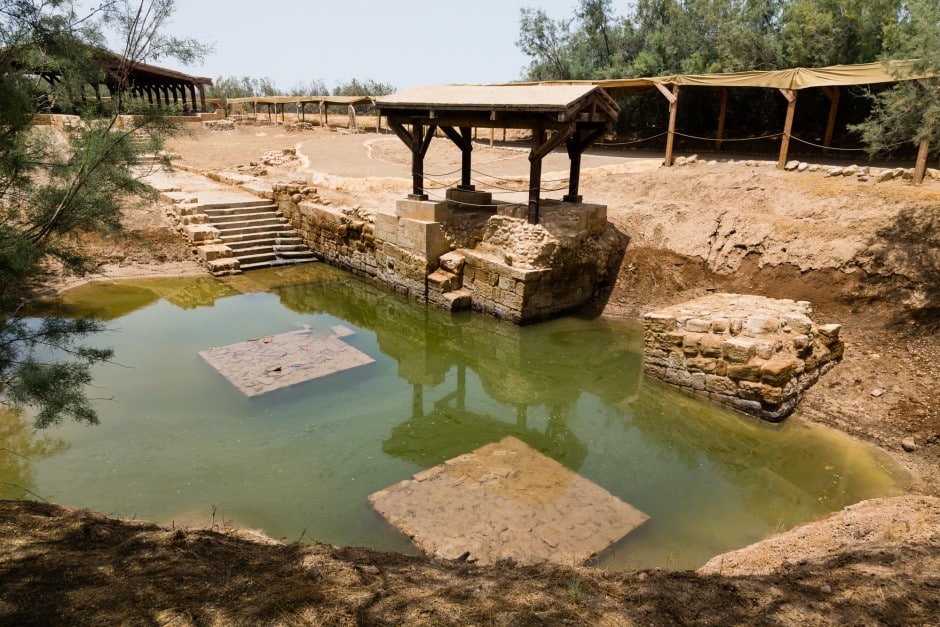
Nestled just nine kilometers north of the Dead Sea, this captivating archaeological site is made up of two key areas: St. Elias Hill and the John the Baptist Churches, located near the Jordan River. In the heart of the Qafra region, it is revered in Christian tradition as the very spot where Jesus was baptized by John the Baptist. The site offers a fascinating glimpse into the past, with Roman and Byzantine remnants scattered throughout, including ancient churches, small temples, monasteries, caves once inhabited by hermits, and sacred baptismal pools.
The Church of John the Baptist: A Sacred Site of History and Faith
Church of John the Baptist sits east of the Jordan River. Built during the reign of Emperor Anastasius (491–518 AD), this Byzantine church is revered as the site where Jesus was baptized by John the Baptist. Ancient accounts, like those from Theodosius (530 AD), describe the church elevated on large chambers to protect it from the river’s flooding. Although the exact pillar marking Jesus' baptism remains undiscovered, archaeological evidence strongly aligns with these early descriptions.
Recently uncovered and preserved, the marble steps, described by Antoninus Martyr (570 AD), descend toward the Jordan River where priests once performed baptisms. These steps face east, matching the historical details of water flow during floods.
The Mantle Chapel and The Unique “Baptismal Pool”, highlighted by Arculfus (670 AD), are key features of the site. Supported by four stone piers, the chapel marks the spot where Jesus' garments were placed during His baptism. Pilgrims today can descend the marble steps to be baptized in the Jordan river’s waters. Thousands of cross marks were discovered on the original plaster, probably made by believers who were baptized at this holy site.
Nearby, the Lower Basilica lies to the west of the main basilica’s aisles, showcasing intricate marble floors decorated with geometric patterns and vibrant colors. Some remaining walls and architectural elements reflect a different design from the elevated Mantle Chapel and Church of John the Baptist, adding to the rich layering of history at the site.
Built atop earlier structures, the Basilica (Church of the Trinity) features a nave, aisles, a sanctuary with an altar, and beautifully tiled mosaic floors. An eastern hall leads to the cruciform baptismal pool. In the 8th century, Epiphanius noted the church's connection to the cave and spring where John the Baptist lived, underscoring its dedication to the Holy Trinity.
A smaller chapel, constructed over the northwest pier of the Mantle Chapel, marks the exact location of Jesus’ baptism. Abbot Daniel (1106–1107 AD) recorded its significance, and after recent restoration, the chapel now includes protective shelters to preserve its historical integrity.
UNESCO Recognition[2]
In 2015, UNESCO added Al-Maghtas (also known as Bethany Beyond the Jordan) on the World Heritage List, recognizing its immense historical and religious importance. As the site where Jesus was baptized by John, it stands as a pivotal Christian pilgrimage destination and a symbol of shared global religious heritage.
The Hashemite Kingdom Support for Al-Maghtas
In 2003, King Abdullah II of Jordan donated 30 dunams of land for the construction of a Catholic church at Al-Maghtas, providing a welcoming space for pilgrims. And on May 10, 2009, Pope Benedict XVI, joined by King Abdullah II and the Hashemite family, laid the foundation stone for the Catholic Church and Monastery of Al-Maghtas, solidifying the royal family's ongoing support of the site.
Papal Visits to this Sacred Site
A New Church and Monastery
The construction of the Catholic church and monastery was overseen by former Patriarch Fouad Twal and Bishop Salim Sayegh, with significant contributions from Nadim Muasher, a Knight of the Holy Sepulchre, who dedicated the project to his son, who tragically passed away in a car accident at the site. Many other donors, including the Hungarian government, played vital roles in bringing this vision to life.
Today, the site features the church (shrine), two monasteries for friars and nuns, gardens, a visitor center, parking, a walkway, and the Hill of the Cross, which offers breathtaking views of the Jerusalem Mountains. Covering 2,200 square meters, the church is set to be one of the largest in the Middle East, joining esteemed places of pilgrimage and prayer like the Church of the Annunciation, the Church of the Nativity, and the Church of the Holy Sepulchre. The friars and nuns of the Incarnate Word will maintain the site, host pilgrims, and lead prayer and Masses.
Constructed from Tafouhi stone—yellowish stone from Hebron—the church features stained-glass windows crafted in Lebanon in the style of Chartres Cathedral, one of the most celebrated Gothic structures in France.
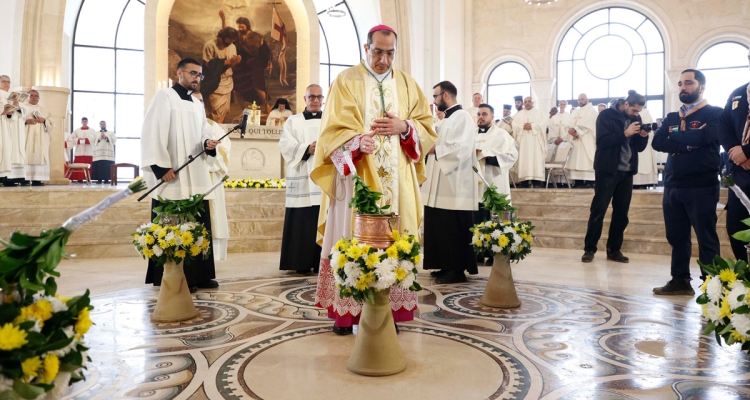
Able to accommodate over 1,000 faithfuls; the church hosts the annual pilgrimage to Al-Maghtas, every January. During this time, masses, prayers, and the renewal of baptismal vows take place all in celebration of the Feast of Christ's baptism and its profound significance in the Christian Faith.
On January 10, 2025, Cardinal Pietro Parolin, Vatican Secretary of State, and Cardinal Pierbattista Pizzabella, Latin Patriarch of Jerusalem, will preside over the Mass during which the dedication of the Altar and the inauguration of the Church of the Baptism of the Lord at the Jordan River. The relics of Pope John Paul II and the Holy Martyrs of Damascus, among others, will be placed inside the Altar. This church has been designated as a pilgrimage destination for the faithful to receive plenary indulgence during the Jubilee of Hope 2025.
[1] https://www.baptismsite.com/the-place-where-jesus-was-baptized/
[2] https://whc.unesco.org/en/list/1446/


Today’s First Reading
From: 1 Samuel 1:1-8
Birth of Samuel
---------------
[1] There was a certain man of Ramathaim-zophim of the hill country of Ephraim, whose name was Elkanah the son of Jeroham, son of Elihu, son of Tohu, son of Zuph, an Ephraimite. [2] He had two wives; the name of the one was Hannah, and the name of the other Peninnah. And Peninnah had children, but Hannah had no children.
[3] Now this man used to go up year by year from his city to worship and to sacrifice to the LORD of hosts at Shiloh, where the two sons of Eli, Hophni and Phinehas, were priests of the LORD. [4] EIkanah sacrificed, he would give portions to Peninnah his wife and to all her sons and daughters; [5] and, although he loved Hannah, he would give Hannah only one portion, because the LORD had closed her womb. [6] And her rival used to provoke her sorely, to irritate her, because the LORD had closed her womb. [7] So it went on year by year; as often as she went up to the house of the LORD, she used to provoke her. Therefore Hannah wept and would not eat. [8] And Elkanah, her husband, said to her, “Hannah, why do you weep? And why do you not eat? And why is your heart sad? Am I not more to you than ten sons?”
***********************************************************************
Commentary:
1:1-7:17. The books of Samuel begin with an account of the birth of the man from whom they take their name, that is, Samuel, who will become a judge of Israel and a prophet. The beginning is like the book of Exodus, which also begins with a birth--that of Moses. In fact, many of Moses’ features apply to Samuel: just as Moses inaugurated a new and very important stage in the history of the people, so Samuel marks the start of the monarchical period, which will forever leave its imprint on the religious profile of Israel.
The story of Samuel comprises only the first part of 1 Samuel, the first seven chapters, which also contain the history of the ark. The narrative includes three distinct accounts arranged in such a way that the first and last have the same protagonist—the birth, calling and activity of Samuel as a prophet (chaps. 1-3), the history of the ark (chaps. 4-6), and then Samuel’s activity as a judge (chap. 7). Although these narratives may have been independent originally, in the final biblical text they form a perfect unity in doctrinal terms, from the point of view of the setting of events (the shrine at Shiloh), and in the identity of their protagonists, Samuel and the priests, the sons of Eli. The shrine at Shiloh, which was located between Bethel and Shechem and which was a main center of worship in the era of the judges (Judg 21:19-21), acquires special importance at this point: Shiloh will be where the monarchical power begins, and its splendor will transfer to the temple of Jerusalem when the ark moves there.
The sons of Eli were the last priests of Shiloh. Whereas Samuel was perfectly faithful to the will of God, the sons of Eli had gradually corrupted the practices of their priestly function; with their death, the temple at Shiloh ceases to have any importance.
The doctrinal thread moving through the three episodes is God’s active intervention in all these important events in the life of the people: to him is due the prodigy of Samuel’s birth (1:1-20)--Samuel, the man chosen to open the way to the monarchy; it is God who exposes the sin of the sons of Eli (chap. 2) and initiates the charming dialogue in which Samuel receives his calling (chap. 3). In the episode of the ark, it is the Lord who punishes his people by taking away the ark, the sign of his presence (chap. 4); it is he who visits countless misfortunes on the Philistines who have taken possession of the ark (chap. 5) and it is he who forces them to return it to Israel, which receives it with delight (chap. 6). Finally, the Lord makes Samuel a judge over his people (chap. 5), able to exercise his function at all the shrines of Israel--in Bethel, Gilgal and Mizpah (7:15).
From the very start, the book of Samuel is a sort of religious interpretation of history, in the sense that it puts more emphasis on the meaning of the events it narrates than on their chronological order or their geographical situation. Samuel is a figure of Christ who will initiate the final stage of salvation through his complete obedience to the will of God (cf. Phil 2:8).
1:1-28. Samuel’s birth is described with all the elements denoting a miraculous event, emphasizing divine intervention and the child’s importance. With no hope of a human solution, a childless woman, humiliated by her husband’s (other) fertile wife, seeks a way out of her anguish by asking God, her only hope, to give her a son. Her husband loves her, but he cannot understand her (v. 8); Eli, the priest and head of the shrine at Shiloh, comes to bless her but even he cannot understand her (vv. 15-l7). God is the only one who listens to her, and he accepts the vow she has made to him (v. 11). Hannah follows in the line of Sarah, Rachel and the mother of Samson--other women in whom the action of God could be seen very clearly when he took away the stigma of their barrenness. But, above all, she is the prototype of the devout woman who perseveres in prayer, convinced that it will be heard. “Why is it necessary to list here all those who, by praying as they ought to do, won from God the greatest gifts? For it would be easy for anyone to take an abundant sample of cases based in holy Scripture. Hannah gave birth to Samuel, who was to be compared with Moses himself (cf. Jer 15:1), because although she was sterile, she had faith and prayed to the Lord (1 Sam 1:9ff). [...] How many favors each of us could tell of if we recalled with gratitude the gifts we have received in order to praise God for them! Once they have been watered by the grace of the Holy Spirit through constant prayer, souls that have gone for a long time without bearing fruit, sterile in the most noble part of their being and with the signs of death on their souls, think wholesome thoughts and are filled with the knowledge of the truth” (Origen, "De Oratione", 13, 2-3).
Hannah, who will bear Samuel in her womb, is a figure of Mary and also “a symbol of the Church which carries the Lord. Her prayer is not clamorous, rather it is calm and refined; she prays in the depths of her heart because she knows that God listens to her there” (St Cyprian, "De Oratione Dominica", 5).
Samuel comes into the world as a gift from God; he is the one who was “asked for of the Lord” (cf. v. 20), according to a popular etymology of his name. His mission on earth will be as exceptional as his birth; Hannah presents him at the shrine: “as long as he lives he is lent the Lord” (v. 28). Samuel is brought up by the priest at the shrine of Shiloh (cf. Judg 18:31; 21:19), that is, within the ancient institutions of the time of the judges; thus, the new institutions he will establish do not imply any break with or rejection of what went before.
From: Mark 1:14-20
Jesus Begins to Preach and Calls His First Disciples
----------------------------------------------------
[14] Now after John was arrested, Jesus came into Galilee, preaching the gospel of God, and saying, "The time is fulfilled, and the kingdom of God is at hand; repent, and believe in the Gospel."
[16] And passing along by the Sea of Galilee, he saw Simon and Andrew the brother of Simon casting a net in the sea; for they were fishermen. [17] And Jesus said to them, "Follow me and I will make you become fishers of men." [18] And immediately they left their nets and followed him. [19] And going on a little farther, he saw James the son of Zebedee and John his brother, who were in their boat mending the nets. [20] And immediately he called them; and they left their father Zebedee in the boat with the hired servants, and followed him.
***********************************************************************
Commentary:
14-15. "The gospel of God": this _expression is found in St Paul (Rom 1:1; 2 Cor 11:7; etc.) where it means the same as "the gospel of Jesus Christ" (2 Thess 1:8; etc.), thereby implying the divinity of Jesus Christ. The imminence of the Kingdom requires a genuine conversion of man to God (Mt 4:17; Mk 6: 12; etc.). The prophets had already spoken of the need for conversion and for Israel to abandon its evil ways (Jer 3:22; Is 30:15; Hos 14:2; etc.).
Both John the Baptist and Jesus and his Apostles insist on the need for conversion, the need to change one's attitude and conduct as a prerequisite for receiving the Kingdom of God. John Paul II underlines the importance of conversion for entry into the Kingdom of God: "Therefore, the Church professes and proclaims conversion. Conversion to God always consists in discovering his mercy, that is, in discovering that love which is patient and kind (cf. 1 Cor 13:4) as only the Creator and Father can be; the love to which the 'God and Father of our Lord Jesus Christ' (2 Cor 1:3) is faithful to the uttermost consequences in the history of his covenant with man: even to the Cross and to the death and resurrection of the Son. Conversion to God is always the fruit of the 'rediscovery' of this Father, who is rich in mercy.
"Authentic knowledge of the God of mercy, the God of tender love, is a constant and inexhaustible source of conversion, not only as a momentary interior act but also as a permanent attitude, as a state of mind. Those who come to know God in this way, who 'see' him in this way, can live only in a state of being continually converted to him. They live, therefore, "in statu conversionis" and it is this state of conversion which marks out the most profound element of the pilgrimage of every man and woman on earth "in statu viatoris" (John Paul II, "Dives In Misericordia", 13).
16-20. In these verses the evangelist describes how Jesus called some of those who would later form part of the Apostolic College (3:16ff). From the start of his public ministry in Galilee the Messiah seeks co-workers to help him in his mission as Savior and Redeemer. He looks for them among people used to hard work, people for whom life is a struggle and whose life-style is plain. In human terms they are obviously at a disadvantage vis-a-vis many of those to whom they will preach; but this in no way prevents their self-surrender from being generous and free. The light lit in their hearts was enough to lead them to give up everything. A simple invitation to follow the Master was enough for them to put themselves completely at his disposal.
It is Jesus who chooses them: he interfered in the lives of the Apostles just as he interferes in ours, without seeking our permission: he is our Lord. Cf. note on Mt 4:18-22.
Disclaimer: Opinions posted on Free Republic are those of the individual posters and do not necessarily represent the opinion of Free Republic or its management. All materials posted herein are protected by copyright law and the exemption for fair use of copyrighted works.