Free Republic
Browse · Search
Religion
Topics · Post Article

Skip to comments.

Catholic Caucus: Daily Mass Readings xx-December-2025
Universalis/Jerusalem Bible ^

Posted on 12/03/2025 4:33:58 AM PST by annalex

3 December 2025

Saint Francis Xavier, Priest
on Wednesday of the 1st week of Advent


Basilica of St. Francis Xavier, Dyersville Iowa

Readings at Mass

Liturgical Colour: White. Year: A(II).

Readings for the feria

Readings for the memorial

These are the readings for the feria


First readingIsaiah 25:6-10

The Lord will prepare a banquet for every nation

On this mountain,
the Lord of hosts will prepare for all peoples
a banquet of rich food, a banquet of fine wines,
of food rich and juicy, of fine strained wines.
On this mountain he will remove
the mourning veil covering all peoples,
and the shroud enwrapping all nations,
he will destroy Death for ever.
The Lord will wipe away
the tears from every cheek;
he will take away his people’s shame
everywhere on earth,
for the Lord has said so.
That day, it will be said: See, this is our God
in whom we hoped for salvation;
the Lord is the one in whom we hoped.
We exult and we rejoice
that he has saved us;
for the hand of the Lord
rests on this mountain.


Responsorial PsalmPsalm 22(23)
In the Lord’s own house shall I dwell for ever and ever.
The Lord is my shepherd;
  there is nothing I shall want.
Fresh and green are the pastures
  where he gives me repose.
Near restful waters he leads me,
  to revive my drooping spirit.
In the Lord’s own house shall I dwell for ever and ever.
He guides me along the right path;
  he is true to his name.
If I should walk in the valley of darkness
  no evil would I fear.
You are there with your crook and your staff;
  with these you give me comfort.
In the Lord’s own house shall I dwell for ever and ever.
You have prepared a banquet for me
  in the sight of my foes.
My head you have anointed with oil;
  my cup is overflowing.
In the Lord’s own house shall I dwell for ever and ever.
Surely goodness and kindness shall follow me
  all the days of my life.
In the Lord’s own house shall I dwell
  for ever and ever.
In the Lord’s own house shall I dwell for ever and ever.

Gospel AcclamationIs33:22
Alleluia, alleluia!
The Lord is our judge, the Lord our lawgiver,
the Lord our king and our saviour.
Alleluia!
Or:
Alleluia, alleluia!
Look, the Lord will come to save his people.
Blessed those who are ready to meet him.
Alleluia!

Gospel
Matthew 15:29-37

The crowds praised the God of Israel

Jesus reached the shores of the Sea of Galilee, and he went up into the hills. He sat there, and large crowds came to him bringing the lame, the crippled, the blind, the dumb and many others; these they put down at his feet, and he cured them. The crowds were astonished to see the dumb speaking, the cripples whole again, the lame walking and the blind with their sight, and they praised the God of Israel.
  But Jesus called his disciples to him and said, ‘I feel sorry for all these people; they have been with me for three days now and have nothing to eat. I do not want to send them off hungry, they might collapse on the way.’ The disciples said to him, ‘Where could we get enough bread in this deserted place to feed such a crowd?’ Jesus said to them, ‘How many loaves have you?’ ‘Seven’ they said ‘and a few small fish.’ Then he instructed the crowd to sit down on the ground, and he took the seven loaves and the fish, and he gave thanks and broke them and handed them to the disciples, who gave them to the crowds. They all ate as much as they wanted, and they collected what was left of the scraps, seven baskets full.

Continue

These are the readings for the memorial


First reading
1 Corinthians 9:16-19,22-23

I should be punished if I did not preach the Gospel

I do not boast of preaching the gospel, since it is a duty which has been laid on me; I should be punished if I did not preach it! If I had chosen this work myself, I might have been paid for it, but as I have not, it is a responsibility which has been put into my hands. Do you know what my reward is? It is this: in my preaching, to be able to offer the Good News free, and not insist on the rights which the gospel gives me.
  So though I am not a slave of any man I have made myself the slave of everyone so as to win as many as I could. For the weak I made myself weak: I made myself all things to all men in order to save some at any cost; and I still do this, for the sake of the gospel, to have a share in its blessings.


Responsorial Psalm
Psalm 116(117):1-2
Go out to the whole world; proclaim the Good News.
or
Alleluia!
O praise the Lord, all you nations,
  acclaim him all you peoples!
Go out to the whole world; proclaim the Good News.
or
Alleluia!
Strong is his love for us;
  he is faithful for ever.
Go out to the whole world; proclaim the Good News.
or
Alleluia!

Gospel AcclamationMt28:19,20
Alleluia, alleluia!
Go, make disciples of all the nations.
I am with you always; yes, to the end of time.
Alleluia!

GospelMark 16:15-20

Go out to the whole world; proclaim the Good News

Jesus showed himself to the Eleven and said to them:
  ‘Go out to the whole world; proclaim the Good News to all creation. He who believes and is baptised will be saved; he who does not believe will be condemned. These are the signs that will be associated with believers: in my name they will cast out devils; they will have the gift of tongues; they will pick up snakes in their hands, and be unharmed should they drink deadly poison; they will lay their hands on the sick, who will recover.’
  And so the Lord Jesus, after he had spoken to them, was taken up into heaven: there at the right hand of God he took his place, while they, going out, preached everywhere, the Lord working with them and confirming the word by the signs that accompanied it.

Continue


You can also view this page with the New Testament in Greek and English.

Christian Art

Illustration

Each day, The Christian Art website gives a picture and reflection on the Gospel of the day.

The readings on this page are from the Jerusalem Bible, which is used at Mass in most of the English-speaking world. The New American Bible readings, which are used at Mass in the United States, are available in the Universalis apps, programs and downloads.

You can also view this page with the Gospel in Greek and English.


TOPICS: Catholic; General Discusssion; Prayer; Worship
KEYWORDS: catholic; mk16; mt15; ordinarytime; prayer
For your reading, reflection, faith-sharing, comments, questions, discussion.

1 posted on 12/03/2025 4:33:58 AM PST by annalex
[ Post Reply | Private Reply | View Replies]

To: All

KEYWORDS: catholic; mk16; mt15; ordinarytime; prayer;


2 posted on 12/03/2025 4:34:45 AM PST by annalex (fear them not)
[ Post Reply | Private Reply | To 1 | View Replies]

To: nickcarraway; NYer; ELS; Pyro7480; livius; ArrogantBustard; Catholicguy; RobbyS; marshmallow; ...


Alleluia Ping

Please FReepmail me to get on/off the Alleluia Ping List.


3 posted on 12/03/2025 4:35:47 AM PST by annalex (fear them not)
[ Post Reply | Private Reply | To 2 | View Replies]

To: annalex
Chris Robinson: My Dad [our Jim Robinson] Passed Away Peacefully Monday Night (October 27th) In Our Home.
Jim still needs our prayers. Thread 2
Prayer thread for Salvation's recovery
Pray for Ukraine
Prayer thread for Fidelis' recovery
Update on Jim Robinson's health issues
4 posted on 12/03/2025 4:36:15 AM PST by annalex (fear them not)
[ Post Reply | Private Reply | To 3 | View Replies]

To: annalex
Matthew
 English: Douay-RheimsLatin: Vulgata ClementinaGreek NT: Byzantine/Majority Text (2000)
 Matthew 15
29And when Jesus had passed away from thence, he came nigh the sea of Galilee. And going up into a mountain, he sat there. Et cum transisset inde Jesus, venit secus mare Galilææ : et ascendens in montem, sedebat ibi.και μεταβας εκειθεν ο ιησους ηλθεν παρα την θαλασσαν της γαλιλαιας και αναβας εις το ορος εκαθητο εκει
30And there came to him great multitudes, having with them the dumb, the blind, the lame, the maimed, and many others: and they cast them down at his feet, and he healed them: Et accesserunt ad eum turbæ multæ, habentes secum mutos, cæcos, claudos, debiles, et alios multos : et projecerunt eos ad pedes ejus, et curavit eos,και προσηλθον αυτω οχλοι πολλοι εχοντες μεθ εαυτων χωλους τυφλους κωφους κυλλους και ετερους πολλους και ερριψαν αυτους παρα τους ποδας του ιησου και εθεραπευσεν αυτους
31So that the multitudes marvelled seeing the dumb speak, the lame walk, and the blind see: and they glorified the God of Israel. ita ut turbæ mirarentur, videntes mutos loquentes, claudos ambulantes, cæcos videntes : et magnificabant Deum Israël.ωστε τους οχλους θαυμασαι βλεποντας κωφους λαλουντας κυλλους υγιεις χωλους περιπατουντας και τυφλους βλεποντας και εδοξασαν τον θεον ισραηλ
32And Jesus called together his disciples, and said: I have compassion on the multitudes, because they continue with me now three days, and have not what to eat, and I will not send them away fasting, lest they faint in the way. Jesus autem, convocatis discipulis suis, dixit : Misereor turbæ, quia triduo jam perseverant mecum, et non habent quod manducent : et dimittere eos jejunos nolo, ne deficiant in via.ο δε ιησους προσκαλεσαμενος τους μαθητας αυτου ειπεν σπλαγχνιζομαι επι τον οχλον οτι ηδη ημεραι τρεις προσμενουσιν μοι και ουκ εχουσιν τι φαγωσιν και απολυσαι αυτους νηστεις ου θελω μηποτε εκλυθωσιν εν τη οδω
33And the disciples say unto him: Whence then should we have so many loaves in the desert, as to fill so great a multitude? Et dicunt ei discipuli : Unde ergo nobis in deserto panes tantos, ut saturemus turbam tantam ?και λεγουσιν αυτω οι μαθηται αυτου ποθεν ημιν εν ερημια αρτοι τοσουτοι ωστε χορτασαι οχλον τοσουτον
34And Jesus said to them: How many loaves have you? But they said: Seven, and a few little fishes. Et ait illis Jesus : Quot habetis panes ? At illi dixerunt : Septem, et paucos pisciculos.και λεγει αυτοις ο ιησους ποσους αρτους εχετε οι δε ειπον επτα και ολιγα ιχθυδια
35And he commanded the multitude to sit down upon the ground. Et præcepit turbæ ut discumberent super terram.και εκελευσεν τοις οχλοις αναπεσειν επι την γην
36And taking the seven loaves and the fishes, and giving thanks, he brake, and gave to his disciples, and the disciples to the people. Et accipiens septem panes, et pisces, et gratias agens, fregit, et dedit discipulis suis, et discipuli dederunt populo.και λαβων τους επτα αρτους και τους ιχθυας ευχαριστησας εκλασεν και εδωκεν τοις μαθηταις αυτου οι δε μαθηται τω οχλω
37And they did all eat, and had their fill. And they took up seven baskets full, of what remained of the fragments. Et comederunt omnes, et saturati sunt. Et quod superfuit de fragmentis, tulerunt septem sportas plenas.και εφαγον παντες και εχορτασθησαν και ηραν το περισσευον των κλασματων επτα σπυριδας πληρεις

5 posted on 12/03/2025 4:41:38 AM PST by annalex (fear them not)
[ Post Reply | Private Reply | To 4 | View Replies]

To: annalex

Catena Aurea by St. Thomas Aguinas

15:29–31

29. And Jesus departed from thence, and came nigh unto the sea of Galilee; and went up into a mountain, and sat down there.

30. And great multitudes came unto him, having with them those that were lame, blind, dumb, maimed, and many others, and cast them down at Jesus’ feet; and he healed them:

31. Insomuch that the multitude wondered, when they saw the dumb to speak, the maimed to be whole, the lame to walk, and the blind to see: and they glorified the God of Israel.

JEROME. Having healed the daughter of this Chananæan, the Lord returns into Judæa, as it follows, And Jesus departed from thence, and came nigh unto the sea of Galilee.

REMIGIUS. This sea is called by various names; the sea of Galilee, because of its neighbourhood to Galilee; the sea of Tiberias, from the town of Tiberias. And going up into a mountain, he sat down there.

CHRYSOSTOM. It should be considered that sometimes the Lord goes about to heal the sick, sometimes He sits and waits for them to come; and accordingly here it is added, And there came great multitudes unto him, having with them those that were dumb, lame, blind, maimed, and many others.

JEROME. What the Latin translator calls ‘debiles’ (maimed), is in the Greek χυλλοὺς which is not a general term for a maimed person, but a peculiar species, as he that is lame in one foot is called ‘claudus,’ so he that is crippled in one hand is called χυλλός.

CHRYSOSTOM. These shewed their faith in two points especially, in that they went up the mountain, and in that they believed that they had need of nothing beyond but to cast themselves at Jesus’ feet; for they do not now touch the hem even of His garment, but have attained to a loftier faith; And cast them down at Jesus’ feet. The woman’s daughter He healed with great slackness, that He might shew her virtue; but to these He administers healing immediately, not because they were better than that woman, but that He might stop the mouths of the unbelieving Jews, as it follows, and he healed them all. But the multitude of those that were healed, and the ease with which it was done, struck them with astonishment. Insomuch that the multitude wondered when they saw the dumb to speak,

JEROME. He said nothing concerning the maimed, because there was no one word which was the opposite of thisa.

RABANUS. Mystically; Having in the daughter of this Chauanæan prefigured the salvation of the Gentiles, He came into Judæa; because, when the fulness of the Gentiles shall have entered in, then shall all Israel be saved. (Rom. 11:25.)

GLOSS. (ap. Anselm.) The sea near to which Jesus came signifies the turbid swellings of this world; it is the sea of Galilee when men pass from virtue to vice.

JEROME. He goes up into the mountain, that as a bird He may entice the tender nestlings to fly.

RABANUS. Thus raising his hearers to meditate on heavenly things. He sat down there to shew that rest is not to be sought but in heavenly things. And as He sits on the mountain, that is, in the heavenly height, there come unto Him multitudes of the faithful, drawing near to Him with devoted mind, and bringing to Him the dumb, and the blind, & c. and cast them down at Jesus’ feet; because they that confess their sins are brought to be healed by Him alone. These He so heals, that the multitudes marvel and magnify the God of Israel; because the faithful when they see those that have been spiritually sick richly endued with all manner of works of virtuousness, sing praise to God.

GLOSS. (ord.) The dumb are they that do not praise God; the blind, they who do not understand the paths of life; the deaf, they that obey not; the lame, they that walk not firmly through the difficult ways of good works; the maimed, they that are crippled in their good works.

15:32–38

32. Then Jesus called his disciples unto him, and said, I have compassion on the multitude, because they continue with me now three days, and have nothing to eat: and I will not send them away fasting, lest they faint in the way.

33. And his disciples say unto him, Whence should we have so much bread in the wilderness, as to fill so great a multitude?

34. And Jesus saith unto them, How many loaves have ye? And they said, Seven, and a few little fishes.

35. And he commanded the multitude to sit down on the ground.

36. And he took the seven loaves and the fishes, and gave thanks, and brake them, and gave to his disciples, and the disciples to the multitude.

37. And they did all eat, and were filled: and they took up of the broken meat that was left seven baskets full.

38. And they that did eat were four thousand men, beside women and children.

JEROME. Christ first took away the infirmities of the sick, and afterwards supplied food to them that had been healed. Also He calls His disciples to tell them what He is about to do; Then Jesus called his disciples unto him, and said, I have compassion on the multitude. This He does that He may give an example to masters of sharing their counsels with the young, and their disciples; or, that by this dialogue they might come to understand the greatness of the miracle.

CHRYSOSTOM. (Hom. liii.) For the multitude when they came to be healed, had not dared to ask for food, but He that loveth man, and hath care of all creatures, gives it to them unasked; whence He says, I have compassion upon the multitude. That it should not be said that they had brought provision with them on their way, He says, Because they continue with me now three days, and have nothing to eat. For though when they came they had food, it was now consumed, and for this reason He did it not on the first or second day, but on the third, when all was consumed that they might have brought with them; and thus they having been first placed in need, might take the food that was now provided with keener appetite. That they had come from far, and that nothing was now left them, is shewn in what He says, And I will not send, them, away fasting, lest they faint by the way. Yet He does not immediately proceed to work the miracle, that He may rouse the disciples’ attention by this questioning, and that they may shew their faith by saying to Him, Create loaves. And though at the time of the former miracle Christ had done many things to the end that they should remember it, making them distribute the loaves, and divide the baskets among them, yet they were still imperfectly disposed, as appears from what follows; And his disciples say unto him, Whence should we have so much, bread in the wilderness as to fill so great a multitude? This they spoke out of the infirmity of their thoughts, yet thereby making the ensuing miracle to be beyond suspicion; for that none might suspect that the loaves had been got from a neighbouring village, this miracle is wrought in the wilderness far distant from villages. Then to arouse His disciples’ thoughts, He puts a question to them, which may call the foregone miracle to their minds; And Jesus saith unto them, How many loaves have ye? They said unto him, Seven, and a few little fishes. But they do not add, ‘But what are they among so many?’ as they had said before; for they had advanced somewhat, though they did not yet comprehend the whole. Admire in the Apostles their love of truth, though themselves are the writers, they do not conceal their own great faults; and it is no light self-accusation to have so soon forgotten so great a miracle. Observe also their wisdom in another respect, how they had overcome their appetite, taking so little care of their meals, that though they had been three days in the desert, yet they had with them only seven loaves. Some other things also He does like to what had been done before. He makes them to sit down on the ground, and the bread to grow in the hands of the disciples; as it follows, And he commanded the multitude to sit down on the ground.

JEROME. (Sup. c. 14:15.) As we have spoken of this above, it would be tedious to repeat what has been already said; we shall therefore only dwell on those particulars in which this differs from the former.

CHRYSOSTOM. The end of the two miracles is different; And they took up of the broken meat that was left seven baskets full. Now they that had eaten were four thousand men, besides children and women. Whence are the fragments fewer in this miracle than in the former, although they that ate were not so many? It is either that the basket1 in this miracle is of larger capacity than the basket2 in the former, or that by this point of difference they might remember the two separate miracles; for which reason also He then made the number of baskets equal to the number of the disciples, but now to the number of the loaves.

REMIGIUS. In this Gospel lection we must consider in Christ the work of His humanity, and of His divinity. In that He has compassion on the multitudes, He shews that He has feeling of human frailty; in the multiplication of the loaves, and the feeding the multitudes, is shewn the working of His divinity. So here is overthrown the error of Eutyches1, who said, that in Christ was one nature only.

AUGUSTINE. (de Cons. Ev. ii. 50.) Surely it will not be out of place to suggest upon this miracle, that if any of the Evangelists who had not given the miracle of the five loaves had related this of the seven loaves, he would have been supposed to have contradicted the rest. But because those who have related the one, have also related the other, no one is puzzled, but it is understood at once that they were two separate miracles. This we have said, that wherever any thing is found done by the Lord, wherein the accounts of any two Evangelists seem irreconcilable, we may understand them as two distinct occurrences, of which one is related by one Evangelist, and one by another.

GLOSS. (ap. Ans.) It should be noted, that the Lord first removes their sicknessess, and after that feeds them; because sin must be first wiped away, and then the soul fed with the words of God.

HILARY. As that first multitude which He fed answers to the people among the Jews that believed; so this is compared to the people of the Gentiles, the number of four thousand denoting an innumerable number of people out of the four quarters of the earth.

JEROME. For these are not five, but four thousand; the number four being one always used in a good sense, and a four-sided stone is firm and rocks not, for which reason the Gospels also have been sacredly bestowed in this number. Also in the former miracle, because the people were neighbours unto the five senseso, it is the disciples, and not the Lord, that calls to mind their condition; but here the Lord Himself says, that He has compassion upon them, because they continue now three days with Him, that is, they believed on the Father, Son, and Holy Spirit.

HILARY. Or, they spend the whole time of the Lord’s passion with the Lord; either because when they should come to baptism, they would confess that they believed in His passion and resurrection; or, because through the whole time of the Lord’s passion they are joined to the Lord by fasting in a kind of union of suffering with Him.

RABANUS. Or, this is said because in all time there have only been three periods when grace was given; the first, before the Law; the second, under the Law; the third, under grace; the fourth, is in heaven, to which as we journey we are refreshed by the way.

REMIGIUS. Or, because correcting by penitence the sins that they have committed, in thought, word, and deed, they turn to the Lord. These multitudes the Lord would not send away fasting, that they should not faint by the way; because sinners turning in penitence, perish in their passage through the world, if they are sent away without the nourishment of sacred teaching.

GLOSS. (ord.) The seven loaves are the Scripture of the New Testament, in which the grace of the Holy Spirit is revealed and given. And these are not as those former loaves, barley, because it is not with these, as in the Law, where the nutritious substance is wrapped in types, as in a very adhesive husk; here are not two fishes, as under the Law two only were anointed, the King, and the Priest, but a few, that is, the saints of the New Testament, who, snatched from the waves of the world, sustain this tossing sea, and by their example refresh us lest we faint by the way.

HILARY. The multitudes sit down on the ground; for before they had not reposed on the works of the Law, but they had supported themselves on their own sins, as men standing on their feet.

GLOSS. Or, they sit down there1 on the grass, that the desires of the flesh may be controlled, here on the ground, because the earth itself is commanded to be left. Or, the mountain in which the Lord refreshes them is the height of Christ; there, therefore, is grass upon the ground, because there the height of Christ is covered with carnal hopes and desires, on account of the carnal; here, where all carnal lust is banished, the guests are solidly placed on the basis of an abiding hope; there, are five thousand, who are the carnal subjected to the five senses; here, four thousand, on account of the four virtues, by which they are spiritually fortified, temperance, prudence, fortitude, and justice; of which the first is the knowledge of things to be sought and avoided; the second, the restraining of desire from those things that give pleasure in the world; the third, strength against the pains of life; the fourth, which is spread over all the love of God and our neighbour. Both there, and here women and children are excepted, because in the Old and New Testament, none are admitted to the Lord who do not endure to the perfect man, whether through the infirmity of their strength, or the levity of their tempers. Both refreshings were performed upon a mountain, because the Scriptures of both Testaments commend the loftiness of the heavenly commands and rewards, and both preach the height of Christ. The higher mysteries which the multitudes cannot receive the Apostles discharge, and fill seven baskets, to wit, the hearts of the perfect which are enlightened to understand by the grace of the seven-fold Spirit. (Is. 11:2.) Baskets are usually woven of rushes, or palm leaves; these signify the saints, who fix the root of their hearts in the very fount of life, as a bulrush in the water, that they may not wither away, and retain in their hearts the palm of their eternal reward.



Catena Aurea Matthew 15

6 posted on 12/03/2025 4:44:27 AM PST by annalex (fear them not)
[ Post Reply | Private Reply | To 5 | View Replies]

To: annalex


The Miracle of the Loaves and Fishes

Lambert Lombard

Oil on panel, 104 x 110 cm
Rockox House, Antwerp

7 posted on 12/03/2025 4:45:18 AM PST by annalex (fear them not)
[ Post Reply | Private Reply | To 6 | View Replies]

To: annalex
Mark
 English: Douay-RheimsLatin: Vulgata ClementinaGreek NT: Byzantine/Majority Text (2000)
 Mark 16
15And he said to them: Go ye into the whole world, and preach the gospel to every creature. Et dixit eis : Euntes in mundum universum prædicate Evangelium omni creaturæ.και ειπεν αυτοις πορευθεντες εις τον κοσμον απαντα κηρυξατε το ευαγγελιον παση τη κτισει
16He that believeth and is baptized, shall be saved: but he that believeth not shall be condemned. Qui crediderit, et baptizatus fuerit, salvus erit : qui vero non crediderit, condemnabitur.ο πιστευσας και βαπτισθεις σωθησεται ο δε απιστησας κατακριθησεται
17And these signs shall follow them that believe: In my name they shall cast out devils: they shall speak with new tongues. Signa autem eos qui crediderint, hæc sequentur : in nomine meo dæmonia ejicient : linguis loquentur novis :σημεια δε τοις πιστευσασιν ταυτα παρακολουθησει εν τω ονοματι μου δαιμονια εκβαλουσιν γλωσσαις λαλησουσιν καιναις
18They shall take up serpents; and if they shall drink any deadly thing, it shall not hurt them: they shall lay their hands upon the sick, and they shall recover. serpentes tollent : et si mortiferum quid biberint, non eis nocebit : super ægros manus imponent, et bene habebunt.οφεις αρουσιν καν θανασιμον τι πιωσιν ου μη αυτους βλαψη επι αρρωστους χειρας επιθησουσιν και καλως εξουσιν
19And the Lord Jesus, after he had spoken to them, was taken up into heaven, and sitteth on the right hand of God. Et Dominus quidem Jesus postquam locutus est eis, assumptus est in cælum, et sedet a dextris Dei.ο μεν ουν κυριος μετα το λαλησαι αυτοις ανεληφθη εις τον ουρανον και εκαθισεν εκ δεξιων του θεου
20But they going forth preached every where: the Lord working withal, and confirming the word with signs that followed.Illi autem profecti prædicaverunt ubique, Domino cooperante, et sermonem confirmante, sequentibus signis.εκεινοι δε εξελθοντες εκηρυξαν πανταχου του κυριου συνεργουντος και τον λογον βεβαιουντος δια των επακολουθουντων σημειων αμην

8 posted on 12/03/2025 4:47:33 AM PST by annalex (fear them not)
[ Post Reply | Private Reply | To 7 | View Replies]

To: annalex

Catena Aurea by St. Thomas Aguinas

16:14–18

14. Afterward he appeared unto the eleven as they sat at meat, and upbraided them with their unbelief and hardness of heart, because they believed not them which had seen him after he was risen.

15. And he said unto them, Go ye into all the world, and preach the Gospel to every creature.

16. He that believeth and is baptized shall be saved; but he that believed not shall be damned.

17. And these signs shall follow them that believe; In my name shall they cast out devils; they shall speak with new tongues;

18. They shall take up serpents; and if they drink any deadly thing, it shall not hurt them; they shall lay hands on the sick, and they shall recover.

GLOSS. (non occ.) Mark, when about to finish his Gospel, relates the last appearance of our Lord to His disciples after His resurrection, saying,1 For the last time he appeared unto the eleven as they sat at meat. (Acts 1:4, 9)

GREGORY. (ubi sup.) We should observe that Luke says in the Acts, As he2 was eating with them he commanded that they should not depart from Jerusalem, and shortly afterwards, while they beheld he was taken up. For He ate, and then ascended, that by the act of eating, the truth of the flesh might be declared; wherefore it is also here said, that he appeared to them for the last time as they sat at meat.

PSEUDO-JEROME. But He appeared when all the eleven were together, that all might be witnesses, and relate to all men what they had seen and heard in common. It goes on: And upbraided them with their unbelief and hardness of heart, because they believed not them who had seen him after his resurrection.

AUGUSTINE. (ubi sup.) But how was this done the last time? The last occasion on which the Apostles saw the Lord upon earth happened forty days after the resurrection; but would He then have upbraided them for not believing those who had seen Him risen, when they themselves had so often seen Him after His resurrection? It remains therefore that we should understand that Mark wished to say it in few words, and said for the last time, because it was the last time that He shewed Himself that day, as night was coming on, when the disciples returned from the country into Jerusalem, and found, as Luke says (Luke 24:33.), the eleven and those who were with them, speaking together concerning the resurrection of our Lord. But there were some there who did not believe; when these then were sitting at meat, (as Mark says,) and were still speaking, (as Luke relates,) The Lord stood in the midst of them, and saith unto them, Peace be unto you; (Luke 24:36) as Luke and John say. (John 20:19) The rebuke therefore which Mark here mentions, must have been amongst those words, which Luke and John say, that the Lord at that time spoke to the disciples. But another question is raised, how Mark says that He appeared when the eleven sat at meat, if the time was the first part of the night on the Lord’s day, when John plainly says that Thomas was not with them, who, we believe, had gone out, before the Lord came in to them, after those two had returned from the village, and spoken with the eleven, as we find in Luke’s Gospel. But Luke in his relation leaves room for supposing that Thomas went out first, while they spoke these things, and that the Lord entered afterwards; Mark however from his saying, for the last time he appeared to the eleven as they sat at meat, forces us to believe that he was there, unless indeed, though one of them was absent, he chose to call them the eleven, because the company of the Apostles was then called by this number, before Matthias was chosen into the place of Judas. Or if this be a harsh way of understanding it, let us understand that it means that after many appearances, He shewed Himself for the last time, that is, on the fortieth day, to the Apostles, as they sat at meat, and that since He was about to ascend from them, He rather wished on that day to reprove them for not having believed those who had seen Him risen before seeing Him themselves, because after His ascension even the Gentiles on their preaching were to believe a Gospel, which they had not seen. And so the same Mark immediately after that rebuke says, And he said unto them, Go ye into all the world, and preach the Gospel to every creature. And lower down, He that believeth not shall be condemned. Since then they were to preach this, were not they themselves to be first rebuked, because before they saw the Lord they had not believed those to whom He had first appeared?

GREGORY. (ubi sup.) Another reason also why our Lord rebuked His disciples, when He left them as to His bodily presence, was, that the words which He spoke on leaving them might remain more deeply impressed upon the hearts of His hearers.

PSEUDO-JEROME. But He rebukes their want of faith, that faith might take its place; He rebukes the hardness of their stony heart, that the fleshy heart, full of love, might take its place.

GREGORY. (ubi sup.) After rebuking the hardness of their hearts, let us hear the words of advice which He speaks. For it goes on: Go ye into all the world, and preach the Gospel to every creature. Every man must be understood by every creature; for man partakes something of every creature; he has existence as have stones, life as trees, feeling as animals, understanding as have Angels. For the Gospel is preached to every creature, because he is taught by it, for whose sake all are created, whom all things are in some way like, and from whom therefore they are not alien. By the name of every creature also every nation of the Gentiles may be meant. For it had been said before, Go not into the way of the Gentiles. (Matt. 10:5) But now it is said, Preach the Gospel to every creature, so that the preaching of the Apostles which was thrust aside by Judæa, might be an assistance to us, since Judæa had haughtily rejected it, thus witnessing to her own damnation.

THEOPHYLACT. Or else; to every creature, that is, whether believing or unbelieving. It goes on: He that believeth and is baptized shall be saved. For it is not enough to believe, for he who believeth and is not baptized, but is a catechumen, has not yet attained to perfect salvation.

GREGORY. (ubi sup.) But perhaps some one may say in himself, I have already believed, I shall be saved. He says what is true, if he keeps his faith by works; for that is a true faith, which does not contradict by its deeds what it says in words. There follows: But he that believeth not shall be damned.

BEDE. (ubi sup.) What shall we say here about infants, who by reason of their age cannot yet believe; for as to older persons there is no question. In the Church then of our Saviour children believe by others, as also they drew from others the sins which are remitted to them in baptism. It goes on: And these signs shall follow them that believe; In my name shall they cast out devils; they shall speak with new tongues; they shall take up serpents.

THEOPHYLACT. That is, they shall scatter before them serpents, whether intellectual or sensible, as it is said, Ye shall tread upon serpents and scorpions, which is understood spiritually. But it may also mean sensible serpents, as when Paul received no hurt from the viper. There follows: And if they drink any deadly thing, it shall not hurt them. (Luke 10:19) We read of many such cases in history, for many persons have drank poison unhurt, by guarding themselves with the sign of Christ. It goes on: They shall lay hands on the sick, and they shall recorer.

GREGORY. (ubi sup.) Are we then without faith because we cannot do these signs? Nay, but these things were necessary in the beginning of the Church, for the faith of believers was to be nourished by miracles, that it might increase. Thus we also, when we plant groves, pour water upon them, until we see that they have grown strong in the earth; but when once they have firmly fixed their roots, we leave off irrigating them. These signs and miracles have other things which we ought to consider more minutely. For Holy Church does every day in spirit what then the Apostles did in body; for when her Priests by the grace of exorcism lay their hands on believers, and forbid the evil spirits to dwell in their minds, what do they, but cast out devils? And the faithful who have left earthly words, and whose tongues sound forth the Holy Mysteries, speak a new language; they who by their good warnings take away evil from the hearts of others, take up serpents; and when they are hearing words of pestilent persuasion, without being at all drawn aside to evil doing, they drink a deadly thing, but it will never hurt them; whenever they see their neighbours growing weak in good works, and by their good example strengthen their life, they lay their hands on the sick, that they may recover. And all these miracles are greater in proportion as they are spiritual, and by them souls and not bodies are raised.

16:19–20

19. So then after the Lord had spoken unto them, he was received up into heaven, and sat on the right hand of God.

20. And they went forth, and preached every where, the Lord working with them, and confirming the word with signs following. Amen.

PSEUDO-JEROME. The Lord Jesus, who had descended from heaven to give liberty to our weak nature, Himself also ascended above the heavens; wherefore it is said, So then after the Lord had spoken unto them, he was received up into heaven.

AUGUSTINE. (ubi sup.) By which words He seems to shew clearly enough that the foregoing discourse was the last that He spake to them upon earth, though it does not appear to bind us down altogether to this opinion. For He does not say, After He had thus spoken unto them, wherefore it admits of being understood not as if that was the last discourse, but that the words which are here used, After the Lord had spoken unto them, he was received into heaven, might belong to all His other discourses. But since the arguments which we have used above make us rather suppose that this was the last time, therefore we ought to believe that after these words, together with those which are recorded in the Acts of the Apostles, our Lord ascended into heaven.

GREGORY. (ubi sup.) We have seen in the Old Testament that Elias was taken up into heaven. But the ethereal heaven is one thing, the aerial is another. The aerial heaven is nearer the earth, Elias then was raised into the aerial heaven, that he might be carried off suddenly into some secret region of the earth, there to live in great calmness of body and spirit, until he return at the end of the world, and pay the debt of death. We may also observe that Elias mounted up in a chariot, that by this they might understand that a mere man requires help from without. But our Redeemer, as we read, was not carried up by a chariot, not by angels, because He who had made all things was borne over all by His own power. We must also consider what Mark subjoins, And sat at the right hand of God, since Stephen says, I see the heavens opened, and the Son of Man standing at the right hand of God. Now sitting is the attitude of a judge, standing of one fighting or helping. Therefore Stephen, when toiling in the contest, saw Him standing, whom he had for his helper; but Mark describes Him as sitting after His assumption into heaven, because after the glory of His assumption, He will in the end be seen as a judge.

AUGUSTINE. (de Symbolo, 4) Let us not therefore understand this sitting as though He were placed there in human limbs, as if the Father sat on the left, the Son on the right, but by the right hand itself we understand the power which He as man received from God, that He should come to judge, who first had come to be judged. For by sitting we express habitation, as we say of a person, he sat himself down in that country for many years; in this way then believe that Christ dwells at the right hand of God the Father. For He is blessed and dwells in blessedness, which is called the right hand of the Father; for all is right hand there, since there is no misery. It goes on: And they went forth and preached every where, the Lord working with than, and confirming the word with signs and wonders.

BEDE. (ubi sup.) Observe that in proportion as Mark began his history later, so he makes it reach in writing to more distant times, for he began from the commencement of the preaching of the Gospel by John, and he reaches in his narrative those times in which the Apostles sowed the same word of the Gospel throughout the world.

GREGORY. (ubi sup.) But what should we consider in these words, if it be not that obedience follows the precept and signs follow the obedience? For the Lord had commanded them, Go into all the world preaching the Gospel, and, Ye shall be witnesses even unto the ends of the earth.

AUGUSTINE. (Epist. cxcix. 12.) (Acts 1:8) But how was this preaching fulfilled by the Apostles, since there are many nations in which it has just begun, and others in which it has not yet begun to be fulfilled? Truly then this precept was not so laid upon the Apostles by our Lord, as though they alone to whom He then spoke were to fulfil so great a charge; in the same way as He says, Behold, I am with you always, even unto the end of the world, apparently to them alone; but who does not understand that the promise is made to the Catholic Church, which though some are dying, others are born, shall be here unto the end of the world?

THEOPHYLACT. But we must also know from this that words are confirmed by deeds as then in the Apostles works confirmed their words, for signs followed. Grant then, O Christ, that the good words which we speak may be confirmed by works and deeds, so that at the last, Thou working with us in word and in deed, we may be perfect, for Thine as is fitting is the glory both of word and deed. Amen.

Catena Aurea Mark 16

9 posted on 12/03/2025 4:49:36 AM PST by annalex (fear them not)
[ Post Reply | Private Reply | To 8 | View Replies]

To: annalex

5 Things You Should Know About St. Francis Xavier

December 2, 2025

Recognized as the patron saint of missions, St. Francis Xavier led a ministry that was uniquely focused on cultural assimilation. In his 18 years of missionary work, Francis learned a new language, traveled hundreds of miles, and baptized thousands of converts, demonstrating not simply a zeal for the Gospel, but a heart for the people. As we celebrate his Memorial on December 3, we invite you to discover five things you should know about his life and ministry.

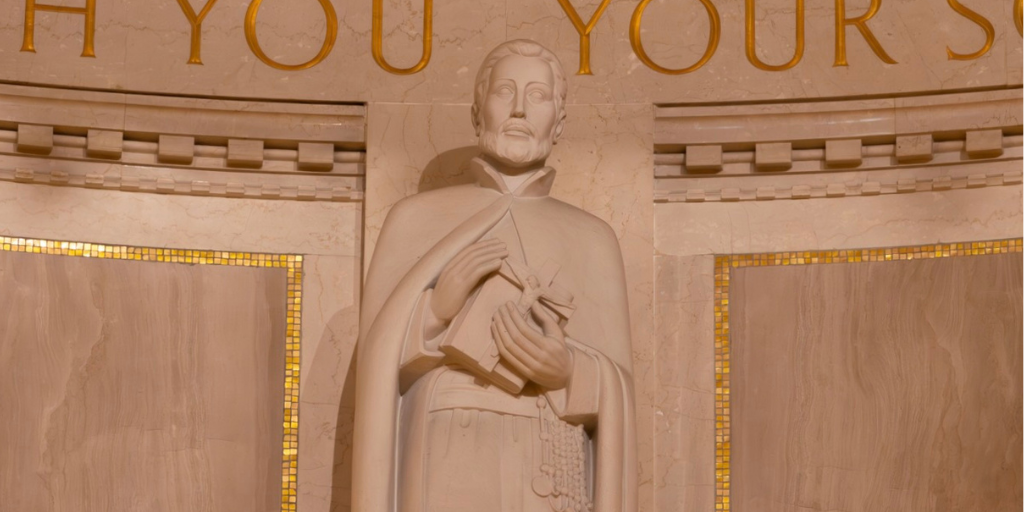
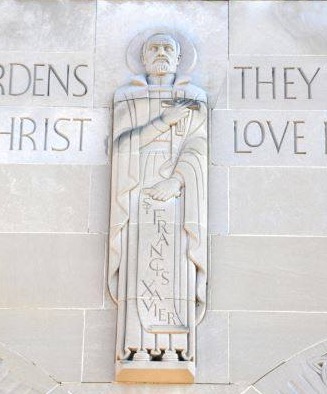
St. Francis Xavier portrayed in the west portico

1. Francis Xavier studied at the University of Paris alongside Saint Ignatius of Loyola.

Born in 1506, Francis grew up in Navarre, Spain, where his father oversaw the king of Navarre’s council. When he was old enough, he began studying at the University of Paris, where he met Ignatius of Loyola. Through their friendship, Francis realized that God was calling him to work in ministry, and in 1534, he decided to join Ignatius in founding the Society of Jesus. Three years later, Francis was also ordained as a priest.

2. He once spent 13 months at sea.

Not only did Francis make vows of poverty and chastity when joining the Society, but he also promised to spread Gospel. To help fulfill the Society’s aim of sending missionaries into foreign lands, Francis departed for Goa in 1541. Unfortunately, he suffered from severe seasickness, making the 13-month voyage an arduous journey.

3. To make the Gospel accessible to Goa’s lower classes, he set verses to popular tunes of the era, and soon, the Scriptures were sung across the region.

Though Christianity was somewhat established in Goa, Francis soon discovered that many of those who claimed the name of Christ lived in shameless hedonism. Mistreatment of slaves and women, and a disregard for impoverished people characterized the lives of these nominal Christians. Francis determined to inspire true holiness not only through his personal conduct, but through unconventional practices. To make the Gospel accessible to the lower classes, he set verses to popular tunes of the era, and soon, the Scriptures were being sung across the region.

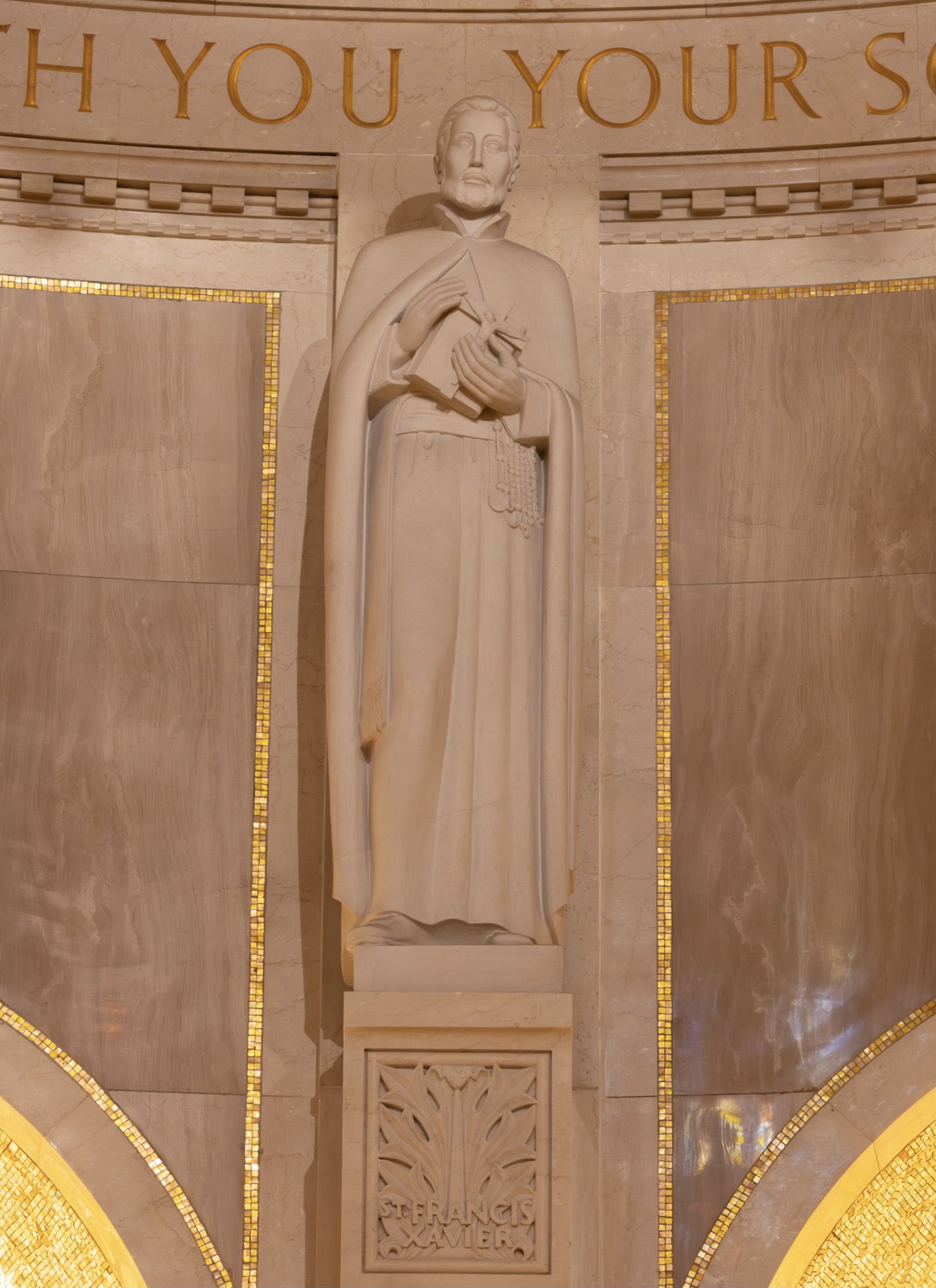
He also ministered to unbelievers through humanitarian work, assisting in the leper community, hospitals, and prisons. Francis later ventured beyond Goa to the surrounding areas, where he dressed like a pauper in order to better relate to the locals.Marble statue of St. Francis Xavier

St. Francis Xavier portrayed in the west apse

4. After spending just two years in Japan, Francis helped lead nearly 2,000 people there to Christ.

After ministering in Goa and India for several years, Francis felt called to continue his mission work in Japan alongside a small group of fellow Catholics. At the time of the group’s arrival in Kagoshima in 1549, Japan was largely untouched by the West. Francis spent the majority of his first year there studying Japanese and translating theological works into the language so that he could more effectively share the Gospel. Through these efforts, he began converting some of the locals to Christianity. Displeased by his growing influence, Kagoshima’s Buddhist leaders had Francis barred from the city. He then began preaching in other parts of the nation, and after just two years, had helped lead nearly 2,000 people to Christ.

5. In Goa, Francis dressed like a beggar to blend in – but in Japan, he dressed in fine robes and had his fellow missionaries pretend to be his attendants.

While assimilation once again helped Francis better reach people, the task looked very different in Japan. Instead of dressing humbly like he did in Goa, Francis found that more people were interested in speaking with him if he appeared wealthy and important. So, as he continued his ministry, he dressed in fine robes and had his fellow missionaries pretend to be his attendants. As a result, some officials liked him so much that they permitted him to freely hold services in an unused Buddhist temple. During his time in Japan, Francis helped plant the seeds of a ministry that would continue to flourish as more missionaries came to the country.

In the years that followed, Francis sought to minister to the people of China, but tragically fell ill on his voyage there and passed away on an island six miles off the coast. He was canonized on the same day as St. Ignatius of Loyola in 1622.

At the National Shrine, you can find St. Francis Xavier portrayed in the west portico and in the west apse of the Great Upper Church.

Sources:

Butler’s Lives of Saints, ed. Bernard Bangley.

Rohling, Geraldine M., PhD, MAEd. The Basilica of the National Shrine of the Immaculate Conception: Guide and Tour Book. Washington, D.C.: Basilica of the National Shrine of the Immaculate Conception, 2018.

“St. Francis Xavier,” Britannica.

“St. Francis Xavier,” Catholic News Agency.

“St. Francis Xavier,” New Advent.

The Way of Saints, Dr. Tom Cowan.

10 posted on 12/03/2025 4:55:55 AM PST by annalex (fear them not)
[ Post Reply | Private Reply | To 9 | View Replies]

To: annalex
https://www.nationalshrine.org/blog/5-things-you-should-know-about-st-francis-xavier/
11 posted on 12/03/2025 4:58:09 AM PST by annalex (fear them not)
[ Post Reply | Private Reply | To 10 | View Replies]

To: annalex

NAVARRE BIBLE COMMENTARY(RSV)

Ad Majorem Dei Gloriam (To the Greater Glory of God)

First Reading:

From: Isaiah 25:6-10a

The Lord’s banquet
----------------------------
[6] On this mountain the Lord of hosts will make for all peoples a feast of fat things, a feast of wine on the lees, of fat things full of marrow, of wine on the lees well refined. [7] And he will destroy on this mountain the covering that is cast over all peoples, the veil that is spread over all nations. [8] He will swallow up death for ever, and the Lord God will wipe away tears from all faces, and the reproach of his people he will take away from all the earth; for the Lord has spoken.

Songs of salvation
---------------------------
[9] It will be said on that day, “Lo, this is our God; we have waited for him that he might save us. This is the Lord; we have waited for him; let us be glad and rejoice in his salvation.”

[10] For the hand of the Lord will rest on this mountain.

***********************************************
Commentary:

25:6-8. The Lord has prepared a special feast for all the nations on Mount Zion. There he will provide succulent food and fine wine – a symbolic reference to the divine fare that God will provide and which surpasses anything that man could imagine.

These words prefigure the Eucharistic banquet, instituted by Jesus in Jerusalem, in which he provides divine nourishment, his own Body and Blood, which strengthens the soul and is a pledge of future glory: “To share in ‘the Lord’s Supper’ is to anticipate the eschatological feast of the ‘marriage of the Lamb’ (Rev 19:9). Celebrating this memorial of Christ, risen and ascended into heaven, the Christian community waits ‘in joyful hope for the coming of our Saviour, Jesus Christ’” (John Paul II, Dies Domini, 38). The saints often encourage us to bear this in mind when we receive the Eucharist: “It is an eternal pledge to us; it assures us of a place in heaven; it is a guarantee that one day heaven will be our home. Moreover, Jesus Christ will raise up our bodies in glory, in accordance with how often and with what dignity we have received his Body in Holy Communion” (St John Baptist Mary Vianney, Sermon on Holy Communion).

“Death” (v. 8) is a metaphor for the definitive destruction of Israel: God gives an assurance that it will never happen. Also, St Paul quotes this verse when he rejoices that the resurrection of Christ marks the definitive victory over death (1 Cor 15:54-55), and it appears also in the book of Revelation, when it proclaims the salvation that has been wrought by the Lamb who has died and risen again: “he will wipe away every tear from their eyes, and death shall be no more, neither shall there be mourning nor crying nor pain anymore, for the former things have passed away” (Rev 21:4; cf. also Rev 7:17). The Church, too, speaks in similar vein in its prayer for the dead, beseeching God to receive them into his Kingdom “There we hope to share in your glory when every tear will be wiped away. On that day we shall see you, our God, as you are. We shall become like you and praise you forever through Christ our Lord, from home all good things come” (Roman Missal, Eucharistic Prayer III).

25:9-26:6. After the celebration of the banquet prepared by God, two hymns are intoned that will be sung “on that day”. The first praises the Lord: he is faithful; those who put their hope of salvation in him will never be disappointed, whereas Moab will be laid low on account of its pride (25:9-12). The second hymn returns (cf. 25:1-5) to the theme of praise of the Lord for giving refuge to the poor and needy (26:1-6).

12 posted on 12/03/2025 7:37:24 AM PST by fidelis (Ecce Crucem Domini! Fugite partes adversae! Vicit Leo de tribu Juda, Radix David! Alleluia!)
[ Post Reply | Private Reply | To 11 | View Replies]

Gospel Reading:

From: Matthew 15:29-37

The Canaanite Woman (Continuation)
----------------------------------
[29] And Jesus went on from there and passed along the Sea of Galilee. And He went up into the hills, and sat down there. [30] And great crowds came to Him, bringing with them the lame, the maimed, the blind, the dumb, and many others, and they put them at His feet, and He healed them, [31] so that the throng wondered, when they saw the dumb speaking, the maimed whole, the lame walking, and the blind seeing; and they glorified the God of Israel.

Second Miracle of the Loaves
----------------------------
[32] Then Jesus called His disciples to Him, and said, "I have compassion on the crowd, because they have been with Me now three days, and having nothing to eat; and I am unwilling to send them away hungry, lest they faint on the way." [33] And the disciples said to Him, "Where are we to get bread enough in the desert to feed so great a crowd?" [34] And Jesus said to them, "How many loaves have you?" They said, "Seven, and a few small fish." [35] And commanding the crowd to sit down on the ground, [36] He took the seven loaves and the fish, and having given thanks He broke them and gave them to the disciples, and the disciples gave them to the crowds. [37] And they all ate and were satisfied; and they took up seven baskets full of the broken pieces left over.

***********************************************************************
Commentary:

29-31. Here St. Matthew summarizes Jesus' activity in this border area where Jews and pagans were living side by side. As usual He teaches and heals the sick; the Gospel account clearly echoes the prophecy of Isaiah which Christ Himself used to prove that He was the Messiah (Luke 7:22): "the eyes of the blind shall be opened, and the ears of the deaf unstopped..." (Isaiah 35:5).

"They glorified the God of Israel": this clearly refers to the Gentiles, who thought that God could give the power to work miracles to Jews only. Once again the Gentiles are seen to have more faith than the Jews.

32. The Gospels speak of our Lord's mercy and compassion towards people's needs: here He is concerned about the crowds who are following Him and who have no food. He always has a word of consolation, encouragement and forgiveness: He is never indifferent. However, what hurts Him most are sinners who go through life without experiencing light and truth: He waits for them in the Sacraments of Baptism and Penance.

33-38. As in the case of the first multiplication (14:13-20), the Apostles provide our Lord with the loaves and the fish. It was all they had. He also avails of the Apostles to distribute the food—the result of the miracle--to the people. In distributing the graces of salvation God chooses to rely on the faithfulness and generosity of men. "Many great things depend--don't forget--on whether you and I live our lives as God wants" (St J. Escriva, "The Way", 755).

It is interesting to note that in both miracles of multiplication of loaves and fish Jesus provides food in abundance but does not allow anything to go to waste. All Jesus' miracles, in addition to being concrete historical events, are also symbols of supernatural realities. Here abundance of material food also signifies abundance of divine gifts on the level of grace and glory: it refers to spiritual resources and eternal rewards; God gives people more graces than are strictly necessary. This is borne out by Christian experience throughout history. St. Paul tells us that "where sin increased, grace abounded all the more" (Romans 5:20); he speaks of "the riches of His grace which He lavished upon us" (Ephesians 1:8) and tells his disciple Timothy that "the grace of our Lord overflowed for me and with the faith and love that are in Christ Jesus" (1 Timothy 1:14).

13 posted on 12/03/2025 7:37:41 AM PST by fidelis (Ecce Crucem Domini! Fugite partes adversae! Vicit Leo de tribu Juda, Radix David! Alleluia!)
[ Post Reply | Private Reply | To 12 | View Replies]

Click here to go to the My Catholic Life! Devotional thread for a meditation on today’s Gospel Reading.

14 posted on 12/03/2025 7:38:25 AM PST by fidelis (Ecce Crucem Domini! Fugite partes adversae! Vicit Leo de tribu Juda, Radix David! Alleluia!)
[ Post Reply | Private Reply | To 13 | View Replies]

Disclaimer: Opinions posted on Free Republic are those of the individual posters and do not necessarily represent the opinion of Free Republic or its management. All materials posted herein are protected by copyright law and the exemption for fair use of copyrighted works.

Free Republic
Browse · Search
Religion
Topics · Post Article

FreeRepublic, LLC, PO BOX 9771, FRESNO, CA 93794
FreeRepublic.com is powered by software copyright 2000-2008 John Robinson