Elizabeth Johnson | Faith Catholic
Most American Catholics have probably never heard of St. Andrew Dung-Lac, whose feast day is celebrated Nov. 24. He represents the suffering and persecution of hundreds of thousands of Vietnamese Catholics who died for the faith over the past three centuries, as well as the many Catholics who continue to face persecution as they attempt to practice their religion in communist Vietnam.
Spanish, Portuguese and French missionaries brought Catholicism to Vietnam in the late 1500s. The religion spread throughout the country, but by the 1800s, Catholics began to be tortured and killed for practicing their faith. From 1820 to 1841, Emperor Minh-Mang – known as the Nero of Vietnam – ordered the persecution of thousands of Christians. In 1847, Minh-Mang ordered another round of persecutions when he suspected foreign missionaries and Vietnamese Catholics of supporting his son, who was leading a rebellion against him. Even after Minh-Mang’s death, persecutions continued in his name until the late 1800s. Some records estimate that between 100,000 and 300,000 Catholics were killed or tortured within a 60-year period of the 1800s.
One of those who suffered martyrdom was Andrew Dung-Lac, a native Vietnamese priest. Born in 1795, Dung An Tran was introduced to the Catholic faith when he was 12 years old. After three years of education in Christianity, he was baptized and took the name Andrew Dung. He learned Chinese and Latin, and became a catechist, teaching others in the Vietnamese countryside about Jesus. He furthered his studies, and in 1823 was ordained a priest, serving in a parish in Ke Dam.
In 1835, Father Dung was imprisoned by Emperor Minh-Mang, but his parishioners raised money to pay for his release. After leaving prison, he changed his name to Andrew Lac, and moved to another area to continue his preaching and teaching. But he was captured again in 1839, along with another priest, Peter Thi, to whom he had gone to receive the sacrament of reconciliation. They were ransomed, but recaptured after only a few months. Both priests were taken to Hanoi, where they were tortured and finally beheaded on Dec. 21, 1839.
Andrew Dung-Lac and Peter Thi were beatified by Pope Leo XIII in 1900, but it was not until 1988 that they and 115 other martyrs of Vietnam were canonized by Pope John Paul II. The group – who came from Vietnam, Spain and France – includes 50 priests, eight bishops, 42 lay people, 16 catechists and one seminarian.
NAVARRE BIBLE COMMENTARY(RSV)
Ad Majorem Dei Gloriam (To the Greater Glory of God)
First Reading:
From: Daniel 1:1-6, 8-20
Arrival at the Court
--------------------
[1] In the third year of the reign of Jehoiakim king of Judah, Nebuchadnezzar king of Babylon came to Jerusalem and besieged it. [2] And the Lord gave Jehoiakim king of Judah into his hand, with some of the vessels of the house of God; and he brought them to the land of Shinar, to the house of his god, and placed the vessels in the treasury of his god. [3] Then the king commanded Ashpenaz, his chief eunuch, to bring some of the people of Israel, both of the royal family and of the nobility, [4] youths without blemish, handsome and skillful in all wisdom, endowed with knowledge, understanding learning, and competent to serve in the king’s palace, and to teach them the letters and language of the Chaldeans. [5] The king assigned them a daily portion of the rich food which the king ate, and of the wine which he drank. They were to be educated for three years, and at the end of that time they were to stand before the king. [6] Among these were Daniel, Hananiah, Misha-el, and Azariah of the tribe of Judah.
Royal Fare--God’s Servants Tested
---------------------------------
[8] But Daniel resolved that he would not defile himself with the king’s rich food, or with the wine which he drank; therefore he asked the chief of the eunuchs to allow him not to defile himself. [9] And God gave Daniel favor and compassion in the sight of the chief of the eunuchs; [10] and the chief of the eunuchs said to Daniel, “I fear lest my lord the king, who appointed your food and your drink, should see that you were in poorer condition than the youths who are of your own age. So you would endanger my head with the king.” [11] Then Daniel said to the steward whom the chief of the eunuchs had appointed over Daniel, Hananiah, Misha-el, and Azariah; [12] “Test your servants for ten days; let us be given vegetables to eat and water to drink. [13] Then let our appearance and the appearance of the youths who eat the king’s rich food be observed by you, and according to what you see deal with your servants.” [14] So he hearkened to them in this matter, and tested them for ten days. [15] At the end of ten days it was seen that they were better in appearance and fatter in flesh than all the youths who ate the king’s rich food. [16] So the steward took away their rich food and the wine they were to drink, and gave them vegetables.
The Wisdom of the Three Young Men
---------------------------------
[17] As for these four youths, God gave them learning and skill in all letters and wisdom; and Daniel had understanding in all visions and dreams. [18] At the end of the time, when the king had commanded that they should be brought in, the chief of the eunuchs brought them in before Nebuchadnezzar. [19] And the king spoke with them, and among them all none was found like Daniel, Hananiah, Misha-el, and Azariah, therefore they stood before the king [20] And in every matter of wisdom and understanding concerning which the king inquired of them, he found them ten times better than all the magicians and enchanters that were in all his kingdom.
**************************
Commentary:
1:1-6:29. These chapters deal with Daniel at the court of the kings of Babylon--Nebuchadnezzar (1:1-4:37), Belshazzar (chap. 5) and Darius the Mede (chap. 6). These three reigns, arranged in a line as if they really followed one another cover the entire period from the start of the Babylonian captivity to the arrival of Cyrus of Persia, who allowed the Jews to return to their homeland (cf. 1:21). The main themes running through these chapters are: 1) divine protection afforded Daniel and his companions; 2) the help that these young Jews render the kings; 3) their faithfulness to the Lord despite trials and ordeals; 4) the acknowledgment of the God of Israel by these pagan kings. In the overall context of the book, these first six chapters introduce the God of Israel and Daniel, who will later receive a revelation about the end of the world. They also provide the Jews of the Diaspora with a model of how a Jew in a pagan society ought to live. For that reason, the Church will read them with interest because she lives in the midst of the world and “realizes that she is truly linked with mankind and its history by the deepest of bonds” (Vatican II, "Gaudium Et Spes", 1).
1:1-4:37 Nebuchadnezzar was the king who was responsible for the deportation of the Jews, and the most famous of the Babylonian kings. That may explain why he gets so much space in the book: Daniel interprets two dreams for him (2:1-49; 4:1-37), and the king three times acknowledges the God of Israel (2:46-49; 4:1-3; 4:37). Each episode in these chapters is an independent unit, and they all combine to show the qualities that Daniel and these other Jews had: they were accomplished people, successful in life; at the same time they stayed true to God, even when their religion was put to the test.
1:1-21. This chapter acts as an introduction to the whole book. It tells us who Daniel was and how he and his companions became members of Nebuchadnezzar’s household. The dates given at the start and finish of the chapter (vv. 1, 21) show that Daniel was connected with the whole period of the exile.
1:1-7. The third year of the reign of Jehoiakim was 606 BC, but the siege and sack of Jerusalem by Nebuchadnezzar took place in 597. The sacred writer is content to use vague references like this; and it may well be that he is advancing the date of the deportation because that is more in line with seventy years--the length of the exile according to Jeremiah 25:11. The Hebrew word translated as “eunuch” (v. 3) is "saris", which could refer to any palace officials or guards, not necessarily eunuchs. The country of Shinar is Babylonia, which is how the Greek version translates the name. It was quite common in the ancient East for a victorious king to appoint state officials from among the noblemen of subject peoples; Jewish officials, for example, could be very useful in dealings with Jewish communities.
1:8-16. The sacred writer extends Jewish regulations about food (cf. 1 Mac 1:62) to wine, to show that keeping to the Jewish law was much better for the youths than eating the king’s fare would have been. Besides, to eat and drink at the royal table would have involved eating and drinking things offered to the gods; it would have been a form of communing with pagan gods. As those young men saw it, being good Jews was not incompatible with the performance of duties for which they were trained. Similarly, “to remind a Christian that his life is meaningless unless he obeys God’s will does not mean separating him from other men” (St Josemaria Escrivá, "Christ Is Passing By", 21).
God can afford protection by making use of people’s good dispositions; here he causes the chief eunuch to be well-disposed to the Jewish youths (v. 9). Thus, “though often unconscious collaborators with God’s will, men can also enter deliberately into the divine plan by their actions, their prayers and their sufferings” ("Catechism of the Catholic Church", 307).
1:17-21. Although Daniel and his companions are given a very good Chaldean education, their wisdom comes from God, not from that training (v. 17) It includes the understanding of all things human and, in Daniel’s case, the ability to interpret dreams and visions. The king will soon see for himself that Daniel and the Jews have greater wisdom than others, but he does not yet know where it comes from (he will, later: cf. 2:47). But the Jewish or Christian reader of the book does know what the source of this true wisdom is: "God's truth is his wisdom which commands the whole created order and governs the world (cf. Wis 13:1-9). God who alone made heaven and earth (cf. Ps 115:15), can alone impart true knowledge of every created thing in relation to himself” ("Catechism of the Catholic Church", 216).
Summing up the career of these Jewish youths in Babylon, and aware that their wisdom came from the Word of God, St Hippolytus of Rome comments: “It was the Word who gave them wisdom and made them faithful witnesses [to him] in Babylon, so that through them what was worshipped in Babylon would be scorned. Nebuchadnezzar was defeated by three young men whose faith was tested in the fires of the furnace, the holy woman Susanna was delivered from the jaws of death and the terrible depth of ancient evil was laid bare. These were the victories won by four young men in Babylon; they were beloved of God and nurtured the fear of the Lord in their hearts” ("Commentarium In Danielem", 1, 11).
Gospel Reading: From: Luke 21:1-4
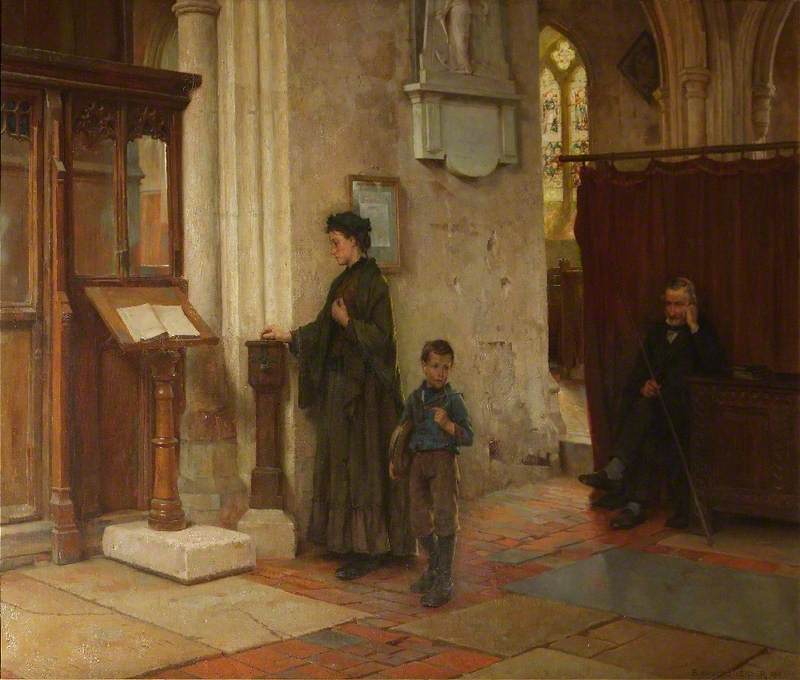
The Widow's Mite
----------------
[1] He (Jesus) looked up and saw the rich putting their gifts into the treasury; [2] and He saw a poor widow put in two copper coins. [3] And He said, "Truly I tell you, this poor widow has put in more than all of them; [4] for they all contributed out of their abundance, but she out of her poverty put in all the living she had."
***********************************************************************
Commentary:
1-4. Our Lord, surrounded by His disciples, watches people putting offerings into the treasury. This was a place in the women's courtyard, where there were various collection boxes for the offerings of the faithful. Just then, something happens whose significance Jesus wants His disciples to notice: a poor widow puts in two small coins, of very little value. He describes this as the greatest offering of all, praising the generosity of giving alms for this purpose, particularly that of those people who give part of what they need. Our Lord is moved by this tiny offering because in her case it implies a big sacrifice. "The Lord does not look", St. John Chrysostom comments, "at the amount offered but at the affection with which it is offered" ("Hom. on Heb", 1). Generosity is of the essence of almsgiving. This woman teaches us that we can move God's heart if we give Him all we can, which will always amount to very little even if we give our very lives. "How little a life is to offer to God!" (St Josemaria Escriva, "The Way", 42).