Catena Aurea by St. Thomas Aguinas
CHAP. 19
19:45–48
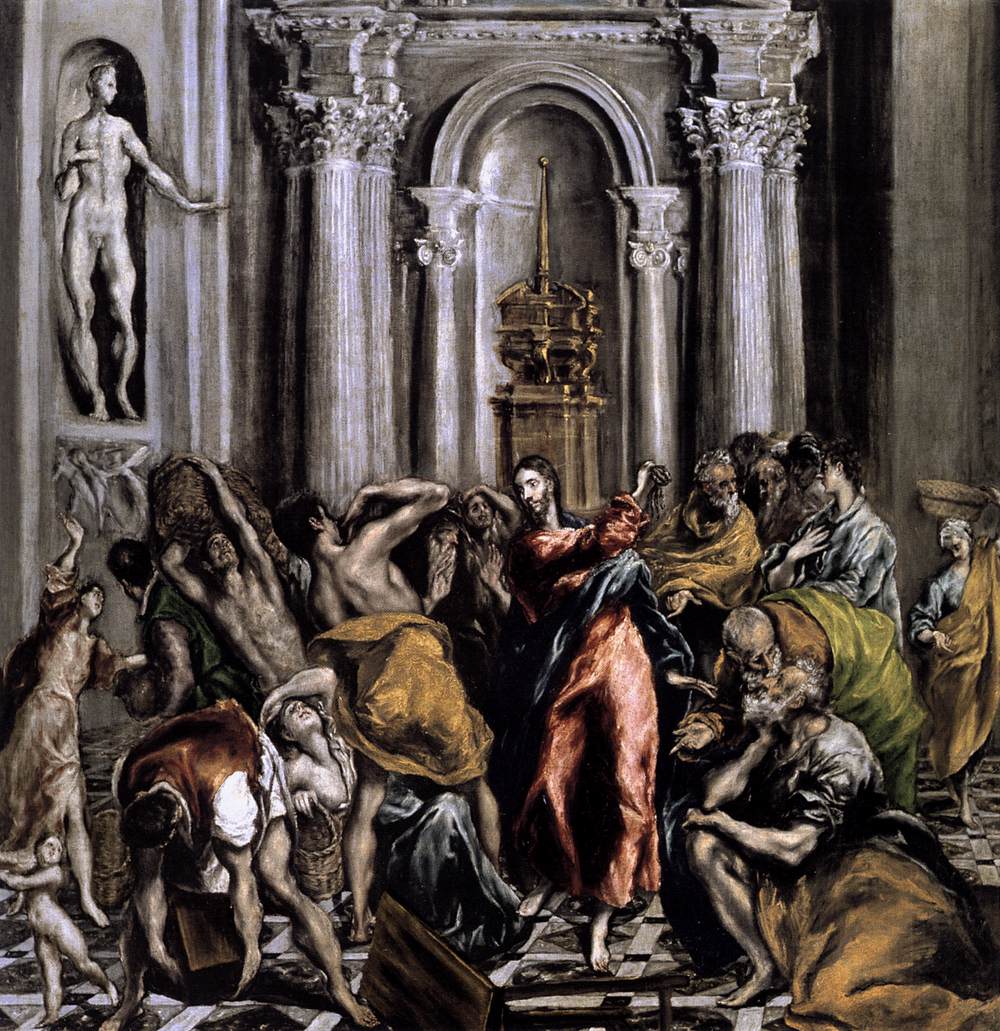
45. And he went into the temple, and began to cast out them that sold therein, and them that bought;
46. Saying unto them, It is written, My house is the house of prayer: but ye have made it a den of thieves.
47. And he taught daily in the temple. But the Chief Priests and the Scribes and the chief of the people sought to destroy him,
48. And could not find what they might do: for all the people were very attentive to hear him.
GREGORY. (ut sup.) When He had related the evils that were to come upon the city, He straightway entered the temple, that He might cast out them that bought and sold in it. Shewing that the destruction of the people arose chiefly from the guilt of the priests.
AMBROSE. For God wishes not His temple to be a house of traffic, but the dwelling-place of holiness, nor does He fix the priestly service in a saleable performance of religion, but in a free and willing obedience.
CYRIL OF ALEXANDRIA. Now there were in the temple a number of sellers who sold animals, by the custom of the law, for the sacrificial victims, but the time was now come for the shadows to pass away, and the truth of Christ to shine forth. Therefore Christ, who together with the Father was worshipped in the temple, commanded the customs of the law to be reformed, but the temple to become a house of prayer; as it is added, My house, &c.
GREGORY. For they who sat in the temple to receive money would doubtless sometimes make exaction to the injury of those who gave them none.
THEOPHYLACT. The same thing our Lord did also at the beginning of His preaching, as John relates; and now He did it a second time, because the crime of the Jews was much increased by their not having been chastened by the former warning.
AUGUSTINE. (de Qu. Ev. lib. ii. qu. 48.) Now mystically, you must understand by the temple Christ Himself, as man in His human nature, or with His body united to Him, that is, the Church. But inasmuch as He is the Head of the Church, it was said, Destroy this temple, and I will raise it up in three days. (John 2:19.) Inasmuch as the Church is joined to Him, is the temple so interpreted, of which He seems to have spoken in the same place, Take these away from hence; signifying that there would be those in the Church who would rather be pursuing their own interest, or find a shelter therein to conceal their wickedness, than follow after the love of Christ, and by confession of their sins receiving pardon be restored.
GREGORY. (Hom. 39. ut sup.) But our Redeemer does not withdraw His word of preaching even from the unworthy and ungrateful. Accordingly after having by the ejection of the corrupt maintained the strictness of discipline, He now pours forth the gifts of grace. For it follows, And he was teaching daily in the temple.
CYRIL OF ALEXANDRIA. Now from what Christ had said and done it was meet that men should worship Him as God, but far from doing this, they sought to slay Him; as it follows, But the chief priests and scribes and the chief of the people sought to destroy him.
BEDE. Either because He daily taught in the temple, or because He had cast the thieves therefrom, or that coming thereto as King and Lord, He was greeted with the honour of a heavenly hymn of praise.
CYRIL OF ALEXANDRIA. But the people held Christ in far higher estimation than the Scribes and Pharisees, and chiefs of the Jews, who not receiving the faith of Christ themselves, rebuked others. Hence it follows, And they could not find what they might do: for all the people were very attentire to hear him.
BEDE. This may be taken in two ways; either that fearing a tumult of the people they knew not what they should do with Jesus, whom they had settled to destroy; or they sought to destroy Him because they perceived their own authority set aside, and multitudes flocking to hear Him.
GREGORY. (ut sup.) Mystically, such as the temple of God is in a city, such is the life of the religious in a faithful people. And there are frequently some who take upon themselves the religious habit, and while they are receiving the privilege of Holy Orders, are sinking the sacred office of religion into a bargain of worldly traffic. For the sellers in the temple are those who give at a certain price that which is the rightful possession of others. For to sell justice is to observe it on condition of receiving a reward. But the buyers in the temple are those, who whilst unwilling to discharge what is just to their neighbour, and disdaining to do what they are in duty bound to, by paying a price to their patrons, purchase sin.
ORIGEN. If any then sells, let him be cast out, and especially if he sells doves. For of those things which have been revealed and committed to me by the Holy Spirit, I either sell for money to the people, or do not teach without hire, what else do I but sell a dove, that is, the Holy Spirit?
AMBROSE. Therefore our Lord teaches generally that all worldly bargains should be far removed from the temple of God; but spiritually He drove away the money-changers, who seek gain from the Lord’s money, that is, the divine Scripture, lest they should discern good and evil.
GREGORY. (ut sup.) And these make the house of God a den of thieves, because when corrupt men hold religious offices, they slay with the sword of their wickedness their neighbours, whom they ought to raise to life by the intercession of their prayers. The temple also is the soul of the faithful, which if it put forth corrupt thoughts to the injury of a neighbour, then is it become as it were a lurking place of thieves. But when the soul of the faithful is wisely instructed to shun evil, truth teaches daily in the temple.
Catena Aurea Luke 19
Pope St. Gelasius I – The 49th Pope
Pope St. Gelasius I has been remembered as the most prolific writer while serving as the head of the Catholic Church for at least its first five centuries.
Born into the crumbling world of the failing Western Roman Empire in North Africa before it fell to the Vandal barbarians, he nonetheless argued for the primacy of the Patriarch of Rome over and ahead of the other four patriarchs throughout Christendom found in the East in Constantinople, Antioch, Jerusalem, and Alexandria.
Pope St. Gelasius has been remembered as the pope who spelled out the political authority of the pontiffs for the next thousand years of ecclesiastical and secular history, especially in the geographical boundaries that formerly comprised the late Western Roman Empire.
Early Years and Ministry of Pope St. Gelasius I
Gelasius was born in the province of Roman North Africa before the wealthy territory finally attracted and fell to the invading Vandals and their new kingdom they established at Carthage in 428. The rest of his life, whenever he was asked where he was born, Gelasius would say that “I was born a Roman in Africa,” revealing his affection for the long bygone land of his birth. This made Gelasius the third and final pope who was a Berber of North Africa by his ancestry.
Gelasius worked for many years in Rome as an assistant to his predecessor Pope Felix III. St. Gelasius was so accomplished a writer for the day that Felix kept him busy drafting papal documents in his service. In fact, both before and during his papacy term, Gelasius I wrote so many documents that he became known as the most prolific writer of the church’s leaders for the next five centuries at least.
Of his surviving writings from over 1,500 years ago, we still have many of his over 100 treatises and letters. In one of these, he famously stated that “There are two powers by which this world is chiefly ruled: the sacred authority of the priesthood and the authority of kings.” This key declaration would define the authority of the papacy for many centuries to come.
Gelasius’ Critical Defining of the Political Supremacy of the Pope Over All Other Church and Lay Hierarchy
Long considered way ahead of his time by his statements, understanding, and the depth of his writings, Gelasius’ writing style put him in between the popes of the Late Antiquity period and the Early Middle Ages. This political doctrine of the papacy and its supremacy that he (first of the later popes) forcefully espoused and then subsequently rigorously defended until he eventually died became the dominant defining political understanding and guiding force of the Catholic Church for the next thousand years.
St. Gelasius I Life and Ministry as Pope
Pope Gelasius was tireless in his efforts to combat what he saw as heresy on all fronts. In the still surviving East of the Roman Empire, he battled with the Patriarch of Constantinople concerning the dual nature of Christ as both divine and human at once.
He began the millennium long struggle with the Eastern Roman/Byzantine Emperors over who was the ultimate head of the universal church— the pope living in Rome or the Eastern Emperors in distant Constantinople.
The final resolution of this epic struggle of the ages only occurred in 1453 when the last Eastern Roman Emperor Constantine XI was defeated and deposed by the Ottoman Turks.
Closer to home, St. Gelasius I witnessed an annual pagan festival in the city of Rome that offended him greatly. This was known as the Lupercalia. The Roman pagan festival of fertility and renewal had purification overtones that were unacceptable to Gelasius as supreme pontiff.
He spent his entire papacy struggling to overturn this festival. In the end by 494 A.D., Gelasius I was ultimately successful in converting the pagan festival he abhorred into the church sponsored Feast of the Purification, which became finally known as the Presentation of the Lord, though it is more commonly referred to today as Candlemas around the Catholic world.
List of Events In The Life of Pope St. Gelasius I
| Date | Event | Title |
|---|
| 1 Mar 492 | Elected | Pope (Roma, Italy) |
| 1 Mar 492 | Ordained Bishop | Pope (Roma, Italy) |
| 19 Nov 496 | Died | Pope (Roma, Italy) |
Brief history of Pope St. Gelasius I
– Born – 410 AD
– Birth Name – Gelasius
– Died – around November 19, 496
How Pope St. Gelasius I Died
Pope Gelasius was only the Roman pontiff for four short years. He was already 82 years old when he ascended to the office of the papacy in succeeding his predecessor Pope Felix III. It was not a great shock four years later when he died naturally of old age at a respectable 86.
In a day when the typical life expectancy after the fall of the Western Roman Empire amounted to around 40 years for the majority of individuals, Gelasius enjoyed a long and fruitful life.
Pope St. Gelasius I accomplished so much in his short yet dynamic time in the Papal office that the church nominated for him a commemorating feast day of November 21st on the anniversary of his death and interment.
– Papacy began – March 1, 492 A.D.
– Papacy ended – November 19, 496 A.D.
– Successor – Pope Anastasius II
Interesting Facts About Pope St. Gelasius I
Gelasius was born the last of the African and Berber descendent popes. He was thus the third and final one of his Berber African race.
Pope Gelasius was the very first pope to receive the honored title the “Vicar of Christ.”
As personal assistant to his predecessor Pope Felix III, Gelasius proved to be so adept at writing that the pope employed him continuously in drafting important papal documents.
While he was pope himself, Sr. Gelasius I insisted on strict orthodox practice in Catholicism. He was the first such pope to continuously demand obedience by all church hierarchy to the pope in Rome’s supreme authority as the heir to St. Peter who the church was already calling the first pontiff by this time.
Pope St. Gelasius I left behind over 100 treatises and letters that he wrote both before and during his brief time in the office of the papacy. Over 40 of these individual writings survive in their entirety to this day. They are preserved in the Vatican Library in Rome.
popehistory.com
Catena Aurea by St. Thomas Aguinas
12:46–50
46. While he yet talked to the people, behold, his mother and his brethren stood without, desiring to speak with him.
47. Then one said unto him, Behold, thy mother and thy brethren stand without, desiring to speak with thee.
48. But he answered and said unto him that told him, Who is my mother? and who are my brethren?
49. And he stretched forth his hand toward his disciples, and said, Behold my mother and my brethren!
50. For whosoever shall do the will of my Father which is in heaven, the same is my brother, and sister, and mother.
HILARY. Because He had spoken all the aforesaid things in the power of His Father’s majesty, therefore the Evangelist proceeds to tell what answer He made to one that told Him that His mother and His brethren waited for Him without; While he yet spake unto the people, his mother and his brethren stood without desiring to see him.
AUGUSTINE. (De Cons. Ev. ii. 40.) We are to understand without doubt that this happened close upon the foregoing; for he begins to tell it with the words, And while he yet spake. What can that yet mean but that it was at the very time He spake the foregoing things? Mark also follows up that which He had said concerning blasphemy against the Holy Ghost, by saying, And there came his mother and his brethren. (Mark 3:31) Luke has not observed the order of action here, but has placed this earlier as he happened to recollect it.
JEROME. (cont. Helvid. 14, et seq.) From this is taken one of Helvidius’s propositions, on the ground that mention is made in the Gospel of the brethren of the Lord. How, says he, are they called brethren of the Lord, if they were not his brethren? But now it should be known that in divine Scripture men are said to be brethren in four different ways, by nature, by nation, by kindred, and by affection. By nature, as Esau and Jacob. By nation, as all Jews are called brethren, as in Deuteronomy, Thou shalt not set over thee a foreigner who is not thy brother. (Deut. 17:15) They are called brethren by kindred who are of one family, as in Genesis, Abraham said unto Lot, Let there not be strife between thee and me, for we are brethren. (Gen. 13:8) Also men are called brethren by affection, which is of two kinds, special and general. Special, as all Christians are called brethren, as the Saviour says, Go tell my brethren. General, inasmuch as all men are born of one father, we are bound together by a tie of consanguinity, as in that, Say unto them that hate you, Ye are our brethren. (Is. 66:5 sec. LXX.) I ask then, after which manner these are called the Lord’s brethren in the Gospel? According to nature? But Scripture saith not, neither calling them sons of Mary nor of Joseph. By nation? But it is absurd that some few out of all the Jews should be called brethren, seeing that all the Jews who were there might have thus been called brethren. By affection, either of a human sort, or of the Spirit? If that be true, yet how were they more His brethren than the Apostles, whom He instructed in the inmost mysteries. Or if because they were men, and all men are brethren, it was foolish to say of them in particular, Behold, thy brethren seek thee. It only remains then that they should be His brethren by kindred, not by affection, not by privilege of nation, not by nature.
JEROME. (in loc.) But some suspect the brethren of the Lord to be sons of Joseph by another wife, following the idle fancies of apocryphal writers, who have coined a certain woman called E sea. But we understand by the brethren of the Lord, not the sons of Joseph, but cousins of the Saviour, sons of a sister of Mary, an aunt of Our Lord, who is said to be the mother of James the Less, and Joseph, and Jude, whom in another place of the Gospel we find called the brethren of the Lord. (Mark 6:3) And that cousins are called brethren, appears from every part of Scripture.
CHRYSOSTOM. (Hom. xliv.) But mart the loftiness of His brethrena; when they should have come in and heartened with the crowd, or if they would not this, to have waited the end of His speech, and then to have approached Him—they on the contrary call Him out to them, and do this before the multitude, therein shewing their superabundant love of honour, and also, that with all authority they lay their commands upon Christ. This the Evangelist covertly hints when he says, While he yet spake; as much as to say, Was there no other time? But what did they seek to say? Was it aught of the dogmas of truth? then should they have brought it forth before all, that all might profit thereby. But if of other things that concerned themselves alone, they should not have called Him in such haste, whence it is plain that they did this out of vain glory.
AUGUSTINE. (De Nat. et Grat. 36.) But whatever may be decided concerning these brethren, yet concerning the holy Virgin Mary, (for the honour of Christ,) when sin in her is in question, I would not have it brought into doubt. For from this only we might know that more abundant grace was conferred upon her that she should overcome sin on all sides, because she merited to conceive and bring forth Him Who it is clear had no sin. It follows; Then said one unto him, Behold, thy mother and thy brethren stand without seeking thee.
JEROME. He that delivers this message, seems to me not to do it casually and without meaning, but as setting a snare for Him, whether He would prefer flesh and blood to the spiritual work; and thus the Lord refused to go out, not because He disowned His mother and His brethren, but that He might confound him that had laid this snare for Him.
CHRYSOSTOM. For He said not, Go and say unto her, She is not My mother, but continues His discourse to him that had brought Him word; as it follows; But he answered and said unto him that told him, Who is my mother? and who are my brethren?
HILARY. And He cannot be held to have thought meanly of His mother, seeing that in His passion He evinced the most extreme carefulness for her.
CHRYSOSTOM. But had He desired to disown His mother, He would have done it at the time when the Jews cast His birth in His teeth.
JEROME. He did not then, as Marcion and Manichæus say, disown His mother, so as to be thought to be born of a phantasm, but He preferred His Apostles to His kindred, that we also in a comparison of our affections should set the spirit before the flesh.
AMBROSE. (in Luc. 8:21.) Nor does He overthrow the duty of filial submission, which is conveyed in the command, Honour thy father and thy mother, (Ex. 20:12.) but shews that He owes more to the mysteries and relationship of His Father, than of His mother; as it follows, And stretching out his hand to his disciples, he said, Behold my mother and my brethren.
GREGORY. (Hom. in Ev. iii. 2.) The Lord deigned to call faithful disciples His brethren, saying, Go, tell my brethren. Since then a man may be made a brother of the Lord by coming to the faith, it should be enquired how one may become also His mother. Be it known by us then, that he that by believing is made brother or sister of Christ, becomes His mother by preaching; for in pouring Him into the heart of the hearer, he may be said to beget the Lord; and he is made the Lord’s mother, when by his word love of the Lord is begotten in the mind of his neighbour.
CHRYSOSTOM. And besides what has been said, He taught also somewhat more, namely, that we should not neglect virtue relying on any kindred. For if it profited His mother nothing that she was such, if she had not had virtue, who is there that shall be saved by his kindred? For there is one only nobility, to do the will of God, and therefore it follows, Whoso shall do the will of my Father which is in heaven, the same is my brother, and sister, and mother. Many women have blessed that holy Virgin and her womb, and have desired to be made such mothers. What is it then that hinders? Behold, He hath set before you a broad way, and not women only, but men likewise, may become the mother of God.
JEROME. Let us also expound in another way. The Saviour is speaking to the multitude—that is, He teaches the Gentiles the inward mysteries; His mother and His brethren, that is the synagogue and the Jewish people, stand without.
HILARY. Although they had like the rest power to come in, yet they abstain from all approach to Him, for he came unto his own, and his own received him not. (John 1:11.)
GREGORY. (ubi sup.) Thus also His mother is declared to stand without, as though she was not acknowledged, because the synagogue is therefore not acknowledged by its Author, because it held to the observance of the Law, and having lost the spiritual discernment thereof, kept itself without to guard the letter.
JEROME. And when they shall have asked and enquired, and sent a messenger, they shall receive for answer, that their will is free, and that they can enter in, if they will believe.
Catena Aurea Matthew 12
NAVARRE BIBLE COMMENTARY(RSV)
Ad Majorem Dei Gloriam (To the Greater Glory of God)
First Reading:
From: 1 Maccabees 4:36-37, 52-59
Purification and Dedication of the Temple
-----------------------------------------
[36] Then said Judas and his brothers, “Behold, our enemies are crushed; let us go up to cleanse the sanctuary and dedicate it.” [37] So all the army assembled and they went up to Mount Zion.
[52] Early in the morning on the twenty-fifth day of the ninth month, which is the month of Chislev, in the one hundred and forty-eighth year, [53] they rose and offered sacrifice, as the law directs, on the new altar of burnt offering which they had built. [54] At the very season and on the very day that the Gentiles had profaned it it was dedicated with songs and harps and lutes and cymbals [55] All the people fell on their faces and worshipped and blessed Heaven, who had prospered them. [56] So they celebrated the dedication of the altar for eight days, and offered burnt offerings with gladness; they offered a sacrifice of deliverance and praise. [57] They decorated the front of the temple with golden crowns and small shields; they restored the gates and the chambers for the priests, and furnished them with doors. [58] There was very great gladness among the people, and the reproach of the Gentiles was removed. [59] Then Judas and his brothers and all the assembly of Israel determined that every year at that season the days of dedication of the altar should be observed with gladness and joy for eight days, beginning with the twenty-fifth day of the month of Chislev.
***********************************************************************
Commentary:
4:36—61. Now that the enemy threat has been removed, the Maccabees’ first priority is to cleanse the temple and reinstate religious worship--which would put their relationship with God on a proper footing, and which was what the war was all about.
The cleansing is entrusted to “blameless priests” as the Law laid down (cf. Lev 22:3-9). The stones of the altar that Ezra consecrated in his time (cf. Ezra 3:2-5) must be thrown into the Gehenna valley like those from the pagan altars; so they seek a temporary solution until such time as a prophet should come (v. 46; cf. 9:27; 14:41; Dan 3:38). The building of a new altar in line with what Exodus 20:25 laid down reminds us of the dedication of the temple by Solomon (cf. 1 Kings 8:1-66) and the dedication of the temple of Ezra-Nehemiah (cf. Ezra 5:1-6:22). In 2 Maccabees 10:1-8 these events are reported more briefly, but mention is made there of how the fire for the sacrifices was made.
The importance acquired by the feast established to commemorate the dedication of the temple can be seen from 2 Maccabees 1:9, 18; 2:16. In Hebrew this festival is called "Hanukkah" and in Greek "Encenias" because to mark it lamps or candles are lit in people’s houses (as is the Jewish practice today) to symbolize the light of the Law. It was on this feast that Jesus told the Jews that he was the Son of God (cf. Jn 10:22-39).
Gospel Reading: From: Luke 19:45-48
Jesus in the Temple
-------------------
[45] And He (Jesus) entered the temple and began to drive out those who sold, [46] saying to them, "It is written, `My house shall be a house of prayer'; but you have made it a den of robbers."
[47] And He was teaching daily in the temple. The chief priests and the scribes and the principal men of the people sought to destroy Him; [48] but they did not find anything they could do, for all the people hung upon His words.
***********************************************************************
Commentary:
45-48. Jesus' indignation shows His zeal for the glory of His Father, to be recognized at this time in the temple itself. He inveighs against the traders for engaging in business which has nothing to do with divine worship (cf. Matthew 21:12; Mark 11-15). Even the priests allowed some of these abuses to go on--perhaps because they benefited from them in the form of taxes. The traders did perform services necessary for divine worship but this was vitiated by their excessive desire for gain, turning the temple into a marketplace.
"My house shall be a house of prayer": Jesus uses these words from Isaiah (56:7; cf. Jeremiah 7:11) to underline the purpose of the temple. Jesus' behavior shows the respect the Temple of Jerusalem deserved; how much more reverence should be shown our churches, where Jesus Himself is really present in the Blessed Sacrament. (cf. notes on Matthew 21:12-13; and Mark 11:15-18).
[The notes on Matthew 21:12-13 states: 12-13. Although God is present everywhere and cannot be confined within the walls of temples built by man (Acts 17:24-25), God instructed Moses to build a tabernacle where He would dwell among the Israelites (Exodus 25:40). Once the Jewish people were established in Palestine, King Solomon, also in obedience to a divine instruction, built the temple of Jerusalem (1 Kings 6-8), where people went to render public worship to God (Deuteronomy 12).
Exodus (23:15) commanded the Israelites not to enter the temple empty-handed, but to bring some victim to be sacrificed. To make this easier for people who had to travel a certain distance, a veritable market developed in the temple courtyards with animals being bought and sold for sacrificial purposes. Originally this may have made sense, but seemingly as time went on commercial gain became the dominant purpose of this buying and selling of victims; probably the priests themselves and temple servants benefited from this trade or even operated it. The net result was that the temple looked more like a livestock mart than a place for meeting God.
Moved by zeal for His Father's house (John 2:17), Jesus cannot tolerate this deplorable abuse and in holy anger He ejects everyone--to show people the respect and reverence due to the temple as a holy place. We should show much greater respect in the Christian temple--the Christian churches--where the eucharistic sacrifice is celebrated and where Jesus Christ, God and Man, is really and truly present, reserved in the tabernacle. For a Christian, proper dress, liturgical gestures and postures, genuflections and reverence to the tabernacle, etc. are expressions of the respect due to the Lord in His temple.
The notes on Mark 11:15-18 states: 15-18. Our Lord does not abide lack of faith or piety in things to do with the worship of God. If He acts so vigorously to defend the temple of the Old Law, it indicates how we should truly conduct ourselves in the Christian temple, where He is really and truly present in the Blessed Eucharist. "Piety has its own good manners. Learn them. It's a shame to see those `pious' people who don't know how to attend Mass--even though they go daily,--nor how to bless themselves (they throw their hands about in the weirdest fashion), nor how to bend the knee before the Tabernacle (their ridiculous genuflections seem a mockery), nor how to bow their heads reverently before a picture of our Lady" (St J. Escriva, "The Way", 541).