
Catena Aurea by St. Thomas Aguinas
CHAP. 19
19:41–44
41. And when he was come near, he beheld the city, and wept over it,
42. Saying, If thou hadst known, even thou, at least in this thy day, the things which belong unto thy peace! but now they are hid from thine eyes.
43. For the days shall come upon thee, that thine enemies shall cast a trench about thee, and compass thee round, and keep thee in on every side,
44. And shall lay thee even with the ground, and thy children within thee; and they shall not leave in thee one stone upon another; because thou knewest not the time of thy visitation.
ORIGEN. All the blessings which Jesus pronounced in His Gospel He confirms by His own example, as having declared, Blessed are the meek; He afterwards sanctions it by saying, Learn of me, for I am meek; and because He had said, Blessed are they that weep, He Himself also wept over the city.
CYRIL OF ALEXANDRIA. For Christ had compassion upon the Jews, who wills that all men should be saved. Which had not been plain to us, were it not revealed by a certain mark of His humanity. For tears poured forth are the tokens of sorrow.
GREGORY. (Hom. 39. in Ev.) The merciful Redeemer wept then over the fall of the false city, which that city itself knew not was about to come upon it. As it is added, saying, If thou hadst known, even thou (we may here understand) wouldest weep. Thou who now rejoicest, for thou knowest not what is at hand. It follows, at least in this thy day. For when she gave herself up to carnal pleasures, she had the things which in her day might be her peace. But why she had present goods for her peace, is explained by what follows, But now they are hidden from thy eyes. For if the eyes of her heart had not been hidden from the future evils which were hanging over her, she would not have been joyful in the prosperity of the present. Therefore He shortly added the punishment which was near at hand, saying, For the days shall come upon thee.
CYRIL OF ALEXANDRIA. If thou hadst known, even thou. The Jews were not worthy to receive the divinely inspired Scriptures, which relate the mystery of Christ. For as often as Moses is read, a veil overshadows their heart that they should not see what has been accomplished in Christ, who being the truth puts to flight the shadow. And because they regarded not the truth, they rendered themselves unworthy of the salvation which flows from Christ.
EUSEBIUS. He here declares that His coming was to bring peace to the whole world. For unto this He came, that He should preach both to them that were near, and those that were afar off. But as they did not wish to receive the peace that was announced to them, it was hid from them. And therefore the siege which was shortly to come upon them He most expressly foretells, adding, For the days shall come upon thee, &c.
GREGORY. (ut sup.) By these words the Roman leaders are pointed out. For that overthrow of Jerusalem is described, which was made by the Roman emperors Vespasian and Titus.
EUSEBIUS. But how these things were fulfilled we may gather from what is delivered to us by Josephus, who though he was a Jew, related each event as it toot place, in exact accordance with Christ’s prophecies.
GREGORY. This too which is added, namely, They shall not leave in thee one stone upon another, is now witnessed in the altered situation of the same city, which is now built in that place where Christ was crucified without the gate, whereas the former Jerusalem, as it is called, was rooted up from the very foundation. And the crime for which this punishment of overthrow was inflicted is added, Because thou knewest not the time of thy visitation.
THEOPHYLACT. That is, of my coming. For I came to visit and to save thee, which if thou hadst known and believed on Me, thou mightest have been reconciled to the Romans, and exempted from all danger, as did those who believed on Christ.
ORIGEN. I do not deny then that the former Jerusalem was destroyed because of the wickedness of its inhabitants, but I ask whether the weeping might not perhaps concern this your spiritual Jerusalem. For if a man has sinned after receiving the mysteries of truth, he will be wept over. Moreover, no Gentile is wept over, but he only who was of Jerusalem, and has ceased to be.
GREGORY. (ut sup.) For our Redeemer does not cease to weep through His elect whenever he perceives any to have departed from a good life to follow evil ways. Who if they had known their own damnation, hanging over them, would together with the elect shed tears over themselves. But the corrupt soul here has its day, rejoicing in the passing time; to whom things present are its peace, seeing that it takes delight in that which is temporal. It shuns the foresight of the future which may disturb its present mirth; and hence it follows, But now are they hid from thine eyes.
ORIGEN. But our Jerusalem is also wept over, because after sin enemies surround it, (that is, wicked spirits,) and cast a trench round it to besiege it, and leave not a stone behind; especially when a man after long continency, after years of chastity, is overcome, and enticed by the blandishments of the flesh, has lost his fortitude and his modesty, and has committed fornication, they will not leave on him one stone upon another, according to Ezekiel, His former righteousness I will not remember. (Ezek 18:24.)
GREGORY. (Hom. 39. in Ev.) Or else; The evil spirits lay siege to the soul, as it goes forth from the body, for being seized with the love of the flesh, they caress it with delusive pleasures. They surround it with a trench, because bringing all its wickedness which it has committed before the eyes of its mind, they close confine it to the company of its own damnation, that being caught in the very extremity of life, it may see by what enemies it is blockaded, yet be unable to find any way of escape, because it can no longer do good works, since those which it might once have done it despised. On every side also they inclose the soul when its iniquities rise up before it, not only in deed but also in word and thought, that she who before in many ways greatly enlarged herself in wickedness, should now at the end be straitened every way in judgment. Then indeed the soul by the very condition of its guilt is laid prostrate on the ground, while its flesh which it believed to be its life is bid to return to dust. Then its children fall in death, when all unlawful thoughts which only proceed from it, are in the last punishment of life scattered abroad. These may also be signified by the stones. For the corrupt mind when to a corrupt thought it adds one more corrupt, places one stone upon another. But when the soul is led to its doom, the whole structure of its thoughts is rent asunder. But the wicked soul God ceases not to visit with His teaching, sometimes with the scourge and sometimes with a miracle; that the truth which it knew not it may hear, and though still despising it, may return pricked to the heart in sorrow, or overcome with mercies may be ashamed at the evil which it has done. But because it knows not the time of its visitation, at the end of life it is given over to its enemies, that with them it may be joined together in the bond of everlasting damnation.
Catena Aurea Luke 19
St. Edmund the Martyr
Though from the time of King Egbert, in 802, the Kings of the West-Saxons were monarchs of all England, yet several kings reigned in certain parts after that time, in some measure subordinate to them. One Offa was King of the East-Angles, who, being desirous to end his days in penance and devotion to Rome, resigned his crown to St. Edmund, at that time only fifteen years of age, but a most virtuous prince, and descended from the old English-Saxon kings of this isle. The saint was placed on the throne of his ancestors, as Lydgate, Abbo, and others express themselves, and was crowned by Humbert, Bishop of Elman, on Christmas Day, in 855, at Burum, a royal villa on the Stour, now called Bures, or Buers. Though very young, he was by his piety, goodness, humility, and all other virtues, the model of good princes. He was a declared enemy of flatterers and informers, and would see with his own eyes and hear with his own ears, to avoid being surprised into a wrong judgment, or imposed upon by the passions or ill designs of others. The peace and happiness of his people were his whole concern, which he endeavoured to establish by an impartial administration of justice and religious regulations in his dominions. He was the father of his subjects, particularly of the poor, the protector of widows and orphans, and the support of the weak. Religion and piety were the most distinguishing part of his character. Monks and devout persons used to know the psalter without book, that they might recite the psalms at work, in travelling, and on every other occasion. To get it by heart St. Edmund lived in retirement a whole year in his royal tower at Hunstanton (which he had built for a country solitude), which place is now a village in Norfolk. The book which the saint used for that purpose was religiously kept at St. Edmundsbury till the dissolution of abbeys.
The holy king had reigned fifteen years when the Danes infested his dominions. Hinguar and Hubba, two brothers, the most barbarous of all the Danish plunderers landing in England, wintered among the East-Angles; then, having made a truce with that nation, they in summer sailed to the north, and landing at the mouth of the Tweed, plundered with fire and sword Northumberland, and afterwards Mercia, directing their march through Lincolnshire, Northamptonshire, and Cambridgeshire. Out of a lust of rage and cruelty, and the most implacable aversion to the Christian name, they everywhere destroyed the churches and monasteries; and, as it were in barbarous sport, massacred all priests and religious persons whom they met with. In the great monastery of Coldingham, beyond Berwick, the nuns, fearing not death but insults which might be offered to their chastity, at the instigation of St. Ebba, the holy abbess, cut off their noses and upper lips, that appearing to the barbarians frightful spectacles of horror, they might preserve their virtue from danger; the infidels accordingly were disconcerted at such a sight, and spared their virtue, but put them all to the sword. In their march, amongst other monasteries, those of Bardney, Crowland, Peterborough, Ely, and Huntingdon were levelled with the ground, and the religious inhabitants murdered. In the Cathedral of Peterborough is shown a monument (removed thither from a place without the building) called Monks'-Stone, on which are the effigies of an abbot and several monks. It stood over the pit in which fourscore monks of this house were interred, whom Hinguar and Hubba massacred in 870. The barbarians, reeking with blood, poured down upon St. Edmund's dominions, burning Thetford, the first town they met with, and laying waste all before them. The people, relying upon the faith of treaties, thought themselves secure, and were unprepared. However, the good king raised what forces he could, met the infidels, or at least a part of their army near Thetford, and discomfited them. But seeing them soon after reinforced with fresh numbers, against which his small body was not able to make any stand, and being unwilling to sacrifice the lives of his soldiers in vain, and grieving for the eternal loss of the souls of his enemies, who would be slain in a fruitless engagement, he disbanded his troops and retired himself towards his castle of Framlingham, in Suffolk. The barbarian had sent him proposals which were inconsistent both with religion and with the justice which he owed to his people. These the saint rejected, being resolved rather to die a victim of his faith and duty to God, than to do anything against his conscience and religion. In his flight he was over taken and surrounded by infidels at Oxon, upon the Waveney: he concealed himself for some short time, but, being discovered, was bound with heavy chains and conducted to the general's tent. Terms were again offered him equally prejudicial to religion and to his people, which the holy Icing refused to confirm, declaring that religion was dearer to him than his life, which he would never purchase by offending God. Hinguar, exasperated at this answer, in his barbarous rage caused him to be cruelly beaten with cudgels, then to be tied to a tree and torn a long time together with whips. All this he bore with invincible meekness and patience, never ceasing to call upon the name of Jesus. The infidels were the more exasperated, and as he stood bound to the tree, they made him a mark wantonly to shoot at, till his body was covered with arrows like a porcupine. Hinguar at length, in order to put an end to the butchery, commanded his head to be struck off. Thus the saint finished his martyrdom on the 20th of November, in 870, the fifteenth of his reign, and twenty-ninth of his age; the circumstances of which St. Dunstan learned from one who was armour-bearer to the saint and an eye-witness. The place was then called Henglesdun, now Hoxon, or Hoxne; a priory of monks was afterwards built there which bore the name of the martyr.
The saint's head was carried by the infidels into a wood and thrown into a brake of bushes; but miraculously found by a pillar of light and deposited with the body at Hoxdon. These sacred remains were very soon after conveyed to Bedricsworth, or Kingston, since called St. Edmundsbury, because this place was St. Edmund's own town and private patrimony; not on account of his burial, for <Bury> in the English-Saxon language signified a court or palace. A church of timber was erected over the place where he was interred, which was thus built according to the fashion of those times. Trunks of large trees were sawn lengthways in the middle and reared up with one end fixed in the ground, with the bark or rough side outermost. These trunks being made of an equal height and set up close to one another, and the interstices filled up with mud or mortar, formed the four walls, upon which was raised a thatched roof. Nor can we be surprised at the homeliness of this structure, since the same was the fabric of the royal rich abbey of Glastonbury, the work of the most munificent and powerful West-Saxon kings, till in latter ages it was built in a stately manner of stone. The precious remains of St. Edmund were honoured with many miracles. In 920, for fear of the barbarians under Turkil the Dane, in the reign of King Ethelred, they were conveyed to London by Alfun, bishop of that city, and the monk Egelwin, or Ailwin, the keeper of this sacred treasure, who never abandoned it. After remaining three years in the Church of St. Gregory, in London, it was translated again with honour to St. Edmundsbury in 923. The great church of timberwork stood till King Knute, or Canutus, to make reparation for the injuries his father Swein, or Sweno, had done to this place and to the relics of the martyr, built and founded there, in 1020, a new most magnificent church and abbey in honour of this holy martyr. The unparalleled piety, humility, meekness, and other virtues of St. Edmund are admirably set forth by our historians. This incomparable prince and holy martyr was considered by succeeding English kings as their special patron, and as an accomplished model of all royal virtues. The feast of St. Edmund is reckoned among the holidays of precept in this kingdom by the national council of Oxford in 1222; but is omitted in the constitutions of Archbishop Simon Islep, who retrenched certain holidays in 1362.
No Christian can be surprised that innocence should suffer. Prosperity is often the most grievous judgment that God exercises upon a wicked man, who by it is suffered, in punishment of his impiety, to blind and harden himself in his evil courses, and to plunge himself deeper in iniquity. On the other hand God, in his merciful providence, conducts second causes so that afflictions fall to the share of those souls whose sanctification he has particularly in view. By tribulation a man learns perfectly to die to the world and himself, a work which, without its aid, even the severest self-denial and the most perfect obedience, leave imperfect. By tribulation we learn the perfect exercise of humility, patience, meekness, resignation, and pure love of God; which are neither practiced nor learned without such occasions. By a good use of tribulation a person becomes a saint in a very short time, and at a cheap rate. The opportunity and grace of suffering well is a mercy in favour of chosen souls; and a mercy to which every saint, from Abel to the last of the elect, is indebted for his crown. We meet with sufferings from ourselves, from disappointments, from friends, and from enemies. We are on every side beset with crosses. But we bear them with impatience and complaints. Thus we cherish our passions, and multiply sins by the very means which are given us to crucify and overcome them. To learn to bear crosses well is one of the most essential and most important duties of a Christian life. To make a good use of the little crosses which we continually meet with is the means of making the greatest progress in all virtue, and of obtaining strength to stand our ground under great trials. St. Edmund's whole life was a preparation for martyrdom.
ewtn.com
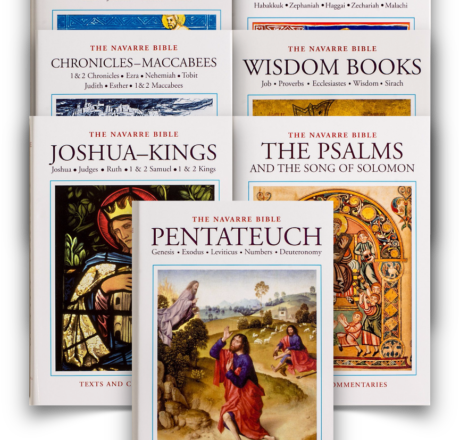
NAVARRE BIBLE COMMENTARY(RSV)
Ad Majorem Dei Gloriam (To the Greater Glory of God)
First Reading:
From: 1 Maccabees 2:15-29
Mattathias Takes Action at Mode-in
----------------------------------
[15] Then the king’s officers who were enforcing the apostasy came to the city of Modem to make them offer sacrifice. [16] Many from Israel came to them; and Mattathias and his sons were assembled. [17] Then the king’s officers spoke to Mattathias as follows: “You are a leader, honored and great in this city, and supported by sons and brothers. [18] Now be the first to come and do what the king commands, as all the Gentiles and the men of Judah and those that are left in Jerusalem have done. Then you and your sons will be numbered among the friends of the king, and you and your sons will be honored with silver and gold and many gifts.”
[19] But Mattathias answered and said in a loud voice: “Even if all the nations that live under the rule of the king obey him, and have chosen to do his commandments, departing each one from the religion of his fathers, [20] yet I and my sons and my brothers will live by the covenant of our fathers. [21] Far be it from us to desert the law and the ordinances. [22] We will not obey the king’s words by turning aside from our religion to the right hand or to the left.”
[23] When he had finished speaking these words, a Jew came forward in the sight of all to offer sacrifice upon the altar in Modein, according to the king’s command. [24] When Mattathias saw it, be burned with zeal and his heart was stirred. He gave vent to righteous anger; he ran and killed him upon the altar. [25] At the same time he killed the king’s officer who was forcing them to sacrifice, and he tore down the altar. [26] Thus he burned with zeal for the law, as Phinehas did against Zimri the son of Salu.
[27] Then Mattathias cried out in the city with a loud voice, saying: “Let every one who is zealous for the law and supports the covenant come out with me!” [28] And he and his sons fled to the hills and left all that they had in the city.
***********************************************************************
Commentary:
2:15-28. Mattathias certainly behaves savagely but he has a special reason for acting in this way: it helps to legitimate his leadership and that of his descendants in the liberation of Israel. Due to his priestly background Mattathias was a man of some status; what he did could influence others. Here, in a sense, he represents the people. Not only does he not succumb to the temptation to gain social and financial advantage by being untrue to his conscience and his religion (cf. vv. 17-22); he shows signs of being a savior of his people. His action is comparable to that of Phinehas (v. 26), that priest who, according to Numbers 25:6-15, ran a spear through an Israelite and a Midianite woman, thereby turning God’s wrath back from the people. In reward for his action God gave Phinehas a covenant of peace and promised him and his line a perpetual priesthood (cf. v. 54). Moreover, on that occasion God disposed that the Israelites should attack the Midianites and defeat them. The memory of Phinehas endured in Jewish tradition (cf. Ps 106:28-31; Sir 45:23). Although the sacred writer does not expressly say so, the comparison with Phinehas gives us an inkling that Mattathias is becoming someone who has a covenant with God and will be a savior of the people.
Both Phinehas and Mattathias were motivated by zeal for the Lord and for his Law (vv. 24, 26-27; Num 25:11). Although the way they expressed their zeal was understandable only in that distant context (it would not he acceptable today), their zeal for God and the things of God is still something to be imitated (cf. Origen, "Commentarii in Epistulam ad Romanos", 8, 1). Our Lord Jesus Christ will also feel zealous for the house of God, the temple, and will perform a symbolic act of violence against those who profaned it (cf. Jn 2:17; Ps 69:9). It is this sort of zeal that leads a Christian to “holy intransigence". “Be uncompromising in doctrine and conduct. But be yielding in manner. A mace of tempered steel, wrapped in quilted covering. Be uncompromising, but don’t be obstinate” (St J. Escriva, "The Way", 397).


