Catena Aurea by St. Thomas Aguinas
18:1–8
1. And he spake a parable unto them to this end, that men ought always to pray, and not to faint;
2. Saying, There was in a city a judge, which feared not God, neither regarded man:
3. And there was a widow in that city; and she came unto him, saying, Avenge me of mine adversary.
4. And he would not for a while: but afterwards he said within himself, Though I fear not God, nor regard man;
5. Yet because this widow troubleth me, I will avenge her, lest by her continual coming she weary me.
6. And the Lord said, Hear what the unjust judge saith.
7. And shall not God avenge his own elect, which cry day and night unto him, though he bear long with them?
8. I tell you that he will avenge them speedily. Nevertheless when the Son of man cometh, shall he find faith on the earth?
THEOPHYLACT. Our Lord having spoken of the trials and dangers which were coming, adds immediately afterward their remedy, namely, constant and earnest prayer.
CHRYSOSTOM. He who hath redeemed thee, hath shewn thee what He would have thee do. He would have thee be instant in prayer, He would have thee ponder in thy heart the blessings thou art praying for, He would have thee ask and receive what His goodness is longing to impart. He never refuses His blessings to them that pray, but rather stirs men up by His mercy not to faint in praying. Gladly accept the Lord’s encouragement: be willing to do what He commands, not to do what He forbids. Lastly, consider what a blessed privilege is granted thee, to talk with God in thy prayers, and make known to Him all thy wants, while He though not in words, yet by His mercy, answers thee, for He despiseth not petitions, He tires not but when thou art silent.
BEDE. We should say that he is always praying, and faints not, who never fails to pray at the canonical hours. Or all things which the righteous man does and says towards God, are to be counted as praying.
AUGUSTINE. (lib. ii. qu. 45.) Our Lord utters His parables, either for the sake of the comparison, as in the instance of the creditor, who when forgiving his two debtors all that they owed him was most loved by him who owed him most; or on account of the contrast, from which he draws his conclusion; as, for example, if God so clothe the grass of the field, which to-day is, and tomorrow is cast into the oven, shall he not much more clothe you, O ye of little faith. So also here when he brings forward the case of the unjust judge.
THEOPHYLACT. We may observe, that irreverence towards man is a token of a greater degree of wickedness. For as many as fear not God, yet are restrained by their shame before men, are so far the less sinful; but when a man becomes reckless also of other men, the burden of his sins is greatly increased.
It follows, And there was a widow in that city.
AUGUSTINE. The widow may be said to resemble the Church, which appears desolate until the Lord shall come, who now secretly watches over her. But in the following words, And she came unto him, saying, Avenge me, &c. we are told the reason why the elect of God pray that they may be avenged; which we find also said of the martyrs in the Revelations of St. John, (Rev. 6:10.) though at the same time we are very plainly reminded to pray for our enemies and persecutors. This avenging of the righteous then we must understand to be, that the wicked may perish. And they perish in two ways, either by conversion to righteousness, or by punishment having lost the opportunity of conversion. Although, if all men were converted to God, there would still remain the devil to be condemned at the end of the world. And since the righteous are longing for this end to come, they are not unreasonably said to desire vengeance.
CYRIL OF ALEXANDRIA. Or else; Whenever men inflict injury upon us, we must then think it a noble thing to be forgetful of the evil; but when they offend against the glory of God by taking up arms against the ministers of God’s ordinance, we then approach God imploring His help, and loudly rebuking them who impugn His glory.
AUGUSTINE. (ut sup.) If then with the most unjust judge, the perseverance of the suppliant at length prevailed even to the fulfilment of her desire, how much more confident ought they to feel who cease not to pray to God, the Fountain of justice and mercy? And so it follows. And the Lord said, Hear what, &c.
THEOPHYLACT. As if He said, If perseverance could melt a judge defiled with every sin, how much more shall our prayers incline to mercy God the Father of all mercies! But some have given a more subtle meaning to the parable, saying, that the widow is a soul that has put off the old man, (that is, the devil,) who is her adversary, because she approaches God, the righteous Judge, who neither fears (because He is God alone) nor regards man, for with God there is no respect of persons. Upon the widow then, or soul ever supplicating Him against the devil, God shews mercy, and is softened by her importunity. After having taught us that we must in the last days resort to prayer because of the dangers that are coming, our Lord adds, Nevertheless, when the Son of man cometh, shall he find faith on the earth?
AUGUSTINE. (Serm. 115.) Our Lord speaks this of perfect faith, which is seldom found on earth. See how full the Church of God is; were there no faith, who would enter it? Were there perfect faith, who would not move mountains?
BEDE. When the Almighty Creator shall appear in the form of the Son of man, so scarce will the elect be, that not so much the cries of the faithful as the torpor of the others will hasten the world’s fall. Our Lord speaks then as it were doubtfully, not that He really is in doubt, but to reprove us; just as we sometimes, in a matter of certainty, might use the words of doubt, as, for instance, in chiding a servant, “Remember, am I not thy master?”
AUGUSTINE. (ut sup.) Our Lord adds this to shew, that when faith fails, prayer dies. In order to pray then, we must have faith, and that our faith fail not, we must pray. Faith pours forth prayer, and the pouring forth of the heart in prayer gives stedfastness to faith.
Catena Aurea Luke 18
National Catholic Register, Nov 15, 2025 / 04:00 am
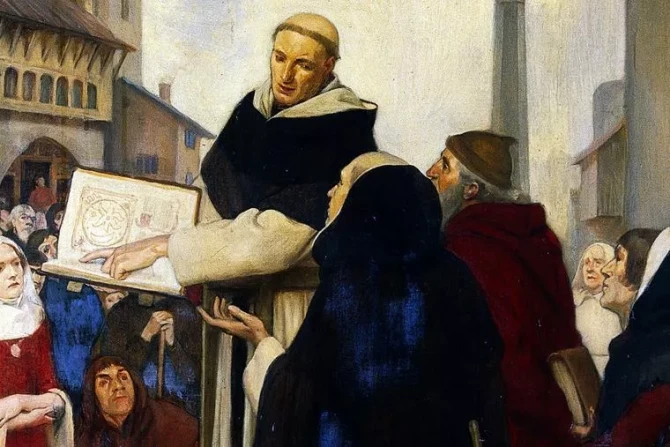
St. Albert the Great was considered the “wonder and the miracle of his age” by his contemporaries. He was an assiduous Dominican whose accomplishments and gifts to the Church are difficult to exaggerate.
Born around 1206 and joining the Order of Preachers in 1223, Albert quickly became a master of almost every academic subject. Notwithstanding the standards of his own time, he became a pioneer of the natural sciences — both empirical and philosophical. His teachings on nature and theology were revolutionary, and he captured the attention of a young and taciturn Dominican — St. Thomas Aquinas.
While surpassing all his contemporaries in intellect and cogency, it was his own student who managed to shine brighter than he. If Albert blazed the path, then it was Aquinas who reached and held the summit. Then, tragically, when the quick flash of Aquinas’ life was over, it was Albert who defended him and held him up as a beacon of light for the whole Church. St. Albert the Great was a teacher, a bishop, and a forerunner to some of the greatest theological gifts the Church has received.
After joining the Dominicans, Albert went to Paris in 1245 and successfully received his doctorate. He then began teaching in Paris and then in Cologne, Germany. It was during his time in Cologne that he noticed a young man named Thomas. The quiet student was nicknamed “Dumb Ox” by his peers, because of his weight and the mistaken notion that his silence was due to an obtuse mind. In time, Albert realized the great acumen of the young man, and Albert took him on as a disciple.
God and nature
What drew Aquinas — and the praise and condemnation of others — to Albert was his exhaustive study of nature and God. Though it was over a millennium since the birth of Christ, the Church still struggled to define nature and its role in creation. In essence, different theological camps disagreed on how to communicate a supposedly autonomous nature — with its own laws and movements — and an omnipotent God.
If it snows, is God making it snow or are there self-moving natural causes for the snow? Though a simplistic example, the relationship between God and nature is a deciding point between theology and science or even faith and reason. Oftentimes, certain groups worried that granting nature independent causes would detract from God’s glory or resurrect pagan ideals.
At the center of many related controversies was the pagan philosopher Aristotle. The writings of Aristotle had come originally to Catholicism through Jewish and Islamic scholars, which detrimentally imported a good deal of erroneous commentary. The errors — which ranged from a misunderstanding of Aristotle to thinking Aristotle was infallible — colored the Catholic mind against the Greek philosopher on many counts.
Albert’s indefatigable spirit strove to show that Aristotle’s account of nature could import a great service to the Church and her theology. Though he wrote an entire chapter titled “The Errors of Aristotle,” Albert showed that the principles articulated in Aristotle’s natural philosophy could be harmoniously placed within the cosmos described by Scripture.
The Church and science
The first major gift Catholicism has inherited from the riches of St. Albert’s pursuit is the idea that the Church and science are not at war with one another. Though nature moves by its own laws, the Author of those laws is the same Author of holy Scripture — this stance is a great affirmation of the belief in a harmony between faith and reason.
The philosophical foundations for the Church discussing issues like evolution, the age of the earth, psychology, the origins of the universe, etc., all point back to the early erudition of St. Albert the Great. The concept of nature having its own causes, and that those causes could be studied via experiments, was so revolutionary that many could not decipher between scientific experiments and magic; thus, St. Albert was once accused of being a magician.
Scholasticism
The second achievement of St. Albert was Scholasticism and his pupil St. Thomas Aquinas. The Scholastic approach was unique in the sense that it centered itself on a true belief in the harmony of faith and reason, and in a well-ordered cosmos with one Divine Author. It was precisely this holistic gathering of all the sciences under one divine science that earned the scholastic St. Albert the title of “universal doctor.”
It would be difficult to exaggerate the importance Scholasticism still holds within Holy Mother Church. Pope Leo XIII declared that “it is the proper and singular gift of Scholastic theologians to bind together human knowledge and divine knowledge in the very closest bonds.”
Pope Sixtus V confirmed that Scholasticism “has an apt coherence of facts and causes, connected with one another; an order and arrangement, like soldiers drawn up in battle array … by these the light is divided from darkness, and truth from falsehood. The lies of heretics, wrapped up in many wiles and fallacies, being stripped of their coverings, are bared and laid open.”
And while St. Albert must be remembered in his own right, we must acknowledge the magnificence of his student — St. Thomas Aquinas.
After Thomas’ sudden death on the way to the Council of Lyons, St. Albert declared that the “light of the Church” had gone out. Later, the Church bestowed upon St. Thomas the title of “angelic doctor.”
The Church only continued to esteem the scholar and his scholasticism: The “chief and special glory” was having his “Summa Theologiae” laid upon the altar as a source of inspiration at the Council of Trent. He was then declared the patron of all Catholic schools and universities by Pope Leo XIII.
Behind all the appropriate adulation for St. Thomas, his “Summa” and all it represents is the genius and perseverance of St. Albert.
This story was first published by the National Catholic Register, CNA’s sister news partner, on Nov. 15, 2011, and has been adapted and updated by CNA.
catholicnewsagency.com